
periodical issue
Quest
A Quarterly of Inquiry, Criticism and Ideas
By Denis de Rougemont, A. H. Somjee, Abu Sayeed Ayyub, Sterling P. Lamprecht, C. L. Nahal, Dan Jacobson, Lola Chatterjee, Hephzibah Jesudasan, A. K. Ramanujan, Bal Patil, Feroze F. Moos, Haig Khatchadourian, Prof. Amlan Datta, Manashi Das Gupta, C. R. M. Rao, A. B. Shah, B. G. Verghese, Sadhan Kumar Ghosh, P. Lal, Jai Ratan, Pradip Sen, Anita Desai, Deb Kumar Das, Sasthibrata Chakravarti
Printed and published by Miss Sheela Singh for the Indian Committee for Cultural Freedom, Army and Navy Building, 148 Mahatma Gandhi Rd., Bombay 1, at Inland Printers, Victoria Mills Buildings, 55 Gamdevi Road, Bombay 7. · Bombay · 1960
130 pages
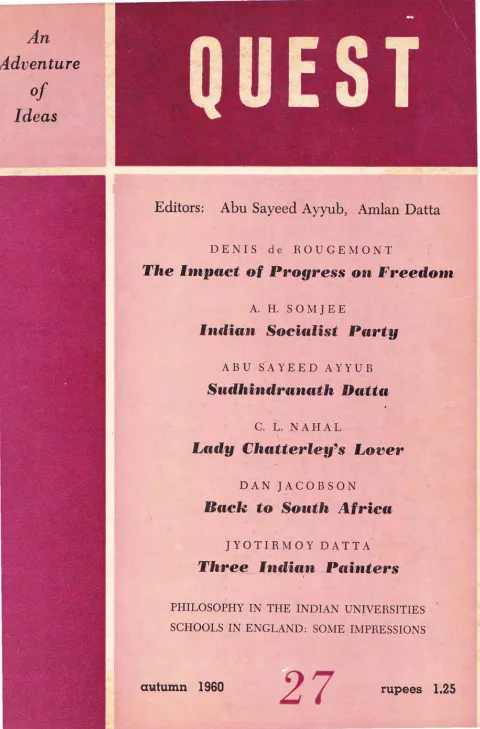
QUEST
Summary
Quest No. 27 (Oct./Dec. 1960), the longest issue of the run so far at 130 pages, opens with Denis de Rougemont’s retrospective address on the tenth anniversary of the Congress for Cultural Freedom, then turns to A. H. Somjee’s diagnosis of why no Indian party can honestly claim the name ‘socialist’. A. S. Ayyub’s memorial tribute to the poet and Quest advisory editor Sudhindranath Datta (who had died only weeks earlier, on 25 June 1960) sits alongside Sterling P. Lamprecht’s outsider’s critique of dogmatic traditionalism in Indian university philosophy departments, C. L. Nahal’s defence of D. H. Lawrence against the Lady Chatterley’s Lover obscenity charge (with a dissenting extract from Katherine Anne Porter), and Dan Jacobson’s dispatch on the psychology and near-term prospects of apartheid South Africa. Shorter pieces cover English schooling, the Tamil poet Kamban, five poems, a review-essay on modern Indian painters (Amrita Sher-Gil, an unnamed Sikh-nobleman portrait, and M. F. Husain), P. Lal’s translation of the Savitri legend, two continuing epistolary debates (on the objectivity of value, and on direct versus representative democracy), B. G. Verghese’s report from the Congress’s Berlin conference, a books column, nine book reviews, and a heated correspondence exchange over whether Indian creative writers should write in English. The issue is bookended by a full contributors’ page and closes on the perennial editorial argument, begun in Quest 26, that fiction and poetry by Indians in English remain the exception rather than the rule — a position the Writers Workshop group (P. Lal, Jai Ratan, Pradip Sen, Anita Desai, Deb Kumar Das, Sasthibrata Chakravarti) contests at length.
Essays
The Impact of Progress on Freedom
By Denis de Rougemont
Denis de Rougemont looks back on the first ten years of the Congress for Cultural Freedom, unpacking its name — Congress, Freedom, Culture — to argue that the Congress is not a political front but a standing effort by intellectuals to defend the preconditions of freedom. He locates danger to freedom not only in totalitarian systems but in poverty, in the West’s own materialism, and above all in the meaninglessness that both dictatorship and mass affluence can produce; culture, he argues, is what restores meaning by combining tradition with criticism and invention. He closes by insisting freedom is not itself the ultimate value but the means by which individuals can risk, choose and find meaning, and that a society’s health is measured by the chances it gives each person to do so, not by statistics.
- Traces the Congress for Cultural Freedom’s ten-year evolution from an anti-dictatorship ‘striking force’ into a broader inquiry into the effects of technical and cultural progress on freedom.
- Defines culture as passing on tradition AND permitting ‘criticism and disruption’; the two must stay balanced or each becomes dangerous.
- Names three complementary sources of renewal on the world stage: Western technology/intellect, African ‘living soul’ (song, dance, rhythm), and the Indian ‘spirit’.
- Argues the loss of meaning in life, not political repression alone, is what most corrodes the will to be free.
- Concludes freedom is not an absolute end in itself but the means to the ‘perpetual enhancement of the individual’s possibility of taking personal risks’.
Problems of an Indian Socialist Party
By A. H. Somjee
A. H. Somjee argues that Indian politics is saturated with parties claiming ‘socialism’ — Congress, the Communist Party, the Praja Socialist Party — yet none earns the label on European terms. He diagnoses four specifically Indian problems: too many rival ‘socialisms’, an ‘incipient collectivism’ oriented toward raising national income rather than redistributing it, excessive dependence on individual personalities (especially Nehru) rather than settled party principle, and naked electoral opportunism that treats a socialist label as a vote-getting device rather than a programme. His most pointed claim is that Congress ‘socialism’ is really just Nehru’s personal conviction projected onto the party machine, and that the PSP is paralysed by personality clashes rather than doctrine.
- Distinguishes four Indian problems facing self-styled socialist parties: ‘too many socialisms’, incipient collectivism, personalism, and electoral opportunism.
- Contrasts European socialism’s emphasis on redistributing existing wealth with the Indian emphasis on raising national income and capital investment first.
- Judges Congress’s ‘socialist pattern of society’ to be Nehru’s personal project rather than a genuinely internalised party doctrine — ‘Nehru-deep’.
- Describes the Praja Socialist Party as riven by ex-Congressmen, ex-Communists and Gandhians with no agreed theory, dominated by personalities rather than principle.
- Argues no Indian party contesting elections has ever done so purely on socialist grounds, instead courting ‘maharajas, jagirdars, religious leaders… local lawyers, contractors, bootleggers, dadas’ for votes.
Sudhindranath Datta
By Abu Sayeed Ayyub
Abu Sayeed Ayyub’s memorial essay on the poet Sudhindranath Datta (30 October 1901 – 25 June 1960), written within weeks of his death, argues that Datta’s poetry drew its power from unresolved contradictions: a man of ‘princely’ good fortune whose verse sang of life’s emptiness; a professed hard-line behaviourist materialist whose poems are wracked by an idealist’s grief at a Godless, meaningless universe; a poet of classical prosodic discipline who wrote in the syntax of abstract discursive prose. Ayyub compares Datta’s contradiction to Arthur Koestler’s (whom he says he once challenged directly in Calcutta) and to Bishnu Dey’s uneasy Marxism, concluding that Datta was ‘balanced and whole though not unified’ — an anekantavadi who accepted that no single worldview exhausts truth. The essay includes several stanzas of Datta’s own poetry in translation, including from ‘1945’ and ‘Cyclone’.
- Frames Datta’s biography (privileged upbringing, wide travel, recent return from a two-year US/European trip, sudden death at 59) against the bleak, ‘despair’-illumined tone of his poetry.
- Identifies Datta’s central contradiction as philosophical materialism at war with an emotional, near-idealist horror at a meaningless universe.
- Notes a formal contradiction too: classically disciplined Bengali prosody carrying the syntax of abstract, logical prose.
- Compares Datta’s contradictions to Arthur Koestler’s simultaneous belief in ‘cosmic emotion’ and description of the universe as ‘lousy’.
- Credits Datta’s 1931-40 quarterly Parichay with pioneering ‘new poetry’ and ‘new criticism’ in Bengali despite having ‘few readers’.
- Quotes Datta’s own translated verse (from the poems ‘1945’ and ‘Cyclone’) to illustrate the despair he calls the poetry’s true ‘Zeit motif’.
Philosophy in the Indian Universities
By Sterling P. Lamprecht
The American philosopher Sterling P. Lamprecht reports on visits to some twenty Indian university philosophy departments in 1958-59, concluding that Indian academic philosophy is ‘frequently hampered by an uncritical allegiance’ to what is treated as a single, unified ‘Indian tradition’ — usually equated, incorrectly in his view, with metaphysical idealism borrowed more from Anglo-Hegelian sources than native Sanskrit texts. He recounts a senior professor who insisted his own tradition was wholly true and all others largely false, and a seminar where a professor’s ‘intemperate harangue’ silenced a student for ninety minutes. Lamprecht argues India’s real opportunity — a synthesis of Eastern and Western thought free of the nationalistic bias that limits Bergson, Russell or Dewey — is being squandered by dogmatism on one side and student docility on the other, and closes urging ‘humanism’ (the ‘middle way’) over otherworldly asceticism as India’s most needed philosophical message.
- Based on a 1958-59 tour of roughly twenty Indian universities’ philosophy departments.
- Argues there is ‘no such thing as the Indian tradition on any subject at all’ — the Vedas, Upanishads, Pali texts and Sutras contain idealism, realism, materialism, theism and atheism alike.
- Contends that academic Indian idealism is imported Anglo-Hegelian technique (Bradley, Bosanquet) more than native Sanskrit philosophy.
- Reports dogmatic classroom dynamics: rote dictation, memorised lecture notes reproduced verbatim in exams, and one seminar where a professor’s harangue prevented a student from ever making his point.
- Argues India’s mixed intellectual inheritance gives it a unique chance to build a philosophy ‘more widely significant… than philosophy has ever been before’, but that promise so far exceeds achievement.
- Closes with a postscript letter to Ayyub noting his observations were confined mainly to Hindu professors, with only brief contact with Muslim teachers at Aligarh and Hyderabad.
Lady Chatterley’s Lover and Lawrence
By C. L. Nahal
C. L. Nahal defends D. H. Lawrence against the reputation for obscenity that followed Lady Chatterley’s Lover, arguing Lawrence’s real subject across his whole body of work is not ‘sex’ but ‘self’: a near-Vedantic conviction that ultimate reality can never be grasped by intellect alone and must be approached through reverence for the created, embodied world, of which sex is the most intense expression. Nahal concedes real weaknesses — a contrived plot premise (Clifford’s disability is an accident, not organic impotence, undermining Connie’s moral case for leaving him), didactic ‘prejudged’ characterisation, and language that ‘overstepped its mark’ — but insists the novel is a serious, moral (if inferior) work within Lawrence’s larger, ‘religiously’ phallic vision, and that Lawrence’s own life was strikingly puritanical despite his reputation. A boxed extract from Katherine Anne Porter’s Encounter essay ‘A Wreath for the Gamekeeper’ is printed immediately after, giving the opposite, hostile view of the novel and the ‘fraudulent crusade’ mounted in its defence.
- Argues Lawrence’s true theme across his career is ‘self’, not ‘sex’ — reality is approached through the finite, embodied world since ‘the infinite can never be known as infinite’.
- Identifies a structural flaw: Clifford Chatterley’s impotence stems from a war wound, not disease, which weakens the moral logic of Connie leaving him.
- Cites Lawrence’s own private conduct (refusing to spend a night with Frieda before marriage) as evidence he was, personally, puritanical rather than licentious.
- Grants that Lawrence ‘overstepped his mark’ in his use of explicit sexual vocabulary, arguing the plea of ‘artistic necessity’ does not fully justify it.
- Concludes the novel is inferior to The Rainbow and Women in Love but still ‘a serious and moral novel’ when judged by the artist’s motive rather than by taboo words alone.
- The editors append, without endorsement, a hostile extract from Katherine Anne Porter calling the book ‘a very laboriously bad book’ and mocking the ‘publicity device’ around its defence.
Back to South Africa
By Dan Jacobson
Novelist Dan Jacobson, reporting on a visit home amid South Africa’s 1960 political crisis (Sharpeville and its aftermath), argues that the country’s overriding fact is not any single dramatic reckoning but vast empty space, poverty (white and black alike), and an Afrikaner nationalism forged from repeated historical defeat and English contempt. He analyses apartheid as a ‘Big Lie’ — the plan for ‘Bantu National Homes’ most South Africans will never see, and Verwoerd’s literal vision of a city sliced like a cake by race — and predicts neither a single apocalyptic uprising nor indefinite stalemate, but ‘a long series of crises’ as growing Afrikaner prosperity makes leaders more willing to negotiate even as followers grow less able to bear rising world condemnation. He closes arguing that the racial ‘purity’ of white South Africans is itself already a fiction, and that the country’s fate will be decided as much by ordinary human failings — ‘indifference… lethargy… greed’ — working against the government as by any grand ideological force.
- Describes South African apartheid policy as a fantastical ‘Big Lie’: the promised ‘Bantu National Homes’ are the existing, overcrowded Reserves, and Verwoerd’s model city is literally ‘round, and cut into segments radiating from a centre’ by race.
- Contrasts the position of South African whites with French colons in Algeria: white South Africans have no metropolitan power to fall back on and ‘will have to do their own fighting… with their own lives’.
- Predicts neither swift revolution nor indefinite stability but a prolonged, unpredictable series of crises, intensified rather than eased by growing Afrikaner prosperity.
- Argues world condemnation weakens Afrikaner Nationalist morale among followers even if it hardens some leaders’ paranoia.
- Notes that ‘the whites of South Africa are no longer white’ in blood, undercutting the very racial ‘purity’ the Nationalist movement claims to defend.
- Explicitly reports, rather than endorses, the language and logic of segregationist and racist rhetoric of the period in order to dissect it; flagged here as historically dated, offensive terminology used critically, not approvingly, by the (white, liberal, anti-apartheid) author.
Some Impressions of Schools in England
By Lola Chatterjee
Lola Chatterjee, an Indian teacher educated partly in England, tours several Harrow schools — a state Primary and Junior School, a Secondary Modern, and (briefly and less successfully) the famous Harrow public school itself — and reports admiringly on post-war British state education’s move away from rote academic instruction toward ‘activity-wise’ learning, free school lunches, and vocational streaming, while also registering the strain on teachers of ‘latch-key children’ from busy or broken homes. She contrasts this favourably, and pointedly, with India’s ‘woefully inadequate’ primary provision, closing with a call for free compulsory schooling, food, music and enough paid teachers.
- Visits a state Primary/Junior School (co-educational, LCC-run, post-war housing estate catchment) and finds an emphasis on activity-based learning over formal instruction.
- Introduces the concept of the ‘latch-key child’ — a child from a busy or broken home who lets themselves into an empty house after school — as a strain teachers must additionally manage.
- Describes the 1944 Education Act’s tripartite Grammar/Technical/Secondary Modern system and visits a thriving Secondary Modern school with a student-built swimming pool and strong vocational options.
- Finds the famous Harrow public school itself disappointing to visit — more a ‘historical monument’ shown to tourists than a living school, with staff and pupils largely inaccessible.
- Closes by explicitly comparing England’s provision unfavourably against India’s ‘woefully inadequate’ primary education and calling for free schooling, food and adequately paid teachers.
Kamban’s Forte
By Hephzibah Jesudasan
Hephzibah Jesudasan argues that the Tamil poet Kamban’s ‘especial forte’ is neither the beauty of his language (which she grants is often uneven) nor his descriptive imagery, but a Shakespeare-like gift for dramatic characterisation and psychological insight, which turns his Ramayana into something closer to a supreme drama than a conventional epic. She singles out his humanising treatment of Ravana — a villain ‘only in that he is not able to be a saint’ — and his restrained, indirect rendering of Rama’s grief, arguing Kamban wrings sympathy even for the story’s ‘worst’ characters in a way few poets, including Valmiki, Milton or Tennyson, ever manage, while acknowledging Kamban’s genius overcame considerable orthodox religious opposition in his own time.
- Argues Kamban’s central genius is dramatic/psychological, not merely stylistic — ‘human interest really is Kamban’s especial forte’.
- Notes Kamban faced orthodox Vaishnavite opposition in his own era for a relatively free-thinking Ramayana (e.g. Rama calling the hunter Guha his brother, and denying caste distinctions matter more than character).
- Contrasts Kamban’s treatment of Ravana — sympathetic, humorous, tragic in defeat — with how thinly villains like Iago or Milton’s Satan earn the reader’s compassion.
- Praises Kamban’s indirection in depicting emotion, as when Rama merely ‘bites his lips’ rather than lamenting outright for Sita.
- Ranks Kamban far above Valluvan and Ilango among Tamil poets, and above Valmiki as a dramatist of human passion.
Water as Metaphor
By A. K. Ramanujan
A. K. Ramanujan’s ‘Water as Metaphor’ uses tidal and oceanic imagery — currents that shape the boatman, wash away ‘carious coasts’, and dissolve ‘father seeds’ and ‘mother-roots’ — as a figure for forces that both sustain a ‘landsman’ self and threaten to dissolve its inherited identity into ‘alien seas’.
- Builds an extended metaphor of ocean currents that both nourish (fishing, whaling) and erode (coastlines, ancestral roots).
- Turns from external, working-world imagery (boatmen, fishwives, whale-men) to an internal ‘grief’s own map of veins and rents’.
- Ends on an image of dissolution — ‘drinking without gills the lees, the greensick light of alien seas’.
Truants
By A. K. Ramanujan
A. K. Ramanujan’s ‘Truants’ is a short, wry poem about the futility of disciplining children (‘dulness dress them… a taste of cat-o’-nine fears’) into conformity, since ‘thoughts will be children’ and will find ways to play and transgress regardless.
- Catalogues conventional disciplinary measures (washing, dressing plainly, corporal punishment) aimed at suppressing childish unruliness.
- Argues such measures fail because thought itself remains childlike and truant.
- Closes on an image of concealed rebellion: children who ‘play at sin’ ‘under the skin’.
Hope
By Bal Patil
Bal Patil’s short poem ‘Hope’ compares hope to a loyal dog waiting patiently in a corner, ready to respond to ‘a slight pat’ and ‘lick the bones’ of one’s desire.
- A brief, single-image poem comparing hope to a domestic animal’s patient loyalty.
- Ends on the ambivalent image of hope ‘licking the bones’ of desire, suggesting both comfort and scraps.
And these my words
By Feroze Moos
Feroze Moos’s ‘And these my words’ is a quiet, imagistic poem about persistence and quiet renewal — words ‘undisturbed and quiet’ amid ‘congealing dust’ and falling autumn leaves — ending on an image of unseen, unheard change (‘little understood leaves falling unstruck in a wind not seen before’).
- Uses seasonal, natural imagery (autumn, leaves, wind) to figure quiet, unnoticed processes of change.
- Balances stillness (‘still alive… involuntarily’) against continuous, imperceptible transformation.
In Remembrance
By Haig Khatchadourian
Haig Khatchadourian’s ‘In Remembrance’ — described in the contributors’ page as his first poem published in a professional venue — is a formal love-elegy about disciplining oneself to forget a lost intimacy ‘now and again, almost casually’, while hoping for a reunion ‘on the other side’ where the suppressed past can be ‘taken out’ again.
- A first-person address to a lost love, structured around the discipline of forced forgetting.
- Uses the image of packed-away porcelain/china to figure a treasured but deliberately unused memory.
- Ends on a hoped-for future reunion where the ‘common past’ can be reclaimed.
Three Indian Painters
By Jyotirmoy Datta
Under the printed title ‘Two Indianists and A Painter’, Jyotirmoy Datta reviews R. de L. Furtado’s album Three Painters, using Amrita Sher-Gil as his central case study of what he calls modern Indian art’s central flaw: painters who set out consciously to be ‘fundamentally Indian’ rather than simply painting sincerely, producing art that is ‘picturesque rubbish’ created partly for the admiration of foreigners. He contrasts Sher-Gil’s abrupt, deliberate ‘conversion to Indianism’ (decided in a Paris studio, he speculates, out of failure to make her mark as a European modernist) with Georges Rouault’s slow, organic stylistic evolution, and with M. F. Husain, whom he singles out as the one painter of the three who borrows from Western modernism (Matisse’s blank faces, rendered instead as a ‘black mark’) creatively rather than merely imitatively, without anxiously performing Indianness.
- Frames Amrita Sher-Gil as a romantic, mythologised figure whose real paintings are harder to see clearly than the legend around her.
- Argues Sher-Gil’s ‘conversion to Indianism’, decided while still in Paris, was less an organic discovery than a deliberate career strategy after failing to find a distinctive style there.
- Diagnoses a broader problem in modern Indian painting: an anxious, conscious pursuit of a ‘patently Indian manner’ (unlike modern Bengali poetry, protected from this anxiety by its own language) which produces triviality.
- Contrasts Sher-Gil’s and George Keyt’s imitative borrowings from Cezanne/Gauguin and Picasso with M. F. Husain’s more original transformation of a Matisse motif (the blank face, replaced by ‘a black mark’).
- Quotes and mildly mocks Furtado’s introduction, which claims Indian art shows a ‘ceaseless endeavour’ of ‘spirited new conceptions’ comparable to industrial output figures.
The Story of Savitri
By P. Lal (translated by)
P. Lal’s translation from the Mahabharata retells the story of Savitri, who marries the doomed Satyavan knowing (via the sage Narada’s prophecy) that he will die within a year, and who, when Yama the god of death comes personally to claim her husband’s soul, follows him on foot, wins his admiration through a series of wise sayings about virtue and companionship, and extracts from him — as successive ‘boons’ granted for anything except Satyavan’s life — the restoration of her blind father-in-law’s sight and kingdom, a hundred sons for her own father, and finally, by asking for a hundred sons for herself and Satyavan (a boon impossible to fulfil without his life), tricks Yama into returning her husband to her. The frame narrative has the sage Markandeya tell this story to Yudhishthira as reassurance that Draupadi, too, will bring the Pandavas good fortune despite her sufferings.
- Savitri knowingly marries Satyavan despite Narada’s prophecy that he will die within a year.
- When Yama comes in person to take Satyavan, Savitri follows on foot rather than turn back, winning Yama’s respect through successive wise sayings.
- She wins boons restoring her father-in-law’s sight and kingdom and granting her own father a hundred sons, before winning Satyavan’s life itself by a clever final request that only he could fulfil.
- The story is framed as Markandeya’s consolation to Yudhishthira that Draupadi, like Savitri, will bring good fortune out of suffering.
- The translation preserves formulaic epic dialogue and repeated ritual phrasing characteristic of the Sanskrit original.
Social Norms in Value-judgements
By Manashi Das Gupta and A. S. Ayyub
Continuing a debate begun in Quest 25, Manashi Das Gupta presses Abu Sayeed Ayyub on his claim that ‘higher’ values (truth, beauty) can be simultaneously personal and objective without resting on social consensus or external criteria, asking what moral obligation attaches to objective values and how his position differs from defining value as mere persistent liking. Ayyub replies by distinguishing four senses of ‘good’ (bare desire; lifetime satisfaction/prudence; the value of a personality, tied to duty; and the ‘eternal values’ of truth, beauty and moral perfection, tied to personal morality), arguing that only the last kind generates a non-universal, self-binding ‘ought’, and that consensus or external aesthetic criteria (he cites conflicting judgements of Whitehead, Edith Sitwell and Nandalal Bose) cannot settle higher-value disputes — only ‘the depth, durability and felt rightness of one’s own experience’ can, with correction possible only through further value-intuition, not external adjudication.
- Das Gupta questions whether ‘objective’ values can exist without either social confirmation or an inherent moral obligation attached to them.
- Ayyub distinguishes four types of ‘good’ — desired object, lifetime-satisfaction (‘prudence’), personality-value (tied to duty), and ‘eternal values’ of truth/beauty/moral perfection (tied to ‘personal morality’).
- Ayyub argues appreciating an objective aesthetic value (e.g. Othello’s excellence) carries no universal moral obligation in the way a genuine moral duty does.
- He rejects both social-consensus and ‘external criteria’ theories of aesthetic value, citing disagreement over Whitehead, Edith Sitwell and Nandalal Bose as evidence no reliable consensus exists.
- Concludes that higher-value judgements are validated only by ‘the depth, durability and felt rightness of one’s own experience’, correctable only by further self-reflection, not by group verdict.
Democracy and Public Opinion
By C. R. M. Rao and A. B. Shah
C. R. M. Rao challenges A. B. Shah’s Quest 25 article for treating ‘enlightened public opinion’ as democracy’s only guarantee and for dismissing ‘direct democracy’ as unworkable, arguing that decentralised, grassroots democracy (as advocated by Jayaprakash Narayan and earlier M. N. Roy) deserves a fair trial precisely because representative institutions transplanted onto post-colonial societies without a ‘living tradition of democracy’ remain fragile — as shown by Germany’s own descent from an educated, representative democracy into Nazism. In reply, Shah clarifies his original paper was scoped narrowly to representative democracy as practised since Indian independence, denies that decentralisation alone amounts to ‘direct democracy’ in Roy’s or Jayaprakash’s full sense, defends state support for cultural development as unavoidable in an under-developed country provided it does not compromise cultural freedom, and turns Rao’s charge back on intellectuals themselves, arguing they show no more tolerance or integrity than the politicians they criticise.
- Rao argues democracy in under-developed countries needs ‘deeper cultural roots’, not only enlightened opinion, citing Germany’s fall into Fascism despite a cultured, educated public.
- Rao urges combining representative democracy at the national level with ‘direct democracy’ — decentralised, local self-government — rather than treating them as mutually exclusive.
- Shah replies that true ‘direct democracy’ (as JP or the late M. N. Roy conceived it) is not the same as mere administrative decentralisation, and remains unworkable if pushed to the level of the individual.
- Shah defends state funding for cultural renaissance as necessary in a resource-poor society, provided cultural freedom is preserved, while criticising specific failures (communists in academic administrative posts, fellow-travellers in government).
- Shah closes by turning the charge of intolerance back on intellectuals themselves, arguing they show no greater consistency, tolerance or integrity than the politicians they criticise.
Reflections on the Berlin Congress
By B. G. Verghese
B. G. Verghese reports from the June 1960 Berlin conference of the Congress for Cultural Freedom, held ten years after its founding in the same city, where roughly 250 non-communist intellectuals debated ‘Progress in Freedom’ across four seminar groups. Verghese, attending the political- and social-progress groups, finds Western delegates surprisingly self-flagellating about mass affluence and consumer culture (television, advertising, ‘the mirror on the ceiling of a whorehouse’) while Asian and African delegates looked on bemused, envying the very prosperity being denounced; he sides with those, like Galbraith and Eugene Rostow, who argued poverty remained the graver problem. On political progress, he defends recent military takeovers in Egypt, Iraq and Pakistan as sometimes necessary correctives to feudal oligarchies masquerading as democracies — pointing to Burma’s army-supervised restoration of parliamentary government as a model — arguing many Western academic delegates failed to grasp the socio-economic preconditions Western democracy itself required over 150 years of gradual development.
- Reports Robert Oppenheimer’s opening remark that ‘none of us can count on having enough living to bury our dead’ if ‘this next great war occurs’, and George Kennan’s closing parable about doing one’s duty regardless of apocalyptic anxiety.
- Describes Western delegates’ ‘self-flagellation’ over consumer/mass culture (television, advertising, pornography) as puzzling to Asian and African delegates who still aspired to the prosperity being denounced.
- Sides with Galbraith’s and Eugene Rostow’s counter-argument that poverty, not the ills of affluence, remains the world’s central problem.
- Argues Western democracy was itself the ‘end-product’ of 150 years of gradual economic and social change, a precondition newly independent Asian and African states have not had time to build.
- Defends recent military governments in Egypt, Iraq and Pakistan as, in context, more progressive than the feudal oligarchies they replaced, and cites Burma’s army-supervised return to civilian parliamentary rule as a positive precedent.
- Two unnumbered photographic plates accompany the report: Jayaprakash Narayan speaking at the Berlin conference, and a wide shot of ‘A Section of Group I (Political Progress)’ in session.
Talking about Books
By Sadhan Kumar Ghosh
Sadhan Kumar Ghosh’s books column ranges over William Hazlitt’s essays (newly collected by the Nonesuch Press), praising Hazlitt’s ‘honesty and authority’ and his fusion of argument with autobiographical disclosure; Robert Bruce Lockhart’s memoir Giants Cast Long Shadows; Paul Léautaud’s Journal of a Man of Letters (‘a more painful and more human document than Gide ever presents’); and new poetry collections by William Plomer and Lawrence Durrell alongside Rupert Brooke’s Poetical Works, before closing on Bernard Berenson’s photographic-diary volume The Passionate Sightseer.
- Praises William Hazlitt as, in Ghosh’s view, ‘the greatest of English prose writers’, valuing the way personal disclosure and ‘tantrums’ deepen rather than merely mar his essays.
- Criticises Geoffrey Keynes’s Nonesuch Press selection of Hazlitt as omitting key essays and treating the sensitive Liber Amoris episode too lightly.
- Reviews Robert Bruce Lockhart’s Giants Cast Long Shadows as more a ‘stock-taking of the last four decades’ than a true collection of profiles, most moving in its Scottish-highlands memories rather than its portraits of the famous.
- Finds Paul Léautaud’s newly translated journals a more ‘painful and human’ Parisian literary document than André Gide’s memoirs.
- Surveys Rupert Brooke, William Plomer and Lawrence Durrell as poets who have ‘reintegrated poetry with ordinary life’ after the closed-shop formalism of the post-Eliot era.
- Closes admiring Bernard Berenson’s late diaries (Bernard Berenson: The Passionate Sightseer) for their Gibbon-like reflections on history and art.
Modern Indo-Anglian Poetry
By David McCutchion
David McCutchion reviews the anthology Modern Indo-Anglian Poetry (ed. P. Lal and K. Raghavendra Rao) as the first collection to break from the outworn diction, false heroics and ‘Romantic melancholy’ of earlier Indian poetry in English, praising its 1950s poets — Nissim Ezekiel above all — for a ‘very British caution and preciseness’ and a modern, largely un-‘Indian’ imagery (dahlias and apples rather than hibiscus), while noting the collection’s persistent themes of alienation, impermanence and a loss of Rabindranath-style acceptance of eternal process; he singles out Dom Moraes, Pradip Sen and Srinivas Rayaprol for particular praise.
- Credits the anthology with rejecting the ‘outworn diction’ and ‘false heroics’ of earlier Indo-Anglian verse in favour of concrete, precise imagery.
- Finds the poets’ imagery and themes closer to contemporary British poetry than to anything distinctively Indian — ‘international’ flowers like dahlias rather than hibiscus, apples rather than mangoes.
- Identifies recurring themes of alienation, impermanence and ‘a fin-de-siecle weariness’ rather than a Tagore-like acceptance of ‘oneness with eternal processes’.
- Singles out Nissim Ezekiel’s ‘disciplined spareness’ as among the most accomplished work in the collection, alongside Dom Moraes, Pradip Sen and Srinivas Rayaprol.
- Notes the anthology and related Writers Workshop booklets suggest Indo-Anglian poetry ‘may be about to reach maturity’.
The Parrot’s Death
By David McCutchion
In the second half of the same continuous review, David McCutchion turns to P. Lal’s own booklet The Parrot’s Death, praising Lal as ‘a finely sensitive, unpretentious young poet’ whose free and metrical verse creates ‘an aura’ around simple objects — a parrot, a woman’s slippers, old photographs — rather than defining them outright.
- Praises P. Lal’s handling of both free and metrical verse as ‘happily deft, if a little precious’.
- Notes Lal’s technique of creating ‘an aura’ around objects rather than describing them directly.
- Places The Parrot’s Death among the early Writers Workshop booklets (alongside Pradip Sen, Nissim Ezekiel, Kewlian Sio) that McCutchion sees as evidence of a maturing Indo-Anglian poetry scene.
Stages of Economic Growth
By Siddhartha Sen
Siddhartha Sen reviews W. W. Rostow’s The Stages of Economic Growth: A Non-Communist Manifesto sharply, arguing Rostow’s five-stage growth theory ‘sugar-coats’ rather than refutes Marx, and that Rostow’s substitution of a ‘complex’ consumer for Marx’s oppressed proletariat merely swaps one caricature (the profit-maximiser) for another (the tail-fin-obsessed American suburban worker) — concluding it is the affluent society Rostow celebrates, not Marx, that looks ‘cockeyed’ by the book’s own account.
- Summarises Rostow’s five stages of economic growth: traditional society, transitional society, ‘take-off’, maturity, and mass consumption.
- Argues Rostow’s account of the mechanisms of growth (capital accumulation, state role, ‘demonstration effect’, land reform) restates rather than refutes Marx’s own analysis.
- Criticises Rostow’s central rebuttal of Marx — that man seeks more than profit — as replacing one reductive model of human motivation with another, equally reductive one.
- Concludes ironically that the book’s real, unintended achievement is an ‘excellent sociological study’ of American intellectual dishonesty.
Changing Pattern of Family in India
By Siddhartha Sen
Siddhartha Sen reviews The Changing Pattern of Family in India (ed. P. D. Devanandan and M. M. Thomas), noting the volume’s contributors are all practising Christians who assess the erosion of the joint-family system against explicitly Christian ideals, and — while acknowledging their conclusions are ‘logically sound’ given their premises — questions whether India’s rapid Westernisation is quietly becoming a ‘secular’ Christianisation.
- Notes remarkably little prior Indian research existed on family change compared to Western sociology of the family.
- Observes the volume’s contributors are all practising Christians who use Christian ideals as their explicit yardstick for judging social change.
- Grants their conclusions are internally consistent even while their underlying premises are ‘foreign’ or ‘alien’ to Indian society.
- Suggests India’s rapid modernisation amounts to becoming ‘Christianised in a secular manner’ even without formal religious conversion.
History of Bengali Literature
By Indira Talyarkhan
Indira Talyarkhan reviews Sukumar Sen’s History of Bengali Literature (Sahitya Akademi, with a foreword by Jawaharlal Nehru), praising its comprehensive sweep from the Brahmi script through the Vaishnav poets to Rabindranath Tagore, while noting some awkward English phrasing by the author and — pointedly, given Quest’s own recent loss — that the book gives insufficient space to Sudhindranath Datta, whose influence on modern Bengali poetry she compares to T. S. Eliot’s on the West.
- Covers the book’s sweep from the Brahmi alphabet and Apabhramsa through the Vaishnav poets (Vidyapati, Candidas, Chaitanya) to Rabindranath Tagore.
- Notes both of India’s national anthems (‘Bande Mataram’ and ‘Jana Gana Mana’) originate in Bengali literary sources discussed in the book.
- Criticises the author’s occasional awkward English usage despite his eminence as a linguist.
- Specifically faults the book for giving insufficient space to Sudhindranath Datta, whom Talyarkhan compares to T. S. Eliot in stature and influence — notable given Datta’s death is separately mourned elsewhere in this same issue.
Simone de Beauvoir
By Matilda Strimpfel
Matilda Strimpfel reviews the first volume of Simone de Beauvoir’s memoirs, Memoirs of a Dutiful Daughter, praising its ‘astonishing natural consistency’ as an account of an intensely bookish, intellectually driven girlhood shaped by the opposed influences of a sceptical father and devoutly Catholic mother, culminating in her rejection of religion and her meeting with Jean-Paul Sartre at the Sorbonne — while gently questioning whether Beauvoir’s own explanation of why she ‘became an intellectual’ owes more to hindsight than to memory.
- Describes Beauvoir’s childhood as split between her sceptical, theatre-loving father’s ‘intellectual life’ and her devoutly Catholic mother’s ‘spiritual life’, which she experienced as ‘two radically heterogeneous fields’.
- Traces her gradual rejection of Catholicism and eventual denial of God’s existence as literature replaces religion in her inner life.
- Suggests the book’s account of why this ‘disequilibrium… is the main reason why I became an intellectual’ shows the influence of hindsight and rationalisation.
- Notes the volume ends with Beauvoir’s meeting with Jean-Paul Sartre, whom she found to embody the intellectual devotion to truth that had shaped her own youth.
- Judges the book characteristically French in its ‘unashamedly intellectual’ seriousness, contrasting it with how an English girl of the period would have been raised.
The Leopard
By Shirin Sabavala
Shirin Sabavala reviews Giuseppe di Lampedusa’s The Leopard, finding its account of a Sicilian princely family’s fortunes during the Risorgimento intelligent in its class analysis but dramatically inert — ‘nothing much has happened’ — though she singles out the novel’s St. Martin’s Summer episode at Donnafugata as its most evocative writing, and notes it was the author’s only novel, completed shortly before his death.
- Summarises the plot: Don Fabrizio, Prince of Salina, accepts social change by marrying his ward to a nouveau-riche mayor’s daughter, embodying his nephew’s maxim ‘If you want things to stay as they are, things will have to change.’
- Criticises the novel for lacking narrative speed, with class analysis that ‘holds up the narrative’ without being profound enough to sustain a purely contemplative novel.
- Praises the St. Martin’s Summer episode at the country palace of Donnafugata as the book’s most evocative writing.
- Notes the novel was Lampedusa’s only work, written after twenty-five years of contemplation and published posthumously to bestseller success.
The Affair
By Rhona Ghate
Rhona Ghate reviews C. P. Snow’s The Affair, the eighth novel in his Strangers and Brothers sequence, praising its close, sincere study of how a Cambridge college’s Fellows split into factions over whether to reinstate a young scientist accused (and possibly wrongly) of scientific fraud, arguing Snow deliberately chose a ‘closed society’ to show political motives and emotions with unusual clarity.
- Summarises the plot: a young Fellow, Donald Howard, is suspended for an apparently faked photograph in his thesis, then new evidence implicates his late, more eminent collaborator instead.
- Notes the novel can be read independently of the seven-volume Strangers and Brothers sequence that precedes it.
- Praises Snow’s choice of a small, ‘closed society’ (the college) as a device for revealing political motives more clearly than national politics would allow.
- Credits the novel’s ‘pedestrian style’ with contributing to a feeling of documentary solidity, given Snow’s own background as a Cambridge Fellow and public servant.
Fuel for the Flame
By Matilda Strimpfel
Matilda Strimpfel reviews Alec Waugh’s Fuel for the Flame, a novel of intrigue, romance and Cold War politics on a fictional oil-rich Buddhist island, judging that despite an impressively varied cast of characters and plot threads, the novel’s ‘flames of passion, of nationalism and of the oilwells’ burn with ‘such a superficial glare’ that there ‘isn’t enough fuel to go round.’
- Summarises the plot’s setting: Karak, a fictional oil-rich island, where Western oil executives, an ageing Buddhist monarch, and a British-advised colonial administration intersect.
- Notes the novel folds in Cold War anxieties (communist infiltration ‘from their breeding-ground in post-independence Calcutta’) alongside romantic and colonial intrigue.
- Concludes the novel is well organised and entertaining but ultimately superficial, lacking substance beneath its plot mechanics.
The Communist Party of the Soviet Union
By V. B. Karnik
V. B. Karnik reviews Leonard Schapiro’s The Communist Party of the Soviet Union as the first authoritative, objective party history, tracing it from pre-revolutionary factional disputes through Lenin’s construction of a disciplined, centralised party to Stalin’s terror, and endorsing Schapiro’s argument that ‘the evils of Stalinism are the evils of Leninism’ since Stalin followed rather than invented the party’s core organisational logic — while noting Schapiro ends on cautious optimism that a post-Stalin generation, without ‘the burden of guilt of keeping Stalin in power’, might permit gradual change.
- Frames the book as the first authoritative history of the CPSU as an institution, written as ‘a kind of biography of the party’.
- Endorses Schapiro’s central claim that the mechanisms of Stalinist terror originated with Lenin, not Stalin alone: ‘the evils of Stalinism are the evils of Leninism.’
- Quotes at length the Old Bolshevik Piatakov’s chilling account of total self-abnegation to the party (‘he would fuse himself with it, abandon his own personality’).
- Notes Schapiro, as a historian, refuses to predict the Soviet future but ends ‘on a fairly optimistic note’ about a younger post-Stalin generation.
Creative Writing in India
By P. Lal and others
Members of Calcutta’s Writers Workshop (P. Lal, Jai Ratan, Pradip Sen, Anita Desai, Deb Kumar Das, Sasthibrata Chakravarti) write to dispute a Quest 26 editorial claim that fiction and poetry by Indians in English are necessarily ‘freakish’ or ‘highly exceptional’, citing R. K. Narayan, Mulk Raj Anand, Nirad C. Chaudhuri, Kamala Markandaya, Dom Moraes and others as counter-evidence and arguing English is simply ‘a sharp tool’ well suited to a genuinely cosmopolitan Indian readership. The unsigned editorial reply concedes little ground, arguing that outside Dom Moraes (an English mother-tongue speaker) and ‘three or four others’ the standard claimed has not been reached, that no Indian-English poet named in the list of counter-examples is mentioned, and that Bengali writers from Tagore to Sudhindranath Datta already absorbed ‘cosmopolitan’ modern influences fully within their own language — promising a fuller response from Jyotirmoy Datta in the next issue.
- Writers Workshop members argue a ‘pretty high standard’ of Indian creative writing in English already exists, listing R. K. Narayan, Balachandra Rajan, Mulk Raj Anand, Khushwant Singh, G. V. Desani, Raja Rao, Kamala Markandaya, Nirad C. Chaudhuri, Dom Moraes and others.
- They argue a writer cannot switch languages by topic (‘Now I must write a poem about the harvest season in Bengali… Now I must write one about a diesel tractor in English’) and must simply use whichever language is his natural medium.
- The unsigned editorial reply distinguishes ‘error of fact’ from ‘error of value’, conceding the named authors exist but disputing that most reach the claimed standard, and noting no Indian-English poet besides the English-mother-tongue Dom Moraes is offered as a counter-example.
- The reply argues Bengali writers — Tagore, Pramatha Chowdhury, Sudhindranath Datta, Amiya Chakravarti, Buddhadeva Bose, Bishnu Dey — already absorbed cosmopolitan modern influences within their own language, undercutting the case for English as the necessary vehicle.
- The reply promises a fuller response from ‘Jyotirmoy Datta, a young creative writer in Bengali’ in the following issue.
Essay 31
An unsigned, one-paragraph editorial announcement — printed between the Somjee article and the Sudhindranath Datta tribute, with no entry of its own on the contents page — announces that from the following January Quest will begin publishing, in alternate issues, a ‘Letter from New York’ by William Phillips (editor of Partisan Review) on American cultural events, with a matching ‘Letter from Paris’ planned for the other alternate issues.
- Announces a new regular feature: a ‘Letter from New York’ by Partisan Review editor William Phillips, on American cultural events, starting the following January.
- Announces plans for a companion ‘Letter from Paris’ to run in alternate issues.
- Appears as an unlisted, unsigned editorial insert with no contents-page entry of its own.
Generated by the v1.5 extraction pipeline. Awaiting editorial review.
Metadata and summary are AI-extracted from the source PDF and reviewed for editorial accuracy. The original work is available via the Read PDF tab above (where present); paragraph-level citation inside the PDF is deferred to a future engagement.
People in this work
- Denis de Rougemontauthor
- A. H. Somjeeauthor
- Abu Sayeed Ayyubauthor
- Sterling P. Lamprechtauthor
- C. L. Nahalauthor
- Dan Jacobsonauthor
- Lola Chatterjeeauthor
- Hephzibah Jesudasanauthor
- A. K. Ramanujanauthor
- Bal Patilauthor
- Feroze F. Moosauthor
- Haig Khatchadourianauthor
- Prof. Amlan Dattaauthor
- Manashi Das Guptaauthor
- C. R. M. Raoauthor
- A. B. Shahauthor
- B. G. Vergheseauthor
- Sadhan Kumar Ghoshauthor
- P. Lalauthor
- Jai Ratanauthor
- Pradip Senauthor
- Anita Desaiauthor
- Deb Kumar Dasauthor
- Sasthibrata Chakravartiauthor
- Nirad C. Chaudhuri
- Sudhin Datta
- Laxmanshastri Joshi
- David McCutchion
- Siddhartha Sen
- Indira Talyarkhan
- Matilda Strimpfel
- Shirin Sabavala
- Rhona Ghate
- V. B. Karnik
- Sheela Singh
- Jawaharlal Nehru
- Jayaprakash Narayan
- Mahatma Gandhi
- John Stuart Mill
- Karl Marx
- Rabindranath Tagore
- Immanuel Kant
- M. N. Roy
- John Kenneth Galbraith
- Adam Smith
- Ishwar Chandra Vidyasagar