
periodical issue
Quest
A Quarterly of Inquiry, Criticism and Ideas
By G. V. Karandikar, Swami Agehananda Bharati, H. R. Pasricha, John A. Ramsaran, Hephzibah Jesudasan, P. R. Daswani, RAJENDRA AvASTHI, William Phillips, Prof. Amlan Datta, Chatursen Shastri, Nissim Ezekiel, Ira de, G. C. S. Marar, S. R. Ra.jan, Prof. M. Ruthnaswamy, Satish C. Saberwal, Sudhir Chandra, Sadhan Kumar Ghosh
Printed and published by MISS SHEELA SINGH for the Indian Committee for Cultural Freedom, Army and Navy Building, 148 Mahatma Gandhi Rd., Bombay 1, at Inland Printers, Victoria Mills Buildings, 55 Gamdevi Road, Bombay 7. · Bombay · 1962
126 pages
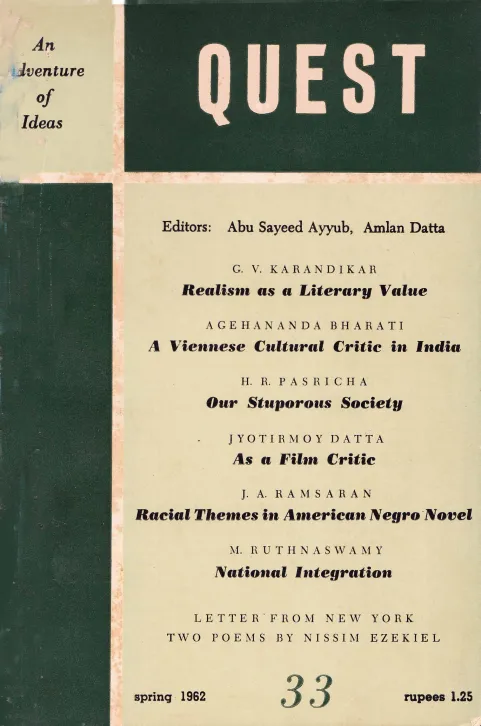
Quest
Summary
Quest No. 33 (contents page ‘APRIL/JUNE 1962’; cover ‘spring 1962’) is a general number of the Bombay quarterly ‘of Inquiry, Criticism and Ideas’ sponsored by the Indian Committee for Cultural Freedom, edited by Abu Sayeed Ayyub and Amlan Datta with Nirad C. Chaudhuri and Laxmanshastri Joshi as advisory editors, Nissim Ezekiel as Reviews Editor and Mrs. Laeeq Futehally as Astt. Reviews Editor. Its argumentative centre is a sustained attack on the official rhetoric of ‘national integration’ from three directions at once: a three-part DISCUSSION in which M. Ruthnaswamy likens the National Integration Committee to Sydney Smith’s Dame Partington mopping back the Atlantic and proposes love of the physical land of India in place of the jargon, Satish C. Saberwal argues that emotional integration is a sickness when pursued as a goal rather than as a by-product of social justice, and Sudhir Chandra charges the Government of India with deliberate hypocrisy about caste and proposes legislating the mention of caste out of personal names. Running alongside it is H. R. Pasricha’s eleven-page indictment of Indian society as stuporous, complacent and afflicted by a post-colonial ‘release phenomenon’, with socialism imposed by edict at Avadi and a Djilas-style New Class living off permits and licences, and William Phillips’s ‘Letter from New York’ on an America polarised by the bomb between the John Birch Society and the back-yard fallout shelter on one side and SANE and the Committees of Correspondence on the other.
The literary and cultural half is unusually combative. Agehananda Bharati, a Viennese Indologist at Syracuse, proposes ‘cultural criticism’ as a formal anthropological and philosophical tool and applies it to what he calls the Hindu Renaissance, insisting that genuine criticism must antagonise its informants; G. V. Karandikar reads realism as a polymorphic concept whose literary value rests on ‘resonant correspondence’ and ‘creative objectivity’; J. A. Ramsaran surveys the American Negro novel from Richard Wright to Paule Marshall; Hephzibah Jesudasan traces Tamil womanhood across twenty centuries and finds the Sangam age freer than what followed; Rajendra Avasthi expounds Thoreau’s anti-institutional individualism; P. R. Daswani analyses what makes a body of ideas an ideology; and Jyotirmoy Datta reports twelve months of reviewing Indian films as an anatomy of mass addiction rather than of art. Chatursen Shastri’s translated Hindi story ‘The Price of Cucumber’ turns a bazar bidding war over two cucumbers into a suicide; four poems (two by Nissim Ezekiel, and one each by Ira De, G. C. S. Marar and S. R. Rajan) fill pp.71-74. Sadhan Kumar Ghosh’s roving books column, ten signed reviews - David McCutchion’s demolition of Srinivasa Iyengar’s ‘Indian Writing in English’ is the most severe - eight unlisted short notices, an unsigned obituary of the former Quest reviewer Pratap Chatterji, and two blocks of contributor biographies close the issue. The contents page lists none of the short notices, the obituary, the contributor blocks, the short story’s translator, or the boxed Rabindranath Tagore quotation printed as filler on p.48.
Essays
Realism as a Literary Value
By G. V. Karandikar
Karandikar argues that realism cannot be defined by an essential quality, because nothing belongs to naive realism, naturalism, surrealism and socialist realism alike that does not also belong to something else. What the kinds share is an operational rather than an essential unity: all are referential, all claim excellence through some correspondence with something external to the work. Reduced to two words, the significance of ‘real’ in realistic literature and in the creative attitude behind it is ‘correspondence’ and ‘objectivity’ - an objectivity that is not disinterestedness, since no surrealist or Marxist realist treats art as a disinterested pursuit.
He then insists on a distinction he thinks is the cause of much confused thinking ‘in this part of our country’: aesthetic values and literary values are not the same, and literature is not merely a fine art to be judged by laws of configuration or formal beauty. Defining literature as ‘a configuration of imaginative action in language’, he locates aesthetic value in ‘configuration’ and specifically literary value in ‘imaginative action in language’. He refines his two key terms into ‘resonant correspondence’ - the quality by which conventional linguistic symbols are informed with the significance of human experience, operating across an internal, a subjective and an objective field - and ‘creative objectivity’, which achieves objectivity not by denying emotion but by referring it to the total emotional experience of humanity, and which he calls the instrumental value to resonant correspondence’s intrinsic value. He closes with two conjectures offered as experimental: that a realistic element has played a liberating role in every period of revolutionary literary change, working with romanticism and classicism alike while decadent forms of both revolt against it; and that many authors who never professed realism passed through a realistic phase from which they drew strength, the development from romantic impulse to classical or purely aesthetic restraint usually being mediated by it.
- Realism is a polymorphic concept with no essential quality common to all its kinds; its unity is operational, resting on correspondence with something external to the work.
- The significance of ‘real’ in realistic literature reduces to two words: ‘correspondence’ and ‘objectivity’.
- Realist objectivity is a craving to consider human experience in its essential character, not a claim to disinterestedness.
- Aesthetic values and literary values are distinct; literature is a fine art plus something more, judged by an additional set of values.
- Literature is defined as ‘a configuration of imaginative action in language’, and its characteristic values are refined into ‘resonant correspondence’ and ‘creative objectivity’.
- Historically, a realistic element has played a liberating role in every period of revolutionary literary change; biographically, many non-realist authors passed through a realistic phase.
Cultural Criticism as a Tool for Social Studies
By Agehananda Bharati
Bharati proposes ‘cultural criticism’ as a new heuristic device for the social sciences, and defines it formally: criticism pronounced by an investigator born in culture A about the patterns of culture B, addressed to native informants of B. His own case is the example - a native of Vienna criticising Indian cultural patterns before Indian hearers and readers. He separates two uses. For the anthropologist or sociologist the point is purely to elicit information, like a psychologist deliberately irritating a patient; for the philosopher it is to change what he criticises, like a psychotherapist who annoys a patient to improve his health. He warns that the tool will not make friends: it will excite, annoy or infuriate informants, that being the price of interesting information, and the alien critic will meet official as well as private censure, since ‘mind your own business or get out’ is the standing proposition of governments towards him.
The substance of the essay is a distinction between trivial complaint and genuine cultural criticism. Complaints about bad roads, hygiene, red tape or corrupt officials in India - or about juke-boxes, medicated meats and impolite waiters in America - may be well founded but are trivial, because every intellectual knows them already. Real cultural criticism attacks patterns: the oleographs of gods and Gandhi and Nehru; Gandhi’s ideas about sexual continence, resented precisely because the charismatic’s predilections become morally normative; the Hindu conjunction of academic knowledge with spiritual status, which he calls ‘intellectual dishonesty’; the Brahmin professor who dismissed Stcherbatsky as no scholar because he visited Paris nightclubs. He cites Edward Shils on the Indian intellectual tradition seeking fusion with an already-known principle rather than discovery, Shils again on non-attachment inhibiting private libraries, and McCutchion on Indian resistance to the aesthetically experimental. He rejects the objection that criticism slurs national honour - only refutation of contents is a valid objection - attacks ‘cradle-committedness’, denies that finding cultural differences must mean fighting, offers ‘let’s enjoy our differences’ as a new basis for coexistence, complains that American anthropologists shy away from literate high cultures for want of a tool, and insists that the enterprise must be mutual, with Indians criticising Americans and Europeans in turn.
- Defines cultural criticism as criticism of culture B’s patterns pronounced by an investigator native to culture A, addressed to B’s own members.
- Distinguishes the anthropologist’s use (criticise to elicit information) from the philosopher’s (criticise to change the pattern).
- Complaints about bad roads, hygiene and corrupt officials are not cultural criticism but trivia everyone already knows.
- Genuine cultural criticism must antagonise informants; the antagonism is a fact, not a justification, resting on ethnocentricity.
- Illustrates with the ‘Hindu Renaissance’: Gandhi on sexual continence, the conflation of academic knowledge with spiritual status, and the pandit who denied Stcherbatsky was a scholar.
- Argues the enterprise must be reciprocal to become a medium of cosmopolitan communication.
Our Stuporous Society
By H. R. Pasricha
The longest piece in the issue, in six numbered sections, described by its author as an attempt to describe, assess and record the state of Indian society from the intellectual, political and social points of view, with no claim to originality beyond compiling and applying the considerations. Pasricha begins with a warning that India is emotionally and traditionally tied to Great Britain and constantly compares itself with British conditions, though what works in Britain may not work here. He then formulates a law of criticism, borrowing J. K. Galbraith’s Indian remarks on criticism as an index of fraternity: the ability to withstand criticism is directly proportional to a society’s cultural development and inversely proportional to its primitiveness, so that excessive sensitivity is an overt expression of an inner knowledge of inferiority. Newly liberated nations are touchy about prestige, and Indians suffer from what he names a ‘RELEASE PHENOMENON’ - long servitude producing an introvert’s conviction of unrecognised merit, which he sets out after release to prove, confining the exposition to spiritual matters since he has little else to show. The claim of antiquity is unassailable but age is not merit, and can mean senility.
He then reads Indian history as largely a dismal tale, a millennium of subjugation leaving disunity, shortsightedness, supine acceptance, obsequiousness and sycophancy and a personality cult on a bigger scale than Russia’s; credits the British with geographical unity, English, admiration for parliamentary institutions and above all a disciplined national army, without which partition could not have been survived; and diagnoses a dual personality in the educated Indian, an advanced liberal outside the family and centuries back inside it. On this soil socialism was superimposed by edict at Avadi without countrywide discussion. He argues that economic theories hold only for short periods, that Adam Smith, Malthus, Ricardo and Marx have all been falsified or await verification, that Marxism needs revision to stay scientific and that Revisionism should be normal; that socialist planning presupposes dedicated men who are likelier to come from the class with secure incomes; that no government could provide work for more than a small minority; and that prosperity achieved by socialist means would sound socialism’s death knell. Section V describes Djilas’s New Class in India, old guard plus bandwagon riders, making fortunes from permits and licences convertible into currency more readily than currency itself. Section VI turns on the educated, whose isolation and disdain have let leadership pass to half-educated agitators, with encouragement from the party in power and its leader; on women, whom he judges disproportionately unenlightened and no restraining influence on their husbands; and on the businessman, degraded by the ancient law-givers and degrading business in return, who stands to gain most from free enterprise and does least for it. He concludes that Indian society is apathetic and smug in the belief that everything will come right by the grace of God.
- Formulates a law: the ability to withstand criticism is directly proportional to a society’s cultural development and inversely proportional to its primitiveness.
- Names a ‘release phenomenon’ by which long servitude produces an inverted inferiority complex and an over-anxious assertion of spiritual superiority.
- Credits British rule with geographical unity, the English language, parliamentary ideals and a disciplined army, and blames a millennium of conquest for disunity and sycophancy.
- Argues socialism was imposed by edict at Avadi without national discussion, and that economic laws are transient, Marx’s included, so Revisionism should be treated as normal.
- Applies Djilas’s ‘New Class’ to India: an indigent, unscrupulous political class enriching itself through permits and licences.
- Holds that India’s freedom rests dangerously on the goodwill of a single person and that no one party or government should become irreplaceable.
- Indicts the educated classes, Indian women and the business community in turn for abdicating social leadership.
Racial Themes in American Negro Novels
By J. A. Ramsaran
A survey of what Ramsaran calls, for want of a more concise label, the Negro novel - fiction by Negro novelists chiefly about Negro life. Whatever the vocabulary bandied about in discussion (identity, affirmation, integrity, assimilation, engaged, disengaged), the dominant notes are fear, hate and anger, and the only freedom most Negro novelists seem to enjoy is the freedom to write on squalor, crime and delinquency generously mixed with sex. Harlem is no longer Canaan and Chicago no longer the Yankee El Dorado; the discontent of the ‘Negro Renaissance’ of the twenties has grown into the clamour for desegregation and found literary expression in the protest novel. Ramsaran notes Frank London Brown’s insistence that Trumbull Park was a novel of statement rather than protest, since protest implies supplication, but finds that most social novels by Negroes follow one pattern: grievances realistically presented, cumulatively indicting American democracy - while conceding that the right to protest, claimed and exercised in the North, is itself a redeeming feature of that democracy. Richard Wright’s Native Son supplies the prototype protest hero in Bigger Thomas, and The Outsider adds disillusion with communism and more violence but less savagery.
Ralph Ellison’s Invisible Man is for him the outstanding recent treatment of self-awareness, brilliantly conceived, its invisibility both objective and subjective: the white man’s inability to see the Negro as human and the Negro’s own unawareness of his identity. On the obsession with identity he is sceptical of Negritude, warning that in a land where colour-blindness is a social disease, belief in the superiority of blackness may spread a doctrine as iniquitous as the one it hopes to supersede, and quotes Baldwin’s account of finding himself a kind of bastard of the West as the best statement of the dilemma. He traces the love-hate and rape complex to slavery and the mammy-raised white child, notes Faulkner’s Intruder in the Dust and finds nothing in Negro writing as moving as Delta Autumn; surveys the theme of ‘passing’ from Chesnutt and Weldon Johnson; the economic subsidiary theme of sharecropping, union exclusion and lynching in Killens’s Youngblood; the West Coast novels of Chester Himes; and the delinquency and crime novels of Mark Kennedy, Julian Mayfield and Willard Motley. He concludes that these novels mainly serve as social documentaries, and singles out Paule Marshall’s Brown Girl, Brownstones and Baldwin’s Go Tell It on the Mountain as the two that add poetic insight to documentary and so approach art.
- Whatever the critical vocabulary, the dominant notes of the Negro novel are fear, hate and anger.
- Richard Wright’s Native Son is the prototype protest novel; Ellison’s Invisible Man the outstanding treatment of self-awareness and identity.
- The right to protest, exercised in the North, is itself counted a redeeming feature of the American democracy the novels indict.
- Warns that Negritude and cultural chauvinism risk a doctrine as iniquitous as the racism they oppose.
- Traces the rape and love-hate themes to slavery and to white children raised by black mammies, with Faulkner’s Delta Autumn the most moving treatment of convergence.
- Most such novels function as social documentaries; only Paule Marshall and Baldwin add the poetic insight that raises the form towards art.
Tamil Womanhood Down the Ages
By Hephzibah Jesudasan
Jesudasan studies the Tamil woman across almost twenty centuries of literature under three heads - her appearance, her position in society, and her own contribution to the literature that reflects her - on the ground that few women can be observed against so long a changing background. On appearance she notes that the Sangam conception of beauty was not today’s: the poets saw the woman’s complexion as ‘maamai’, the dark purple to light mauve of a tender mango leaf, golden being a sign of pallor, and it is the Aryan entry that displaces maamai with gold, perhaps bringing the habit of turmeric with it.
On position she argues, with regret, that Tamil womanhood has never recovered the prestige of Sangam times, which even Subramania Bharati, Tiru. Vi. Ka. and the Freedom Movement have not fully restored. Sangam society was masculine and near-military and paid bride-price, but it was monogamous among the masses, ignored polygamy, never honoured the prostitute, understood wifely jealousy, kept the woman free of her in-laws and of child marriage, and through Tiruvalluvar held that the good woman is her own guardian - in pointed contrast to Manu’s chastity enforced by father, husband or son. Wifehood rather than motherhood was the corner-stone, and the worship of noble wifehood became almost a religion. Degradation follows in stages: the Post-Sangam idealisation of the prostitute Madavi on a level with the wife Kannahi; the Bhakti movement’s flood of Sanskrit literature and Aryan custom, bringing child marriage, seclusion, subjection and polygamy, so that woman’s power revives only as mother and the joint family is founded; Jain and Buddhist influence; and the Siddhars, who fearlessly whipped hypocrisy and casteism but dragged woman into the pillory as a snare, imposing a prudery worse than Victorian on the upper-class woman while leaving her poorer sister, whose one enemy was poverty, untouched. The British period brought a mass awakening through English education and the prohibition of child marriage and sati, though custom dies hard. On literature, her output rises and falls with her social hold: the Sangam anthologies include daughters of hunters and potters, and Adiyaman gave the poetess Avvai the Nelli fruit of immortality rather than eat it himself; Karaikkal Ammaiyar, a tradesman’s wife, is the morning star of Tamil and hence Indian bhakti poetry; Andal is the one major Bhakti poetess; then silence, but for the twelfth-century second Avvai, the People’s Poetess and Singer-for-Gruel of the beggar class, the most quoted Tamil poet of all, after whom ‘the rest is silence’ until the recent return of the Tamil woman to fiction, the short story and literary discussion.
- Sangam beauty was ‘maamai’, the dark mango-leaf complexion; golden signified pallor until the Aryan entry reversed the ideal.
- Sangam society gave the Tamil woman monogamy, freedom from in-laws and child marriage, and Tiruvalluvar’s doctrine that the good woman is her own guardian, against Manu’s enforced chastity.
- Wifehood, not motherhood, was the corner-stone of ancient Tamil society, and the prostitute was never honoured in it.
- Decline proceeds through the Post-Sangam idealisation of Madavi, the Bhakti movement’s importation of Aryan custom and polygamy, and the Siddhars’ shaming of sex.
- English education and British prohibition of child marriage and sati produced a mass awakening among the upper classes who needed it most.
- Her literary output tracks her social standing: labourers’ daughters in the Sangam anthologies, Karaikkal Ammaiyar and Andal in the Bhakti age, the beggar-class second Avvai in the twelfth century, then near-silence.
”Ideology” in Social Change
By P. R. Daswani
A short conceptual analysis of what an ideology is, what social function it corresponds to, and what its conditions of success are, worked through Communist ideology as the example most familiar to readers but explicitly without comparing its merits to any other. Ideology is both factor and product of social change: a factor because action springs from ideas, a product because no idea emerges without an already changed situation. But scattered ideas are only opinions; an ideology begins to be born when they are raised to a social theory covering the general relationships or values of a society and ready to answer every social problem, and it is completed only when an organisation exists that binds people to realise it. Without that organisation a complete social theory is an individual philosophy (Marx’s Communism before the Communist League and the Manifesto) or at best a doctrine, like laissez faire; the two conditions may arrive in either order, but both are needed.
Its social function corresponds to, without being identical with, the interplay of conservative and radical forces - both of which have a role, since without the radical element society degenerates into senile weakness and without the conservative it leaps into a stormy whirlpool. No ideology is wholly one or the other: the same ideology may be conservative on one question and radical on another, so classifying ideologies by their dominant element is a facile over-simplification, and calling one reactionary or utopian is true only relative to a particular question and to the viewpoint of the person using the word. Success depends on external factors - rival ideologies, the values, habits and customs of the people, and the ‘social realities’ needing prior attention - and on internal ones: the ideology’s vitality, the inner strength of the organisation, its ability to present a united front, and possession of the means, whether the parliamentary adaptation the Communists attempted in Kerala, a propaganda and election machine in present-day India, or the equipped army that let them exploit China in the nineteen-forties. Finally, success means only that the ideology has come to be accepted as the basis for action and planning, not that its aims are realised: Russia has kept Communism as the basis for social action since 1919 while the withering away of the state has receded and the abolition of private property has been much modified.
- An ideology requires two things: a more or less complete social theory, and an organisation bound to realise it; either may come first but both are necessary.
- Without an organisation a social theory is only an individual philosophy or, if widely held, a mere doctrine such as laissez faire.
- Ideologies correspond to, but are not identical with, the conservative and radical forces in society; both forces are necessary.
- No ideology is wholly conservative or wholly radical, so ‘reactionary’ and ‘utopian’ are true only relative to a single question and the speaker’s viewpoint.
- Success depends on external conditions (rival ideologies, popular values, pressing social realities) and internal ones (vitality, organisational unity, available means).
- Acceptance as a basis for action is not realisation: Russia’s withering-away of the state has receded while Communism remains its basis.
Social & Political Ideas of Thoreau
By Rajendra Avasthi
An exposition of Thoreau built almost entirely from quotation, with a critical coda. Avasthi begins from the claim that Thoreau holds something everlasting - a universal constructive genius - underlies all creation, so that all life is one and man is primarily related to Nature rather than tied to institutions, a universal and not merely social organism. Knowledge lies in the unity of the soul with Nature and is attained by living experience, not doctrinisation; truth is known by the feeling within, corresponds to love, and requires no authoritative intermediary. Evil arises when man is not one with Nature, so responsibility lies wholly with him and blaming circumstances is neither useful nor justifiable, though evil can only be minimised, not eliminated: disease is a permanent condition of life. Reform must therefore begin and mostly end with the individual - ‘Follow your own genius’ - and economic and social reform can do no good until he reforms himself, after which they become superfluous.
From this follow the practical doctrines Avasthi sets out at length: simplify, so that the necessities leave leisure for higher callings; live in the present, which dissolves theft and hoarding; make riches means and not end; treat all work as an absorbing pursuit and never earn money merely; substitute cooperation for competition; perform daily physical labour as moral and spiritual discipline, but stop short of exhaustion. The machine is not to be dispensed with but limited, since as used it multiplies demands and imposes a division of labour that impoverishes the non-worker as much as the worker - ‘it is not the tailor alone who is the ninth part of a man; it is as much the preacher, and the merchant and the farmer’. On institutions Thoreau is against business, government, religion and social forms, and would abnegate marriage and family for the highest type of life. The State rests on violence and confronts only the body; the best government governs not at all; a healthy citizen should be no more aware of his government than a healthy man of his bodily functions, and a really healthy society is one in which no one thinks of participating. Where government is tyrannical there is a right to revolt without waiting for a majority, by non-violent passive resistance and civil disobedience - ‘under a government which imprisons any unjustly, the true place for a just man is also a prison’. Democracy is majority imposition, rule of the physically strongest, demanding average thought; voting for the right is doing nothing for it. Avasthi’s coda credits Thoreau with practising what he preached and living his philosophy, reports Emerson, Stevenson, Dreiser, Henry Miller and Krutch on his wildness and his ‘Robinson Crusoe Complex’, and answers Krutch: Thoreau sought communion with Nature rather than isolation, chose solitude and rejoiced in it, and was no escapist. But his non-violence, unlike that of the Quakers, Tolstoy and Gandhiji, was not thorough-going; he was more a rebel against existing institutions than a preacher of non-violence, and, in Stevenson’s judgement, ‘always a very Yankee sort of oriental’.
- Thoreau’s starting point is the oneness of all life in Nature, from which man’s primary relation is to Nature and not to institutions.
- Evil arises from man’s separation from Nature, so responsibility is wholly individual and reform must begin with the self; social reform then becomes superfluous.
- Simplification, living in the present, absorbing work and daily physical labour are the practical means; the machine is to be limited, not abolished.
- The State rests on violence; the best government governs not at all, and a healthy society is one in which no one thinks of participating in government.
- Democracy is rule by the physically strongest, producing average thought; voting for the right is only a feeble expression of desire that it prevail.
- Avasthi rejects Krutch’s ‘Robinson Crusoe Complex’ reading but judges Thoreau’s non-violence less thorough-going than that of the Quakers, Tolstoy or Gandhi.
Letter from New York
By William Phillips
A dispatch on the American political and literary mood, carrying an editorial footnote that it ‘has been inadvertently held over from our last issue’. Phillips reports that the cold war has begun to shake up the country: official thinking has become tougher though its consequences often remain secret, a new right is flexing its muscles, and anxiety has swept those who feel powerless on both left and right - but since the American system is designed to conceal rather than express conflict, the new attitudes crop up in odd, almost eccentric forms. The reasons are not hard to find: the grim euphony of ‘red or dead’, the sinking-in of the fact that American power is no longer absolute, and the bomb hovering over everything, which is destroying politics by reducing it to diplomatic manoeuvre. For the first time the idea of progress - which he glosses as the notion that everything will become better by remaining the same - can no longer be counted on, and not knowing what lies ahead has become the accepted view, the lack of perspective converted from a national prejudice into an historic truth.
Crisis has polarised. On the right, Goldwater, the National Review and the John Birch Society thrive on fear of communism, reviving the McCarthy game of smear and double talk with an appeal to red-blooded Americanism and masculinity, while the saner spokesmen trade on the notion that the country has been too soft because it is infected with communism, socialism and liberalism lumped together; the effect is to make anti-communism synonymous with strength and so make it easier for communists to line up with reform and progress. On the left, SANE is the most balanced multilateralist body, with Norman Cousins and Norman Thomas prominent, while H. Stuart Hughes is the least eccentric unilateralist, though unilateral disarmament is too masochistic to make headway. He notes one difference from abroad: intellectuals elsewhere take purer, more relaxed positions because there are no immediate consequences, whereas everyone in America shares the feeling that what the country does is decisive, so that even socialists and pacifists find it hard to disengage and ‘responsible’ thinking has reached epidemic proportions in the new breed of military intellectuals. The biggest thing sweeping the country, getting more attention than either armament or disarmament, is the do-it-yourself bomb shelter, built furtively in suburban back yards out of shame and to keep the neighbours out, sometimes stocked with guns - an extension of private property underground that would read as defeatism if it were not so absurd, and which, if it worked, would save ‘the idiocy of the village’ at the expense of urban civilisation. Against it on the left stands the Committees of Correspondence, circulating an undoctrinaire bulletin, with Riesman and Fromm most active. In the arts nothing so dramatic: Malamud’s A New Life shows how domesticated the best modern fiction has become, Salinger builds far-out associations round conventional elements, Robert Lowell’s translations give foreign poetry a native personality, and essay collections by Mary McCarthy and Hannah Arendt are notable for an intelligence and unconventionality he finds atrophying. He closes on an administration that seems intelligent and civilised by contrast but is rattled by the right, held back by stored-up smugness, and lacks a theory of history.
- The cold war has toughened official thinking and polarised opinion, but the American system conceals rather than expresses conflict, so new attitudes appear eccentrically.
- The bomb is destroying politics by reducing it to diplomatic manoeuvre, and the idea of progress can no longer be counted on.
- The new right (Goldwater, National Review, the John Birch Society) makes anti-communism synonymous with strength, which helps communists line up with reform.
- American intellectuals, unlike those abroad, cannot take ‘purer’ positions because they believe what their country does is decisive.
- The do-it-yourself back-yard bomb shelter is the biggest thing sweeping the country, built furtively and sometimes stocked with guns to keep neighbours out.
- In the arts, the best modern fiction has become domesticated; Malamud, Salinger, Lowell, McCarthy and Arendt are the notable recent books.
One Year as a Film Critic
By Jyotirmoy Datta
Datta’s report after twelve months as a film critic, three evenings a week. He opens by refusing the expected inside view of the racket: he has had no chance to kiss an actress or see her black-money account book, though he can confirm that stars are paid mostly in black money, which is common knowledge. His adventures were limited to sneaking in and out of dark halls where the air is foul with a thousand noses and the stink of urinals, from which he draws his central thesis: people do not see films for entertainment but to get the kick the Romans got from a gladiatorial show. Art can accommodate what shocks and horrifies - Macbeth’s head on a platter, Tamburlaine’s chariot drawn by captive kings - when art comes close to life; but the epic poets and nineteenth-century novelists produced works that are no substitute for the casino or the brothel, and a good novel leaves one more receptive to experience, whereas an evening at the cinema leaves almost no feelings at all. He documents the aftermath clinically: headache, moist cold palms, a pulse above 100, a mild hangover of the nerves, and concludes that most film-goers are addicts and the industry an unwitting gang of dope peddlers.
He then sizes the fact. Over 400 features a year in 4,000 show-houses, an estimated five hundred million tickets, against 1.6 million radio sets in 1959 and a registered daily-newspaper circulation of 3.8 million in 1958 - one copy for every hundred Indians. The State, like Vijaynagar taking a cut of brothel revenue, takes a third of a three-rupee ticket in West Bengal, duties imports, cesses exposed film, charges rent for compulsory documentaries and appoints censors as sanitary experts. The cinema therefore commands the largest audience, but he doubts it communicates anything, and calls the belief that it does - voiced by Nehru at the Delhi film festival and by the Vice-President - a widely held and dangerous myth, since the censors act on it: no medium can both lead public opinion and have mass appeal, as Northcliffe learned. He then argues against the follower of Vinoba Bhave who blames industrialisation, pointing out that feudal societies are excellent film markets and that Krittibash’s Bengali Ramayana carries the same ‘vulgar’ obsessions, rancid jokes and treacly sentiment, as do Shakespeare, Dickens and Dostoyevsky; the craving for strong nervous stimulants is not industrial in origin. He demolishes the sex-appeal myth with evidence from a film magazine’s question columns, where of fourteen worshipful questions eight were asked by women about actresses or men about actors, and notes that fans adore rather than desire. Finally he classifies films into three genres - art films, where the director like Satyajit Ray uses story, camera, actors and score as pliable material and uses no stars at all; story films faithful to an original novel, as with Saratchandra; and formula films built round stars, with hacks patching up plots and five Calcutta releases in three months credited ‘Story-Story Dept.’ He ends on the martyrs of filmdom, the handsome newcomers too fine or velvety for this world of shocks, and on a hope: the Elizabethan conventions were bad too, so a crop of geniuses might yet make great popular art out of conventions he calls shocking, shocking, shocking.
- People do not see films for entertainment but for the kick of a gladiatorial show; the post-film state is a mild nervous hangover with a pulse above 100.
- Most film-goers are addicts and the industry has become, unawares, a gang of dope peddlers, taxed by the State as Vijaynagar taxed brothels.
- Cites over 400 features a year, 4,000 show-houses and an estimated 500 million tickets against 1.6 million radio sets and 3.8 million newspapers.
- Rejects as a dangerous myth, held by Nehru among others, the belief that films educate: no medium can both lead opinion and have mass appeal.
- Denies that industrialisation caused mass vulgarity, citing Krittibash’s Bengali Ramayana, Shakespeare, Dickens and Dostoyevsky.
- Demolishes the ‘sex appeal’ myth with fan-mail evidence that fans adore stars of their own sex.
- Classifies films as art films (Satyajit Ray, no stars), story films faithful to a novel, and formula films built round black-money stars.
The Price of Cucumber
By Chatursen Shastri
A story in seven numbered parts, translated from Hindi by N. N. Banerji. It opens not with the story but with a lament: since Delhi became the capital and New Delhi was built, hordes of Punjabis have descended on the city, bought land for a song, become its leaders and banished untouchability along with delicacy and refinement; the narrator surveys Khalsa hotels advertising jhatka meat, Sikhs in pants and boots eating chapatis, and, in Chandni Chowk, crepe-silk saris, sleeveless blouses and high-heeled sandals worn by women he calls crows in the borrowed feathers of the peacock, trailed by domesticated husbands carrying their parcels. Part II recalls Chandni Chowk thirty-eight years earlier: pebbled concrete, ekkas and phaetons, the road watered twice a day, shady trees under which hundreds dozed, vendors under cane umbrellas, the elephant of Jaimal Fatey, a peculiar softness in the Delhi speech and even in the vendors’ cries - and Delhiwalas who ate only the season’s first vegetables, lady fingers and karelas at a rupee a seer, peeling their fruit with a knife and wrapping it in silver paper.
The story proper turns on two cucumbers. In the month of Fagun a young fruit vendor with an orange turban and a cane basket cries tender cucumbers ‘lovely as the fingers of Laila or the ribs of Majnu’. An old kahar with a white moustache stops to buy; a strongly built young kahar throws down an eight-anna bit for them; and the two bid each other up - a rupee, two, five, ten, twenty, twenty-five, thirty, fifty - until the old man, before hundreds of onlookers, declares he will buy both for a hundred rupees and would pay five thousand if he had to. The young man leaves in shame and anger, and the crowd shouts ‘Bravo old Mehra!’ The old servant, Ramdeen, carries the cucumbers home to Lala Jagat Narain, who hears the story, undoes the gold necklace from his own neck and puts it round his servant’s, wraps him in his shawl, embraces him and weeps: ‘Well done my Ramdeen, you have saved my prestige in the market’. He then sends the cucumbers on a silver plate, under flowers and a handkerchief, as a humble gift to Lala Shiva Prasad. Shiva Prasad, hearing what happened in the bazar, rolls off his masnad and spits out his pan; he sends the plate inside, fills another with gold mohurs as Ramdeen’s reward, and returns his compliments. By sunrise the city learns he has taken poison, leaving a note that he had been insulted in the bazar and could no longer show his face anywhere in the world. A coda states that both Rais’ names are imaginary but both families still exist in Delhi, and that the man called Jagat Narain has become very poor: his palace has crumbled, his descendants pass their time with the greatest difficulty in a couple of intact rooms, and live on the rent of the bottom storey.
- Frames the story with a lament for a coarsened Delhi, blaming the Punjabi influx that followed the building of New Delhi.
- Recalls Chandni Chowk thirty-eight years earlier, when Delhiwalas ate only the season’s first vegetables as a mark of cultivation.
- The plot is a public bidding war between two servants over two out-of-season cucumbers, climbing from four annas to a hundred rupees.
- The winning servant Ramdeen is rewarded with his master’s own gold necklace and shawl for having ‘saved my prestige in the market’.
- The cucumbers are sent as a gift to a rival Rai, who returns gold mohurs and then kills himself over the insult.
- A coda notes the names are invented but the families real, and that the victorious house is now reduced to two rooms of a crumbled palace.
IMAGE
By Nissim Ezekiel
A sixteen-line lyric, the first of the two poems the contents page groups as ‘Two Poems’. The early light ‘leers’ at a sleeping face dreaming of its fears; the speaker, awake, places his lips on her eyes to make the nightmare vanish. From that domestic gesture the poem turns aphoristic: between a wedded pair nothing dies but holds its breath and then repeats its promises, and habit, fear and faith rise - or sink - to kisses. The closing quatrain makes the title’s image reflexive: it is the speaker himself who is defined in the early light, as ‘The unheroic mind / Shaking off its night.’
- A domestic waking scene: the speaker kisses his sleeping wife’s eyes to dispel her nightmare.
- Marriage is figured as a state in which nothing dies but everything holds its breath and repeats its promises.
- Habit, fear and faith are levelled by being made to ‘rise (or sink) to kisses’.
- The title’s image resolves onto the speaker, defined by the early light as an unheroic mind shaking off its night.
IN THE GARDEN
By NISSIM EZEKIEL
The second of the two poems grouped on the contents page as ‘Two Poems’, printed under its own title on p.72. Six tercets addressed to a ‘you’, framed by the refrain ‘It seemed to me so much like you.’ It was like her to find the planning of the garden faulty and the birds too few; her walk was slow and informal among trees whose names she knew and flowers commonplace or rare; she said the elephant of broken stone deserved a closer view than animals of flesh and bone. The catalogue of her preferences runs on - the spacious lawns defined with sand where children shouted and breezes blew, the water negotiating obstructive rocks like a lucid mind, the bridges modestly designed - all of them better, she held, than the tower of clocks and the hedges ruining every view. At that the speaker felt her kindness harden, and the refrain closes the poem.
- A portrait of a companion built entirely from her judgements on a garden, bracketed by the refrain ‘It seemed to me so much like you.’
- Her taste runs to the informal and the modest: lawns, water among rocks, unassuming bridges.
- She prefers a broken stone elephant to living animals, and objects to the clock tower and the view-blocking hedges.
- The poem’s turn is the speaker’s sense of her ‘kindness harden’ at the point of her most confident dismissal.
The Hunt
By Ira De
A seventeen-line poem on the day the doe was killed, seen from a distance and then very close. The hunters come slowly against a dim, colourless sky, their faces blurred; outside, the fires are lit and flaming, and voices ‘like flies (suddenly turned bees)’ gather up the sounds around them. They come in slowly and put her down; hushed voices and loving hands lift her, and the fawn rests content beside her. The poem’s disturbing centre is the tenderness of the handling: they give her looks like her lover and caress her smooth loins tenderly, then suddenly leave her to others - and then they strip, hack and cut, and put aside the sorrow in her eyes. A two-line coda brings the killing into the house: the speaker’s child cried with doe eyes that day, and the food on the plate was warm ash.
- The hunt is rendered through sound and blurred vision rather than action - fires, dimmed sky, voices like flies turned bees.
- The dead doe is handled with the tenderness of a lover before being stripped, hacked and cut.
- The line ‘And put aside the sorrow in her eyes’ makes the butchering an act of deliberate moral aversion.
- The closing couplet transfers the doe’s eyes to the speaker’s own crying child and turns the meal to warm ash.
Dry No Eyes
By G. C. S. Marar
Two four-line stanzas set side by side in two columns at the head of p.74. The left stanza refuses consolation: dry no eyes, there must be tears as there is beauty and as the years fall; man is no stone to lie unmoved; lovers are mortal, and all the loved. The right stanza turns the same thought outward into a series of invocations - the fall of leaf, the fall of tree, the dawn unveiling night’s inconstancy - and closes on the poem’s argument, that our spirits bless what hands surrender, and it is the vanishing that makes us tender.
- An eight-line lyric arguing that tears are as necessary as beauty and as inevitable as the falling years.
- Mortality is generalised from lovers to ‘all the loved’.
- The second stanza’s invocations - fall of leaf, fall of tree, dawn unveiling night - set impermanence against consolation.
- The closing couplet states the thesis: it is the vanishing that makes us tender.
The Satyr Noon
By S. R. Rajan
A short free-verse poem occupying the lower half of p.74, printed under the title ‘THE SATYR MOON’ although the contents page calls it ‘The Satyr Noon’. Its subject, introduced only as ‘HE’, is the moon as satyr: he lazy-leaps and falls on clouds, paints goat hair golden, and curls a sleepy snore around lamp posts; then, after a break, he looks down over roofs, extends a hoof, and lifts a cool shaft of light. The typography does the work of the argument - the poem is set in short broken lines with an ellipsis and a stanza gap, and closes on the words ‘OF LIGHT.’ in capitals.
- The moon is personified as a satyr, referred to only as ‘HE’.
- Its action is a sequence of lazy verbs: leaps, falls, paints, curls a snore, looks down, extends a hoof, lifts.
- Goat hair painted golden is the image that links the satyr to moonlight.
- Typographic breaks and closing capitals - ‘OF LIGHT.’ - carry the poem’s emphasis.
National Integration
By M. Ruthnaswamy
The first of three DISCUSSION pieces, printed under its own head ‘National Integration I’. Ruthnaswamy opens with Sydney Smith on the Lords’ rejection of the 1831 Reform Bill: Dame Partington with her mop trying to push back the Atlantic, excellent at a slop or puddle but never to have meddled with a tempest. That is what the National Integration Committee and its Emotional Integration Committee off-shoot remind him of. He lists their recommendations at length - the Preventive Detention Act and collective fines against communal groups, amendment of the Penal Code, mass contacts; and from the Emotional Integration Committee’s Interim Report, admissions and scholarships on means and merit rather than caste or religion, caste and religion columns dropped from application forms, the three-language formula, a national pledge twice a year, the daily national anthem, a common school uniform, world and national seminars and a world exhibition of textbooks, and Hindi strengthened as the inter-State language - and dismisses them as either treating symptoms or betraying a lack of a sense of humour. Mass contacts cannot produce national unity, which is a product of education and therefore a long-term process; learning several languages cannot produce it either, since the Tower of Babel was destroyed and languages multiplied precisely to prevent unity; and imposing Hindi must be a century-long process against southern resistance from Dravidian languages with a longer history and superior literature.
He finds the Union Education Minister more realistic in starting with the family and neighbourhood - but to start with the family is to start with caste, since the vast majority of families are built on caste marriage, and so long as marriage is caste-based the spirit of caste, which is the spirit of division, cannot be exorcised. He therefore reads the Congress statement that caste, ‘having declined in social life … has entered politics and public administration’ as audacious, and itemises how caste influences ministerial promotions, candidate selection by the Congress ‘foremost and prototype among them’, and appointments in commercial and educational life - Marwari firms appointing Marwaris, Brahmins appointing Brahmins - ‘even in this year of grace (God save the mark) of 1962’. Education that fully recognises the fact of caste is the surest way to integration: mixed Managing Committees and teaching staffs would be a living daily lesson. On the Minister’s proposals for syllabuses he argues that the culture to be imbibed is not the traditional, predominantly Hindu culture but the end-product of Indian history from the marriage of Aryan and Dravidian onwards, compounded of Hindu, Buddhist, Jain, Muslim and Western strands - illustrated in Tagore’s poetry, the novels of Mulk Raj Anand and R. K. Narayan, the painting of Bhendre and Hebbar, the sculpture of Roy Chaudhuri - and that folk dances are more unifying than Bharata Natyam, while the popularity of film music over Carnatic shows which way the wind blows. His own positive programme is that education for integration should centre on love of the land of India: its trees, animals, rivers and mountains taught from the primary classes, heroes and folk tales told at home, a map of India in every classroom, and the loveliness of India displayed by poster, cinema and radio at railway stations, bus-stops and the village chavadi, with poets and painters encouraged and statesmen making its improvement and defence their first duty. The jargon of ‘national integration’ should give way to the honest word patriotism, and implementation should be entrusted to an independent, whole-time, dedicated National Trust of men of culture drawn from teaching, medicine, law and industry, with politicians and ministers excluded and Government confined to contributing funds. He closes by recommending English retained as the medium of higher education and administration and the Defence and Central Civil Services kept national in composition, north and south in balance.
- Compares the National Integration Committee to Sydney Smith’s Dame Partington mopping back the Atlantic.
- Holds the Committees’ recommendations either treat symptoms (Preventive Detention, collective fines, dropping caste columns) or lack a sense of reality (mass contacts, three languages, Hindi).
- Locates the real obstacle in caste marriage, and so calls the Congress claim that caste has declined in social life audacious.
- Argues the culture to be taught is not traditional Hindu culture but the composite end-product of Aryan, Dravidian, Buddhist, Jain, Muslim and Western strands.
- Proposes love of the land of India - geography, flora, fauna, rivers, mountains - as the true content of education for integration.
- Would replace the jargon of ‘national integration’ with patriotism and hand implementation to a non-political National Trust.
- Recommends retaining English as the language of higher education and administration and keeping the Defence and Central Civil Services nationally balanced.
Essay 17
By Satish C. Saberwal
The second DISCUSSION piece, printed under its own head ‘National Integration II’; the contents page leaves its title cell blank. Saberwal grants that the spate of conferences has been hailed as belated recognition of a real malady, but argues that something has gone seriously wrong in the diagnosis and in several of the prescriptions. The basic problem, in his judgement, is that the overwhelming majority place their loyalties with ascriptive groups - caste, religion, language - whose membership is determined by birth and carries high emotional tone, while the concept of social justice has struck only shallow roots, so that when two groups’ interests clash individuals take their cues from group interest and not from justice; and this holds for most graduates of Indian universities as much as for illiterate villagers.
He isolates two factors in the current thinking. The first assumes the people need an alternative focus for emotional investment and offers the nation. The second assumes that removing overt symbols of these groups - from the names of political parties, universities, possibly hotels and hostels - will make the groups themselves lose significance; of which he writes that the whole operation looks like one vast effort at sweeping the dirt and putting it under the charpai, and the dirt remains. He then presses three objections. It ignores the psychological bases: eight-year-olds in India already hold fairly elaborate and almost invariably adverse images of a bhangi, a bania, a brahmin, a mussalman and a madrassi, and investigation of highly educated adults would probably show little difference. It ignores the sociological bases: a caste group is an endogamous kinship group, marriage outside one’s caste is among the rarest of things whatever the Constitution is said to have abolished, and a man running a business, standing for election or making appointments yields all too frequently to pressure from his kinsmen. And it emphasises emotion at the cost of factual knowledge, the possibilities of personal experience and the ability imaginatively to take the other man’s place, proposing to transfer the people’s emotion to a mythical entity - while the course of history is heavy with the millions sacrificed to such glorious abstractions. The specific danger of an emotionally charged national image is a climate in which heresy is taboo: arguing for a plebiscite in Kashmir would run into that sanctity, Sheikh Abdullah finds no friend in India, and any would-be friends remember Mridula Sarabhai’s fate. He tells the story of a young man who asked a saintly public figure whether it was morally right to let visitors go to Kashmir during B & K’s 1955 visit and was told ‘I think we can trust Nehru’s judgment on foreign affairs’ - noting there is not even a faint echo in India of the British protest over Suez or the American minority opposition over Cuba. His conclusion is that emotional integration is a sickness when sought as the goal rather than as the by-product of rational decisions dictated by the canons of social justice; that Gandhi’s techniques, when used in India at all, now serve political and self-interested rather than social ends, witness hunger-striking students who have failed an examination; whereas American students, church and labour leaders have adapted them to integrate restaurants, buses, bus-stations and beaches and gone to jail together for it. He asks how many Indians have suffered with Harijans and Muslims over wells, restaurants and residential areas, or married outside their caste and encouraged their kinsfolk to, and closes with William Empson’s lines on the poison that fills the whole blood stream and the waste that remains and kills.
- Diagnoses the malady as ascriptive group loyalty plus shallow roots for the concept of social justice, holding equally for graduates and illiterate villagers.
- Dismisses the removal of overt group symbols as sweeping the dirt under the charpai - the dirt remains.
- Objects that the psychological bases are ignored: eight-year-olds already hold adverse out-group stereotypes little different from educated adults’.
- Objects that the sociological bases are ignored: caste is an endogamous kin group and marriage outside it remains among the rarest of things.
- Warns that an emotionally charged national image makes heresy taboo, citing Kashmir, Sheikh Abdullah and Mridula Sarabhai.
- Argues emotional integration is a sickness as a goal and healthy only as the by-product of decisions dictated by social justice.
- Contrasts Indian slogan-mongering with American students’ adaptation of Gandhi’s techniques to desegregate public facilities at the cost of jail.
Essay 18
By Sudhir Chandra
The third DISCUSSION piece, printed under its own head ‘National Integration III’; the contents page leaves its title cell blank. Chandra names caste the most prominent and dangerous obstacle to integration, and charges the Government of India with deliberate blindness amounting to hypocrisy. His illustrative episode: when Taya Zinkin, then the Manchester Guardian’s India correspondent, gave an All India Radio talk in which the word ‘caste’ was changed to ‘group’, because as far as the Ministry of Information and Broadcasting is concerned there is no caste in India except untouchability, which has been abolished. Stretched to its logical implications, this amounts to saying that no all-out assault by the Indian Government on the system is in question - ‘We fight against an enemy only when we recognise his existence, not against one whom we think, rightly or wrongly, to be dead.’ The disappointed fact, he writes, is that the secular leaders of secular India have done much to eradicate untouchability and nothing whatsoever to destroy caste, untouchability being only a constituent of the larger problem.
Against those who expect caste to die naturally with secularism, technology, rationalism and democracy he answers that the same argument has been made for fifty years and more without appreciable ground gained, and that caste has shown remarkable adaptability in an uncongenial atmosphere; the national crisis leaves no time to let it go its own obstinate way. His central proposal is a law prohibiting the use and therefore the mention of caste or sub-caste along with a person’s name, on the ground that caste has no autonomous continuity but survives on a fresh lease of life from each new generation, and that loyalty to caste is not innate but carefully cultivated in every child by family and community - so the plastic minds of the young must be protected during their impressionable years. Little can be hoped from the present generation, who even when they speak against caste ‘suffer from a strange schizophrenia’, intellectually opposed and emotionally leaning towards it, as Edward Shils pointed out of Indian intellectuals. To the objection that legislation must come from below and needs a prior psychological transformation, he replies that this holds only to some extent for politically stable and experienced democracies; in newly independent countries the legislature must also pass laws that may not please the majority, and the choice is between waiting until legislation is unnecessary and passing it at once. To those who treat the problem as economic he grants that untouchability’s removal is really economic but denies it for caste as a whole: the three upper castes and their sub-divisions cannot be ranked as backward or well off, since all contain every economic cross-section, so the superstructure rests on social and not economic discrimination, and the task is not to improve a caste’s material position but to make more people see such distinctions as a denial of elementary justice and of the inalienable rights of man. He adds simpler measures for those who really wish caste to go: give children inter-communal and inter-provincial names, following Ustad Alauddin Khan, whose daughters are called Sarojini and Anusuya, or a North Indian acquaintance who named his son Sundaram, or at least delete caste surnames; and encourage inter-caste and inter-provincial marriage, which requires liberal parents to abdicate the traditional Indian right of arranging their children’s marriages, since such marriages must be of love and not of parental negotiation - and which requires genuine co-education, not the existing institutions where boys and girls live in two water-tight compartments.
- Charges the Government of India with hypocrisy over caste, illustrated by AIR changing ‘caste’ to ‘group’ in Taya Zinkin’s broadcast.
- Holds that secular India’s leaders have done much against untouchability and nothing to destroy caste itself.
- Rejects the expectation that caste will die naturally: the argument is fifty years old and caste has proved remarkably adaptable.
- Proposes legislation prohibiting the mention of caste or sub-caste alongside a person’s name, since caste loyalty is cultivated, not innate.
- Answers the ‘legislation must come from below’ objection: newly independent legislatures must also pass laws displeasing to the majority.
- Denies that caste as a whole is an economic problem, since the three upper castes contain all economic cross-sections alike.
- Recommends inter-communal names, deletion of caste surnames, and inter-caste love marriages supported by genuinely un-segregated co-education.
Talking About Books
By Sadhan Kumar Ghosh
A roving books column set in small type across two columns, running through some eighteen mostly British books without transitions. Ghosh holds that the best anthologies are personal and generally have a nexus with Nature, and thinks it just that R. S. Thomas, ‘the most Blundenish of the younger poets’, should have edited Batsford’s anthology of Country Verse, quoting its preface on nature as man’s background for thousands of years. He is unkind to Richard Church’s Calm October, which Heinemann’s primacy in essays exposes: Church has the style but not the soul of an essayist, is not a real ruminant, and his regret at the essay’s decline is merely disappointment at the closing of a market - ‘It does not do to sniff at small mercies or big books.’ Francis Williams’s tape-recorded A Prime Minister Remembers is excellently contrived, and the essential Attlee emerges: the man who fixed the date for Indian independence, saw the folly of bombing China during Korea, and was petty in his correspondence with Laski. He works through the ten essays of Kenneth Muir’s Keats: a Reassessment, dissenting sharply from Muir on the meaning of Hyperion and turning a Muir sentence on Garrod back on Muir himself.
The column continues: Irving Howe’s Politics and the Novel is stimulating and Orwellian, and Howe’s disturbing conclusion that the best political novelists have often been reactionary is noted; Pritchett’s When my Girl comes Home is summarised story by story and credited with outgrowing the trick surprises of the imitation O. Henrys; Claud Cockburn’s View from the West is a worthy third volume, quoted at length on what British libel law does to satire. His longest complaint is against the new edition of Sampson’s Concise Cambridge History of Literature, whose chapter ‘The Age of Eliot’ by R. C. Churchill he calls unworthy of the book and capriciously partisan - Blunden and Graves dismissed in one line, Angus Wilson unmentioned, supercilious arrogance towards Maugham, Swinnerton and Compton Mackenzie, and, most tainted, a section on criticism that calls Eliot and Leavis great critics while failing to acknowledge Bowra, Lucas and Wilson Knight. Then Bergonzi on the early Wells, Osbert Lancaster’s Signs of the Times, and a sustained engagement with Empson’s Milton’s God, whose thesis that Milton was doing his best with a hopeless assignment Ghosh answers by relocating the poem’s interest in the doctrines Milton lived by, with Helen Gardner quoted in support. Norman Kelvin on Meredith is judged necessary after Sassoon’s ineptitude; Orwell is called far and away the most significant prose writer of the century, unique in his awareness of individual isolation and of the importance of good English, prose like a window-pane, and expressly ranked above ‘mere political writers like Koestler, Silone, Malraux or Salvemini’. Tillotson’s Augustan Studies is delightful and its essay on Johnson’s Dictionary recommended even to those allergic to the eighteenth century; Methuen’s New Arden editions under Ridley and Muir are dependable, with Muir’s treatment of the Porter scene and the Hecate scenes in Macbeth examined in detail; Leonard Woolf’s Growing is satisfactory as an interlude; and the column closes on George Steiner’s Death of Tragedy - not an obituary but a series of sparkling essays - and on Brecht’s Mutter Courage still pulling her wagon through the winter night.
- An unsignposted column of short notices, mostly of British books, running from anthologies of country verse to George Steiner on tragedy.
- Holds that the best anthologies are personal and have a nexus with Nature, and that Richard Church has the style but not the soul of an essayist.
- Attacks R. C. Churchill’s new ‘Age of Eliot’ chapter in the Concise Cambridge History as capricious partisanship that slights Blunden, Graves and Angus Wilson.
- Answers Empson’s Milton’s God by relocating Paradise Lost’s interest in the doctrines Milton lived by, with Helen Gardner in support.
- Ranks Orwell far and away the most significant prose writer of the century and above ‘mere political writers like Koestler, Silone, Malraux or Salvemini’.
- Examines Kenneth Muir’s New Arden Macbeth on the authenticity of the Porter scene and the spuriousness of the Hecate scenes.
Punjabi Century 1857-1947
By P. Lal
Printed under the headline ‘Another Unknown Indian’. Lal can think of many reasons to recommend Prakash Tandon’s memoir - mature wit, engaging sincerity, unaffected modesty, a subtle blending of sentimentality and matter-of-factuality - but calls its anecdotal glory one of the strongest. Memoirs, he says, move to extremes, the Wordsworthian growth of a poet’s mind on one side and the Pepysian brass tacks of daily life on the other; Tandon believes in brass tacks but polishes them with immense artistry, so that his account of three generations looks like worked bidri metalware or a Kashmiri shawl. He dwells on the thirty-two pages about the marriage of Tandon’s twenty-four-year-old uncle Dwarka Prashad to the seventeen-year-old Savitri, the marriage preliminaries described in detail, and Savitri’s death giving birth to her first child - for Lal an episode with all the sweetsick purifying flavour of a Greek tragedy, as hard to communicate as why Oedipus is pursued or why Lear undoes his button. He quotes Raja Rao’s ‘India is an idea, a metaphysic’ and finds Tandon exploring that metaphysic in the Punjab with the accent on suffering and irreparable loss, ending in a frightening look at the horrors of partition. That chapter he praises for an antiseptic objectivity which makes the migration grislier than the lurid pictures painted in Train to Pakistan, and for closing with the human story of a young Sikh who saves a Muslim girl from a crowd, marries her, delivers her second child in a pit while hiding from the police, and loses her to fever because he dare not take her to hospital.
Against the charge of melodrama he answers that such writing is didactic in the finest sense because it embodies the truth of a lived experience, and he improves on Maurice Zinkin’s Foreword comparing the book to Kim: Kim is one of the world’s great stories, ‘but Mr Tandon writes from the inside.’ The style he finds like transparent glass, without the egoism so irritating in a reminiscer - even the romance with Ingegard, whose Scandinavian nose took his fancy, is described without gentle excess: no roses, no juning, mooning or swooning, a pucca Punjabi romance conducted tongue in cheek. Lal enjoys the mischievous wit throughout: the Punjabis astonished in 1811 at rulers ‘so incredibly red-faced, and dressed in such quaint tight clothes displaying their bottoms so indecently’; grand-uncle’s English as ‘git-mit git-mit’; schoolboys’ rainy-day applications invoking the grace of God in English, just in case God changed His mind; the deft analysis of Punjabi hospitality and biradari justice; and the Lahore chapter that only a Lahori can catch. His key text is Tandon’s near-conversion by a preaching Scotsman, declined because baptism meant a public bath in a freezing London winter - a very Punjabi remark in its dry wit and practical jocularity, and evidence that Tandon simply enjoyed the tamasha without being deceived by it: a mela is a mela, and put life in place of mela and you have the Punjabi’s paradoxical attitude, that the most serious outlook on life is not to take it seriously. He signs off as a kattar Punjabi who has succumbed to Bengal as Tandon has to Bombay, recommending the book with a Shabash and a Punjabi flourish.
- Places Tandon between Wordsworthian introspection and Pepysian brass tacks, and finds him a polisher of brass tacks.
- Reads Savitri’s death in childbirth, after thirty-two pages on her marriage, as having the flavour of a Greek tragedy.
- Prefers the partition chapter’s antiseptic objectivity to the lurid pictures of Khushwant Singh’s Train to Pakistan.
- Improves on Maurice Zinkin’s Kim comparison: Kipling wrote a great story from outside, Tandon writes from the inside.
- Finds the style transparent and free of the reminiscer’s egoism, even in the courtship of the Swedish Ingegard.
- Reads Tandon’s refusal of baptism because it meant a public bath as the key Punjabi remark: a mela is a mela, and no Punjabi takes one seriously.
Land Reforms and Group Dynamics
By Satish C. Saberwal
Printed under the headline ‘The Future of our Village’. Saberwal says the book evokes ambivalent reactions and proceeds in order: summarise the argument, note the welcome features, criticise the rest. Baljit Singh and his associates gathered primary data in six villages of Uttar Pradesh, three each in the western and eastern districts. The low productivity of Indian agriculture is documented again, with the contention that the poorest villagers have lost further ground in the last decade; since only a few castes own most of the land, they employ land-based power to dominate the others; the landless strongly favour ceilings and redistribution and the outnumbered owners oppose them; conflict between the groups is frequent and sometimes violent; and factions within the land-owning castes are described with insight. On land reform Singh reports that the Zamindari Abolition and Land Reforms Act of July 1952 raised proprietary households in the sample villages from 9% to 25% but removed only the intermediaries between state and cultivator, some cultivators continuing to own large areas usually tilled by hired labour and share-cropping - Saberwal notes that no data for the sample villages could be found, but that for U.P. as a whole about 4% of cultivators held 25% of the land in lots of 15 acres or more. Ceilings followed by Japanese-style redistribution appear to Singh more or less inescapable, and he argues that the recent U.P. land consolidation strengthened the large cultivator and was therefore untimely. Informants’ felt needs run in the order redistribution, ceilings, consolidation, cooperative farming - the last on an 8% positive response, which Singh discounts in favour of the fact that some cultivators already feel the need for cooperation.
Saberwal credits the book as an indicator of the growing empirical temper of the time, praises the legwork behind the data, counts it a contribution to the slowly growing corpus of field reports on Indian villages - asking whether more of the primary data might be published cheaply, cyclostyled, for professionals - and welcomes the small step, taken via the Tepoztlan reports from Mexico, towards recognising that the Indian peasantry is not unique. Then the objections. Generalising for the whole of India from six Uttar Pradesh villages is only partially mitigated by the Surveys used, and field data and extensive generalisation should at least have been presented in separate sections. The tendency to extrapolate startlingly is worse: Saberwal quotes in full the passage in which, from a clear majority opposed to joint ownership of costly farm equipment, Singh derives the ‘proof’ that each type of service cooperative will grow in popularity as people gain experience of it. Most deplorable of all is the simultaneous attempt to report primary field data, generalise freely upon it, and sell readers proposals that have no demonstrated relationship whatsoever to the data - advocacy which belongs properly to political pamphleteering, an honourable occupation in its own right, but which should not be mixed with a scientific monograph.
- Summarises Baljit Singh’s findings from six Uttar Pradesh villages: low productivity, the poorest losing further ground, land-based caste domination and frequent conflict.
- Notes Zamindari Abolition raised proprietary households from 9% to 25% while removing only intermediaries, with about 4% of U.P. cultivators holding 25% of the land.
- Credits the book for legwork, for the growing empirical temper, and for a small comparative step via the Tepoztlan reports from Mexico.
- Objects to generalising for all India from six villages without separating field data from generalisation.
- Quotes in full a passage where a majority against joint equipment ownership is turned into ‘proof’ that service cooperatives will grow in popularity.
- Concludes that mixing political advocacy with a scientific monograph violates the integrity of the social sciences.
Drama in Modern India
By S. R. Tikekar
Printed under the headline ‘Two PEN Symposia’. Tikekar reviews the two symposia held in October 1957 at the Baroda session of the fourth PEN Conference, bound in one handy volume with addresses by Dr. S. Radhakrishnan, Pandit Jawaharlal Nehru and Smt. Hansa Mehta. Sixteen writers took part in the first, so that the volume reports the progress of drama in sixteen Indian languages - more than the Constitution’s fourteen, since English was rightly counted an Indian language and Maithili and Sindhi were added, while there is no report on Kashmiri, which the Constitution does name. He thinks PEN chose the topic excellently and the writers did not understand it: they gave eight varying captions to their essays, many missed the implication of ‘Modern’, and it was apparently never stated whether the radio play - whose requirements of technique and performance are so different - fell within the scope, so that some writers discussed it and others were silent.
He then works through the contributions. B. K. Barua traces Assamese drama with masterly detail and a helpful method of translating titles alongside Roman transliteration; Narendra Dev lists more than two hundred Bengali plays with their authors; Gulabdas Broker mentions just seven Gujarati plays, two of them from the eighteen-sixties; K. R. Srinivasa Iyengar covers English drama by Indian playwrights who ‘essayed drama in English’ but seldom for actual performance, with due appreciation of T. P. Kailasam’s Mahabharata themes in the intellectual idiom of the day; Induprakash Pandey records Western authors translated into Hindi but not the titles; V. K. Gokak on Kannada sounds authoritative and shows deep study; N. R. S. Kurup cleverly shows the trends preceding modern Malayalam social plays; Jayakanta Mishra bemoans that ‘Unlike Bengal and Maharashtra there is no Calcutta or Bombay in Mithila’ and takes that for the reason Western influence has not been felt there; D. G. Nadkarni names Vijay Tendulkar and Sarita Padki the most outstanding contributors to modern Marathi drama and describes the mill-area white-collar playwrights whose plays sell into several editions. Tikekar checks B. V. (Mama) Varerkar’s post-script claim that the Bengal theatre played a notable part in the anti-partition agitation before Bengal became a ‘renegade’, leaving Maharashtra to exploit drama as a weapon of mass agitation, against the lists themselves - sixty Bengali titles suggest political themes against two Marathi ones. He goes on through Panigrahi’s Ibsenian contemporary Oriya drama in search of a new man as hero, Pritam Singh’s Punjabi drama used to make audiences ‘finer, wiser and worthier social beings’, and the happiest surprise of the symposium, the progress of drama in Sanskrit, ‘the so-called dead, classical language’, where a political play of 1937 ending on the British withdrawal and the handing over of India to Gandhiji had run into three editions by 1952; then Malkani on Sindhi drama not yet in professional hands, Ramaswami Sastri on a Tamil drama that has yet to evolve a simple artistic prose, Telugu plays written without female roles for want of actresses, and Mohammed Hasan on Urdu drama held back by the total absence of an Urdu stage. His verdict is that the sixteen reports would have been immensely more useful with a detailed directive issued well in advance and better-chosen writers. Of the second symposium’s six participants he holds that only A. S. Ray fully grasped the problem, in arguing in a well-reasoned argument that a writer must not write to order, that there can be a writer without a reader, and that to prescribe responsibilities to writers over the heads of readers is wrong.
- Reports drama in sixteen Indian languages, English included as an Indian language, with Maithili and Sindhi added and Kashmiri missing.
- Faults the symposium’s planning: eight different captions, the implication of ‘Modern’ widely missed, and the status of the radio play never settled.
- Checks Varerkar’s claim that Bengal became a ‘renegade’ and Maharashtra led theatrical agitation against the play lists, and finds it doubtful.
- Calls the progress of drama in Sanskrit the happiest surprise, citing a 1937 political play in three editions by 1952.
- Notes the Telugu dearth of actresses producing plays without female roles, and Urdu drama held back by the absence of an Urdu stage.
- Holds that of the second symposium’s six participants only A. S. Ray grasped that a writer must not write to order.
Indian Philosophy of Education
By S. Natarajan
Printed under the headline ‘Kabir on Education’. Natarajan holds that the book Professor Humayun Kabir has given us with this pretentious title is made up mostly of convocation addresses and similar ephemeral pronouncements, and that Kabir, much too preoccupied with current educational policy to write a coherent and comprehensive study, is himself aware of this and cautions the reader in several places. The title emerged from two Oxford talks of 1956 on education in ancient and medieval India; on that he built a section on education today and a 1960 San Francisco lecture on education and national development, and added other pieces gathered from the past six years which at least have the advantage of being addressed to Indian audiences.
The review’s substance is a complaint about omissions and a correction. A reader looking for the great educational work of the Brahmos of Bengal, the Arya Samajists of the North, the Theosophical Society in the South, the secularists of the Elphinstone Institute and the Deccan Education Society of Western India will be disappointed, and Kabir has more to say for Macaulay than for Ram Mohan Roy; it is strange, given so many omissions, to find a rather long discourse on Vivekananda, Aurobindo Ghose, Gandhi, Tagore and Iqbal, but Kabir obviously restricted himself before a foreign audience to known names. More surprising is that where Kabir speaks at length of Sir Syed Ahmed he is concerned only with Sir Syed’s failure to come to terms with Indian history. Natarajan answers that the Aligarh venture was intended to develop an elite while other Indian educational efforts aimed at the widest possible base; that contrary to the prevailing impression it was not Aligarh so much as external forces that made Indian Muslims conscious of a religious brotherhood countering national sentiment - Djemal ed Din, founder of the Pan-Islamic movement, coming to India from Afghanistan around 1881 for confidential talks with Muslim leaders, and Gandhi’s own advocacy of the Khilafat Movement; and that Sir Syed, too pronounced an admirer of the British to favour anything opposing the Government, produced a Western-oriented elite that would have had little effect on the mass movement after 1920. He grants that the convocation addresses contain much that is original, and that away from his favourite theme of Basic Education Kabir has a human approach refreshing in one associated with the Government - though he turns Kabir’s own rebuke to critics back on him, asking what purpose is served by telling students yet to pass that their system is worthless. On compartmental education, national integration and integrated education Kabir says a great deal that bears repetition and says it well, and most of the speeches still read fresh. Natarajan’s last point answers Kabir’s puzzlement at the failure of Muslims and Christians to accept pre-Muslim and pre-Christian heroes as part of their heritage: there is nothing surprising in it, since where the older traditions are the living faith of the majority community, the distinctness of the minority lies in repudiating that past - the more so with a society like the Hindus’, which has a genius for assimilating the heroes, habits and traditions of societies in proximity to it.
- Finds the book mostly convocation addresses and ephemeral pronouncements under a pretentious title, as Kabir himself half concedes.
- Lists the omitted educational movements - Brahmos, Arya Samajists, Theosophical Society, Elphinstone Institute secularists, Deccan Education Society - and notes more space for Macaulay than for Ram Mohan Roy.
- Corrects Kabir on Sir Syed Ahmed: Aligarh sought an elite, but external forces such as Djemal ed Din’s 1881 mission and Gandhi’s Khilafat advocacy created the sense of religious brotherhood.
- Turns Kabir’s rebuke of critics back on him: what purpose is served by telling students yet to pass that their system is worthless?
- Credits a refreshingly human approach when Kabir is away from Basic Education, and speeches that still read fresh.
- Answers Kabir’s puzzlement over minorities and pre-Muslim heroes: where the older tradition is the majority’s living faith, minority distinctness lies in repudiating it.
Industrial Enterprise in India
By Mahesh Desai
Printed under the headline ‘Mixing up the Economy?’. Desai opens on the peculiar consensus: the secretariat of the Federation of Indian Chambers of Commerce and Industries no less than the pamphleteers of the Left agree that India has, and may continue to have, a mixed economy - so that mixed economy, like non-alignment, is one of those things easy to be eloquent about as long as no specific policy has to be derived from it. But Indian development calls for specific policies all the time and in every sphere, so in practice the remarkable agreement amounts to an unending controversy over whether a particular new enterprise belongs to the public or the private sector, and how arbitrary the present demarcation is; and since the objective of economic development is greater equality while the obvious consequence of whatever development has occurred is greater inequality, he suggests the debate may be irrelevant. Economic thinking would be closer to actual effort if it asked whether the logic of development in Indian conditions pushes it along a particular direction. Nabagopal Das has not only written a book about industrial enterprise in India without asking that question, but has written it so as to mute its angrier overtones - achieved, in large measure, by the urbane quality of his scholarship and a style at once polite and professorial but uncommonly clear.
Desai then follows the argument. After a comprehensive survey of a hundred years of Indian industrial enterprise at the start of the Third Plan, Das finds ‘cogent reasons for cherishing the hope that business enterprise in the private sector will continue to flourish’, and the book in a sense argues the case for that comforting conclusion. Before reaching it he examines the joint-stock company as the principal instrument of industrial development, presents the twin problems of financing and managing industry as met by the increasing skill and resourcefulness of Indian entrepreneurs, and in that context analyses the birth, growth, strength and weaknesses of the managing agency system and the crucial role it played in creating the industrial base - followed by a rather formal examination of Company Law’s effect on the system and the control that has come over its dubious methods, with the suggestion that the system has not been all that bad and could not do much mischief under the vigilant eye of the Company Law Administration. This revised third edition ends with a longish discussion of topical socio-economic issues: the concentration of economic power, the impact of a powerful public sector and of its bigness and bad management on national life, and the inhibiting effect on private investment of the unconsidered exercise of the State’s regulatory power. Desai finds the final exhortation to ‘secure a very wide dispersal of the ownership of equity capital’ reminiscent of blue-chip counters in big Tokyo department stores or American share-brokers’ advertisements, and misses throughout any awareness of what Professor Thomas Balogh calls India’s ‘primeval underemployment’ and of the necessity to remove it through galloping industrialisation. His verdict: the underlying thinking of the book antedates the period of planning although the book itself is semantically up to date.
- FICCI’s secretariat and the pamphleteers of the Left agree on ‘mixed economy’, which is easy to be eloquent about until a specific policy must be derived.
- Suggests the public-versus-private debate may be irrelevant, since development aims at equality and has so far produced inequality.
- Faults Das for never asking whether the logic of Indian development pushes it in a particular direction.
- Credits urbane scholarship and an uncommonly clear style with muting the book’s angrier overtones.
- Summarises the defence of the managing agency system and of Company Law administration as adequate control over its dubious methods.
- Misses any awareness of Thomas Balogh’s ‘primeval underemployment’ and of galloping industrialisation as the remedy.
- Concludes the book’s underlying thinking antedates planning although its vocabulary is up to date.
Tales from the Calendar
By Ferrokh K. R. Mehta
Printed under the headline ‘Brecht as a Story Teller’. Mehta notes that since Brecht died in 1956 he has become a world-wide vogue and a legend in Europe, chiefly through his plays: in West Germany the frequency of their production has surpassed Shaw’s and is less frequent only than Shakespeare’s. This slim volume contains most of the short stories Brecht wrote and considered worth preserving, and a few of his poems. In giving it its title Brecht recalls the ‘peasant calendars’ of an earlier age, when collections of satirical tales, fables, aphorisms and little descriptions of historical or everyday episodes were a traditional form of popular instruction and entertainment in rural areas - a deliberate revival of the name, and a choice of contents, in accord with his clearly expressed view that the function of literature, whether in drama, verse or prose, is to stimulate through entertainment the wits, the social consciousness and the moral sensibilities of ordinary men and women.
Both the prose and the verse display a disarming simplicity in perfect consonance with that approach, and Brecht’s skill as a prose writer rests soundly on his capacity to communicate a story briefly, conveying the effect of rapid action in a few vivid strokes. The purpose of Galileo was, Brecht said, ‘to teach us to survive’, and many of the tales and poems concern people who are mute symbols of humanity’s will to endure; the ‘Brechtian moment’ of the plays - man selling his fellow-men - is also the theme of some of the work here, though while he found men and women acting inhumanly towards each other he accepted that they too were victims of their social environment. Plagued by the defeat of goodness in life, Brecht evolved into a cynic but, like most cynics, retained a hard core of pity; ‘The Augsburg Chalk Circle’ and ‘The Heretic’s Coat’ show him at his most humane, and in all his stories he shies away from the dramatic and the spectacular, containing himself and evoking a response through narrative lucidity. The most entertaining and engrossing, for Mehta, are those dealing with a major event or the men of history - ‘The Experiment’, ‘Caesar and his Legionary’ and ‘Socrates Wounded’ - amazingly fresh, as though a hidden facet had suddenly been illuminated by the clear light of Brecht’s vision. He advises those who have never encountered Brecht before, who in India would be legion, to make his acquaintance first in the plays, since enchanting as most of these stories and poems are they lack the scope and power of the drama - but once acquainted, the reader will want to read everything. On the much-discussed political creed he is brisk: read his works, his political views just couldn’t matter less; if he had any creed to expound as a writer it was his ferocious pacifism as an anti-militarist, and above all he comes through as a compassionate cynic with an eye for the humour in most situations and a dogged, determined love for life, such as it is.
- Brecht’s posthumous vogue rests on the plays, whose West German production frequency has passed Shaw’s and trails only Shakespeare’s.
- The title revives the satirical ‘peasant calendars’ and matches Brecht’s view that literature should stimulate the wits and moral sensibilities of ordinary people through entertainment.
- Finds a disarming simplicity and a capacity to convey rapid action in a few vivid strokes.
- Reads the ‘Brechtian moment’ - man selling his fellow-men - as present here, with the actors themselves victims of their social environment.
- Judges ‘The Augsburg Chalk Circle’ and ‘The Heretic’s Coat’ his most humane, and the historical tales the freshest.
- Advises newcomers to start with the plays, and dismisses the debate over Brecht’s politics in favour of his ‘ferocious pacifism’.
Indian-Writing in English
By David McCutchion
Printed under the headline ‘English as we Write it’, and the most severe review in the issue. McCutchion reports that Srinivasa Iyengar, Professor of English at Andhra, has cultivated this field ‘off and on for the last thirty years’ and has now produced not an expansion but a rewriting of his earlier books, out of British Council lectures at Leeds in 1959. It brings in everybody, from ‘the beginnings: Rammohan Roy’ to the latest novels of Raja Rao and Balachandra Rajan and the poetry of Writers Workshop Calcutta, from Derozio to Ved Mehta; novels, short stories, poetry, essays, journalism, speeches and even Sastri’s and Rajaji’s lectures on the Ramayana; chapters each for Toru Dutt, Sarojini Naidu, Mulk Raj Anand, Narayan and Raja Rao, three for Sri Aurobindo, two for Gandhi and Gandhi literature and two for Tagore.
Its outstanding feature - for praise or blame according to taste - is that it is more concerned with spiritual than with literary values, more with aura than with words, and a ‘spiritual’ bias is everywhere in evidence: Anand Lall’s House at Adampur is objected to not for its crude magazine style, which is found an asset, but for ‘unsavoury’ subject matter; Nirad Chaudhuri’s Autobiography is found ‘morbid’ and covered in a quarter of a page while ‘Vighneswara’ receives five and a half; M. N. Roy is no more than a name in a list; Desani’s All about Mr. Hatterr, considered by some the most interesting experiment in Indo-Anglian writing, gets a single sentence. The book’s patron saint is Aurobindo, brought in all over the place to elucidate Tagore and Gandhi, to confirm the divinity of the cow or the worth of Indian writing in English. Against Iyengar’s claim that considered merely as poet and critic Aurobindo would rank among the supreme masters of our time, McCutchion protests: the Life Divine is not passionately involved in concrete reality; to an ordinary mortal ‘Overmind poetry’ is vague, abstract and long-winded, and, as Vivian de Sola Pinto has said, Tennysonian; Aurobindo said poetry must be like the mantra, but Savitri is 24,000 lines long, 3,000 longer than The Ring and the Book, which Iyengar reports triumphantly. Iyengar takes P. Lal to task for ‘foaming at the Himalayas’, and McCutchion answers that he would sooner have a good solid pebble than a hollow mountain. He then turns Iyengar’s pleas for tolerance and an open mind against him as risking the failure to discriminate at all, printing three quoted poems with Iyengar’s approving critical comments - ‘A “Shropshire Lad” quality’, ‘sensuous - even sensual - poetry with a vengeance’, ‘singing for the sheer joy of singing’ - to show them banal, gushing, or simply ludicrous, and listing the outworn poetic diction (‘Nay, part not so’, ‘beauteous’, flowers that ‘ope’, people in ‘vestments’) passed over in silence. Iyengar’s own critical vocabulary he finds of the same Victorian romantic period, free with ‘galvanize’ and ‘vintage’ and given to rash comparisons - Four Chapters as Tagore’s Doctor Zhivago, Malgudi as Narayan’s Casterbridge, Rajaji as ‘the Socrates of the Tamil country’, a speech-day peroration described as ‘almost Upanishadic’. The issue at stake, he insists, is whether Indian literature in English will set itself standards and whether those standards are to be Victorian or modern; we should not be taken in by the fulsome compliments of English scholars quoted ad lib, since Bloomsbury good breeding and a bad colonial conscience do not make for the clearest judgement, and above all Indian writing in English should not be encouraged to be regarded as a dog walking on its hind legs. With those reservations made, he grants that the book is most useful, quotes extensively, covers a vast range, is packed with information including quaint items, is indispensable as a reference book and concludes with an exhaustive bibliography - ‘Professor Iyengar has diligently cultivated his field - now somebody must pull out the weeds.’
- The survey’s outstanding feature is that it values spiritual over literary qualities, ‘more with aura than with words’.
- Documents the resulting distortions: Nirad Chaudhuri’s Autobiography a quarter page against five and a half for ‘Vighneswara’; M. N. Roy a name in a list; Desani a single sentence.
- Rejects the ranking of Aurobindo among the supreme masters: ‘Overmind poetry’ is vague and Tennysonian, and Savitri is 24,000 lines long.
- Turns Iyengar’s plea for an open mind against him by printing three quoted poems alongside their approving critical comments.
- Warns against the fulsome compliments of English scholars, Bloomsbury good breeding and a bad colonial conscience.
- Grants the book is indispensable as a reference work with an exhaustive bibliography, but needs weeding.
Adrift in Soho
By Lina Mayadas
Printed under the headline ‘Bohemians at Large’. Mayadas recalls that with his very first book, The Outsider, Colin Wilson overwhelmed the critics with the obscure, various depths of his reading and quite literally quoted his way to fame. Harry Preston, the hero of Adrift in Soho, is cast in much the same image as his author - in fact only a thinly fictionised Colin Wilson: nineteen, with literary pretensions, prone to interrupt his thoughts with light allusions to Gracchus Babeuf, Grillparzer, Aksakov and Pisemsky. What was merely an alarming if pedantic erudition in Wilson writing a tract on the state of civilisation seems out of character in a youth just thrown out of the R.A.F. for ‘nervous unsuitability’ and presumably with little or no university education.
Upset that working in a stone quarry has not produced the catharsis his disillusioned young soul requires, and spurred on mystically and inexplicably by a grandparent’s death, Preston decides that London and what he naively calls ‘freedom’ are just the things to bring out the best in him - to help him, he thinks, ‘write a great play or a great novel.’ While that literary event is in the offing he arrives in London, runs smack into coffee-bar society and finds it interesting, intellectual and ‘free’ despite its members trying almost without exception to spend his money for him. Through the eyes of this rather tiresome young man we meet the stock characters of bohemia: the inevitable homosexuals, the marihuana smokers, the professional parasites, the bearded youths in duffle-coats, the arty-looking girls in red stockings, the consumptive young men with long blond hair and sunken eyes, the ravaged-looking middle-aged women who mix drinks in chamber-pots. Moving from double-beds containing at least three people apiece and soup cooked in buckets to the studio of a dedicated artist, we find, not surprisingly, the same conceits, smallnesses and problems of identity Preston thought he had escaped on entering Soho; and when someone attempts a justification of the boheme - ‘all the great reformers have been vagabonds and layabouts, socially unpresentable’ - the touch of bravado is quite unconscious. Never understanding that these people are not importantly different from those he is running from, Preston is pursued throughout by a nagging sensation of futility; he talks of ‘the tasteless substance of everyday life’ and asserts that certain lives bear a stamp of futility, and is frequently superlatively futile himself. Mayadas cannot help agreeing with him that he goes about ‘meeting futile people and absorbing a futile, gritty experience’, and finds it a pity that a well-written novel containing some excellent evocative descriptions - such as of the menage at Ladbroke Street - and some telling observations should, after a display of much knowledge but little wisdom, turn out to be finally boring and, yes, futile.
- Reads Harry Preston as a thinly fictionised Colin Wilson, whose erudition is out of character in an R.A.F. reject of nineteen.
- Notes that Wilson, with The Outsider, ‘quite literally, quoted his way to fame’.
- Catalogues the stock bohemia of the novel - coffee-bar society, duffle-coats, red stockings, drinks mixed in chamber-pots.
- Finds in the dedicated artist’s studio the same conceits and identity problems Preston thought he had escaped.
- Hears the bohemians’ self-justification as unconscious bravado.
- Concludes that a well-written novel with excellent descriptions turns out finally boring and futile.
The Place of Reason in Ethics
By K. D. Valicha
Printed under the headline ‘Moral Reasoning’. Valicha reports the purpose of Toulmin’s book as extricating ethics from metaphysical issues and considering the subject purely in its practical - or rather social - perspective: the problem, as Toulmin words it, is to discover what kinds of argument, of reasoning, it is proper for us to accept in support of moral decisions, which requires abandoning most of our intellectual machinery and presuppositions and asking, from our knowledge of the practical situations in which such questions become important, what kind of answer the question calls for.
Valicha grants a great deal. It is undeniably true that problems of morality are felt only within their social setting and that the best understanding of them is gained in the light of that; problems of economics and of politics each have a social setting within which alone they can be comprehensively understood, and the social significance of ethical problems need not be denied. But he objects to the emphasis that makes ethical concepts merely tools for the achievement of social results, since ‘Sociality does not exhaust morality’: even where ethics is part of the process by which the desires and actions of a community’s members are harmonised, the ideal on which that ethical organisation rests rises above its social significance. What Toulmin fails to make with sufficient clarity is the distinction between a moral principle and an established practice of a society, and the result is the rather limited place he assigns to reason - two kinds of moral reasoning only, one justifying a practice by reference to the ideal of social harmony, the other justifying a particular action by showing it an instance of an established practice or principle. Valicha quotes Toulmin on duty as ‘inextricable from the “mechanics” of social life’, on ethics’ function as correlating feelings and behaviour so as to make everyone’s aims as far as possible compatible, on obligation as part of the procedure for minimising conflicts of interest, and on ‘X is right’ as meaning ‘X is the thing to do in these circumstances, to encourage others to do’, and on the privacy of the final comparison between two whole ways of life. His central criticism is that Toulmin primarily neglects the moral ‘ought’ that characterises the ethical approach to experience, which raises the issue to the valuational level - ‘what is the thing to do is the thing worth doing’ - and that although consequences do count, the rightness of a course can be discussed independently of them: a Hindu Brahmin might consider the rightness of marrying outside his caste though his decision would cause unhappiness to other members of it, and the worth of an institution is moral even when it questions the propriety of the social system itself. He grants that the book has the virtue of clarity, that what the author questions is the place of theories of ethics and their validity in our ethical reasonings, and that Toulmin’s quotation from John Wisdom - on wanting a device to bring out the relation between the ways ethical sentences and others are used, so as to give their place on the language-map - makes the point clearer; his own conclusion is that what is basically pertinent is to distinguish the ethical approach to experience, without belittling Toulmin’s purpose.
- Toulmin’s purpose is to extricate ethics from metaphysics and ask what kinds of reasoning properly support moral decisions.
- Valicha grants that moral problems are felt only within a social setting and best understood in its light.
- His central objection: ‘Sociality does not exhaust morality’ - the ideal on which a society’s ethical organisation rests rises above its social significance.
- Toulmin fails to distinguish clearly between a moral principle and an established social practice, which narrows the place he gives reason.
- Toulmin neglects the moral ‘ought’, which raises the question to the valuational level: what is the thing to do is the thing worth doing.
- Rightness can be discussed independently of consequences - a Brahmin weighing marriage outside his caste despite the unhappiness it would cause.
A House for Mr. Biswas
By A.A.
A short review printed under the headline ‘Indians in the West Indies’ and signed only ‘A. A.’ It opens with the question how the Indian communities scattered around the world - in the Far and Middle East, in Africa, in the West Indies - live, and answers that you should not bother reading reports by governments and earnest scholars in search of doctorates, because you will learn far more from Naipaul’s novels and stories than from any number of reports, and, needless to say, far more interestingly. In telling the story of the life and death of Mr. Mohun Biswas, one-time reporter of the Trinidad Sentinel, Naipaul has painted a picture of a family that is Indian but away from India, flavoured it with the flavour of the robust West Indies, and given us something vitally and fascinatingly alive.
The reviewer finds Naipaul’s humour original, penetrating yet gentle, shared by Mr. Biswas with his creator, and finds it impossible not to like the little man struggling ineffectually against the trials of his harassed life: the stars inauspicious at his birth; school where he chants and learns that ‘ought oughts are ought’; work as sign painter, shopkeeper, overseer and reporter; and a youthful and very mild indiscretion that leads him into marriage with the Tulsi family, the rest of his life being a series of attempts to escape its clutches - a large house and store, a dominant mother, a strong masculine lead, miscellaneous shadowy relatives and numerous children. Only towards the end does he manage to acquire a house of his own where he can feel master of himself and his family, and it seems only typical that it is a jerry-built unfinished house he is bamboozled into buying at an exorbitant price; but it is his own, and when he is dying it is comforting to know he will die in it, the quoted passage on how terrible it would have been to have died among the Tulsis, ‘amid the squalor of that large, disintegrating and indifferent family’, or worse, to have lived and died ‘unnecessary and unaccomodated’. Among the recent vigorous writers from the West Indies, the reviewer ranks Naipaul the most eminent and polished, and concludes that he gives more than the flavour of the West Indies, for in his characters there is a breath of all humanity.
- Recommends Naipaul’s fiction over official reports and doctoral scholarship as a way of understanding overseas Indian communities.
- Reads the novel as a portrait of a family Indian but away from India, flavoured with the robust West Indies.
- Finds Naipaul’s humour original, penetrating yet gentle, and shared between Mr. Biswas and his creator.
- Traces Biswas’s ineffectual struggle against the Tulsi household and his late, jerry-built, exorbitantly priced house.
- Quotes the dying passage on the horror of having lived and died ‘unnecessary and unaccomodated’.
- Ranks Naipaul the most eminent and polished of the recent West Indian writers.
Essay 30
The first of eight unlisted notices printed under the standing head ‘SHORT NOTICES’, which explains that lack of space prevents full-length reviews of all books received and that those likely to interest readers are briefly noticed in these columns. This notice reports that the author regards his attempt as ‘a four-pronged reconnaissance of territory in large measure unknown to me’ and persuades himself to make the effort only in view of the urgency of academic research in the field, so that the study is tentative and sketchy but bears the distinct mark of scholarship. In the first chapter Hancock argues that although the ‘long haul’ method of fighting a war has been rendered obsolete by the nuclear revolution, all wars, big or small, have a common economic basis in the principle of ‘maximum slaughter at minimum expense’, so the old long-haul method still applies to the economic aspect of the big powers’ war preparations. The second chapter analyses complications in a big peace settlement with special reference to General Smuts at Vereeniging in 1902, concluding that we must not deny to human intelligence the prospect of pulling itself upwards, inch by inch, on to the shore of survival. The third gives a very sympathetic analysis of the Gandhian technique of non-violence with special reference to South Africa, doubts its universal applicability and suggests that what was possible within British constitutionalism in South Africa and India might fail in a totalitarian set-up like Hitler’s Germany. The last analyses the prospects of the international community. The reviewer credits the author with the academic objectivity expected of a trained historian in an open society, notes that it will take a lot of proof to make him a determinist, and observes that he is a great admirer of General Smuts, whom he quotes extensively in war and in peace - understandably, since the publishers report he is currently engaged on a biography of the great General.
- The author himself calls the book a four-pronged reconnaissance of territory largely unknown to him.
- Argues that nuclear weapons have made the ‘long haul’ obsolete in fighting but not in the economics of war preparation.
- Reads the Vereeniging settlement of 1902 through General Smuts as a case study in peace-making.
- Gives a sympathetic account of Gandhian non-violence but doubts it would work outside British constitutionalism.
- The reviewer notes the author’s admiration for Smuts and his forthcoming biography of him.
Essay 31
An unlisted short notice, signed with the initials ‘N.E.’. In this short essay the author has attempted to summarise the meaning of Indian history in ‘a single synoptic chart’, which is expressed visually and then verbally explained with considerable plausibility. Basically the dynamism of Indian history is seen as a conflict between centripetal and centrifugal forces operating in broadly defined geo-political units, graphically illustrated; the chief river basins are designated ‘Areas of Attraction’ and their unbroken political vitality throughout history convincingly demonstrated, with the role of the foreign element soundly grasped and related to the rest of the picture. From the argument emerges the interesting fact that large empires are only a short-lived and feeble feature of Indian polity through history - which the notice says is not a case against unity, because constant internal migrations established cultural homogeneity, while regionalism developed in periods of the absence of central authority and attained its own cultural individuality. The author is against any doctrinaire emphasis on the unity of India for the purpose of advancing national integration, arguing that what is required is a graceful acceptance of the centrifugal forces; following British rule and the industrialisation of India, particularly through large multi-purpose projects requiring cooperation between the regional units, the case for unity has been vastly strengthened. The notice records that the book is of an interpretative nature, does not claim to be based on the scrutiny of primary sources, adds no new material to the data and rests mostly on standard works, but that within that limitation it is a provocative little study which ought to be widely debated.
- Summarises Indian history in a single synoptic chart of centripetal against centrifugal forces in geo-political units.
- Designates the chief river basins ‘Areas of Attraction’ with unbroken political vitality through history.
- Concludes that large empires are only a short-lived and feeble feature of Indian polity.
- Argues against doctrinaire emphasis on unity and for a graceful acceptance of the centrifugal forces.
- Notes that multi-purpose projects requiring inter-regional cooperation have vastly strengthened the case for unity.
- Interpretative rather than source-based, but a provocative study that ought to be widely debated.
Essay 32
An unlisted short notice, signed ‘N.E.’. This account by the Professor of Prehistoric Archaeology at Edinburgh University was first published in 1950 and claims to be a coherent story of the general course of events in prehistoric India from the earliest times to 1000 B.C., with an attempt also to relate the subject to the archaeology of Western Asia. The bulk of the book covers the Bronze Age of Western and Northern India, from about 3000 to 1500 B.C. After a chapter of general introduction, critical of much of the excavation work done in India, there is a survey of the Indian Stone Age and of the subsequent Peasant Communities of Western India; the cities and towns of Sind and the Punjab are described in some detail, followed by a chapter on ‘The Time of Troubles’ during the middle of the second millennium B.C. In the concluding pages the way of life of the Rigveda writers is assessed. The notice adds that the book is illustrated generously.
- A Penguin reissue of a 1950 account by Edinburgh’s Professor of Prehistoric Archaeology.
- Claims to cover prehistoric India from the earliest times to 1000 B.C. and to relate it to Western Asian archaeology.
- Its bulk is the Bronze Age of Western and Northern India, roughly 3000 to 1500 B.C.
- The introduction is critical of much Indian excavation work.
- Concludes with an assessment of the way of life of the Rigveda writers.
Essay 33
An unlisted short notice, signed ‘N.E.’. Sub-titled ‘An Introduction to the History of the American People’, the book offers to meet the need for a survey of the subject ‘by an Englishman’; its object is to ‘provide the British student with a point of departure’, the emphasis falling on ‘the chief distinguishing qualities of the American people’. The notice records that common British misconceptions about American history and culture are very sensibly combatted and that the interconnectedness of American and European history is clearly established. The first chapter is entitled ‘Provincial Society in America in the time of George III’ and the last ‘Democracy in Modern America’; the main picture is sympathetically completed by taking account of the co-existence at all levels of powerful dissents and of regional influences.
- A survey of American history written expressly for the British student by an Englishman.
- Combats common British misconceptions about American history and culture.
- Establishes the interconnectedness of American and European history.
- Runs from ‘Provincial Society in America in the time of George III’ to ‘Democracy in Modern America’.
- Completes the picture by accounting for powerful dissents at all levels and for regional influences.
Essay 34
An unlisted short notice, signed ‘N.E.’. Miss Ivy Compton-Burnett’s eighteenth novel is similar in style and technique to all the others: those who found the earlier ones unreadable should not embark on the latest, while fascinated readers will not be able to resist it, for the mixture as before is in this case a potent drug. Since 1925, at fairly regular intervals, these novels with their characteristically uniform titles have appeared as exercises in a set manner; the titles suggest contrast - Brothers and Sisters, Darkness and Day, Parents and Children, Mother and Son - and the content is nine-tenths dialogue in which the contrast is explored with a relentless series of repartee and contradiction. The notice quotes an exchange on wealth (‘The best thing about wealth is that it is never shared’ / ‘It ought to be’ / ‘That almost seems to make it better’ / ‘The good thing about it is the power to share it’ / ‘But a better one is that the power is not used’) as its specimen. All the characters speak in the same way, including servants and children; things happen but the characters do not change, and there is no action properly so called; wit and wisdom co-exist, but uneasily and in grim disguises, with the level of intellection and sensibility pitched high and evenly maintained. All who have not yet read a novel by Miss Compton-Burnett are recommended to try the experiment with an open mind and to join the ranks of either the unaffected or the disciples - ‘There are no other classes among readers acquainted with her work.’
- The eighteenth novel is stylistically identical to the previous seventeen; converts and refusers will each react as before.
- Nine-tenths dialogue, in which the contrast promised by the uniform titles is explored through relentless repartee.
- All characters, servants and children included, speak in the same register.
- Things happen but the characters do not change, and there is no action properly so called.
- Readers divide into only two classes, the unaffected and the disciples.
Essay 35
An unlisted short notice, signed ‘N.E.’. The underlying objective of the six magazine articles collected here is ‘to understand and interpret the living reality of Hinduism’ and to relate it to the social and intellectual responsibilities of the Christian community in India. The author points out at the outset that Christians in India ‘live in the midst of Hindus no longer as aliens but as kinsmen’, and his book seeks to encourage a Christian initiative in establishing with Hindus ‘identity in cultural interests and social concerns’. An allied and not less important purpose is to discuss the task of ‘the presentation of the Gospel in terms of its application to contemporary social issues and community development’. The first chapter, on the ‘Resurgence of Asian Religions’, is followed by comprehensive statements on Hinduism today as a living force and on the modern movements within it; of more directly Christian interest, narrowly interpreted, is the essay ‘The Gospel and the Hindu Intellectual’, and a discussion of ‘Our Task Today’ concludes the argument - that task being to ‘bring to bear the standards of Christian judgement on all movements that work for reformation and reconstruction of contemporary world life.’
- Six collected magazine articles seeking to understand and interpret the living reality of Hinduism.
- Relates that understanding to the social and intellectual responsibilities of Indian Christians.
- Asserts that Christians in India live among Hindus ‘no longer as aliens but as kinsmen’.
- Discusses presenting the Gospel in terms of contemporary social issues and community development.
- Concludes with ‘Our Task Today’: bringing Christian judgement to bear on all reformist and reconstructive movements.
Essay 36
An unlisted short notice, signed ‘L.F.’ - the only other set of initials besides N.E. in the short-notices run. When the Japan Cultural Forum held its first Young Asian Artists Exhibition in Tokyo in November 1957, it was decided to bring out a history of the Modern Art of Asia; papers on the history and development of painting were collected from Burma, Ceylon, China, India, Indonesia, Japan, Pakistan, the Philippines, Singapore and Thailand and brought together to form the first half of the book, the latter half offering reproductions of paintings hung at the exhibition, with six plates in full colour and fifty in black and white. For the volume’s appearance nearly four years after the exhibition, ‘responsibility rests on the Japanese side’, as the editor puts it; the notice judges that the delay is not likely to have changed in any significant degree the premises on which the book is based. It recalls that Husain’s paintings created a sensation at the Tokyo exhibition and that his prize-winning work Zameen has been used as a frontispiece, adding that an Indian may be pardoned for believing, after going through this book, that Husain emerges as the most considerable figure among the artists in Asia today. Most of the articles on the state of painting in the different Asian countries give a clear and authentic picture, the unsigned article on modern Chinese painting - written perhaps in Hong Kong - and the one on Thai art being particularly illuminating; the paper on Indian painting is by R. Bartholomew of Delhi.
- Grew out of the Japan Cultural Forum’s first Young Asian Artists Exhibition, Tokyo, November 1957.
- Collects papers on painting from ten Asian countries, with six colour and fifty black-and-white plates.
- Appeared nearly four years late, responsibility resting, in the editor’s words, ‘on the Japanese side’.
- Husain’s prize-winning Zameen is the frontispiece, and the notice judges him the most considerable figure among Asian artists today.
- Singles out the unsigned article on modern Chinese painting and the paper on Thai art; the Indian paper is by R. Bartholomew of Delhi.
Essay 37
An unlisted short notice, signed ‘L.F.’, and the last of the eight. In adding this title to their World Classics series the Oxford University Press found themselves in the unique position of being able to ask the author himself to write an introduction to a masterpiece published more than fifty-five years earlier. E. M. Forster says in it that when the book first appeared the reviews were encouraging - ‘One of the reviewers pleasantly calculated that the percentage of sudden deaths amounted to over 44 percent of the adult population. But the book did not sell’ - which the notice finds unsurprising, since such subtly shaded novels do not easily become best-sellers. Forster adds that it is the least popular of his five novels but the one he is most glad to have written, since in it he managed to get nearer than elsewhere to ‘that fusion of mind with head where the creative impulse sparks’. Forster also feels the work has dated badly; the notice answers that insofar as no great novel can ever date this is not true, but that the externals, the physical environment, have changed - in writing about his beloved countryside Forster was, after all, describing it at a time ‘before its roads were too dangerous to walk on and its rivers too dirty to bathe in’.
- OUP could ask the living author to introduce a World Classics reissue of a novel more than fifty-five years old.
- Quotes the reviewer who calculated sudden deaths at over 44 per cent of the adult population, and the fact that the book did not sell.
- Forster calls it the least popular of his five novels but the one he is most glad to have written.
- The notice rejects Forster’s own view that the work has dated, while conceding that the physical environment has changed.
Essay 38
An unsigned, boxed obituary printed on p.107 under the head ‘OBITUARY’, between the last short notice and the ‘Our Reviewers’ block, and not listed on the contents page. It records that in the early days of Quest a very young man walked into the journal’s Bombay office, said he liked it and offered to do office chores in his spare time; that was how Quest came to know Pratap Chatterji, a man of many interests and much enthusiasm for every facet of life, who became one of its regular book reviewers - readers may remember reviews in earlier issues that were highly entertaining as well as intelligent and just. Several months before this issue went to press Chatterji discovered that he had a form of cancer for which there is no cure, and the last year of his life was a desperate and courageous struggle against the disease. He died on the 17th of March that year at the age of thirty, and the editors offer their sympathy to his wife and his family.
- An unsigned editorial obituary of Pratap Chatterji, a former regular Quest book reviewer.
- Records that he first came to the Bombay office as a very young man offering to do chores in his spare time.
- His reviews in earlier issues are described as highly entertaining as well as intelligent and just.
- He died on 17 March 1962 at the age of thirty, after a year’s struggle with an incurable cancer.
- Not listed on the contents page, and one of the few pieces in the issue carrying no byline at all.
Essay 39
A boxed filler quotation of two short paragraphs, set in ruled box at the foot of printed p.48 below the close of P. R. Daswani’s article on ideology, attributed only by a dash and a name in small capitals: ‘-RABINDRANATH TAGORE’. It is not an article, is unlisted on the contents page, and carries no source reference, but it is the one piece of unattributed editorial matter in the issue that reads as a deliberate comment on its neighbours. The first paragraph holds that to be tortured by tyranny is tolerable but to be deluded into the worship of a falsified idol is humiliating for the whole age which by chance is submitted to it. The second argues that there have been times when history has played tricks with men and, through a combination of accidents, magnified the features of essentially small persons into a parody of greatness - and that such a distortion of truth often finds its chance not because these men have extraordinary power in themselves but because they represent some extraordinary weakness of those whom they lead. Placed as it is in an issue whose longest article attacks the Indian personality cult and whose central discussion attacks ‘emotional integration’, the filler functions editorially rather than decoratively.
- A two-paragraph boxed filler quotation attributed only to ‘-RABINDRANATH TAGORE’, with no source given.
- Distinguishes being tortured by tyranny, which is tolerable, from being deluded into worshipping a falsified idol, which humiliates a whole age.
- Holds that history sometimes magnifies essentially small persons into a parody of greatness.
- Locates the cause not in those men’s power but in the extraordinary weakness of those they lead.
- Placed in an issue attacking the Indian personality cult and ‘emotional integration’, it functions as editorial comment rather than decoration.
Generated by the v1.5 extraction pipeline. Awaiting editorial review.
Metadata and summary are AI-extracted from the source PDF and reviewed for editorial accuracy. The original work is available via the Read PDF tab above (where present); paragraph-level citation inside the PDF is deferred to a future engagement.
People in this work
- G. V. Karandikarauthor
- Swami Agehananda Bharatiauthor
- H. R. Pasrichaauthor
- John A. Ramsaranauthor
- Hephzibah Jesudasanauthor
- P. R. Daswaniauthor
- RAJENDRA AvASTHIauthor
- William Phillipsauthor
- Prof. Amlan Dattaauthor
- Chatursen Shastriauthor
- Nissim Ezekielauthor
- Ira deauthor
- G. C. S. Mararauthor
- S. R. Ra.janauthor
- Prof. M. Ruthnaswamyauthor
- Satish C. Saberwalauthor
- Sudhir Chandraauthor
- Sadhan Kumar Ghoshauthor
- Abu Sayeed Ayyub
- Nirad C. Chaudhuri
- Laxmanshastri Joshi
- Laeeq Futehally
- Sheela Singh
- N. N. Banerji
- P. Lal
- S. R. Tikekar
- S. Natarajan
- Mahesh Desai
- Farrokh K. R. Mehta
- David McCutchion
- Lina Mayadas
- KD Valicha
- Mahatma Gandhi
- M. N. Roy
- Jawaharlal Nehru
- John Kenneth Galbraith
- Adam Smith
- Karl Marx
- Vinoba Bhave
- Rabindranath Tagore
- Sarvepalli Radhakrishnan
- Raja Ram Mohan Roy
- Thomas Babington Macaulay
- Henry Louis Vivian Derozio
- C. Rajagopalachari