
periodical issue
Quest
A Quarterly of Inquiry, Criticism and Ideas
By William Henry Harris, Jayantanuja Bandyopadhyaya, Ka Naa Subramanyam, Pradip Sinha, P. Lal, Manashi Das Gupta, Sudhir Chandra, Adi H. Doctor, Hiranmay Karlekar, S. P. Aiyar, Tarasankar Banerjee, Premendra Mitra, Buddhadeva Bose, Subodh Ghosh, Abu Sayeed Ayyub, Leslie de Noronha, Dharmo Civaramoo, Anil Bhatti, Hans Sahl, Jean Grenier, U. R. Anantha Murthy, A. Subbiah, Swami Agehananda Bharati, N. K. Devaraja, Debi Rai
Printed and published by MISS SHEELA SINGH for the Indian Committee for Cultural Freedom, Army and Navy Building, 148 Mahatma Gandhi Rd., Bombay 1, at Inland Printers, Victoria Mills Buildings, 55 Gamdevi Road, Bombay 7. · Bombay · 1963
118 pages
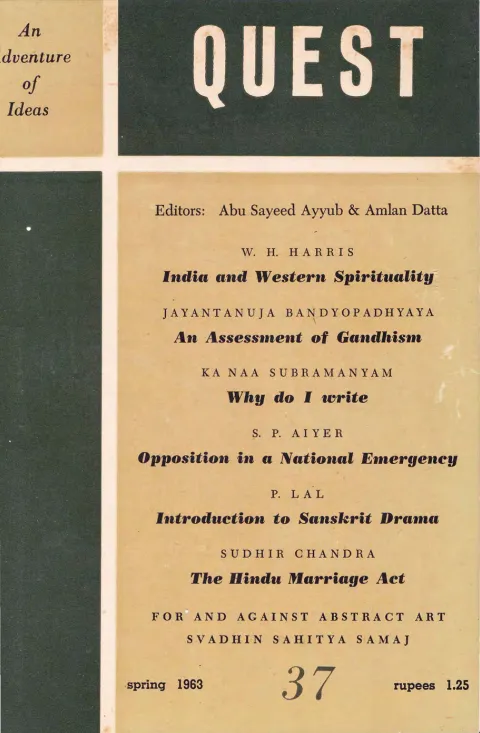
QUEST
Summary
Quest No. 37 (April/June 1963) is the issue in which the Bombay quarterly of the Indian Committee for Cultural Freedom abandons its own rule against current politics. A signed editors’ preface on printed p.54 announces the new CURRENT POLITICS section, attributes the idea partly to the ICCF’s Bombay meeting of late September 1962 and decisively to ‘the massive invasion of India by Communist China in October last’, states outright that the article which follows is ‘evidently written from the point of view of the Swatantra Party’, and reiterates that Quest is not affiliated to any party while excluding the pro-China faction of the CPI from its otherwise open invitation. The two items printed under that head give the issue its argumentative centre: S. P. Aiyer on what an Opposition owes and is owed in a national emergency, ending on an All India Congress Committee circular that calls the Prime Minister’s critics traitors; and the founding manifesto of the Svadhin Sahitya Samaj, drafted, signed and translated by Quest’s own co-editor Abu Sayeed Ayyub over five of the best-known names in Bengali letters, which argues that Chinese aggression cannot be resisted on the military front alone and that writers must fight the ideology behind it.
Around that core the issue runs its usual wide spread, and its recurring subject is the pathology of received ideals. William Henry Harris attacks the liturgical contrast of Indian spirituality with Western materialism and names three spiritual values he finds under Western institutions; Jayantanuja Bandyopadhyaya, reviewing Nirmal Kumar Bose, argues from Ambedkar’s own words that the Poona Pact was signed under duress and that Gandhi’s Hindu orthodoxy disqualified him as an arbiter of communal conflict; Adi H. Doctor demolishes the Sarvodaya doctrine of consensus with village evidence and with Pakistan’s Basic Democrats; Sudhir Chandra calls the Hindu Marriage Act’s incest provisions a State sanction for medieval taboos; A. Subbiah answers a previous issue’s article by defending reservations against high-caste intellectuals; Pradip Sinha reconstructs the Bengal Victorians’ paradox of liberal education and orthodox practice; Manashi Das Gupta relocates alienation from society to the alienated; Ka Naa Subramanyam accounts for why he keeps writing in Tamil; P. Lal sets rasa against catharsis; Hiranmay Karlekar sends back a travel essay from Hawaii. Five poems, a Kannada short story self-translated by U. R. Anantha Murthy, a two-part ARTS symposium on abstract art (Hans Sahl from New York, Jean Grenier from Paris, the latter translated by David McCutchion), eight signed book reviews and an unlisted SHORTER REVIEWS column by the new assistant reviews editor complete it. The correspondence section carries a two-round quarrel over Indian philosophy between Agehananda Bharati and N. K. Devaraja, and a protest from Debi Rai of the Hungry Generation to which the editors append a needling rejoinder.
Essays
India and Western Spirituality
By William Henry Harris
Harris, an American professor of philosophy renewing his Indian studies at Calcutta, sets out to break what he calls the liturgical effect of the standing contrast between Eastern spirituality and Western materialism - a contrast so often repeated that it ‘becomes obviously true since it is so uncritically assumed’. He concedes India’s great spiritual traditions and personalities, warns against sentimentality as much as cynicism (Koestler’s The Lotus and the Robot is his example of the latter), and then refuses the proposed division of labour in which India supplies spirituality and the West supplies material goods. Western technology and science, he argues, have roots in genuinely spiritual values, and some of those contributions were ‘no less spiritual simply because they were secular’.
The body of the essay names three such values and, in each case, sets an Indian ideal’s pathology beside a Western one. Positive freedom - freedom as enablement rather than the negative freedom epitomised in moksha and the sannyasin - is spreading through machines and mass higher education; against Gandhi’s Young India verdict on machinery he answers that renunciation ‘also has its own pathology’ and that the pathology of the ancient ideal of renouncing the fruits of action is formalism, a birth-allotted role played without regard to its social value. The need for personal and material achievement, taken as self-evident in the West, is surprisingly modest in India (he cites Kusum Nair and Eric da Costa); its Western pathology is an invidious pragmatism careless of means. Political leadership answerable to the people is the third, defended not for its material yield but as moral philosophy, with Niebuhr’s formula that man’s capacity for justice makes democracy possible and his inclination to injustice makes it necessary; its pathology is demagoguery, offset because democracy is ‘intrinsically self-educative and self-corrective’. He closes by reading India’s own experience of superficial foreign criticism back to her: a critic’s sense of another culture’s spiritual resources may say most about the critic.
- The Indian-spirituality/Western-materialism contrast is treated as a liturgy that is believed because it is never examined.
- The proposed cultural exchange in which India gives spirituality and the West gives material values is ‘only speciously fair’.
- Three spiritual values are claimed to underlie Western institutions: positive freedom, the need for personal and material achievement, and leadership answerable to the people.
- Every ideal has a pathology: renunciation’s is formalism, the achievement ideal’s is invidious pragmatism, democracy’s is demagoguery.
- Machines and mass university education are read as extensions of positive freedom rather than as threats to the spirit.
- Indian political leadership is praised as extraordinarily fortunate in quality precisely because tradition would have let it get away with much worse.
An Assessment of Gandhism
By Jayantanuja Bandyopadhyaya
Bandyopadhyaya’s piece is a review-article on Nirmal Kumar Bose’s Studies in Gandhism (Calcutta, 1962), signalled only by an asterisk on the title. He opens by conceding that Gandhi cannot be rationally assessed as a personality, only in his ideas and actions, and praises Bose as one of very few Gandhians willing to take the rational approach - quoting Bose’s own confession that he has met no dependable evidence for a Higher Purpose. But he disputes Bose’s central utilitarian claim that satyagraha alone can resolve social conflict. Constitutional method in a democracy is not simply compulsion, since democracy has a built-in mechanism for repealing laws and removing lawmakers; satyagraha, meanwhile, ‘may involve a great deal of psychological coercion’.
The test case is Gandhi’s ‘epic fast’ of September 1932 over separate representation for the untouchables. Quoting Ambedkar’s What Congress and Gandhi Have Done to the Untouchables at length, he shows Ambedkar rejecting the case against the Communal Award before the fast and afterwards describing himself as forced to choose between Gandhi’s life and his people’s rights - so the Poona Pact was a pact ‘signed under duress’, with no change of heart and no permanent resolution. Bose’s own three-sentence account of the episode is quoted to show how brevity manufactures harmony. The remaining sections argue that Gandhi was constitutionally unsuited to the Hindu-Muslim question because he was himself a party to it - a ‘rather conservative Hindu’ and ‘one of the greatest architects of Hindu revivalism in modern India’; that the Khilafat movement produced Pan-Islamic rather than Hindu-Muslim unity; that non-cooperation had petered out before Chauri Chaura (Nehru is quoted on Gandhi acting by instinct and clothing decisions with reasons afterwards); that satyagraha can only be launched against a liberal adversary, since the 1930-32 movement was crushed and no satyagraha could have been mounted against Hitler or Stalin; and that Indian independence had many other causes, from the INA and the 1946 naval mutiny to Labour’s coming to power. Against Bose, he refuses to blame the Congress leaders, since they never claimed non-violence as a creed and Gandhi accepted the Congress knowing it. He ends by granting Gandhism four enduring values: originality as a technique of organised non-violent resistance, originality in a barren field of contemporary Indian thought, a rare attempt to remould society rather than preach at it, and universal moral qualities.
- Presented as an assessment of Gandhism, the article is in substance a critical review of Nirmal Kumar Bose’s Studies in Gandhism, disclosed only in an asterisked footnote.
- Satyagraha is held to involve psychological coercion, and the 1932 fast to have produced a Poona Pact signed under duress, using Ambedkar’s own published account.
- Gandhi’s orthodoxy in ritual, caste and cow-protection is said to have made him a party to the communal dispute and therefore unable to arbitrate it.
- Non-cooperation is argued to have collapsed before Chauri Chaura, with Nehru quoted against the standard account.
- Satyagraha is said to work only against an adversary who resorts to liberal constitutional methods - not against Hitler or Stalin.
- The piece nonetheless credits Gandhism with four enduring values, including originality of technique and a rare attempt to remould society around moral values.
Why do I Write
By Ka Naa Subramanyam
Subramanyam answers his own title by describing the conditions that make the question keep returning. He writes in a language where literary criteria are almost unknown, writers’ conferences take the form of melas, seminars turn into sermons on how writers should write, and a poet is judged by his religious appeal. He began in English at college in 1929, discovered in about 1935 a band of courageous young men writing in Tamil, concluded one should write only in one’s mother tongue, and switched. That group activity deteriorated into incoherence in the forties, and its leaders deserted; the very man who had denounced plagiarism turned out to have passed off a third-hand adaptation of Gogol’s The Inspector General as his own. Of some twentyfive writers in the movement, he says, not one kept the original vision intact.
The material facts are as bleak: an acknowledged Tamil masterpiece published in 1946 had not sold out an edition of 1500 copies by 1962, while derivative serial writers make money and some recognition. He recalls Subramania Bharathi on Rajam Iyer, who wrote exceedingly well in Tamil, failed to be recognised, turned to English and was made editor of Prabuddha Bharatha by Vivekananda. He took up literary criticism for ten years without any bent for it, tried deliberate provocation by attacking the moral maxims of Tiruvalluvar as no part of literature, and drew no response at all from the hundreds who make a living writing on Tiruvalluvar. The final section is autobiographical and unsparing: he began in English because his father was a ‘writer manque’ forced to live as a postal servant, turned to Tamil partly in exaggerated revolt against him, and was reconciled only in the mid-fifties after reaching Paris and returning. He found English an inadequate medium for creative work and Tamil satisfying; his twenty-odd translations from European languages left the Tamil public indifferent; he rediscovered English in the early fifties for money and to explain the Tamil situation to non-Tamils. He concludes that he writes, as he reads, mainly for his own satisfaction, a satisfaction equally describable as vedantic self-knowledge or as competent journalism meeting modest biological needs.
- The essay is a first-person account of a literary culture without criteria, in which the best-known is equated with the best in quality.
- The mid-thirties Tamil movement is described as having made an immediate impact but generated no lasting influence, its anti-plagiarism leader ending as a plagiarist.
- Hard figures are given for the market: an acknowledged 1946 novel had not sold 1500 copies by 1962.
- A deliberate provocation - attacking Tiruvalluvar as outside literature - produced no reaction, which he reads as a cultivated art of ignoring irritants.
- He explains writing in English first as obedience to his father’s ambition and writing in Tamil partly as revolt against it.
- His own literary criticism and his score of translations are presented as instruments that failed to move the readership they were aimed at.
The Bengal Victorians
By Pradeep Sinha
Sinha reconstructs the mental world of the English-educated Bengali gentry of roughly the second and third quarters of the nineteenth century - a group he calls the Bengal Victorians - and identifies its organising contradiction as ‘a combination of unorthodox liberal education with orthodox social practice’. English education’s early unsettling effect, he argues, produced revulsion against everything Indian not from examination of traditional values but from the overpowering force of English civilisation, and it passed: literature, in a contemporary analyst’s words, cannot disorganise society. Three figures carry the argument. Kashiprosad Ghosh, the ‘Indian Bard’, held the most advanced notions of individual liberty while belonging to the orthodox Dharma Sabha and opposing Bethune’s female-education efforts. Sambhu Chunder Mukherjee would advise a friend to visit Europe with his wife for notoriety and then have the hookah used by an ‘English-returned’ visitor emptied and cleared. Bhoodev Mukhopadhyaya gave the contradiction a philosophical solution, standing for a morally purer society while accepting deshachar, and represented the turn to national self-respect that Max Muller had encouraged.
The essay’s set piece is the ‘monster meeting’ of 2 July 1870 in Calcutta, called by the British Indian Association against the government’s 1869-70 turn towards primary vernacular education. Its strangeness is that Englishmen took the pro-vernacular line while the leading Bengalis denounced the importance attached to the vernacular: Raja Narendra Krishna warned of ‘national calamity’, and Rajendralal Mitra explained that unlike Polish, whose defence he acknowledged, Indian vernaculars were poor, undeveloped and divisive, and that abandoning English would be ‘intellectual suicide’. Sinha then locates the class basis: Victorian society had its roots in land and service, not industry, and with very few exceptions its members were connected with land, so that the defence of the permanent settlement was as vital to Victorian opinion as the defence of English. English never became the literary language - 1,347 Bengali publications against 385 English in 1891, and Bankim Chandra making scarcely two thousand rupees a year - and the urge for expression went into journalism. Kristo Das Pal, editor of the Hindoo Patriot, is the representative figure: risen from humble origin by mastery of idiomatic English, unsparing critic of administration and racial attitudes, believer in a free press, and at the same time a thoroughly loyal subject for whom England and India were united by a beneficial dispensation of Providence. Sinha ends on the Bengal Victorian’s refusal to admit the superiority of the English social system, and on the poise that his reconciliation to a non-commercial economy gave him.
- The defining Bengal Victorian paradox is liberal, unorthodox education combined with orthodox social practice.
- The 1870 ‘monster meeting’ inverted the expected alignment: British officials favoured vernacular education while educated Bengalis defended English.
- Rajendralal Mitra explicitly distinguished the Polish case from the Indian, calling Indian vernaculars poor, undeveloped and divisive.
- Victorian society rested on land and service rather than commerce, so defence of the permanent settlement ranked with defence of English.
- Publication figures for 1891 (1,347 Bengali to 385 English) are used to show English never displaced the vernacular as a literary language.
- Kristo Das Pal embodies the type: a free-press absolutist and unsparing critic of administration who remained a wholly loyal subject.
An Introduction to Sanskrit Drama
By P. Lal
Lal’s essay - the contributors page discloses that it is adapted from his introduction to a forthcoming New Directions volume of six Sanskrit dramas he has translated - sets rasa beside catharsis as two attempts to describe involvement and release in aesthetic ritual, and then refuses the easy sociological explanations of each. That catharsis suited a city-state under Persian threat, or that rasa answered to an indolent and sensuous society seeking excessively refined sentiment, are for him half-truths. The real difference is of world-view. Greek tragedy needs one life and a chosen fate: Oedipus is warned by the oracle, takes no heed, and is responsible for his downfall - ‘in the Greek tragic pattern, ignorance of the traffic laws is no excuse for speeding’. Indian metaphysics, by contrast, shuffles the coins; ‘if this life ends in failure, there’s a rebirth around the corner’.
From that he derives the rasa ideal as a disciplined and dispassionate delight, whose symbol is the Gandhara Buddha smile or the detachedly attached Trimurti Shiva at Elephanta, and whose Upanishadic image is the two golden birds, one eating the fruit and the other watching. Drama’s standing as the fifth Veda, produced by Brahma at the gods’ request, makes it revelation rather than amusement, and Kalidasa is quoted to show it was not reserved for the sophisticated nagarika. He then explains Bharata’s prohibitions as protections of the rasa balance - no battle, killing or death on stage, no marriage rites, eating, sleeping, bathing, amorous play or scratching with nails and teeth, no more than four persons on stage at a time, nothing horrific or spectacular, the hero in every act, plots drawn from known legend so the audience gently awaits the expected - and catalogues the eight stable bhavas beneath the ninth, santa rasa, with Keith’s formulation that rasa is one, single and ineffable but subdividable by the sentiments that evoke it. The thirty-three transitory sentiments and their effects are laid out to show the cost of this apparatus: ‘the Hindu mind loves to catalogue things without systematising them’. The closing pages list the deficiencies frankly - sorrow in all its shades but no awareness of the tragic condition, no struggle of conscience in the hero, almost no invented plot, and occasionally a cumbrous artificiality relieved in The Toy Cart by Sudraka’s Prakrit - and end by asking the English reader to grasp the world-view rather than dismiss the form.
- Rasa and catharsis are treated as parallel but incommensurable descriptions of aesthetic release, each following from a world-view rather than from social circumstance.
- Oedipus is read as responsible for his own fate because he knew the prophecy, which anchors the single-life, single-choice Judaeo-Graeco-Christian frame.
- The rasa ideal is disciplined, impersonal delight - santa rasa - symbolised by the Gandhara Buddha smile and the watching bird of the Svetasvetara Upanishad.
- Bharata’s long list of prohibitions is explained functionally, as protecting the delicate interplay of the eight sentiments rather than as prudery.
- The catalogue of thirty-three transitory sentiments is presented as evidence of classification without system, and as a bottleneck for the creative imagination.
- Sanskrit drama’s admitted defects include no tragic condition, no conscience-struggle in the hero, and almost no genuinely invented plot.
The Problem of Alienation
By Manashi Das Gupta
Das Gupta models social life as a communication system - incoming messages decoded, responses sent through proper channels - and locates alienation at the point where a contact point is damaged, typically because the individual starts replying before the whole message is received. Two claims are pressed against the prevailing account. First, the individual is as much giver as receiver. Second, the channels are many and the codes flexible, so the individual can choose his own mode of communication. From this she draws a deliberately unfashionable conclusion: alienation is not a deficit of resources but a mishandling of abundance. If limitation were the cause, children and mentally retarded adults would be its victims; in fact no child has ever been reported to experience alienation, while it typically characterises bright adolescents, and adults of below-average ability never suffer from it.
She then reviews the theoretical field. Fromm, Horney and other neo-Freudians stress the role of the social ‘teachers’ so heavily that they hardly pause on the learner’s responsibility, though all of them are more optimistic than Freud because they work with social interaction rather than biological motivation. Malinowski’s analysis is credited with locating ambivalence in the contradictory expectations built into social structure, which she connects to alienation: the alienated combine an approach response with an avoidance response, and outright rejection by a group produces dejection or aggression, not alienation - ‘there has to be a dual longing springing from impulses incongruous with one another’. Against the neo-Freudians she argues that it is futile to expect a whole social system to be geared to a new learner: a stupid child who fails to learn that fire is hot does not cause anyone to want fire abolished. Freud’s developmental picture is criticised for making the individual a passive reactor, and Adler is defended as the disciple who rose against the theory of passivity with an actively perceptive individual, though later work was not directed to that end. She ends practically: the adolescent wants to affiliate through mastery as much as through love, over-grown self-esteem is what blocks scrutiny of one’s own communicability, a perfectly alienated individual is ‘a perfectly shut-in psychotic’, and since we are not passive objects the best results in re-education come from self-teaching - illustrated with Tagore’s line about walking alone if no one answers your call, to which she answers that it would be better to improve one’s method of calling.
- Alienation is redescribed as a communication failure at a damaged social contact point rather than as a condition inflicted by society.
- The evidential argument turns on who does not report alienation: children and below-average adults, as against bright adolescents and intellectuals.
- Alienation requires both attraction to and distance from a group; outright rejection yields dejection or aggression instead.
- Fromm and Horney are faulted for stressing the social teachers at the expense of the learner’s responsibility; Freud for passivity; Adler is rehabilitated.
- Over-grown self-esteem, not lack of talent, is identified as what prevents the alienated from improving their communicability.
- The prescribed remedy is self-teaching and the deliberate opening of several channels of communication.
The Hindu Marriage Act
By Sudhir Chandra
Chandra’s article - titled on the page ‘Incest among the Hindus: A Critical Examination of the Hindu Marriage Act’ - opens by setting the Act against the supposed silent revolution of enlightened legislation and finding it the one piece of law that reflects no reformist urge: its incest provisions are ‘paradoxical and anachronistic, illogical and reactionary’. The first half is historical. The earliest proscription, Rig Veda 10.10.10, covers only brother and sister, mother and father, with no evidence that cousin marriage was then incestuous. Risley’s theory that man’s urge for variety drove him to marry the unfamiliar is refuted by the widespread practice of compulsory endogamy within varna and sub-caste, and in any case explains no taboo. The totem link, disputed by Goldenweiser on the ground that exogamy is more widely distributed than totemism, survives in India as gotra and pravara. Kane’s joint family is accepted as a source of prohibition - cousins inside one patriarchal household had to be held to sibling status - and the South Indian pattern is neatly explained: marriage with a maternal uncle’s or paternal aunt’s daughter is allowed because neither parent belongs to one’s own joint family, while a paternal uncle’s daughter is taboo. Kane’s eugenic explanation, by contrast, is rejected as anachronistic projection, since no evidence shows the ancients knew the effects of endogamy, the texts argue from the Vedas rather than biology, and if in-breeding were known to be harmful the caste prohibition on exogamy would be inexplicable.
The second half attacks the 1955 Act. It follows Paithinasi’s degrees while professing to rest on Mitakshara and Dayabhaga, drops sagotra and sapravara bars, punishes contravention with a month’s imprisonment or a thousand rupees without voiding a duly solemnised marriage, and leans throughout on custom without distinguishing significant from dead usage. He dates the hardening of the tradition to the medieval commentators, who narrowed the range of views as the practice of Muslim rulers took a more lenient view of incest. The practical objections follow: the Act ‘commends in the South what it prohibits in the North’; eugenic arguments are invoked here while ignored where they would bite, since we do not sterilise the diseased; the prohibition of levirate now serves only to bar remarriage between lovers after a divorce for adultery with a brother-in-law; the psychology of cousin love, traced from childhood affection through the teens to the twenties, is simply ignored; and either party to a prohibited marriage may dissolve it at will and remarry without bigamy, which leaves the innocent relative unprotected. His final objection is political: by giving legal sanction to community custom the Act makes the individual feel the law of the land compels obedience to his sub-caste, a command incompatible with national integration.
- The Vedic proscription is shown to cover only siblings and parents, with cousin prohibition a later extension of the joint-family and gotra systems.
- Risley’s variety-seeking thesis and Kane’s eugenic explanation are both rejected, the latter as reading modern knowledge back into the ancients.
- South Indian cousin-marriage rules are explained structurally by joint-family membership rather than by blood distance.
- The Act is convicted of internal incoherence: Paithinasi’s degrees under a Mitakshara-Dayabhaga banner, penalties without invalidity, and different rules North and South.
- Prohibiting levirate is argued to have no function once divorce exists except to block one particular remarriage.
- The concluding objection is that legal enforcement of community custom entrenches sub-caste authority against national integration.
Consensus or Conflict
By Adi H. Doctor
Doctor argues, against the Sarvodayaites, that conflict rather than consensus is the medium of democratic politics: parties follow natural differences found in all but the most primitive societies and are neither artificial nor a Western import. He takes the Traditionalist case at its strongest, quoting the Minister for Rural Development Shri S. K. Dey on Ram’s Raj, where every village had its Mukhiya or Sarpanch and its panch chosen by consensus with near unanimity and no electioneering, so that ‘good men got invariably chosen’. Two questions follow. Was the past glorious? He answers with the historiography - Aurobindo and others drew on Jayaswal, whose conclusions Altekar later showed to be hastily drawn - and with Collin Rosser’s self-contained, egalitarian Kulu hamlet of Malana, which on closer inspection has a hundred and sixteen Kanet families and three Lohar families kept physically apart, politically dominated and socially ignored. Consensus prevailed, that is, because the panchayat was caste-homogeneous, and the celebrated harmony rested on undemocratic values that went unquestioned through ignorance and belief in a God-ordained division of labour.
Is consensus suitable to modern democracies? He grants that early panchayat elections were often uncontested and explains the sequence: the hitherto oppressed hesitated, then stepped down in favour of higher-caste candidates, then put up their own, at which point tension arose - Ralph Retzlaff’s North Indian case study is summarised in a long footnote ending with a Rajput winning but a Chamar close behind. Susane Rudolph is quoted to the effect that nostalgia for village consensus is neither morally consistent nor practical if change in the material and moral order is thought desirable, and that ‘Prescription minimises conflict, freedom enhances it’. He then follows the Sarvodaya scheme up from village to thana, district, state and national panchayats and finds the indirect selection unworkable, since panchas from far-flung villages cannot know one another well enough to pick the best; observes that untouchability still bars a Harijan from teaching in a village school, so his unanimous appointment to a panchayat is inconceivable; and argues that even without caste, disagreement about who is good and wise would remain, reducing conflict to the level of personalities - which, one critic is quoted as saying, is ‘the open road to dictatorship’. Pakistan supplies the empirical case: after parties were abolished, the Civil and Military Gazette complained that the wooing of voters was going on purely on a personal level, and 80,000 Basic Democrats are easier to corrupt than a mass electorate; Ayub Khan’s own 1960 Constitution Commission reported the need for parties. Finally, on deciding policy by unanimity, he takes the three Sarvodaya alternatives to a vote - indefinite postponement, dissolution and reappointment of the panchayat, and tossing a coin - and dismisses each, noting that postponement is no answer to foreign aggression.
- Political parties are defended as institutional expressions of natural difference, not as an artificial Western import.
- The golden village is dismantled twice: by Altekar’s correction of Jayaswal, and by the caste composition of Rosser’s supposedly egalitarian Malana.
- Early uncontested panchayat elections are read as evidence of the timidity of the oppressed, with tension appearing precisely as they grew bolder.
- Indirect consensus above the village is held to be unworkable because panchas from distant villages cannot know each other.
- Abolishing parties is argued to replace appeals on principle with personal appeals, with Pakistan’s Basic Democrats as the worked example.
- The Sarvodaya substitutes for majority voting - postponement, dissolution, tossing a coin - are dismissed, the first fatally so in a case like foreign aggression.
Hawaii
By Hiranmay Karlekar
Karlekar’s travel essay works by setting the islands’ lush sensuous surface against the working society underneath it. The opening pages are almost entirely descriptive - the sun melting down in cascades of loving warmth, the eight islands floating ‘like petals scattered from the same lotus’, the Pali point where his American companion Annie remarks that King Kamehameha united Hawaii by shoving his enemies down the cliff, the Tantelles at night above Honolulu in its luminous cocoon, Hilo’s amorous trees and the volcano goddess Pele jabbing at the clouds with a knife of molten lava. The pivot is comic: pleased with himself on arrival, he asks a customs officer whether he does not feel like lotus-eating, and is told ‘Nope. We like pineapples here’. From there the essay collects working detail - the Parker Ranch, second biggest cattle ranch in the world, reached by dirt track, with gunless cowboys driving jeeps; the janitor Arthur Reese arriving in a Chevrolet with a guitar; a history professor at Hawaii University who played cricket for the Calcutta Cricket Club at Ballygunge and quarrelled with the Bombay police over prohibition.
The second half turns to race and to the war. He lists men of Japanese, Chinese, Filippino, German, Italian, British, Irish, Fijian, Malayan, Russian, Hungarian, Roumanian, Spanish, Portuguese, Burmese and Hawaiian origin, notes the Hawaiian himself is conspicuously rare, and reports that nearly all have merged into the ‘American Way of life’ - documented through Joan, whose Portuguese grandparents came in the 1890s, whose parents understand but barely speak the language and who neither speaks nor understands it. Senator Fon, Spark M. Matsunaga, Vincent Esposito and the Indian-origin Watumulls are named as immigrants who rose; racial discrimination and the colour bar are recorded as absent, with an American married to a Filippino woman asking how he could talk of segregation when his four children have four different skins. Hawaii’s statehood, university, museum, supermarkets and bowling alleys are set beside the sugarcane and pineapple, and the essay ends at the Punchbowl, where a cross stands for each of the Japanese-Hawaiian dead who fought in Europe, and where the narrator, badly in need of consolation, wishes no more bombs would fall on Hawaii or anywhere else.
- Structured as a deliberate correction of the lotus-eating cliche, announced by the customs officer’s reply about pineapples.
- Working Hawaii - the Parker Ranch, the sugarcane and pineapple economy, the statehood apparatus - is set against the picture-book landscape.
- Racial diversity is catalogued in detail and read as assimilation into American identity across three generations.
- Absence of a colour bar is asserted and illustrated by an interracial family rather than by statistics.
- The essay closes at the Punchbowl war cemetery, turning a travel piece into a short meditation on war and death.
- Hawaii’s Japanese-American troops fighting in Italy and the Vosges are cited as the most spectacular demonstration of assimilation.
Government and Opposition in a National Emergency
By S. P. Aiyer
Aiyer’s article is the first item Quest ever printed under a Current Politics head, and the editors’ preface above it states that it is evidently written from the Swatantra Party’s point of view. He begins from the British model - Parliament as a forum for reconciling conflicting interests, the two-party division a historical accident, the Leader of the Opposition paid because the Opposition is an alternative government - and quotes Smith and Lindeman that majority rule is ‘a useful, almost a mechanical contrivance’ whose function is not to define the perfect solution but to keep the game going. He grants that Government and Opposition worked the Indian system comparatively well for the first eight years, cites W. H. Morris-Jones’s Parliament in India as a hopeful picture, gives Nehru much of the credit and quotes him twice - at Madras in January 1957 on believing completely in stout critics, and in Parliament in May 1962 welcoming a vigorous opposition and recalling old comrades now opposite. From 1958, he argues, impatience with criticism became marked, shading into contempt, and he traces an undercurrent of authoritarianism to Nehru’s own 1930 self-portrait under the pen-name Chanakya, asking whether Jawaharlal might fancy himself as a Caesar.
The political explanation offered is partly financial: the Swatantra Party threatened to siphon off business funds, and during the Third General Elections the Tatas promised the Congress two-thirds of their political donations and a third to Swatantra - a contradiction Masani exposed by arguing in the Lok Sabha against company donations to parties at all. NEFA then vindicated the Opposition and forced Krishna Menon out. The theoretical core is that the Opposition’s role is modified but not suspended in an emergency: restrictions must take the character of a self-denying ordinance rather than being imposed. He credits the exploration of that principle entirely to the Opposition parties, quoting N. G. Ranga on responsible, co-operative opposition and on maximising the defence effort, and Masani on the Labour Party’s support for the armed forces while relentlessly opposing Neville Chamberlain, ‘the guilty man who was responsible for Munich’. Jennings and Greaves on the wartime British Parliament supply the model of a ‘collaborating Council of State’ in which reasoned argument supported from all quarters should move the Government. Against that he sets the fear that the Government may use emergency powers to weaken the Opposition, quoting Ranga on the Defence of India Bill and Rajagopalachari that in any war the first casualty would be democracy. The article closes on an All India Congress Committee circular, numbered in the text, instructing that a positive stand be taken against criticism of the Prime Minister and that ‘those who criticise him are traitors’ - the more serious, Aiyer says, because Nehru was unaware of it until Ranga raised it, and because Nehru called it ‘very improper’ while adding that Swatantra and Jan Sangh members had made very irresponsible statements.
- The Opposition’s function of criticism is held to survive a national emergency, with wartime restraint taking the form of a self-denying ordinance rather than imposition.
- Nehru is credited with building parliamentary confidence up to about 1958 and charged with growing contempt for criticism thereafter.
- Nehru’s own 1930 pseudonymous self-criticism as ‘Chanakya’ is used as the best authority for an authoritarian undercurrent in his character.
- The Tatas’ split donation - two-thirds Congress, one-third Swatantra - is offered as evidence that big business sensed political change.
- Jennings and Greaves on the British wartime Parliament supply the model of a ‘collaborating Council of State’ that India failed to create.
- An AICC circular instructing that critics of the Prime Minister are traitors is presented as a personality cult equating party with government.
Svadhin Sahitya Samaj
By Tarasankar Banerjee Premendra Mitra, Buddhadeva Bose, Subodh Ghosh and A. S. Ayyub
This is the founding statement of the Svadhin Sahitya Samaj, or Society for the Freedom of Literature, printed in English translation; the headnote states that Abu Sayeed Ayyub prepared the Bengali draft on the Samaj’s behalf, that it appeared on 18 January 1963 in Desh, Ananda Bazar Patrika, Jugantar and Lok-Sevak over five signatures, and that the English version is also Ayyub’s. It opens on the artist’s professional detachment - the ‘psychological distance’ from the human situation, looking at man through the wrong end of a telescope - and argues that the crisis has broken it, so that even the individualist thinker finds patriotism rising in his normally secluded mind and knows he may be called to the battle front, as British men of letters were after Dunkirk.
The analysis that follows is unsparing about both the enemy and its Indian allies. What happened in the Himalayan passes changed not only Indian history but the character of the Indian mind; ill-equipped border forces could not meet a long-planned massive attack, ground and lives were lost, and China halted and declared a cease-fire without ending the state of war. Communism is ‘a proselytising and militant creed’ whose believers hold it a sacred duty to spread the dogma by any means, and Khrushchevite talk of coexistence is dismissed as idle talk, adolescent wish-fulfilment or revisionist sophistry, since the path to communism runs through the battlefield. Chinese priorities are read off their monuments: not Confucius or Lao Tse but Chengiz Khan, ‘probably the greatest killer in all human history’, has an imposing mausoleum. If India could be overrun the rest of Asia would follow; if India were left to her democratic construction she would be a rival magnet. The domestic threat is stated bluntly: a big section of the Indian Communist party, a substantial majority of it in West Bengal, would not admit that Communist China had invaded, and its representatives voted against the resolution condemning Chinese aggression at the National Council meeting of 1 November 1962. Parliamentary politics runs against the grain of communist practice, so revolution needs an invading army and the two parties’ roles are complementary. The manifesto then explains why writers in particular must resist: they can admit no authority but their artistic or scientific conscience precisely where dictatorial fiat is most intolerant, so under a dictatorship theirs is the most suspected and persecuted part of society, while those who serve the Polit-bureau are the most pampered. It states the Samaj’s two founding ideals - individual freedom of expression, and the strengthening of democracy understood as a temper of tolerance rather than a form of government - and then turns the argument on itself: sprouts of fascism are visible in the remnants of feudalism and the resurgence of religious authoritarianism, and if they become a real menace the Samaj will oppose them with equal vigour. Its closing pages ask whether Indian culture, whose message is tolerance, can find a place for intolerance too, and define a patriotism that refuses to make tradition turgid by obstructing its flow.
- Presented as a writers’ manifesto: the crisis is said to have broken the artist’s professional detachment and made him answerable as a citizen.
- Communism is characterised as inherently militant and proselytising, with Khrushchevite coexistence dismissed as sophistry.
- The CPI’s refusal to concede that China had invaded, and its National Council vote of 1 November 1962, are cited as the domestic danger.
- The Chinese and Indian communist parties are argued to need each other: invasion without internal chaos cannot succeed, and revolution without invasion cannot either.
- Writers are said to be the first target of any dictatorship because their work admits no authority but their own conscience.
- The manifesto explicitly commits the Samaj to opposing Indian fascism too, naming feudal remnants and religious authoritarianism as its manure.
The Mind is a Medusa-head
By Leslie de Noronha
An untitled poem in three movements, printed first under the POETRY head. The mind is a Medusa-head, petrified with horror at the deformity it is nonetheless implicated in engendering: twisted humpbacked children with eyes of grief, broken bones and suppurating wounds of a necrotic eeriness at which even cripples, cretins and deaf-mute monsters shudder. The second movement makes the source nocturnal - ‘the secret store of knowledge’ and ‘the taste of negativity’ have their moments of conception in the silent moments of the night - and the third traces their passage at dawn into the brain, imagined as a nursery of rotted souls, and then full-blown into the screeching sepulchre of memory. The poem gets its title in the table of contents from its own first line.
- Printed without a title; the contents page supplies the first line as one, capitalising ‘mind’ to ‘Mind’.
- The Medusa figure is used for a mind horrified by what it cannot stop generating, rather than for a petrifying external gaze.
- Knowledge and negativity are given a shared nocturnal conception, moving at dawn from brain to memory.
- The closing image makes memory a sepulchre rather than a store, so nothing is preserved intact.
I See Shadows
By Leslie de Noronha
The second of de Noronha’s two untitled poems, a single verse paragraph built on a series of self-cancelling images: shadows on the opaque walls of a beloved’s hut, followed at once by ‘But I have no beloved’; hard, brittle laughter splintering crystal-clear glass in a hut that has no windows. It then addresses a ‘withered parchment heart’, warning that the jagged ends are sharp and that severed arteries gape with longing, forbids grief on the ground that tears are no sauce for a meal of lotus-leaves, and prescribes sitting endlessly in silent shade and licking no open salted wounds. The last two lines break the tone with an auctioneer’s shout - calling in the rag man, the bone man and the pawn man for a blood-stained suit of clothes going for sale.
- Printed untitled; the contents page names it from its opening phrase.
- Each image is withdrawn as soon as it is offered - the beloved who does not exist, the windows the hut does not have.
- Grief is refused rather than indulged, with lotus-leaves standing for the ascetic consolation that will not serve.
- The closing rag-and-bone call turns the speaker’s own suffering into salvage put up for sale.
Pages Rustle
By Dharmo Civaramoo
A densely imagistic poem, and the first of the two in this issue that carries a printed title. Its governing conceit makes the printed page, the migrating light and the human eye interchangeable apertures. It opens with pages rustling and turning, all printed with shadows, the light migrating to another world, and the claim that ‘Our days are but intervals in a prolonged night’. A city morning follows in which office buildings open like ribs and a cross is nailed to the sun on a cardiac dome, blood spreading opaquely while the speaker closes his lids and calls it meditation. The middle section asks whether God prefers to appear in the dark, warns that all such backgrounds are further veils, and demands that the husk fall from the word so that the eye may shoot its meaning into the skull. The closing movement gathers the smouldering half-closed eye, the kerosene flame caking the roof with smoke-dust, lit particles and sub-atoms as ‘eyelets into the beyond’; sun and child compose each other in a shared stare through the eyelets in the roof; and dew drops hurl down and crash on petals ‘Printed with spectrums, all pages, / Endlessly turning.’
- Page, light, eye and roof-eyelet are treated as one family of apertures throughout.
- The urban morning is rendered anatomically - ribs, cardiac dome, opaque blood - rather than pictorially.
- Meditation is questioned as a closing of the lids rather than an opening, and dark backgrounds are called further veils.
- The ending returns to the opening image, so the poem closes as a page still turning.
The Door
By Dharmo Civaramoo
A short titled poem set against the previous one’s expansiveness. It opens with shade deepening into an abyss ‘Without a quest, / An automatic door opening’ - a door that costs nothing to pass. Against that it sets two creatures for whom the threshold is work or destruction: the bee that has to tap the closed bud, and the moth that seeks a door into the flame and falls cracked. The poem then asks who has entered this hard fire and is tapping the wall from within, and closes with the flame disclosing its petals and revealing the abyss, so that the opening image returns transformed - what the effortful door opens onto is the same abyss the automatic one did.
- Sets an automatic, questless door against thresholds that must be worked for or died into.
- The bee and the moth supply two models of entry: patient tapping and self-destruction.
- The unanswered question about who taps the wall from within turns the poem back on the speaker.
- The flame’s disclosed petals reveal the same abyss the poem began with, closing the circle.
A Filament of Fire
By Anil Bhatti
A short untitled poem printed in the lower half of p.69, the work of a contributor described on the contributors page as still in his teens and publishing for the first time outside school and college magazines. A filament of fire shoots out of the air, propelled by a hand unseen, and fills the speaker with despair and then with wonder: despair because no man-made marvel could surpass the furious beauty of that magic shaft, wonder because the awesome power of the aerial dart was itself ‘embodied beauty / And celestial Art’. The poem leaves the phenomenon unnamed, and its own title comes from the contents page, which capitalises the first line.
- Printed untitled; the contents page supplies ‘A Filament of Fire’ from the first line.
- The poem moves through two named responses in order - despair, then wonder.
- Human making is measured against the unseen hand and found unable to compete.
- Power and beauty are identified rather than contrasted in the closing couplet.
Revolt against Abstract Art
By Hans Sahl
Numbered ‘I’ under the ARTS head, Sahl’s piece is reportage rather than criticism. It begins on an April afternoon outside the Museum of Modern Art in New York, where about twenty young people marched with placards announcing that they were tired of exhibitions of propellers, coffee-grinders, saws, typewriters and ashtrays, that they wanted a museum of the future rather than a mausoleum of modern art, and that children’s drawings belonged in the kindergarten, with Goya quoted - ‘The sleep of reason brings forth monsters’ - and a dog carrying the notice ‘Art is in a bad way now’. Sahl is careful about what they were protesting: not modern art, nor the museum’s permanent collection, nor its exhibitions of Monet, Matisse, Picasso, Braque and Miro, but the tutelage of authority in a matter of taste and a doctrinal stand favouring certain groups. Alfred Barr, the director, is treated generously and damningly at once - no reactionary, but so afraid of failing to recognise a genius that he is inclined to treat as one anybody who declares himself so. Sahl’s own objection is to the apparatus rather than the objects: you may exhibit a trouser button, but employing for it an aesthetic terminology reserved for the noblest human creations betrays both art and those who genuinely seek the new. He notes that such a demonstration in Cassel or Munich would run the risk of exploitation by people who call Van Gogh and Cezanne degenerates, and that modern art has never been reviled in America, Barr himself having given asylum to artists and their works when pictures came off German walls.
The second half follows the critic John Cannaday of the New York Times, who took up the discussion where Emily Genauer of the Herald Tribune had been in splendid isolation, and abolished at a stroke ten years of passive acquiescence. Money is named as the stake: a great deal has been invested in abstract art, prices for a Pollack, a de Kooning or a Franz Kline have become fabulous, and universities and art associations demanded Cannaday’s dismissal. His most sensational article, on ‘New Means, New Forms’ at the Martha Jackson gallery - which opened the day Krushcheff took off his shoe at the United Nations - told readers who had seen string stuck on paper, bugs fixed on a mirror and stuffed stockings attached like dirty sausages to take no further interest in contemporary art and to put their money into the alleviation of human suffering. Sahl then visits him, finds a pleasant and subtle man rather than the fabricated reactionary, and reports his complaint that a critic must always take up a well-defined position and that with abstract painting it is very difficult to talk about quality, which is the basis of all criticism. The interview ends on the seven detective stories Cannaday has written under a pen-name and a dedication he inscribes in his latest, quoting a fifty-year-old man’s confession that he is a murderer. Sahl’s own conclusion is that a revolt against modern art and its managers is in the offing, that there is no question of rejecting the art en bloc, but that it has exhausted its possibilities.
- The Museum of Modern Art picket is carefully distinguished from an attack on modern art itself: the target is the museum’s tutelage of taste.
- Alfred Barr is credited with giving asylum to artists fleeing Germany and faulted for treating self-declared genius as genius.
- The objection is to the misapplication of a reverent aesthetic vocabulary, not to the objects exhibited.
- The investment in abstract art, and the fabulous prices of Pollock, de Kooning and Kline, are named as reasons a dissenting critic was attacked.
- John Cannaday is presented as a humanist strayed into art criticism, who told readers to spend on human suffering rather than on stupidity.
- Sahl concludes that abstract art has exhausted its possibilities without being rejectable wholesale.
Is Abstract Art Dead?
By Jean Grenier
Numbered ‘II’ under the ARTS head and translated from the French by David McCutchion, Grenier’s piece answers the rumour of abstract art’s death by reading the dealers’ behaviour. Those picture dealers who set the tone, he says, have begun to tide over the transition by stopping shows, putting on retrospectives, exhibiting exotic works or exhuming past revolutionary periods now back in favour - which offends nobody, gains time and lets them judge the new current’s chances without banking prematurely on its success. The new figurative current will succeed with the public, he argues, first of all because it is very old, ‘and nothing pleases so much as repetition’: family portraits, battle scenes and idyllic landscapes keep their attraction, as the eternal success of Faust and Carmen shows, and in the arts humanity moves in a circle, its only way of finding something new being to repeat what is old but forgotten - the return to 1900 in fashion being the most distressing sign. He sets that against the stirring flights of scientific invention in the same century, and against the real strides painting had taken through impressionism, cubism and the non-figuratives, as music had since Schonberg.
The survey that follows is a set of verdicts on current Paris shows. ‘The Spanish Painters of Reality’ at the Galerie Charpentier is absolutely incredible and should be seen, serving the purpose the drunken helots served for Spartan children - an excellent antidote or preventive. The ‘Blue Rider’ exhibition at the Galerie Maeght, a triumph for Kandinsky, Franz Marc and Delaunay, and the carefully proportioned ‘School of Paris’ selection at Charpentier, show that contemporary art cannot become entirely faithless to its origins. Grenier then states his own position with an explicit disclaimer of modesty: painting that does not take its themes directly from the outside world has many happy years before it, and a new figurative art will only succeed if grafted on to the living art of today, taking account of microscopic and mineral realities. Pignon carries the final argument. Apprenticed as a manual worker and then as a painter in the school of hard reality, Pignon refuses to define reality by form because form as such is empty and needs a content, and that content is movement - the painter’s movement towards the canvas, the struggle that suppresses the distance between them, and the succession of forms at the speed of lightning in cocks’ beaks, waves and harvesters’ flails. What results is neither image nor synthesis but a painting, something that starts from reality and has nothing to do with what an ordinary man understands by it, and which the man from the street would call abstract ‘whereas it’s simply an extract’.
- The death of abstract art is inferred not from the paintings but from the dealers’ retrospectives and exotica, read as ways of buying time.
- The new figurative current’s advantage with the public is its age: repetition, not novelty, is what pleases.
- ‘The Spanish Painters of Reality’ is recommended as an antidote - worth seeing as a warning rather than as art.
- Grenier commits himself to non-representational painting’s future while insisting any new figurative art must be grafted on to living contemporary art.
- Pignon is used to argue that reality cannot be defined by form, since form is empty and its content is movement.
- The closing distinction turns abstraction into extraction: what the ordinary viewer calls abstract is an extract from reality.
Prakriti
By U. R. Anantha Murthy
A Malnad story, translated from the Kanarese by the author. Sankappayya, an ageing orthodox Brahmin smallholder some twenty thousand rupees in debt, is living alone; the narrative opens with him avoiding the sympathetic questions of Ahmed Byari, a merchant who has leased the orange garden from the creditor Krishna Bhatta, and then moves back six months. His son Nani had stood on one leg against a verandah pillar, defying him for the first time and announcing that he would join his uncle and the Shanubhogue’s son Kittu in a Shimoga coffee club. Through the walls Sankappayya listens to his wife Seethamma reciting forty years of grievance - tigers in the cowshed, leopards taking calves, malaria, pests, mortgaged gold, the widowed daughter Laxmi married against her advice - while the child Shantha plays with his hair and his moustache. He refuses the son his share, considers selling food unworthy of his ancestors, and resolves to live alone with attachment to nobody.
The rest is the day of that resolve unmaking itself. He tries and fails to say to Laxmi the one thing he means; climbing to the Chowdi Bana he meets a tiger’s gaze across the hollow where the tired earth sagged under the weight of the hills, stands transfixed and says aloud, ‘One must live like a tiger’. He is then patronised by the Shanubhogue, who advises swimming with the current, and walks on into a fantasy of worshipping Durgi astride her tiger, in which Laxmi’s kumkum returns red as blood and the cowards vomit blood and die. He arrives to find wild elephants have destroyed the areca and the young orange plants while the watchman Kariya sleeps off toddy, and rationalises the disaster as accident. Lost on an unknown hill at noon, in a landscape of buffaloes lying in filth ‘in blissful satisfaction’, he asks whether Nature is after all indifferent to Man and feels himself inconsequential; then behind the bamboos in the cool shade he sees Laxmi lying in the arms of Kittu, and covers his eyes with his towel. The story ends with the Shanubhogue reporting that the tiger was spotted on its mound and shot from behind by Kogga, with Sankappayya going straight to his creditor’s house, and with him alone at midnight under the jack tree, remembering how he hardened his heart when Shantha ran back crying to stay, scratching a stray cow’s neck and saying aloud, ‘Mother, I am tired’.
- The conflict is generational and economic - an orthodox agriculturist’s will against a son who wants to sell food in town - but is resolved by neither.
- The tiger supplies the story’s ideal of solitary, unafraid living, and is then shot from behind while lying indifferent on its mound.
- Sankappayya’s inability to say what he means to his daughter is repeated at every attempt and is the story’s emotional centre.
- The elephants’ destruction of the garden is deliberately made an accident rather than a judgement, which is what defeats his theory of will.
- Nature’s noon indifference is offered as fulfilment for the buffaloes and as annihilation for a man at war with himself.
- The discovery of Laxmi with Kittu is given in a single unglossed sentence set apart on the page.
The Caste System
By A. Subbiah
Printed under the DISCUSSION head as ‘The Caste System - Vested Interest of the High Castes’, this is a direct reply to Subash Chandra Mehta’s article in the January 1963 issue of Quest. Subbiah’s opening charge is that it has become a fashionable pastime among high-caste intellectuals to condemn caste piously and in almost the same breath to react violently against the measures by which the state tries to mitigate its secular hardships. Mehta had set out to ask whether caste was on the wane and concluded with a plea to abolish reservation for the Backward Classes as against the principles of social justice and bound to lower standards; Subbiah answers that Mehta protests against a vested interest in backwardness while arguing for a longer lease on the infinitely more harmful vested interest the high castes have in caste itself - the position of vantage through which they entrenched themselves in the public services.
The argument then turns on causes and costs. The Brahmin youth’s high linguistic and mnemonic virtuosity is traced to a favourable family, social and educational environment and to an examination system that has become almost exclusively a test of memory and facility in a foreign language; to infer lower intellectual calibre in other castes is unscientific and untenable in a democracy. Reservation need not lower standards, given intelligent recruitment and sympathetic handling by superiors who are mostly high-caste, and even a slight lowering is a small price; in any case the gross deterioration in administrative standards since independence is attributable to incompetence and corruption at levels still dominated by the high castes. Mehta’s own figure - 20% of Mysore government posts allotted to Brahmins - is used against him as still disproportionate to numerical strength, and the claim that ‘instead of the Harijan becoming a Brahmin, the Brahmin is becoming a Harijan’ is called a travesty of facts. He rejects Mehta’s sharp line between Scheduled Castes and Backward Classes, suspecting the latter are resisted harder partly because the treatment of scheduled castes has drawn unsavoury world publicity but principally because the Backward Classes, with a less hopeless background, are the more imminent danger to high-caste supremacy. He concedes individual high-caste people may suffer unfairly, answering with Mehta’s own observation that mobility must be a group phenomenon because upper castes refuse to recognise low-caste individual achievement. He agrees with Mehta’s pessimism about caste’s tenacity, warns that the defensive caste consciousness of the backward communities may with a little provocation become offensive, and closes by asking high-caste leaders to recognise that the system is evolving into a Frankenstein that will menace them too, and to lead a movement to divorce caste from religion and eradicate it root and branch.
- Directly answers a previous issue of Quest, treating Mehta’s conclusion as an anticlimax that undoes his own analysis.
- Brahmin examination advantage is explained environmentally and by the memory-based examination system, not by intellectual calibre.
- Mehta’s own Mysore figure of 20% of posts for Brahmins is turned against him as still disproportionate.
- Post-independence administrative deterioration is attributed to a service still dominated by the high castes.
- The distinction between Scheduled Castes and Backward Classes is rejected, with a motive imputed: the latter threaten high-caste supremacy sooner.
- The closing appeal is prudential as well as moral - caste is becoming a Frankenstein that will menace its beneficiaries.
The Adventure of Criticism
By David McCutchion
The first and longest review in the BOOKS section, on K. R. Srinivasa Iyengar’s The Adventure of Criticism (Asia Publishing House, 691 pp. Rs. 25.00). McCutchion’s objection is announced in his first sentence: here we go adventuring, but not into the jungles of controversy. Iyengar’s is ‘a conciliatory mission’; he wants to be nice to everybody from Charles Morgan to Dr. Leavis and from Baudelaire to Pearl Buck, and his adventures are the fireside kind, ‘the adventures of the soul among masterpieces’ in Anatole France’s phrase. Those who enjoy the clash of opinions - nine separate schools are said to stalk the streets of Cambridge snarling at each other - will be disappointed, because Iyengar roves sedately and, even in the wilderness of modern despair, finds an armchair waiting. The evidence is stylistic: familiarly generalised language on O’Neill, a silver lining in Kafka, and a fatherly sympathy for poor Kafka who tried so hard to find God and just could not quite make it.
Against that McCutchion argues that criticism cannot avoid controversy because literature involves the values we live by, and that to make literature uncontroversial is to take the life out of it. The universities are implicated, rendering literature harmless by turning it into research bound by impartiality and elucidation and into an intellectual game, which is precisely what Leavis reacted against; the archetypal don combines wisdom and wit and stands above the fray. He concedes plenty of wisdom in the collected essays but insists the critic’s business is discrimination, not wisdom, and that Iyengar concedes as much in quoting Eliot on criticism as ‘correction of taste’ before spending the essay placing checks on criticism in the name of fair-mindedness and good manners - a ‘noble enterprise’ to be engaged in with tact by gentlemen, with ‘drain-inspectors’ condemned and Charles Morgan brought in to say the young poet exhibits a fresh burning wound which the critic must touch with love. The second handicap is Iyengar’s ‘seraphic’ view of literature, shared with his preference for Sri Aurobindo’s poetry and poetic theory: if criticism leads not back to life but forward into ‘the heart of Reality’, then discrimination becomes less urgent and less tangible, and criteria like ‘knowledge and integrity’ or ‘a penetrating intellect and a fine imagination’ cannot be applied because they are never cashed out in examples and comparisons. He diagnoses an East-West cleavage - the Indian reliance on theoretical argument against the Anglo-Saxon insistence on concrete reference, aesthetic experience contrasted with samsara against Arnold’s and Leavis’s criticism of life - and illustrates the cost with two quoted passages of identical sentiment and unequal expression. The last paragraphs grant that Iyengar cares, that his catholicism is of service, and that the essays add up to an Indian equivalent of Wellek and Warren’s Theory of Literature which will succeed if it sends readers to the original literature.
- The book is read as a conciliatory mission whose good manners disable it as criticism.
- The central thesis is that criticism cannot avoid controversy because literature engages the values we live by.
- Universities are charged with rendering literature harmless through impartiality and through treating it as an intellectual game.
- Iyengar’s criteria are held to be unusable because they are never applied to particular texts or comparisons.
- His ‘seraphic’ view, linked to his preference for Sri Aurobindo, is said to make discrimination less tangible.
- The review ends by granting the book’s catholicism and its usefulness if it drives readers to the originals.
Economic Development and Social Change in South India
By S. Natarajan
Headed ‘Before and After’, Natarajan’s review of T. Scarlett Epstein’s Economic Development and Social Change in South India (Oxford University Press, 353 pp. Rs. 27.50) opens historically rather than with the book. At the beginning of the century Sayaji Rao Gaekwar of Baroda, himself an enthusiastic social reformer, warned the Indian National Social Reform Conference against complacency, saying much of the progress was due to force of circumstances rather than to intelligent and energetic effort - a remarkable warning at a remarkable time, since the movement was still holding the heights of the preceding decade. Natarajan’s own thesis is that effort spent itself over the next three decades and the compulsion of events asserted itself, that economic forces gained importance after independence, and that specialised regional studies won recognition with them; to Irawati Karve, G. M. Carstairs and F. G. Bailey he now adds Epstein.
The summary of the study is careful. Epstein spent 1954-56 in Mandya District in the old Mysore State comparing two villages of under a thousand people each, both multi-caste and both outside the Community Development Project so that they developed without official direction: ‘Wangala’, a wet village in the centre of the irrigated area four miles from Mandya on a secondary road, and ‘Dalena’, a dry village on the fringe six miles out but near the highway, the electric lines and a railway station. Before irrigation arrived in the later thirties the two were nearly identical, so irrigation is the major variable. Her main conclusion, as he reports it, is that when a society turns from subsistence to a cash economy traditional relations are affected and new ideas ferment; the difference is that in the wet village irrigation led directly to improved farming, while in the dry village the move was towards capturing the surrounding prosperity - black markets that Wangala’s small cultivators could not exploit, and jobs outside. Women’s positions diverge accordingly: Dalena women took on more land work to release their men, Wangala women developed buffalo-tending and money-lending with prestige attached to not working the land. Joint families have broken down in both (ten per cent of Wangala and eight per cent of Dalena households remain joint) but the blame falls on quarrelsome women in one and selfish young men in the other, and adoption is frequent where wet land needs a male heir. On caste, relations changed in Dalena where the economic tie changed and held in Wangala where the pattern was reinforced, and Wangala’s untouchables, with more non-traditional jobs available, had the cohesion to stage a united protest that Dalena’s lacked. The review closes by noting the Rockefeller Foundation’s support and suggesting the Planning Commission, which has evaluated the direct effect of minor irrigation, should draw on her for the social evaluation.
- Frames the book with Sayaji Rao Gaekwar’s warning that reform owed more to circumstance than to intelligent effort.
- Places Epstein in a line of regional studies with Irawati Karve, G. M. Carstairs and F. G. Bailey.
- The comparison works because the two Mandya villages were nearly identical before irrigation arrived in the later thirties.
- Wet and dry villages exploited the same stimulus differently: better cultivation in one, black markets and outside jobs in the other.
- Caste relations changed where the underlying economic tie changed, and held where it was reinforced.
- Ends with a policy suggestion: the Planning Commission should commission the social evaluation to match its irrigation evaluation.
The Achieving Society
By Satish C. Saberwal
Headed ‘The Will to Success’, Saberwal’s review of David C. McClelland’s The Achieving Society (D. Van Nostrand Co. 512 pp.) opens by announcing that psychology makes a belated debut as a major source of ideas for economic development and that it is necessary to mark the event with a beat of drums. He summarises the argument as a chain: growth is the cumulative effect of large numbers of decisions; contemporary industrial and commercial decision-making invariably involves moderate uncertainty and risk-taking; not everyone will take risks, but the entrepreneur characteristically chooses the two in the bush because he has a high psychological need for achievement, McClelland’s ‘n Achievement’. High levels are produced in a childhood that is warm and nurturant, where the father’s dominance is low and the child is under pressure to meet high standards, and a society that places high-n-Achievement men in pivotal decision-making roles is likely to grow fast. Two further factors moderate the outcome: excessive n Power without n Affiliation tends to an authoritarian political system, while high n Affiliation encourages people to neglect task-performance and concentrate on making each other happy - hence the prescription of high n Achievement, moderate n Power and moderate n Affiliation.
Saberwal then says an argument of this sort would deserve no more than a brief ‘how interesting!’ were it not built on a decade of research ranging from pre-Incan Peru and the Friends’ project at Barpali near Rourkela to tests of adolescents and their mothers in the United States, Japan, Brazil, Germany and India, managers in Italy, Turkey and Poland, and children’s story books from forty countries. Disclaiming the competence to examine the whole gamut, he takes one set of investigations in three units. First, individual performance under risk: n Achievement levels for over 700 adolescents in Germany, Brazil and Japan were scored from imaginative stories and from doodles, and the boys then solved arithmetic problems under stated probabilities of success of 3/4, 1/2, 1/3 and 1/20; high-n boys did much better than low-n boys at 1/3, somewhat better at 1/20 and 1/2, and not as well at 3/4. Second, the relation between individual n Achievement in a country and the achievement imagery in its children’s story books: ‘The two variables did not show any clear relationship.’ Third, the cross-national relation between story-book n Achievement in 1925 and 1950 and the rate of growth in electrical production - McClelland having rejected the usual economists’ measures of national income - where the data do provide broad support. He points readers to the new insights on old problems: how slavery may have doomed complex civilisations by lowering n Achievement, why a red ideology may be better than no ideology for development, and why Gandhian notions of village self-sufficiency are anachronistic, with a footnote observing that Gandhian economics probably received from Gandhi little more than his blessings and got its framework from J. C. Kumarappa. The review ends by naming P. C. Mahalanobis, H. J. Bhabha and P. Lal as academic entrepreneurs with high n Achievement and calling urgently for more of them in pivotal places.
- Presents McClelland’s causal chain from childhood conditions through n Achievement and risk-taking to national growth rates.
- Notes the moderating variables: high n Power without n Affiliation tends towards authoritarianism.
- Reports the evidence honestly in three units, including the unit where the predicted correlation failed to appear.
- Records McClelland’s substitution of electrical production growth for national income as the measure of economic growth.
- Flags the book’s verdict that Gandhian village self-sufficiency is anachronistic, with Kumarappa named as the actual source of Gandhian economics.
- Names P. C. Mahalanobis, H. J. Bhabha and P. Lal as Indian academic entrepreneurs - P. Lal being a contributor to this same issue.
Caste in Modern India
By K. Guru Dutt
Headed ‘Our Special Parochialism’, Guru Dutt’s review of M. N. Srinivas’s Caste in Modern India: and Other Essays (Asia Publishing House, 171 pp. Rs. 13.50) begins with a friend who returned the book in a hurry, so depressed by the first chapter that he could not go on - a reaction Guru Dutt calls typical, since caste raises too much emotion and sentiment and sociologists themselves too often cannot reach the objectivity that scientific assessment requires. He credits Srinivas with unusual candour on moot points, notes considerable and perhaps inevitable repetition, finds the critical and descriptive portions good and the constructive suggestions conventional, and observes that five of the eleven essays have been reviewed by the author himself in his introduction. The title essay is summarised as marshalling a formidable mass of evidence on the increased activity of caste in public life, the development of caste organisations in various States, and the incidence of caste in the general elections of 1951 and 1955 - facts now out of date, but confirmed and buttressed by 1962 - and as correcting the impression that caste feeling is dominant only in the South.
The substantive quarrel is conceptual. Guru Dutt accepts Srinivas’s account of the British century: caste grouping was never very rigid, westernisation and improved communications widened the range of caste feeling while weakening interdependence between castes in defined areas, so that ‘The horizontal solidarity of a caste gained at the expense of the vertical solidarity of the castes of a region’ - the result being not a step towards an egalitarian society but the reverse. Caste as a cultural phenomenon, he argues, has been metamorphosed into casteism with powerful dominant castes in every region, a perversion now of the proportions of a public menace which only a small minority sincerely views as such. He quotes at length Srinivas’s own suspicion that professions of a casteless and classless society are convenient rather than meant, since agreeing with progressive resolutions satisfies consciences and worldly prospects while a shrewd sense of facts says nothing serious will be done. His criticism is that Srinivas does not consistently maintain his own distinction, using ‘caste’ where his animadversions are against casteism, and at one point (p.6) treating the recent development as a sign of flexibility rather than a symptom of disintegration. He notes with approval Srinivas’s view that Indian unity should rest on multiple loyalties in a hierarchy of values rather than on single loyalty to the State, and the point that villages can no longer be envisaged as self-contained. On the last essay, a compact survey of Hinduism, he objects that Srinivas identifies Hinduism too much with the structure of caste, and turns the point back with the Hindu doctrine that a worn-out body is discarded by the soul and a new one taken up. He concedes that caste cannot be fitted into the classical four varnas, finds Sanskritization vague in outline and of only academic interest, and closes by respecting Srinivas’s sincerity and courage and expecting the book to be accused of Brahmin bias.
- Opens on the emotional difficulty of the subject, including for sociologists, before assessing the book.
- Accepts Srinivas’s historical account of horizontal caste solidarity gaining at the expense of regional vertical solidarity.
- Makes the caste/casteism distinction the review’s organising criticism: Srinivas coins it and then does not keep to it.
- Quotes Srinivas at length on the convenience of professing a casteless society under a powerful and respected Nehru.
- Objects that Hinduism is identified too closely with the structure of caste, answering with the doctrine of the discarded body.
- Calls Sanskritization vague in its outlines and of only academic interest, while respecting the author’s candour.
Degrees
By Lina Mayadas
Headed ‘Chosisme’, Mayadas’s notice of Michel Butor’s Degrees, translated by Richard Howard (Methuen, London 374 pp. 25s.) opens with the question ‘How close can one get to Truth?’ - pompous and obviously futile as it sounds, the sort of remark that in the company of earnest discontented writers may touch off a literary revolt. Butor’s novel, she says, is the outcome of a writers’ rebellion started appropriately in a Paris cafe five years earlier; the Neo Realists ask the original question with a difference, since their concern is to get not close to and around Truth but at it. Their cult is ‘chosisme’, the ‘ism’ of things, which critics prefer to call Phenomenology because it sounds more of a philosophy and less of an eccentricity than ‘thingishness’. What they are after is to do away with everything that is not a tangible surface fact: they scorn observation beyond the obvious and ‘reality beyond appearance’, avoid at all costs the cliche-clogged definitive statements of eternal truths with which the lesser Victorians dressed up flimsy stories, and refuse to build up heroes and heroines - the idea being not to be for the central character but to be him.
Her objection is that the style has obvious limitations, since no thinking person can disallow that a fact or phenomenon is coloured by the state as well as the quality of one’s mind, and that in practice ‘being the hero’ is easier said than done. She then catches Butor out on his own terms. Degrees begins with the narrator walking into the classroom and stepping up on to the platform, which is fine, and goes on to what the narrator’s uncle Henri Jouret is doing on the other side of the wall behind him, which is outside the narrator’s factual experience: if the book is the central character it cannot tell what people are doing where the narrator is not present, and words like possibly, perhaps and maybe have been studiously left out with ‘is, am, was, were’ used in their stead, so the discrepancy is blatant. The blurb’s claim that this is an audaciously intellectual novel challenging the unreflective assumptions of the reader no less than those of the ordinary novel writer prompts a dry ‘Mr. Butor, we presume?’ She disagrees with the New York Times that this is the most unusual and challenging piece of writing to come from France since the Second World War - asking how many books have been hailed thus - but judges that Degrees is saved despite chosisme, as a drama of the peculiar tension that builds up between teachers and pupils and leaves a scar on the teacher as well, with apologies to the author, ‘a more than surface dimension’. On style, she notes we have all got used to paragraphs beginning in the middle of sentences and ending with commas, and that if it serves the writer’s meaning precisely it serves its purpose, but there is nothing either essentially new or realistic about it.
- Explains chosisme as the refusal of anything beyond tangible surface fact, and the refusal to build up characters.
- Objects on principle that a fact is coloured by the state as well as the quality of the observing mind.
- Convicts the novel on its own rule by citing the narrator’s report of what Henri Jouret is doing behind the wall.
- Notes the substitution of indicative verbs for ‘possibly, perhaps, maybe’ as the grammatical symptom of the same problem.
- Concedes the novel survives its programme as a study of teacher-pupil tension that scars the teacher too.
- Denies the broken paragraphing is either new or realistic, while allowing it may serve the writer’s meaning.
Glimpses of Urdu Literature
By A. H. Mortimer
Headed ‘A Glimpse of Nothing’, Mortimer’s notice of N. S. Gorekar’s Glimpses of Urdu Literature (Jaico Publishing House, 73 pp. Rs. 10.) argues the book fails by its own title. Since it is written in English for the reader of English, he says, the normal conventions of English usage may be presumed adopted, and on that presumption the book is not what it claims to be. The first analogy is architectural: if somebody offered to show him the Taj Mahal he would expect to see the masterpiece, not to listen to a dissertation, however erudite, on the historical events that led to its being built, the types of marble and stone, the exact proportions of the mortar, the masons and craftsmen and their schools, and the incorporation of the best in Islamic and Hindu design - technical information of interest only to a Master Builder, which could not enable him to picture the ethereal beauty which is the Taj Mahal. As an ardent though perhaps inexperienced lover of Urdu he opened the book expecting some of the brighter gems of Urdu expression, quite prepared to find them dimmed by being set in the alien element of English, since translation almost invariably mars the pristine purity of the original. What he found instead was a politico-historical survey of the birth and development of Urdu, well laced with writers’ names and titles and incorporating an ingenious though sometimes baffling form of transliteration, so that he had to turn in haste to his Diwan-i-Ghalib to reassure himself there really was such a thing as beautiful Urdu and not merely a hash-up of Old Punjabi, Khari Boli and Biraj Bhasha modified by Persian, Arabic and some Turkish.
He anticipates the objection that condemning a book merely in the context of its title is unfair if not downright stupid, and that credit is due for the enormous research involved, and answers that he takes off his hat to Professor Gorekar for hard work and profound learning but cannot accept that he has succeeded in what he himself calls an attempt at surveying the entire range of Urdu language and literature in the English language. The second analogy carries the verdict: two boys enter an essay competition on ‘A Garden’. John Smith, son of a nurseryman whose seeds and potted plants are justly famous, settles down immediately and industriously covers sheet after sheet; Tom Jones, the garage owner’s son, looks glumly out of the classroom window, writes a few lines, stares out again, writes a little more. Tom’s few slim sheets look forlorn against John’s thick sheaf, and the result seems a foregone conclusion - but Tom wins, because while John filled pages with planting times, Latin names, manures and the advantages of artificial fertilisers, Tom had been looking out of the window at the school flower garden and putting down what he saw.
- The review is argued entirely from the book’s title and the conventions of English usage it presumes.
- The Taj Mahal analogy separates technical apparatus from the object a reader was promised.
- Translation is granted to mar the original, so the complaint is not that the gems were dimmed but that none were offered.
- Gorekar is credited with research and learning while being denied the claim he makes for his own book.
- The essay-competition parable makes looking out of the window the standard the book fails.
- The closing sentence is the verdict in one figure: an un-illustrated gardening catalogue against a flowering garden.
Russian Panorama
By Ashok Desai
Headed ‘Russia without Politics’, Desai’s notice of K.P.S. Menon’s Russian Panorama (Oxford University Press, 273 pp. Rs. 15.) opens with a general complaint before it reaches the book: ours is an age of politicians, they are the theme of our newspapers and wireless, our conversations and our books, and the subjects of our obsession are such little men that stripped of their purple togas one would hesitate to entrust them with any professional responsibility and in some cases even lock up the cutlery - yet these little Caesers bestride the world and we tend to see other lands in terms of their petty Commissars and Senators. He is therefore grateful for a book on Russia that does not mention steel production under the Seven-Year Plans, or describe the camp at Vorkuta, or report Khrushchev on the historic ties of friendship between Russia and India, and whose author sensibly prefers the company of Tolstoy, Ulanova and Gogol to Molotov, Mikoyan and Kagonovich.
Menon, ambassador at Moscow in the fifties and long a victim of the wander-lust ‘appropriate to my age and spine’, is described as a gentle and cultivated guide to Zagorsk’s cathedrals, the forest at Yasnaya Polyana, the sanatorium at Sochi and the little known land of Moldavia. Compiled from a travel diary, the book sometimes flows as unevenly as any journal, and Desai suggests there is something to be said for writing travels the way Chinese landscape artists paint - studying the landscape with rapt attention and then setting down at home the vision transmuted by genius. The sketches he singles out are anecdotal: Pushkin descended from an Ethiopian grandfather; the cathedral at Zagorsk keeping Ivan the Terrible’s book in which he entered the names of all he killed, starting with his own son; the Hindu temple at Baku with Gurumukhi and Devnagari inscriptions; the Indian merchants who flourished in Astrakhan, including Mogundsov, son of Mohandas; and perhaps the most fortunate job of all, the caviare tasters of the Mikoyan Fishing Combine who have to rinse their mouths with cognac. The review’s one reservation is structural: a book about a total state that imposes itself on every activity of its citizens cannot avoid political comment altogether, or it becomes as insipid as a communique of the Indian Government, and this shows in the chapter on the resurgence in Hungary, its suppression and the alternative approach in Poland. He notes Menon’s argument that Communism since Stalin has a broader and more spirited impulse and has brought ballet, opera and drama to the citizens, with the comic instance of hesitation over Prokofiev’s Romeo and Juliet because the fighting servants of the Montagues and Capulets betrayed a lack of proletarian solidarity, and the fact that Prokofiev’s death went unannounced for a week because it coincided with Stalin’s.
- Opens with a general attack on the age’s obsession with politicians before praising a book that ignores them.
- Values the book for its cultural company - Tolstoy, Ulanova and Gogol rather than Molotov, Mikoyan and Kaganovich.
- Praises the anecdotal sketches: Pushkin’s Ethiopian grandfather, Ivan the Terrible’s register of the killed, the Baku Hindu temple, the caviare tasters.
- Suggests travel writing would gain from the Chinese landscape painter’s method of composing from memory rather than from diary.
- Registers one reservation: a book on a total state cannot avoid political comment without becoming insipid.
- Uses the Prokofiev anecdotes to show how thoroughly the state reached into cultural life.
Trends in Indian Planning
By Sudhir Chandra
Headed ‘Nothing new to Report’, Chandra’s review of Shriman Narayan’s Trends in Indian Planning (Asia Publishing House, pp. 137 Rs. 10.) is the most dismissive in the issue. It opens with the sarcastic verdict that Mr. Shriman Narayan has ‘just’ succeeded in writing a ‘tolerable’ book dealing with almost every conceivable aspect of Indian planning from land reclamation to naturopathy and decentralization to the development of the ‘ethical’ dimension; the book, he says, is concerned less with analysing current trends than with advocating a Sarvodaya pattern of democracy and planning based on decentralization, mutual co-operation and peaceful methods, and the title is justified, if at all, only by the highly debatable observation that the general trends of the last ten years are more or less in the direction in which Gandhi would have liked India to progress.
The summary that follows is fair-minded. Narayan pleads for the development of the human personality and asserts that the measure of a new social order is not accumulated comforts and luxuries but the standard of moral and ethical values governing a nation’s life; a high degree of economic and political decentralisation is required, which would also solve unemployment and under-employment by organising small-scale, cottage, village and agro-industries on a co-operative basis; this does not militate against modern science and technology, since electricity in place of coal power and the demands of strategy in the superatomic era are rendering centralised industry ‘unscientific’; for a time we may put up with coarser and costlier things, but decentralised machines will soon outpace centralised machinery and reduce the strain on transport; village industry alongside agriculture will stop villagers being uprooted and will insure village life against the failure of agriculture; the dignity of labour must be restored because physical labour is a source of moral and spiritual development, and the human touch retained in the midst of specialisation; planning for national unity requires solving unemployment, reducing glaring inequalities and building emotional integration, for which co-operation, now confined to agriculture, will in time extend to heavy industry, housing, trade and commerce. Having set that out, Chandra delivers three judgements: there is not a single original idea of the author’s own in 137 pages, and any man who has read the summary of the Third Plan, knows something of the philosophy of Gandhi and Vinoba and reads a newspaper would find such large-scale borrowing hard to stand; the book abounds in irritatingly silly repetitions even allowing for its subject; and though on the whole consistent it contradicts itself, promising both that official resources will not be dumped where people will not shoulder their responsibilities and that the entire country will be covered with Community Development Blocks by the end of 1963. He ends by congratulating the publishers for having ‘deviated’ from their usual habit of frequent misprinting, since against the record of ‘At the feet of Mahatma Gandhi’ the misprinting of ‘order’ for ‘other’ and ‘hamunity’ for ‘humanity’ is quite excusable.
- Charges the book with advocating Sarvodaya planning under a title promising analysis of trends.
- Restates Narayan’s own argument at length - decentralisation, co-operative village industry, dignity of labour, emotional integration - before rejecting it as unoriginal.
- The central verdict is that the 137 pages contain no idea of the author’s own.
- Identifies a specific self-contradiction about withholding official resources while promising universal Community Development Block coverage by end-1963.
- Ends with sarcasm at the publisher’s misprints, citing two examples and a worse precedent.
- Notable as the second appearance in this issue by Sudhir Chandra, who also wrote the article on the Hindu Marriage Act.
Tasks before Indian Philoscphers
By Agehananda Bharati
Bharati’s letter, written from Syracuse University, New York, attacks N. K. Devaraja’s presidential address to the 1962 Rajasthan Philosophical Conference, which Quest had reproduced in full in its Autumn 1962 issue (Quest 35). His first move is definitional: the comments are philosophical, or culturological, but not ‘Indian’ versus ‘American’, since there is only good, bad or perhaps mediocre philosophy, and the national labels are legitimate only in a purely descriptive, non-evaluating sense - as in anthologies of American philosophers (Dewey, James, Quine) or Indian philosophers (Bhattacharya, Murti, Radhakrishnan). Devaraja, he says, uses them in a value-loaded sense throughout, juxtaposing American-Anglosaxon-European as positivistic, analytical and existentialist with Indian as traditional, spiritual and redemption-oriented. ‘Philosophy must not be flag-waving-nor any other science, including political science’ - and since the speech predated the Chinese conflict there is not even an emotional cause for patriotism from the dais.
The substantive objections follow in order. Devaraja’s frequent references to young Indian philosophers who disdain the ancient tradition are called inexcusably vague: Bharati does not know a single one who uses analytic methods and derides ancient Indian thought, and has seen none of the published younger generation who ‘will not put up with the metaphysical nonsense of the Mahayanists and the Vedantists’; there are young Indian philosophers simply not interested in Mahayana and Vedanta, which is a different matter since no philosopher can prescribe interests to another, and Devaraja is said to confuse derision with lack of interest, while Daya Krishna and J. L. Mehta are named as brilliant analytically-minded men who do hold Indian thought in high esteem. The positivistic insistence on verifiability has long been abandoned or strongly modified by the very people who stipulated it, and Devaraja is obviously thinking of Ayer’s early output - printed in this issue as ‘Language, Trust and Logic’ - which Ayer himself has rescinded, so ‘Why beat a dead horse with holy indignation?’ Nor do contemporary analysts deny cognitive significance to all talk of values; Devaraja seems to have Stevenson’s Ethics and Language in mind, and Moore wrote Principia Ethica well before the young Indian philosophers were born. Against the charge that contemporary Indian philosophy presents a sorry spectacle he asks what would satisfy Devaraja’s standards, naming Daya Krishna’s Nature of Philosophy, commended by Russell, Ayer and Ryle. He objects to aspersions on unnamed ‘people’ advocating a complete rupture with the past, granting only that M. N. Roy advised it but was no academic philosopher, and suspects Devaraja identifies positivists with analysts while ignoring the philosophers of ordinary language. The mockery sharpens at the end: Devaraja’s patriotic pride in the rishis and their bhasyakaras, his attribution of marked originality to Aurobindo, and his enthroning of Gandhi as a deus ex machina with a poetical panegyric calling him ‘almost the replica of a perfect, Platonic man’ draw the question ‘Which Plato? the one who abolishes poetry, or condones infanticide, or fathers totalitarianism’ - and the suggestion that Gandhi deserves study by psychiatrists rather than by philosophers of values. The afterword is constructive: a sound collaborative contract between Indian traditional models and analytical ones is possible, not through woolly mutual respect sponsored by funds and goodwill, but by using analytical tools on Sanskrit, Pali and Tibetan speculative writing, as Prof. Herbert V. Guenther of the Sanskrit University, Varanasi has done.
- Rejects ‘Indian’ and ‘American’ philosophy as evaluative categories, allowing them only as descriptive anthology labels.
- Denies the existence of the young Indian analytic philosophers who supposedly deride Vedanta and Mahayana, and names two who revere it.
- Argues the verifiability criterion was abandoned by its own authors, so attacking it is beating a dead horse.
- Concedes only M. N. Roy as an advocate of complete rupture with the past, while denying he was an academic philosopher.
- Mocks the elevation of Gandhi to a Platonic ideal by asking which Plato is meant.
- Proposes a concrete programme instead: analytical tools applied to Sanskrit, Pali and Tibetan philosophical texts.
Essay 30
By N. K. Devaraja
Devaraja’s reply, datelined Banaras Hindu University, runs under the same printed heading as Bharati’s letter and takes its points in order. He opens by saying the comments do not appear to have been inspired by any serious purpose and that their author seems concerned only to make verbal points by obvious journalistic devices, then answers the charge of vagueness. Most younger Indian philosophers, he says, have no direct acquaintance with Vedanta and Mahayana texts and know them from the histories of Radhakrishnan and S. N. Das Gupta, while having direct access to contemporary European texts; their apathy takes one or more of three forms - that the systems are too religious and other-worldly for a secular India, too speculative and metaphysical, or useless and irrelevant to a thinker philosophising in the modern world - and behind it lies the recent general decline of idealist thought in Europe. He cites the antagonism expressed at philosophers’ gatherings, notably the 1956 Annamalainagar session of the Indian Philosophical Congress where T. M. P. Mahadevan was so provoked by some ‘angry young men’ that he thought fit to defend the position that Shankara was a genuine philosopher. Professing a poor memory for proper names, he then supplies about ten, with their institutions and publications - Rajendra Prasad, Suresh Chandra, Sri Chandra, Yash Deo Shalya, Mrs. Pratima Bowes, J. Swamidasan, Mohit Sen, G. Mishra, and among older people Sri Narasingh Narain.
On the dead horse, he answers that Bharati takes too naive, almost journalistic, a view of the history of philosophy, and unwittingly expresses contempt for the brilliant intellects of modern European philosophy whose revolutionary schemes can barely stand two decades - predicting that Bharati will proclaim linguistic analysis a dead horse once a new Wittgenstein discredits it. He insists he commended logical positivism for inducing a more developed sense of evidence, denies that it died by 1940 or 1950 since Carnap, Reichenbach and Arthur Pap published through the last decade, and quotes Mary Warnock’s Ethics since 1900 that treating ethics as the analysis of language leads to increasing triviality and to moral philosophers in England refusing to commit themselves to moral opinions. Unlike scientific theories, he argues, significant philosophical ideas do not allow themselves to be discredited completely: Plato’s Theaetetus, Nagarjuna’s Karika and Dharmakirti’s Pramanavarttika make as exciting reading today as Wittgenstein’s Investigations, and R. M. Hare found it useful to invoke Aristotle’s practical syllogism. Bharati’s claim that analytic philosophy has separated the chaff from the grain draws the parallel of G. P. Stout on Bradley’s Appearance and Reality accomplishing ‘as much as is humanly possible in ontology’. He rejects the semantic charge about value-loaded usage, notes that Bharati deliberately omitted his qualifier ‘proper’ before ‘patriotic pride’ and ignored ‘probable’ before the exception of Sri Aurobindo, and explains that Aurobindo is markedly original in the sense S. Alexander is. He accuses Bharati of self-contradiction in jeering at rishis and bhashyakaras and then displaying acquaintance with sound secular philosophical thought in Hindu literature, and asks why the ‘Viennese cultural critic’ should feel holy discomfort at experiments Gandhi himself broadcast to his admirers. The close states his real position: he was matching Indian philosophy against the whole European tradition, not the Anglo-American one, since the classics of that tradition before or including Moore and Russell would not exceed the single school of Nyaya-Vaisheshika in number or quality; the parallel is inexact, since the Nyaya literature lacks reference to science and mathematics and British empiricism lacks any profound approach to spiritual values; and he is no traditionalist, holding that Indians should be heirs to all the great traditions while insisting that significant philosophy cannot help being national, because only such philosophy can do justice to what is unique in a culture’s insights.
- Answers the charge of vagueness by naming about ten younger Indian philosophers with institutions and publications.
- Explains the apathy to Vedanta and Mahayana as secular, anti-metaphysical and pragmatic, and links it to idealism’s decline in Europe.
- Defends his treatment of logical positivism by pointing to publications through the 1950s and to Mary Warnock on the trivialising of ethics.
- Argues philosophical ideas, unlike scientific theories, are never wholly discredited, citing Plato, Nagarjuna and Dharmakirti against Wittgenstein.
- Catches Bharati dropping his qualifiers ‘proper’ and ‘probable’ when quoting the address.
- Concludes that significant philosophy cannot help being national, matching Nyaya-Vaisheshika against the British empiricist canon.
The Hungry Generation
By Debi Rai
A short letter of protest on behalf of the Hungry Generation, signed ‘Sd/- DEBI RAI / Editor of the Occasional Manifestoes’. Rai objects that the comment Quest generously attached to Ginsberg’s poem ‘Aether’ is not only incorrect but utterly misleading, and will create a misunderstanding between the magazine’s readers and the Hungry Generation. The correction is a matter of the name’s meaning: they do not call their generation a Hungry Generation because India is a poor country. The word Hunger was found to be the most suitable to signify what he calls the riotous position of our own age - an age which shows the anxiety of a culture suddenly caught in a trap, swarmed with the vacuity of a Nothingness after the war between Rationalism and Romanticism. He asks that the letter be published in the forthcoming number and oblige. The editors print an unsigned-in-contents rejoinder beneath it (see toc_index 38).
- A correction, not an argument: the objection is to an editorial comment attached to a Ginsberg poem in a previous issue.
- Denies that ‘Hungry’ refers to Indian poverty, which is the reading the letter says Quest imputed.
- Offers instead a cultural-historical meaning: hunger as the riotous condition of an age caught between Rationalism and Romanticism.
- Signed with a title rather than a description - ‘Editor of the Occasional Manifestoes’.
- The editors answer immediately below, on the same page, rather than letting the correction stand.
Essay 32
An unsigned-in-contents editorial preface, set in italic above S. P. Aiyer’s article on printed p.54 and signed EDITORS, which announces the creation of the CURRENT POLITICS section and is the most consequential editorial statement in the issue. Three reasons are given in sequence: the editors had for some time past been thinking of revising their policy about keeping current politics out of Quest; the Indian Committee for Cultural Freedom, which met in Bombay towards the end of September 1962, was also of the opinion that such a section would make the magazine more lively and varied; and the massive invasion of India by Communist China in October last changed the pattern of life and thought in this country, so that it is now impossible for any educated Indian not to be vitally interested in political events inside the country and outside.
The second paragraph makes an unusual disclosure. Eschewing party views in the discussion of current political affairs, the editors concede, could hardly be expected or insisted upon - and they then state plainly that the article which follows is evidently written from the point of view of the Swatantra Party. They reiterate that Quest is not even remotely affiliated to any political party, that it is a forum of free discussion, and that freedom of discussion and expression is the only political - ‘or shall we call it spiritual?’ - principle to which Quest is definitely committed. The paragraph ends with the one exclusion the magazine is prepared to make: competent discussion of current politics would be welcome from the standpoint of any political party including the Communist Party, but excluding its pro-China faction so long as the Chinese government pursues a policy which menaces Indian freedom. Read against the rest of the issue, it is the frame within which the Svadhin Sahitya Samaj manifesto - drafted and translated by one of the two editors signing this note - also appears.
- Announces Quest’s reversal of its own standing policy of keeping current politics out of the magazine.
- Attributes the change to three causes: the editors’ own second thoughts, the ICCF’s Bombay meeting of late September 1962, and the Chinese invasion of October 1962.
- Discloses in print that the article which follows is written from the Swatantra Party’s point of view.
- Reiterates non-affiliation and declares freedom of discussion and expression the magazine’s only political principle.
- Makes one explicit exclusion - the pro-China faction of the Communist Party - conditional on Chinese government policy.
Essay 33
The first notice in the unlisted SHORTER REVIEWS column, which begins on printed p.102 under a standing italic note explaining that lack of space prevents full-length reviews of all books received and that those likely to interest readers are briefly noticed in these columns, and which is bylined ‘By LAEEQ FUTEHALLY’ - the issue’s new Assistant Reviews Editor. The book is My Land and My People, the memoirs of the Dalai Lama of Tibet (Asia Publishing House, 248 pp. Rs. 16). Futehally opens on the decision that frames the book: the Dalai Lama was sixteen when the Chinese first invaded, and even in a land where childhood is shorter than in the West he could have sheltered behind his Regent for another two years, but his country’s plight made him assume full powers early, since his people would have to accept many difficult decisions and the least he could do was assure them the decisions came from him, the incarnate Spiritual as well as Temporal Head.
From there she reads the story as a series of despairing attempts to appease the Chinese and stem their physical brutality while casting about for outside help. Tibet had no formal relations with any foreign country and no piece of paper certifying it a free and independent nation - and while treaties, she observes drily, are not remarkable for always being unquestioningly honoured, the lack of one seems not to entitle a country to any moral support, let alone material help. Perhaps it was naive of the Dalai Lama to expect any gesture from outside; he did not get even lip sympathy, ‘and we now know, from first hand experience, how important lip sympathy can be to a people in trouble’ - the one sentence that ties the notice to India’s own position in 1962-63. She praises the natural restraint and dignity with which he describes horrifying brutality, records his admission that he saw efficiency and ‘progress’ in China while finding the appalling grey uniformity of dress, speech and thought unbearable, and quotes his verdict on the National Assembly speeches in Peking as often irrelevant and usually mere echoes of the glorification of communist achievements. His greatest admiration on visiting India, she notes, was reserved for the strong terms in which Opposition members criticised the Government in Parliament, and she suggests he might now have realised that Indians are so unitedly opposed to a Chinese foothold because they are determined to keep their precious right to shout abuse at their own government. The notice closes by crediting the editor, David Howarth, with bridging the culture-gap and thereby doing as much as any individual could to help the unhappy people of Tibet.
- Part of a signed column the contents page does not list at all, introduced by a standing note about lack of space.
- Frames the memoir around the Dalai Lama’s decision to assume full powers two years early so that hard decisions would visibly be his own.
- Draws the political moral that the absence of a treaty appeared to disqualify Tibet from even moral support.
- Uses the Dalai Lama’s admiration for Indian parliamentary criticism to explain Indian resistance to China as a defence of the right to abuse one’s own government.
- Credits the book’s editor, David Howarth, with bridging the culture-gap between author and reader.
Essay 34
The second notice in Laeeq Futehally’s unlisted SHORTER REVIEWS column, on Krishna Kripalani’s Faith and Frivolity (Malancha, New Delhi. 218 pp. Rs. 6). The notice is less about this book than about a genre. It has to be a strong-minded writer, she says, who can allow his less momentous works - magazine articles - to be forgotten, and there is an increasing tendency among Indian writers to collect and reissue between hard covers material once published in a more ephemeral form. She grants that articles written for journals are sometimes outstanding and well worth reprinting, but insists the important thing is to set a sufficiently high standard in judging which pieces are likely to have permanent value and therefore a claim to be reproduced - and that is where many of the recent collections of old articles and essays have failed. Faith and Frivolity is placed as another such collection whose material is inevitably uneven, some pieces being thirty years old. She then sorts the contents into three groups: serious earlier articles about personalities like Gandhi, Tagore, Nehru, C. F. Andrews and Romain Rolland; more recent pieces which the author himself describes as obiter dicta and which are lighter and more amusing; and a third group called Frivolities, made up of comments on everyday events in political life since 1947.
- Treats the book primarily as an instance of a habit - collecting magazine articles into hard covers.
- States the criterion the genre fails: a sufficiently high standard for judging which pieces have permanent value.
- Notes that some pieces are thirty years old, so the unevenness is structural rather than accidental.
- Sorts the book into three groups, taking the author’s own label ‘obiter dicta’ for the middle one.
Essay 35
The third notice in Laeeq Futehally’s unlisted SHORTER REVIEWS column, on The Writer and His Social Responsibility, the report on a seminar sponsored by the Pakistan P.E.N. in collaboration with the Congress for Cultural Freedom, the Bureau of National Reconstruction and the Bengali Academy (Pakistan P.E.N. - 95 pp.) - a body related to Quest’s own sponsor, since the Indian Committee for Cultural Freedom is the Indian affiliate of the Congress for Cultural Freedom, a connection the notice does not remark. She records that the papers were divided into four groups: the writers’ freedom and social responsibility, the writers’ responsibility in totalitarian countries, the writers’ social responsibility vis-a-vis art for art’s sake, and the writers’ role in a technological society. Except in the last group, where the point was not raised, the paper writers in the first three were unanimously agreed that political pressure applied to writers was the least tolerable kind of restriction, with Pasternak the hero and example quoted in most of them. The officers and participants are named: the inaugural address read by Syed Ali Ahsan, General Secretary of the Pakistan P.E.N.; general addresses by the President, Shahid Suhrawardy, and by the Minister for Information and Natural Reconstruction, Habibur Rehman; and among the participants two women writers, Begum Ikramulla and Zeb-un-nissa Hamidulla.
Her own contribution is an argument about the form such a seminar takes. In a discussion of this kind, she says, it must be assumed that the writers are speaking neither to themselves nor to each other but collectively to a large amorphous group outside - their public - because every writer must set for himself the individual degree of freedom or social responsibility within which he can and must write, and does not need a fellow writer to chart these for him. What he does need is a certain lack of interference from outside persons and bodies, which is why she assumes that when writers sit in conference on their social responsibility they must be understood as a craft guild addressing the great world of non-writers. She gives the last word to Jaleel Jalibi, ‘a man who uses vigorous terms’, whose succinct formulation she takes to express the opinion of most participants: the writer’s responsibility is to remain a writer and not to become a courtier. Many of the best Urdu poets, she adds, managed in the past to combine the two offices with some success, but there was a strong inverse ratio between their successes in the two fields - and if improving as a courtier means losing something as a writer, most of the Pakistani writers seem firmly decided that they would prefer to be good writers and bad courtiers.
- Reports a Pakistan P.E.N. seminar held with the Congress for Cultural Freedom, the international body whose Indian affiliate publishes Quest.
- Records unanimity across three of four panels that political pressure is the least tolerable restriction on writers, with Pasternak the standing example.
- Names the officers and two women participants, Begum Ikramulla and Zeb-un-nissa Hamidulla.
- Argues that a writers’ conference on social responsibility can only be understood as a craft guild addressing the non-writing public.
- Ends on Jaleel Jalibi’s formula and on an inverse ratio between success as writer and success as courtier.
Essay 36
The fourth and last notice in Laeeq Futehally’s unlisted SHORTER REVIEWS column, on Big Mac: The Strange Story of the Whale by Erih Kos, translated by Lovett F. Edwards (Methuen & Co. 117 pp. 15s). She begins with the figure itself: there is obviously something about the shape and size of a whale which makes it lend itself again and again to allegory, and here it denotes communism, totalitarianism, or perhaps just mass-culturism. The story is of a man instinctively non-conformist in a conformist social milieu and of his love-hate relationship with a giant whale caught off the Adriatic coast and brought to the city to be exhibited ‘at Government level’. The satire she draws out is one of successive official enthusiasms: the people lose their heads about the whale in answer to official directions; while tickets are scarce it is a mark of status to have seen it; once the exhibition is thrown open free it becomes a sign of steadfastness to visit it every day; and the really devoted and loyal members of the state continue to pay homage even after the whale has putrefied, drowning themselves in perfume and pretending it is just healthily dead.
The narrator, Rade, hates the whole whale business from the first day but cannot stop talking and thinking about it, and she quotes his self-interrogation - ‘My whole relation with the whale was not clear even to me. (What rubbish! Had I got to the point of defining my attitude towards it?)’. He quarrels with his friends and landlady, parts with his mistress and has to change his job because he refuses to admire the whale, and yet cannot prevent himself from secretly going off to look at it after it has begun to decay. Her verdict has two parts, and the second is the sting: the book is a good though not brilliant satire on urban totalitarian society, and it is written by a man considered one of the outstanding authors in Yugoslavia who is, in fact, an important official in the Yugoslav Ministry of Culture and Education.
- Reads the whale as an allegory of communism, totalitarianism or mass culture, and the crowd’s behaviour as successive official enthusiasms.
- Traces the mechanics of conformity: scarcity as status, free access as steadfastness, putrefaction as loyalty.
- Uses the narrator’s own parenthesis to show that refusal is as obsessive as compliance.
- Judges the satire good but not brilliant.
- Closes by noting that its author holds office in the Yugoslav Ministry of Culture and Education - a fact left to speak for itself.
Essay 37
An unsigned apparatus block headed ‘Our Reviewers’, printed on p.105 between the end of the SHORTER REVIEWS column and a Linguaphone advertisement, and absent from the contents page. It gives one-sentence notes on the eight signed reviewers of the BOOKS section, in the order in which their reviews appear: David McCutchion as a lecturer in comparative literature at Jadavpur University, Calcutta; S. Natarajan as working for the Council for Economic Education, Bombay; Ashok Desai as practising law in Bombay; K. Guru Dutt as a journalist and critic who reviews books for the Times of India; Lina Mayadas as writing for Imprint; Satish C. Saberwal as working in the East African Institute of Social Research in Kampala, Uganda; A. H. Mortimer as working for the U.K. High Commission, Bombay; and Sudhir Chandra as having used to lecture in History in Agra University. Its archival value is that it is the only place in the issue where several of these people are identified at all, and that it gives Sudhir Chandra a second, differently worded biography from the one printed for him six pages later in ‘Our Contributors’ - his reviewer note recording an Agra University post and his contributor note recording that he gave up research on the Bengal revolutionary movement to prepare for ‘the competitives’.
- Unlisted apparatus giving one-line identifications for the eight signed reviewers, in the order their reviews appear.
- Several reviewers are identified nowhere else in the issue, so this block is their only printed biography.
- Sudhir Chandra appears here and again in ‘Our Contributors’, with two different notes - the only person in the issue given two printed biographies.
- The notes are occupational rather than biographical: employer and post, with no nationalities and no dates.
- Laeeq Futehally, who wrote the SHORTER REVIEWS column immediately above, is not included in the block.
Essay 38
A three-line editorial rejoinder printed in italic immediately beneath Debi Rai’s letter on p.110 and signed ‘-EDITORS’, not listed on the contents page. Having been asked by Rai to publish his correction and oblige, the editors publish the letter without correction or comment, ‘except the diffident suggestion that a little appetite for grammar might not spoil their reputation as spokesmen of the ‘Hungry Generation.” They add that the poetic meaning of the epithet still remains obscure to them - which means that the editorial comment Rai wrote in to correct is, in substance, restated rather than withdrawn. The note is short, but it is worth recording for two reasons: it is one of only two places in this issue where the editors speak in their own voice (the other being the preface to the Current Politics section on p.54), and it shows the magazine answering a correspondent on the same page rather than allowing his correction to stand unanswered.
- An editorial reply printed under the correspondent’s letter rather than in a later issue.
- Publishes the letter ‘without correction or comment’ and then supplies a comment on its grammar.
- Declines to withdraw the original characterisation, saying the poetic meaning of ‘Hungry Generation’ remains obscure.
- One of only two places in the issue where the editors write in their own voice under the signature EDITORS.
Essay 39
An unsigned apparatus block headed ‘OUR CONTRIBUTORS’ filling printed p.111, unlisted on the contents page, and the issue’s principal source of biographical fact. It gives short notes on fifteen individual contributors in the order of their appearance - Harris at Southern Illinois University and a former Fullbright fellow at Madras; Bandyopadhyaya, who left the Foreign Service for the Praja Socialist Party and a Jadavpur lectureship and is near completing a doctorate on international communism’s impact on Indian politics; Ka Naa Subramanyam, ‘well-known to readers of Quest’; Pradeep Sinha at St. Paul’s College, Calcutta; P. Lal at Hofstra College, whose article is disclosed to be an adaptation of his introduction to a forthcoming New Directions volume of six Sanskrit dramas he has translated; Manashi Das Gupta with a Cornell doctorate and the principalship of Shree Shikshayatan College; Sudhir Chandra, preparing for ‘the competitives’; Adi H. Doctor at Marathwara University with a book forthcoming from Asia Publishing House; Hiranmoy Karlekar, just graduated M.A.; S. P. Aiyar as Edwin Montagu Lecturer at Bombay; Leslie de Noronha as a practising physician, journalist, short story writer and poet; Dharmo Civaramoo as a young Tamil Ceylonese poet and avant-garde painter; Anil Bhatti, still in his teens and publishing for the first time outside school magazines; U. R. Anantha Murthy at Maharaja’s College, Mysore; and A. Subbiah as joint editor of Tamil Culture.
A final paragraph handles the Svadhin Sahitya Samaj signatories as a group rather than individually, saying that of them Tarasankar Banerjee, Buddhadeva Bose and Premendra Mitra are well known outside Bengal and may well be regarded as the most distinguished living Bengali writers, and that Subodh Ghosh established his position twentyfive years ago with his first highly original and powerful short story Fossil. Three things about the block are worth an editor’s attention. It is where the issue’s only stated non-Indian origin appears, in the phrase ‘a young Tamil Ceylonese poet’. Its spellings disagree with the contents page and the article heads in three cases - Pradeep against Pradip Sinha, Hiranmoy against Hiranmay Karlekar, Aiyar against Aiyer. And four bylined contributors get no note at all: Hans Sahl and Jean Grenier of the ARTS symposium, and the correspondents Agehananda Bharati and N. K. Devaraja; the co-editor Abu Sayeed Ayyub, who drafted, signed and translated the manifesto, is likewise not among the signatories described.
- Unlisted apparatus supplying the issue’s fullest biographical information, on fifteen individuals plus one group.
- Discloses that P. Lal’s article is adapted from his introduction to a forthcoming New Directions volume of six Sanskrit dramas.
- Discloses Bandyopadhyaya’s Praja Socialist Party membership, which his article does not mention.
- Contains the issue’s only printed statement of a non-Indian origin: ‘a young Tamil Ceylonese poet’.
- Disagrees with the contents page on three names - Pradeep/Pradip Sinha, Hiranmoy/Hiranmay Karlekar, Aiyar/Aiyer.
- Omits Hans Sahl, Jean Grenier, Agehananda Bharati, N. K. Devaraja and the manifesto’s drafter-translator Abu Sayeed Ayyub.
Essay 40
The statutory ownership statement, printed on p.112 in the left-hand half of a page shared with a Peps cough-lozenge advertisement, headed ‘STATEMENT ABOUT OWNERSHIP AND OTHER PARTICULARS ABOUT ‘QUEST” and ‘FORM IV (See Rule 8)’. It is not an advertisement but a record, and for a periodical archive it is the single most evidentially useful page in the issue, because it states in numbered fields what the masthead only implies. Place of publication: Bombay. Periodicity of its publication: Quarterly - which is the issue’s own statement of its cadence, matching the contents-page self-description ‘A Quarterly of Inquiry, Criticism and Ideas’. Printer’s name: Miss Sheela Singh, nationality Indian, address 148, Mahatma Gandhi Road, Bombay 1. Publisher’s name: the same person, same nationality, same address. Editor’s name: Abu Sayeed Ayyub and Amlan Datta, nationality ‘Indians’, address 5, Pearl Road, Calcutta 17 - so the editorial office is in Calcutta and the business office in Bombay, as the contents page separately instructs contributors. Names and addresses of individuals who own the newspaper and partners or shareholders holding more than one per cent of the total capital: Indian Committee for Cultural Freedom, 148, Mahatma Gandhi Road, Bombay. The declaration is signed by Sheela Singh and dated 9/1/63 - a January date on an issue whose contents page is dated April/June 1963 and whose cover reads ‘spring 1963’.
- Confirms the cadence in the journal’s own words: ‘Periodicity of its publication - Quarterly’.
- Names Sheela Singh as both printer and publisher, and the Indian Committee for Cultural Freedom as sole owner.
- Names Abu Sayeed Ayyub and Amlan Datta as the editors, independently of the masthead.
- Documents the two-office arrangement: editorial at 5 Pearl Road, Calcutta 17; business at 148 Mahatma Gandhi Road, Bombay 1.
- Is the only place in the issue where nationalities are printed, because the form requires them.
- Is dated 9/1/63, three months before the contents-page date of the issue it appears in.
Generated by the v1.5 extraction pipeline. Awaiting editorial review.
Metadata and summary are AI-extracted from the source PDF and reviewed for editorial accuracy. The original work is available via the Read PDF tab above (where present); paragraph-level citation inside the PDF is deferred to a future engagement.
People in this work
- William Henry Harrisauthor
- Jayantanuja Bandyopadhyayaauthor
- Ka Naa Subramanyamauthor
- Pradip Sinhaauthor
- P. Lalauthor
- Manashi Das Guptaauthor
- Sudhir Chandraauthor
- Adi H. Doctorauthor
- Hiranmay Karlekarauthor
- S. P. Aiyarauthor
- Tarasankar Banerjeeauthor
- Premendra Mitraauthor
- Buddhadeva Boseauthor
- Subodh Ghoshauthor
- Abu Sayeed Ayyubauthor
- Leslie de Noronhaauthor
- Dharmo Civaramooauthor
- Anil Bhattiauthor
- Hans Sahlauthor
- Jean Grenierauthor
- U. R. Anantha Murthyauthor
- A. Subbiahauthor
- Swami Agehananda Bharatiauthor
- N. K. Devarajaauthor
- Debi Raiauthor
- Prof. Amlan Datta
- Nirad C. Chaudhuri
- Laxmanshastri Joshi
- Nissim Ezekiel
- Laeeq Futehally
- Sheela Singh
- David McCutchion
- S. Natarajan
- Satish C. Saberwal
- K. Guru Dutt
- Lina Mayadas
- A. H. Mortimer
- Ashok Desai
- Mahatma Gandhi
- Jawaharlal Nehru
- B. R. Ambedkar
- Vinoba Bhave
- Ishwar Chandra Vidyasagar
- Rabindranath Tagore
- Aldous Huxley
- Jayaprakash Narayan
- C. Rajagopalachari
- Minoo Masani
- V. K. Krishna Menon
- Karl Marx
- Nikita Khrushchev
- P. C. Mahalanobis
- M. N. Roy
- Sarvepalli Radhakrishnan
- Rajendra Prasad