
periodical issue
Quest
a bi-monthly of arts and ideas
By C. R. M. Rao, Eliezer Livneh, Ka Naa Subramanyam, R. B. Joshi, S. J. Joshi, M. S. Kalyanasundaram, A. K. Ramanujan
QUEST is published once every two months ... at Army & Navy Building, 148, Mahatma Gandhi Road, Bombay 1. ... QUEST is sponsored by the Indian Committee for Cultural Freedom. / Edited, printed and published by NISSIM EZEKIEL for the Indian Committee for Cultural Freedom, Army and Navy Building, 148, Mahatma Gandhi Road, Bombay 1. At the Kanad Press, Fort Chambers, 109, Parsi Bazar Street, Fort, Bombay 1. · Bombay · 1957
74 pages
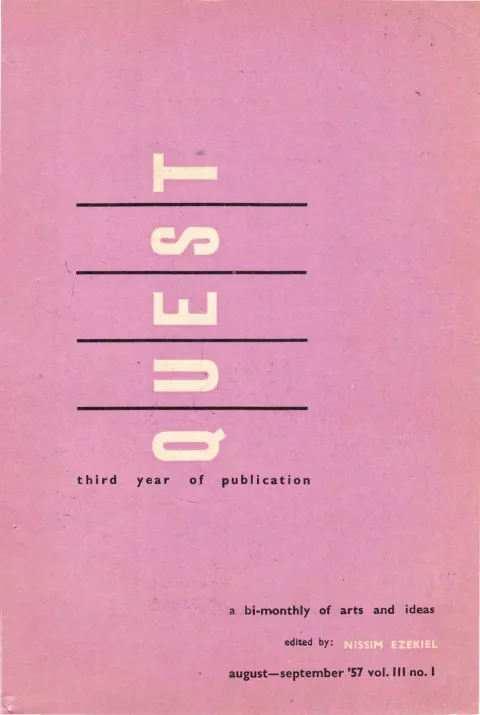
Quest
Summary
Quest Vol. III No. 1 (August-September 1957), edited by Nissim Ezekiel for the Indian Committee for Cultural Freedom, is a Cold-War-aligned Bombay journal of arts, literature and ideas rather than a political-economy periodical. Its non-fiction spine runs from C. R. M. Rao’s essay on the ‘nationalisation of culture’ under Nehruvian planning, through Eliezer Livneh’s balance-sheet of postwar American aid, to R. B. Joshi’s travel piece on the ruined Peshwa capital of Bithur; it also carries unattributed pre-publication excerpts from Milovan Djilas’s The New Class. Its literary and arts content — the bulk of the issue — includes the two prize-winning stories from Quest’s short-story competition for Indian writers (S. J. Joshi’s Marathi ‘The Devil’ and M. S. Kalyanasundaram’s Tamil ‘The Message’), two A. K. Ramanujan poems, Ka Naa Subramanyam’s survey of the Tamil novel, reviews of Bengali theatre and of Soviet and Films Division cinema, and ten book reviews covering subjects from V. P. Menon’s account of the transfer of power to Jacques Maritain’s philosophy of religion and a hostile notice of Soviet propaganda fiction from Chukotka.
Five unnumbered photographic plates — none listed on the printed contents page — are tipped into the issue: a domestic photograph titled ‘The Cradle (Ahmedabad)’ by R. J. Chinwalla; a tribal-folk portrait from Bastar by Shyam Manohar; two film stills illustrating the Tilak documentary review; two photographs of the Bithur memorial and Aurangzeb’s mosque illustrating the Bithur travel piece; and a standalone photo-essay on the fort of Jaisalmer by Dhruva N. Chaudhuri. These plates, plus the Djilas excerpt and the short-story-competition verdict note, are the issue’s substantive unlisted content.
Essays
Nationalisation of Culture
By C. R. M. RAO
C. R. M. Rao argues that the classical-liberal doctrine of minimal government has, within a generation, given way in Indian political thought to an all-encompassing Welfare State ideal, and that even culture — ‘least amenable to planned reform’ — has now become state business and thereby the handmaid of politics. He surveys the post-Independence ‘glut’ of state-sponsored cultural activity (mushairas, exhibitions, National Laboratories, film awards) and argues this quantity masks an intellectual vacuum rather than a genuine renaissance, since neither literature, drama nor science shows a corresponding rise in creative or critical quality. He traces the deeper cause to a confusion of incompatible national ideals pursued simultaneously (democracy and the Welfare State, individual freedom and the Socialist Pattern, non-violence and armed pride, centralised planning and village self-sufficiency), compounded by a nationalised, utilitarian education system. He closes by warning that the fusion of a permanently-ruling party with an ever-expanding state, executed partly through cultural patronage, points not to a Welfare State or a Socialist Pattern but to a ‘Total State’ and indefinite one-party rule.
- Argues the Welfare State ideal has displaced classical liberal minimal government as India’s reigning political idealism.
- Diagnoses a state-driven ‘glut’ of cultural activity (exhibitions, mushairas, film awards, National Laboratories) as quantity without a corresponding rise in creative quality.
- Identifies simultaneously pursued but incompatible national ideals (democracy/Welfare State, individual freedom/Socialist Pattern, non-violence/armed strength).
- Criticizes state nationalisation of textbooks and the frankly utilitarian aims stated in the Second Five Year Plan’s education chapter.
- Warns that state control of culture, layered on economic centralisation and single-party dominance, risks producing a ‘Total State’ rather than a Welfare State.
”Imperialist” Philanthropy
By ELIEZER LIVNEH
Eliezer Livneh draws a tentative ‘balance sheet’ of roughly a decade of American-led foreign aid (UNRRA, the Marshall Plan, Point Four) to some thirty-five countries. He credits the aid with successfully immunising recipient states against Communism or economic collapse in the immediate postwar reconstruction period, noting that former enemies Japan, Germany and Italy became its chief beneficiaries and that even Yugoslavia’s independence from Moscow depended on it. But he argues the calculus changes once aid continues flowing into an already-normal economy: using Greece and Turkey as case studies, he shows how uninterrupted, non-commercial aid inflates bureaucracies, subsidises uncompetitive industry, and feeds chronic inflation, becoming a ‘refined sweet poison’ that erodes national self-reliance rather than a straightforward blessing. He predicts that as Cold War tensions ease, ‘imperialist philanthropy’ will give way to ordinary international investment and trade on a more businesslike footing.
- Estimates total postwar US-led foreign aid at close to 100 million dollars over roughly a decade (the text’s own figure, likely an underestimate of the true billions).
- Argues aid was decisive in anti-Communist reconstruction in Europe and Asia, citing Japan, Germany, Italy and Yugoslavia.
- Distinguishes ‘rebuilding after the war’ aid (broadly beneficial) from continued aid to already-normal economies (Greece, Turkey), which bred bureaucratic bloat and uncompetitive industry.
- Argues continuous non-business assistance is psychologically corrosive: it breeds ingratitude in recipients and ‘rottenness in the leading classes.’
- Predicts a shift from philanthropic aid toward ordinary international trade and investment as Cold War tensions relax.
The Tamil Novel
By KA NAA SUBRAMANYAM
Ka Naa Subramanyam surveys roughly eighty years of the Tamil novel, from Vedanayakam Pillai’s pioneering Prathapa Mudaliar (c.1877) through the ‘serious’ school of Rajam Iyer (Kamalambal Charithram) and A. Madhaviah (Padmavathy Charithram), whom he ranks alongside Flaubert and Turgenev, to the melodrama-driven mass tradition founded by Ponnusamy Pillai (modelled on G. W. M. Reynolds) and refined by prolific adapters like Vaduvoor Duraisamy Iyengar and, above all, the journalist-novelist R. Krishnamurthy (‘Kalki’), whose serialised historical romances set the template most working Tamil novelists still follow. He also surveys a ‘purposive’ school (Mu Varadarajanar and followers) and a small surviving line of serious writers, including his own novels and Janakiraman’s then-unpublished Moha Mul. His diagnosis is a ‘stalemate’: the reading public and the magazines that supply it reward melodrama and communal fiction, serious fiction finds little institutional support (no literary trusts, weak little-magazine culture, few sympathetic publishers), and ‘it will be the lot of the serious novelist in Tamil to flounder as best he can for some more time.’
- Traces the Tamil novel from Vedanayakam Pillai’s 1870s Prathapa Mudaliar through the ‘serious’ novelists Rajam Iyer and Madhaviah of the 1890s.
- Identifies Ponnusamy Pillai (modelled on G. W. M. Reynolds) as founder of a still-dominant melodramatic tradition.
- Credits/blames Kalki (R. Krishnamurthy) as the most influential and widely imitated modern Tamil novelist, prizing plot mechanics over depth.
- Surveys a ‘purposive’/communal school (Mu Varadarajanar and followers) alongside a small surviving group of serious writers.
- Concludes that magazine economics and weak institutional support (no trusts, few little magazines, unsympathetic publishers) leave serious Tamil fiction in a stalemate.
A Day in Bithur
By R. B. JOSHI
R. B. Joshi recounts a day-trip by public bus from Kanpur to Bithur on 11 May 1957, the day after the centenary unveiling of a bust to Peshwa Nanasaheb, opening with a comic account of the overcrowded bus (which at one point also carries two handcuffed ‘dacoits’ and a portly police Darogha Saheb on its roof). In Bithur a Maharashtrian Brahmin priest guides him through the razed grounds of the Peshwa’s palace — reduced to a well and rubble by the British after 1857 — to the misspelled memorial bust (‘Dhu Dhu Pant’ for ‘Dhondo Pant’), to Aurangzeb’s mosque (said to mark the spot where Lakshman left Sita), and finally to the house of Tatya Tope’s descendants, who still keep the family’s portraits and gods. A postscript identifies Bithur/Brahmawarta as Baji Rao II’s place of retirement, Nanasaheb’s launching-point for the 1857 uprising, and, in Hindu myth, the site of Brahma’s creation and horse-sacrifice.
- Describes an overcrowded Kanpur-Bithur bus journey, including two shackled prisoners and a police officer riding on the bus roof.
- Finds the site of the Peshwa’s palace reduced entirely to rubble and a well, with only ruined dependents’ houses nearby.
- Notes the memorial bust to Nanasaheb is inscribed with the misspelling ‘Dhu Dhu Pant’ instead of his actual alias ‘Dhondo Pant.’
- Visits Aurangzeb’s mosque, said locally to mark where Lakshman left Sita, and the house of Tatya Tope’s surviving family.
- Postscript situates Bithur historically (Baji Rao II’s retirement, Nanasaheb’s 1857 revolt) and mythologically (site of Brahma’s creation).
The Devil
By S. J. JOSHI
S. J. Joshi’s Marathi prize story (translated by Mangesh Padki) follows a Bombay chawl-dwelling office clerk and his wife who take in the narrator’s friend Ram after Ram is retrenched, first advising him to send his wife and child to her father’s while he alone lodges with them and job-hunts. As weeks of fruitless searching pass, Ram sinks into a mute, immobile, ravenously hungry passivity that the narrator’s wife likens to the mythical demon of Marathi folklore who must be endlessly fed; the couple’s sympathy curdles into disgust and secret cruelty (denying him a second cup of tea, mocking him behind his back) even as they cannot bring themselves to ask him to leave. One night they catch him furtively pilfering cigarettes and biscuits; by the next morning he has vanished with his belongings, and the narrator is left with sad recognition that ‘the devil has departed… to become a human being.’
- A retrenched clerk, Ram, is taken in by the narrator and his wife after losing his job.
- Ram’s prolonged unemployment turns him into a silent, passive, voraciously hungry presence the wife compares to a folkloric demon.
- The couple’s hospitality curdles into resentment, secret cruelty, and eventual estrangement from their guest.
- Ram is caught secretly taking cigarettes and biscuits at night, underscoring his reduced, furtive state.
- Ram disappears overnight with his belongings; the narrator reflects that ‘the devil’ in him has departed to let him become human again.
The Message
By M. S. KALYANASUNDARAM
M. S. Kalyanasundaram’s Tamil prize story (translated by the author) follows Mohan Chetty, a South Indian government telegraphist whose hoped-for transfer home to Tamil Nadu is instead a posting to remote Bannu on the North-West Frontier. Furious and homesick, he almost resigns rather than go, but is talked out of it by his wife Veda Valli’s patient invocation of duty and the saint Avvaiyar. In Bannu his misery deepens until, asked by a poor Pathan woman to draft a difficult telegram home — a message urging her sons to bear the pain of separation because their earnings are lifting the family and village out of poverty — Chetty is transformed by the act of composing her words. He writes home in a new spirit of acceptance, quoting Avvaiyar on braving ‘tumultuous oceans’ for one’s family, leaving Veda Valli moved to grateful tears and prayer.
- Telegraphist Mohan Chetty is devastated to be posted to Bannu on the North-West Frontier instead of home to Tamil Nadu.
- His wife Veda Valli persuades him, through patient appeals to duty and tradition, not to resign his General Service post.
- A poor Pathan woman asks Chetty to draft a telegram to her migrant sons, urging patience despite the pain of separation.
- Composing her message — which mirrors his own situation — transforms Chetty’s outlook on his own exile.
- Chetty writes home embracing his posting, quoting the Tamil saint Avvaiyar, and his wife is moved to tears of relief.
No Dream, No Symbol
By A. K. RAMANUJAN
A short poem that catalogues nightmares and dreams drawn from literature and myth — Dostoevsky’s flogged-horse dream, Caesar bathed in Caesar’s blood, a girl’s nightmare of her father’s severed head — before turning to the speaker’s own recurring vision of ‘drowning softly’ in the world’s flesh, insisting that unlike the literary dreams it lists, his own vision is ‘no dream, no symbol / but truth the ultimate nightmare.’
- Catalogues literary and mythic dreams and nightmares (Dostoevsky, Caesar/Calpurnia, an unnamed girl’s nightmare).
- Turns from these borrowed images to the speaker’s own recurring dream of drowning in ‘the beating world.’
- Insists the speaker’s own vision is not symbolic or literary but literal ‘truth’ and ‘the ultimate nightmare.‘
Madura: two movements
By A. K. RAMANUJAN
A short two-part poem set in Madurai: the first movement observes the ‘clench of a leper’s crab-like claw,’ moving as ‘nothing in life can move’; the second turns to a temple dancer carved in stone, whose frozen gesture is described, in mirrored language, as moving precisely because it is unmoving.
- First movement: a leper’s diseased hand described in the corrosive imagery of disease.
- Second movement: a temple dancer-statuette caught mid-gesture in stone.
- Both movements are built on the paradox of motion within stillness, using near-identical closing lines.
Stagnation in the Bengali Theatre
By P. C.
A survey of Calcutta’s professional Bengali stage arguing it has declined from the era of great character-actors (Sisir Bhaduri, Ahindra Chowdhury) into formulaic novel-adaptations padded with melodrama and misplaced song-and-dance, illustrated at length by a dissection of Tara Shankar Banerji’s Arogya Niketan. The one bright exception is the amateur troupe Bohurupee under Shambu Mitra, whose disciplined productions of Tagore’s Raktakarobi and Dak Ghar are praised as artistic achievements of the highest order — though even Mitra’s work meets with Bengali intellectuals’ ‘reserve,’ and the professional stage remains hostage to the same commercial values, and recycled talent, as the Bengali film industry.
- Argues the Calcutta professional stage has declined from great character-actors to formula melodrama.
- Dissects Tara Shankar Banerji’s novel-adaptation Arogya Niketan as typical of the confusion of ideas and lack of dramatic economy on the professional stage.
- Singles out the amateur troupe Bohurupee, led by Shambu Mitra, for disciplined, powerful productions of Tagore’s Raktakarobi and Dak Ghar.
- Notes Bengali intellectuals treat even Mitra’s acclaimed productions with reserve, calling his interpretation of Tagore ‘heretical.’
- Attributes the professional stage’s stagnation partly to its capture by film-industry personnel and economics.
Tilak-A film biography
By NISSIM EZEKIEL
Nissim Ezekiel reviews Vishram Bedekar’s forty-minute Films Division documentary on Bal Gangadhar Tilak as ‘honest, simple and mediocre’ — competent enough to avoid the outright fraudulence of typical official documentaries, but banal in showing Tilak only as the conventional virtuous nationalist without artistic interrogation of contradiction. He faults Bedekar’s own defensive framing of Tilak as an ‘elemental force’ like nature as false poetry masking an intellectual failure to grapple with genuinely conflicting historical interpretations, and criticizes the film’s visual poverty: no memorable image, over-literal illustration of the narration (flames filling the screen exactly when the commentator says the country was ‘ablaze’), and an actor used inconsistently to portray Tilak. He closes with a dig at Vasant Desai’s ‘carefully conventional’ score.
- Judges the Films Division’s Tilak documentary competent but banal: ‘not incompetent, not meretricious, not vulgar’ yet without artistic depth.
- Faults director Vishram Bedekar’s own press-release rhetoric describing Tilak as an ‘elemental force’ as evasive false poetry.
- Criticizes the film’s total lack of visual style and its over-literal pairing of commentary and image (flames on screen for ‘ablaze’).
- Notes an actor is used inconsistently to depict Tilak, undermining visual coherence.
- Closes by criticizing Vasant Desai’s musical score as ‘carefully conventional.‘
The Soviet Othello
By D. G. NADKARNI
D. G. Nadkarni compares Sergei Youtkevich’s Soviet colour Othello with Orson Welles’ earlier black-and-white version, judging Youtkevich’s the more successful and coherent film. He praises its clarifying opening (told through Desdemona’s view of Othello’s exploits), its inventive visual symbolism (Iago glimpsed in a sword’s reflection; ruined pillars, fishing nets and a wandering lamb used to evoke tragic atmosphere), and a virile, convincing Emilia, in contrast to Welles’ more erratic, expressionistic ‘camera-eye’ style. He concludes that Bondarchuk’s Othello achieves genuine tragic stature and that Youtkevich’s stylistic consistency — even if his inspiration is ‘more Lamb than Shakespeare’ — surpasses the more subjective Welles.
- Compares Youtkevich’s Soviet colour Othello favourably against Orson Welles’ earlier black-and-white version.
- Praises Youtkevich’s clarifying narrative device of opening through Desdemona’s perspective on Othello’s exploits.
- Highlights inventive visual symbolism: Iago seen in a sword’s reflection, ruined pillars and fishing nets, a wandering lamb.
- Finds the Soviet Emilia (contrasted with Welles’ Fay Compton) more virile and convincing.
- Judges Bondarchuk’s final performance as achieving real tragic stature, giving the Soviet film the edge over Welles’.
The Transfer of Power in India by V. P. Menon
By S. NATARAJAN
S. Natarajan reviews V. P. Menon’s The Transfer of Power in India as a mainly factual record that withholds key documents — notably the original Mountbatten partition plan and the British Cabinet’s amendments to it — leaving readers unable to judge the alternatives for themselves. He argues Menon, absorbed in official adjustments, fails to connect the transfer of power to the deeper trend of linguistic nationalism, which the reviewer considers the real threat to Indian unity (more than provincial autonomy ever was). He traces a ‘Dutch auction’ of ever-worsening constitutional offers (Simon Commission, Round Table Conference, Cripps, Cabinet Mission, Mountbatten) and criticizes Menon’s uncritical admiration for the British-brokered partition, arguing the settlement merely deferred communal violence rather than resolving it, with troubling parallels to India’s later dealings with the United States.
- Faults Menon’s book for withholding key documents (the original Mountbatten plan and Cabinet’s changes to it) rather than letting readers judge for themselves.
- Argues Menon neglects the role of linguistic nationalism, which the reviewer sees as the deeper threat to Indian unity.
- Describes a ‘Dutch auction’ of progressively worse constitutional offers culminating in partition.
- Criticizes Menon’s uncritical admiration for the British settlement, given continuing India-Pakistan violence.
- Draws a parallel between Congress’s earlier dealings with Britain and independent India’s later dealings with the United States.
The Ninth Year of Freedom
By H. SOMJEE
H. Somjee reviews the Indian National Congress’s annual The Ninth Year of Freedom, 1956 as a dry catalogue of government achievement, useful mainly as a reference compendium of Union and State activity and statistics but hobbled by its refusal to evaluate what it reports, particularly on Foreign Affairs, Education and States Reorganisation. He argues a serious history of the ruling party’s record requires three distinct tasks — stating its objectives, assessing achievement against them, and analysing impact on people and rival parties — none of which this exercise in ‘mere reporting’ attempts, regardless of unavoidable party bias.
- Reviews the Congress party’s annual The Ninth Year of Freedom, 1956 as informative but purely descriptive, not evaluative.
- Argues the ninth year of freedom is historically significant for major economic-policy decisions (heavy industry investment, progressive taxation, community projects) rather than immediate achievements.
- Faults the book’s silence on evaluation especially in Foreign Affairs, Education and States Reorganisation chapters.
- Outlines a three-part task — objectives, achievement-assessment, impact-analysis — that a genuine history of the ruling party would require.
- Notes such analysis is left undone by ‘an overburdened Prime Minister and an equally preoccupied president of the party.‘
India, Democracy and Education by Jossleyn Hennessy
By N. L. K.
N. L. K. reviews Jossleyn Hennessy’s India, Democracy and Education, a study built around fieldwork at the Birla Education Trust’s Pilani campus, prefaced by Dr. Radhakrishnan. The reviewer approves Hennessy’s practical prescriptions for good schooling — small teacher-student ratios, boarding-community life, well-equipped campuses, room for independent thought — but rejects the book’s central thesis that democracy has flourished chiefly where peoples inherited Protestant Christian tradition and that such tradition is ‘alien to India,’ calling this philosophically shallow given, for instance, the rise of National Socialism in a Christian Germany and the living Indian institution of the panchayat.
- Reviews Jossleyn Hennessy’s India, Democracy and Education, based on fieldwork at the Birla Education Trust’s Pilani campus.
- Approves the book’s practical educational prescriptions: low teacher-student ratios, boarding-community schooling, well-equipped campuses.
- Rejects Hennessy’s thesis that democracy depends on inherited Protestant-Christian tradition, calling it ‘flimsy.’
- Counters with the example of National Socialism’s rise in Christian Germany and India’s own panchayat tradition.
- Cites Pilani statistics: 6,238 students in 1952 across the Trust’s institutions, 65% fee-funded, 35% Trust-funded.
Approaches to God by Jacques Maritain
By SANTOSH SEN GUPTA
Santosh Sen Gupta gives a close philosophical account of Jacques Maritain’s Approaches to God, summarising Maritain’s ‘sixth way’ argument (from the self’s simultaneous temporal and eternal self-awareness in thought to the necessity of an eternal thinking self, God), his restatement of St. Thomas’s five proofs, his treatment of artistic and moral experience as further paths to God, and his concluding ‘qualified agnosticism’ — that God’s essence, though naturally desired, is knowable only by an act of grace. The reviewer judges it an able exposition but faults Maritain for never logically establishing the nature of God prior to arguing his existence, leaving the book’s ‘natural knowledge’ of God weaker in certitude than ordinary self-knowledge, evident (if at all) only in mystical experience.
- Summarises Maritain’s distinction between the ‘way of proof’ and the ‘way of experience’ (mysticism) as paths to knowing God.
- Explains Maritain’s original ‘sixth way’: the eternal thinking self implied by acts of thought points to God.
- Covers Maritain’s account of artistic experience (beauty as a ‘mirror of God’) and moral experience (right choice implying an objective good, i.e. God).
- Notes Maritain’s concluding position of ‘qualified agnosticism’: God’s essence is knowable only by grace, not by human faculties.
- Faults the book for not first logically determining the nature of God before arguing for his existence.
Work and its Discontents by Daniel Bell
By A. D. GORWALA
A. D. Gorwala praises Daniel Bell’s Work and its Discontents as a clear, engaging short study of alienation in factory work, noting Bell’s prediction that automation will soon make the factory worker himself unnecessary, without offering an answer to what will then occupy human life. Gorwala contrasts the West’s coming ‘release’ from joyless labour with conditions in ‘the darker East,’ where religion (quoting Luther on the housemaid, and comparing it to Hindu teaching on duty) may make monotonous work more bearable, and recommends the book to management, labour, civil servants and social scientists alike.
- Praises Daniel Bell’s Work and its Discontents as clear, well-written, and stimulating.
- Summarises Bell’s prediction that automation will soon eliminate the necessity of the factory worker himself.
- Contrasts the West’s coming ‘release’ from joyless labour with the continuing necessity of monotonous work in ‘underdeveloped lands.’
- Notes religion (Luther’s dictum on the housemaid; Hindu teaching on duty/karma yoga) may make such work more tolerable in India.
- Recommends the book to management, labour, civil servants and social scientists alike.
Atomic Weapons and East-West Relations by P.M.S. Blackett
By P. C.
P. C. reviews P. M. S. Blackett’s Atomic Weapons and East-West Relations, endorsing its core argument that the efficiency of attack and retaliation has reached saturation point, making a further technological arms race pointless — the real need being dispersal and concealment, not better weapons. The reviewer disputes Blackett’s claim that Soviet nuclear parity, rather than politics, caused the post-Stalin thaw, but agrees the West should declare an economically and politically sustainable policy of ‘graduated deterrence’ rather than continuing to over-invest in superweapons at the expense of resources needed for aid to Asia.
- Endorses Blackett’s central claim that the ‘efficiency of means of attack and retaliation’ has reached saturation, making further weapons races pointless.
- Argues the real strategic need is better concealment (‘places to hide’) rather than better weapons.
- Disputes Blackett’s causal claim that Soviet nuclear parity, not politics, produced the post-Stalin relaxation.
- Warns the West’s declaratory ‘massive retaliation’ policy is dangerously disconnected from its actual, modest defence spending.
- Endorses Blackett’s proposed shift to a sustainable policy of ‘graduated deterrence,’ preserving resources for aid to Asia.
The Sound of the Waves by Yukio Mishima
By IQBAL LUKMANI
Iqbal Lukmani frames the growing popularity of Japanese fiction in translation as a welcome escape from Western modernism’s psychological ‘wall of incommunicability,’ and reviews Yukio Mishima’s The Sound of the Waves, a simple love story set in a Japanese fishing village, as a successful example — comparing its unaffected, goodness-centred simplicity to Somerset Maugham’s short story ‘Salvatore’ and praising Mishima’s ability to hold the reader’s attention for nearly two hundred pages without recourse to modernist complexity.
- Frames Japanese fiction in translation as a refreshing alternative to Western modernism’s complexity and ‘wall of incommunicability.’
- Reviews Mishima’s The Sound of the Waves as a simple, effective fishing-village love story.
- Compares the novel’s unaffected ‘goodness’ to Somerset Maugham’s short story ‘Salvatore.’
- Praises Mishima for sustaining narrative interest for nearly 200 pages through simplicity rather than complexity.
The Story Bag by Kim So-Un
By A. A.
A. A. reviews Kim So-Un’s The Story Bag, a collection of Korean folktales, praising the universal charm of folklore and noting that one tale, ‘The Magic Gem,’ closely resembles the Kashmiri ‘Charmed Ring’ story, suggesting the tale-type travelled east from India (though, curiously, never reached Japan). The review commends Setsu Higashi’s translation and the book’s production quality as a model Indian publishers should emulate.
- Reviews Kim So-Un’s The Story Bag, a Korean folktale collection translated by Setsu Higashi.
- Highlights the opening tale’s moral that stories must be shared, not hoarded.
- Identifies ‘The Magic Gem’ as a variant of the Indian/Kashmiri ‘Charmed Ring’ tale, suggesting the tale-type’s diffusion from India.
- Notes this form of folk tale, though widespread across South and East Asia, does not appear in Japan.
- Praises the translation and production quality as exemplary for Indian publishers.
Stories from Chukotka by Ritkheyu
By M. K. HALDAR
M. K. Haldar delivers a sharply critical review of Ritkheyu’s Stories from Chukotka, arguing the stories are Party propaganda dressed as folklore rather than genuine literature — crude paeans to Soviet modernization of the remote Chukchi people (electrification, collectivisation, and literacy ‘brought by Lenin and Stalin’) that flatten real storytelling into an uncritical vehicle for the Party line. He quotes the book’s own claim that ‘where you find Stalin, things are on the right road’ and predicts a Stalin-purged reissue is imminent, closing that if this counts as creative literature rather than propaganda, ‘I shall eat my hat.’
- Reviews Ritkheyu’s Stories from Chukotka as Soviet propaganda disguised as folklore from the remote Chukchi people.
- Notes the stories celebrate Soviet modernization: wind generators, collective farms, and literacy campaigns credited to Lenin and Stalin.
- Quotes the book’s assertion that Stalin’s guidance always eventually ‘comes right,’ predicting a future edition will remove Stalin’s name.
- Argues even ‘private love affairs’ in the stories are subordinated to Soviet propagandistic purpose.
- Concludes the book is an account of Party achievements masquerading as creative literature.
In the Shadow of the Kremlin by Satya Dev Sharma
By B. A. OLKAR
B. A. Olkar dismisses Satya Dev Sharma’s In the Shadow of the Kremlin, a travelogue of a short Soviet visit originally published as magazine articles and apparently reissued without revision, as neither a readable travel narrative nor a serious analysis of Soviet Russia. He catches the author in self-contradiction over whether ordinary Russians can travel freely with an internal passport, and disputes the claim that Radio Moscow offers little beyond ‘harangues,’ concluding the book is dull, ineffective, and ‘not even a promising book.’
- Reviews Satya Dev Sharma’s In the Shadow of the Kremlin, based on unrevised 1955 magazine articles.
- Identifies an internal contradiction about whether Soviet internal passports restrict or merely regulate citizens’ travel.
- Disputes the author’s claim that Radio Moscow broadcasts little beyond ‘harangues.’
- Judges the prose dull and the choice of incidents ineffective for either travelogue or analysis.
- Concludes it is ‘not even a promising book.‘
Essay 22
Unattributed pre-publication excerpts from Milovan Djilas’s forthcoming book The New Class (Praeger, 12 August), not listed in the printed contents. The excerpts argue Communist revolutions, though failing every one of their own stated ideals, succeeded in creating a new privileged ruling ‘class’ of party officials whose control of property is disguised as ‘Socialist’ or ‘state’ ownership; the excerpt traces this class from Lenin and Stalin through the ‘mediocrity’ of Khrushchev’s collective leadership, and predicts its internal contradiction — proclaiming the abolition of class differences while continually increasing them — will leave it judged by history as at once a ‘grandiose’ achievement and a ‘shameful’ method.
- Unlisted excerpts from Milovan Djilas’s forthcoming The New Class (Praeger, 1957).
- Argues Communist revolutions failed their own ideals but created a new privileged ruling class disguising ownership as ‘Socialist’ or ‘state’ property.
- Traces the new class from Lenin/Stalin to the ‘mediocrity’ of Khrushchev’s post-Stalin collective leadership.
- Predicts the class’s core contradiction — claiming to abolish class differences while increasing them — will remain unresolved.
- Frames Communism’s historical legacy as simultaneously ‘grandiose’ in ambition and ‘shameful’ in method.
Essay 23
An unlisted editorial note reporting the results of Quest’s short-story competition for Indian writers, co-sponsored with the Congress for Cultural Freedom: ninety stories were submitted, translated from nine languages (chiefly Marathi, with substantial entries from Hindi, Tamil and Kannada); the judges unanimously awarded first prize to S. J. Joshi’s ‘The Devil’ and, by a majority, second prize to M. S. Kalyanasundaram’s ‘The Message,’ while candidly noting that many entries lost effectiveness in English translation.
- Ninety stories, translated from nine languages, were submitted to Quest’s short-story competition, co-sponsored with the Congress for Cultural Freedom.
- Marathi supplied the largest number of entries, with substantial numbers from Hindi, Tamil and Kannada.
- Judges unanimously chose S. J. Joshi’s ‘The Devil’ for first prize.
- Second prize went, by majority vote, to M. S. Kalyanasundaram’s ‘The Message’; one judge favoured splitting the prize three ways.
- The note candidly states that poetic or subtle stories fared poorly in translation and did not reach final consideration.
Essay 24
An unnumbered, uncaptioned-beyond-title full-page photograph, ‘The Cradle (Ahmedabad),’ credited to R. J. Chinwalla, not listed in the printed contents. It shows two women and a young girl at an Ahmedabad household tending an infant asleep in a swung cloth cradle — straightforward documentary genre photography with no accompanying text.
- An unlisted full-page photographic plate titled ‘The Cradle (Ahmedabad),’ credited to photographer R. J. Chinwalla.
- Depicts a domestic scene of women and a girl tending an infant in a swung-cloth cradle.
- Carries no accompanying text beyond its title and photo credit.
Essay 25
An unnumbered full-page photograph, ‘Maria Tribal Folk of Bastar, Madhya Pradesh,’ credited to Shyam Manohar and captioned ‘Courtesy, The Tribal Research Institute,’ not listed in the printed contents. It shows a Maria tribal man in ornamental beaded necklaces and a turban flanked by two young women in white wraps.
- An unlisted full-page photographic plate titled ‘Maria Tribal Folk of Bastar, Madhya Pradesh,’ credited to photographer Shyam Manohar.
- Sourced via ‘Courtesy, The Tribal Research Institute.’
- Depicts a Maria tribal man and two young women in traditional dress and ornamentation.
Essay 26
An unnumbered plate of two film stills from Vishram Bedekar’s Films Division documentary on Lokamanya Tilak (reviewed at toc_index 10), explicitly captioned as illustrating that review. The upper still shows Tilak reading in the Central Jail, Mandalay, Burma; the lower shows a reconstructed street-scene in Poona during the 1897 plague.
- An unlisted plate of two film stills, explicitly cross-referenced to the Tilak film review on printed page 45.
- Upper still: Tilak reading in the Central Jail, Mandalay, Burma.
- Lower still: a reconstructed street-scene in Poona during the 1897 plague.
Essay 27
An unnumbered plate of two uncredited photographs illustrating R. B. Joshi’s Bithur travelogue (toc_index 4): the memorial bust to Peshwa Nanasaheb at Bithur (with its Devanagari-inscribed base, visible in the image), and Aurangzeb’s mosque at Bithur.
- An unlisted plate of two photographs, uncredited to any photographer, illustrating the Bithur travelogue.
- First photograph: the memorial bust to Peshwa Nanasaheb at Bithur, with a Devanagari inscription on its base.
- Second photograph: Aurangzeb’s mosque at Bithur, described in the accompanying article as built where Lakshman left Sita.
Essay 28
An unnumbered, standalone photo-essay by Dhruva N. Chaudhuri on the fort of Jaisalmer in the Thar Desert, Rajasthan, not connected to any article in the issue and not listed in the printed contents. It documents the hilltop fort (founded, the caption notes, by the Bhatti king Jaisal in 1156) and a city gate through which women pass to fetch water, with the caption noting the city’s population had dwindled to about 8,000 and lacked a regular water supply.
- An unlisted standalone photo-essay on Jaisalmer Fort, credited to photographer Dhruva N. Chaudhuri.
- Captions date the fort’s founding to 1156 by the Bhatti king Jaisal.
- A second photograph shows a city gate with women fetching water.
- The caption reports the city’s population had dwindled to about 8,000 with no regular water supply.
- Unrelated to any other article or theme in the issue; a pure documentary/travel photo-essay.
Generated by the v1.5 extraction pipeline. Awaiting editorial review.
Metadata and summary are AI-extracted from the source PDF and reviewed for editorial accuracy. The original work is available via the Read PDF tab above (where present); paragraph-level citation inside the PDF is deferred to a future engagement.
People in this work
- C. R. M. Raoauthor
- Eliezer Livnehauthor
- Ka Naa Subramanyamauthor
- R. B. Joshiauthor
- S. J. Joshiauthor
- M. S. Kalyanasundaramauthor
- A. K. Ramanujanauthor
- Mangesh Padki
- Nissim Ezekiel
- D. G. Nadkarni
- S. Natarajan
- H. Somjee
- Santosh Sen Gupta
- A. D. Gorwala
- Iqbal Lukmani
- M. K. Haldar
- B. A. Olkar
- Nirad C. Chaudhuri
- Sudhin Datta
- Laeeq Futehally
- Sheela Singh
- R. J. Chinwalla
- Shyam Manohar
- Dhruva N. Chaudhuri
- Rabindranath Tagore
- Jawaharlal Nehru
- Bal Gangadhar Tilak
- Mahatma Gandhi
- Karl Marx