
periodical issue
Quest
A Quarterly of Inquiry, Criticism and Ideas
By C. Rajagopalachari, Michael Polanyi, Philip Spratt, Humayun Kabir, P. C. Chatterji, Gurbachan Singh Talib, M. S. Kalyanasundaram, Punya Sloka Ray, Sibnarayan Ray, Amiya Chakravarti, Evelyn Wood, Chong Mong-ju, Amaresh Datta, F. R. Stanley, Prof. Amlan Datta, Benjamin Polk, Shankar Trivedi, Herbert Luthy, Vasant Palshikar
Printed and published by Miss Sheela Singh for the Indian Committee for Cultural Freedom, Army and Navy Building, 148, Mahatma Gandhi Road, Bombay 1, at the Kanada Press, Podar Chambers, 109, Parsi Bazar Street, Fort, Bombay 1. · Bombay · 1959
118 pages
QUEST
Summary
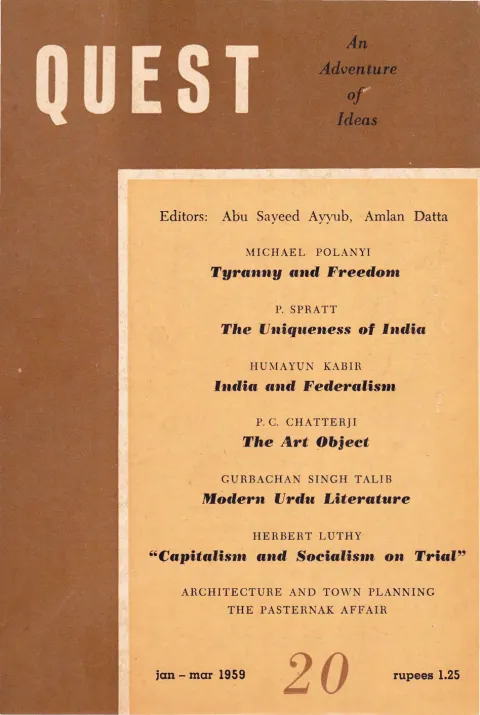
Quest No. 20 (Jan-Mar 1959) is the first issue examined in this run to appear fully under the quarterly masthead of editors Abu Sayeed Ayyub and Amlan Datta, with an advisory board of Nirad C. Chaudhuri, Sudhin Datta and Laxmanshastri Joshi. Its centre of gravity is the crisis of Cold War liberalism: Michael Polanyi’s opening essay diagnoses a ‘modern dynamism’ running from the French Revolution through Stalinism and reads the 1956 Hungarian and Polish revisionists as a reactionary return to 1848 liberal idealism, while Sibnarayan Ray’s essay on the banned Dr. Zhivago and Herbert Luthy’s long review-article dismantling Fritz Sternberg’s Marxist world history extend the same argument about the exhaustion of revolutionary dogma. A second cluster of pieces — P. Spratt’s psychoanalytic essay on Indian ‘uniqueness’, Humayun Kabir’s essay on federalism, and an anonymous (‘A. D.’) diagnosis of pro-Soviet ‘neutralism’ among Indian intellectuals — turns the same Cold War lens on India itself. A third cluster is linguistic and literary: three separate essays on Urdu, Hindi and the sociology of language, P. C. Chatterji on the ontology of the ‘art object’, poems (including Bengali, English and four classical Korean poems in translation), Benjamin Polk on architecture and town planning, and a full page of book reviews (Zhivago, Camus, Toulmin, M. R. Jaykar’s memoirs, and a Marathi short-story collection) plus a public exchange between Shankar Trivedi and C. Rajagopalachari on unilateral disarmament, and a correspondence column debating the decline of the Indian intellectual.
Essays
Tyranny and Freedom
By Michael Polanyi
Polanyi argues that the single ‘master idea’ driving twentieth-century upheaval is the doctrine of unlimited social self-determination, born in the French Revolution, which split into two streams: a revolutionary dynamism that treats law and morality as mere instruments of a single omnipotent centre of power, and a reformist/parliamentary dynamism that extends the rule of law by persuasion. He reads Stalinism as the fullest expression of the first stream, and interprets Pasternak’s ‘thaw’, Tito’s 1948 break, and the 1956 Hungarian and Polish revisionists as evidence that revolutionary dynamism in the Soviet bloc has passed its peak and is receding — a reactionary (in his own, approving, sense) return to the liberal ideals of 1848. He closes by warning against defining democracy procedurally (rule of law plus universal suffrage) without an explicit, admittedly fiduciary, commitment to specific liberal ideals, since procedure alone could as easily uphold a Spanish Inquisition or a Stalinist orthodoxy.
- Locates the source of all modern political dynamism in the French Revolution’s principle of unlimited social self-determination.
- Distinguishes revolutionary dynamism (which destroys legality and denies the reality of moral motives) from reformist/parliamentary dynamism (which extends legality by persuasion).
- Treats Stalinist tyranny as revolutionary dynamism’s most complete form, absorbing all ideals of justice into ‘the internal fuel of its political machinery’.
- Reads the 1956 Hungarian and Polish revisionists, whom he calls ‘reactionaries’, as a return to the liberal-idealist principles of 1848 against Leninist orthodoxy.
- Argues that parliamentary procedure alone cannot define or guarantee a free society; a free society requires an explicit, faith-like commitment to specific ideals of truth and human responsibility.
- Surveys newly independent states (India, Israel, Egypt, Tunisia, Lebanon) briefly, suggesting each is negotiating the same dynamism/liberty tension in its own way.
The Uniqueness of India
By P. Spratt
Spratt asks why India and Europe, despite similar ethnic origins, diverged so sharply in temperament — India more ‘religious, philosophical… introverted, restrained, pessimistic… tolerant, docile’ — and rejects Marxist unilinear explanations (Dange, Kosambi) as unable to account for difference rather than similarity between civilizations. Drawing on V. Gordon Childe, Hamdi Bey and Maine, he argues India’s key institution is caste, itself sustained by a persistently ‘mother-centred’ (as opposed to Europe’s ‘father-centred’) psychic type in the Freudian-Oedipal sense he borrows from Hamdi Bey, reinforced by yogic techniques of sublimating aggression inward rather than outward. He traces Europe’s shift toward the ‘father-centred’ type to the Roman reception of Stoic Natural Law and later to centuries of Christian sexual discipline, and closes by noting — without endorsing either side — that Gandhi, ‘the greatest leader of India out of tribalism into nationhood’, himself admired the Roman Church’s clerical celibacy.
- Frames the problem as explaining civilizational difference, not likeness, against Marxist ‘unilinear’ historiography.
- Credits Hamdi Bey’s psychoanalytic theory: Indian civilisation remains ‘mother-centred’ (weak Oedipal rebellion, tolerant, low psychic tension) while Europe became ‘father-centred’ (punitive conscience, aggressive, expansionist).
- Argues caste, not race or economic class, is the key institution explaining Indian conservatism, following A. M. Hocart against both Marxist class-theory and British race-theory readings of varna.
- Presents yoga as a technique that sublimates aggression inward (via chakra ascent to identification with the mother-goddess) rather than repressing it outward as Christianity does, reinforcing gerontocracy and mother-centred conservatism.
- Traces Europe’s father-centred turn to the Roman adoption of Stoic ‘Law of Nature’ and later to the Church’s long campaign against tribal sexual mores.
- Explicitly declines to prescribe: ‘I am not advocating Gandhian puritanism or the European example… My concern has been solely with the past and the facts.‘
India and Federalism
By Humayun Kabir
Kabir argues that federalism is not a modern expedient but a structural universal of human society, present from the family-as-primitive-state through the village panchayat, and that India in particular elevated it into ‘a philosophy of life’ — unity-in-diversity — rather than treating it, as most nations do, as a grudging necessity. He surveys the family as the original federated unit, the slow transfer of power from family to state, and the long survival of village self-government in India despite successive empires, before turning to the Government of India Act 1935 and the post-Independence debate between centralisers (citing scale economies, defence, and the risk of linguistic sub-nationalism) and decentralisers (citing India’s sheer diversity and administrative delay). His conclusion is that India’s own tradition of ‘unity in diversity’ — Hindu society’s historical ability to absorb heterogeneity without homogenising it — is itself the resource that can reconcile the rival claims of central planning and provincial autonomy.
- Claims federalism is inherent in the very concept of the State, visible even in social-contract and organic theories of sovereignty.
- Traces the shift of authority from family to State via agriculture, warfare, and growing commercial complexity.
- Argues India’s federal character survived unusually long because village panchayats retained real local sovereignty regardless of which empire or dynasty ruled at the centre.
- Reviews the failed 1935 federal scheme (diarchical, weighted toward vested interests) and explains why Congress and the Muslim League were, in retrospect, wrong to have opposed it in favour of provincial autonomy alone.
- Sets out both sides of the post-1947 centralisation/decentralisation debate (scale and defence economies vs. risk of administrative delay and linguistic sub-nationalism).
- Concludes that Hindu society’s historic capacity for ‘unity in diversity’ — not a Hegelian synthesis that erases its parts — is the distinctively Indian resource for reconciling the debate.
What is the Art Object
By P. C. Chatterji
Chatterji asks what, exactly, ‘the art object’ is — not simply the printed score, canvas, or page, since a work like Beethoven’s Violin Concerto or Keats’s ‘Ode to a Nightingale’ must be more than its physical trace. He surveys and rejects two rival theories: the ‘solipsistic’ view that each reader’s re-creation is a different, equally valid poem, and the Croce-Collingwood ‘expressionist’ view that the art object exists only in the artist’s own private act of creation and cannot survive it. Working mainly with poetry (via I. A. Richards’s four-part account of meaning — sense, feeling, tone, intention) and close readings of Gerard Manley Hopkins and Robert Browning, he argues criticism can, contrary to the solipsists, discriminate correct from incorrect readings, and that the art object is best understood as an objective ‘pattern’ or ‘configuration’ latent in the physical stimuli — discoverable, like a figure hidden in a colour-blindness test card, by a sufficiently sensitive and patient viewer.
- Opens with Beethoven’s Violin Concerto to show the art object cannot simply be identified with its physical score or performance.
- Rejects the ‘solipsistic’ view that there is no single poem, only as many poems as there are readings.
- Rejects the Croce-Collingwood view that the art object exists only inside the artist’s private, unrepeatable act of creation.
- Uses I. A. Richards’s four elements of meaning (sense, feeling, tone, intention) and close readings of Hopkins’s ‘Peace’ and Browning to show criticism can adjudicate between competing interpretations.
- Proposes his own resolution: the art object is an objective pattern latent in the physical stimuli, found rather than invented by a sufficiently sensitive and patient critic.
- Uses the analogy of an Ishihara-style colour-vision test card: only the reader with ‘correct vision’ and patience will see the true pattern rather than none or a false one.
Modern Urdu Literature
By Gurbachan Singh Talib
Talib surveys Urdu literature a decade after Partition, arguing the language was placed ‘in something like a quandary’: stripped of its dominant social position in the areas of India where it had evolved for centuries, while its main centre of continued growth — with state patronage and Iqbal’s towering legacy — shifted to Pakistan’s Punjab. He traces Urdu’s earlier history as the possession of a small, socially insulated eighteenth-century elite (producing exquisite but reality-divorced verse) and its transformation after the 1857 Revolt forced that elite into new professions and closer contact with ordinary life, yielding new realism in prose and verse. He concludes that post-Independence Indian Urdu writing, though not producing dramatically new departures in only a decade, is discarding merely ‘ephemeral or capricious’ experiments (free verse, stream-of-consciousness, faddish emphasis on sex) in favour of more mature, socially engaged realism — unhappily but not disastrously diminished, not ‘a dried up stream’.
- Argues Partition placed Urdu ‘in something like a quandary’, losing its former social and educational dominance in India.
- Notes Urdu’s centre of literary growth shifted to Pakistani Punjab, heir to Iqbal’s tradition and backed by state patronage.
- Recounts Urdu’s origin among a small, socially cloistered 18th-century North Indian Muslim elite producing finished but reality-divorced verse.
- Credits the 1857 Revolt’s aftermath with forcing this class into new professions and closer contact with ordinary life, bringing new realism into Urdu prose and verse.
- Reports that post-Independence Indian Urdu writing is shedding faddish techniques (free verse, stream-of-consciousness, sex-emphasis) for more mature social realism.
- Insists India’s contribution ‘is in no way inferior to that of Pakistan’ despite the shift of the language’s institutional centre.
Hindi
By M. S. Kalyanasundaram
Kalyanasundaram, a South Indian Hindi teacher, argues for pragmatic reform of Hindi as the proposed common official language of India, setting aside the political controversy over Southern resistance to Hindi’s imposition. He itemises what he considers genuine structural defects for a learner: unreliable and inconsistent gender assignment for inanimate/abstract nouns, an ambiguous direct/indirect-narration construction around ‘ki’, and the grammatically ‘irrational’ ergative postposition ‘ne’ in the past transitive, which he wants dropped in favour of a simpler subject-verb agreement pattern. He also proposes simplifying Hindi numerals (which invert and irregularly mutate at the tens-ones junction) and criticises Sanskrit neologisms coined by language planners (e.g., ‘yantra’ for machine) as needlessly displacing already-familiar loanwords like ‘machine’ that ordinary people already use. He closes with a slogan distinguishing Hindi-as-mother-tongue from Hindi-as-national-language: ‘Make it rational; it becomes National.’
- Deliberately brackets the North-South political controversy over Hindi imposition to focus on the language’s internal learnability.
- Identifies unpredictable grammatical gender for inanimate/abstract nouns as the first major structural defect for learners.
- Flags the ambiguous ‘ki’-clause construction (direct vs indirect speech) as a second defect, expecting English-style indirect narration to eventually prevail.
- Argues the ergative-like postposition ‘ne’ in transitive past tense is ‘not rational’ and should be dropped, citing errors even among native Hindi-speaking clerks.
- Criticises invented Sanskritic neologisms (e.g. ‘yantra’, ‘vimaan’) as displacing loanwords (machine, aeroplane) ordinary people already use, serving neither professional nor mass audiences.
- Proposes simplifying irregular Hindi numeral formation (e.g. the ‘one-short-of’ pattern for 19, 29, 39) toward a more uniform decimal pattern.
- Closes with the reformist slogan ‘Make it rational; it becomes National.‘
Language and Audience
By Punya Sloka Ray
Punya Sloka Ray argues that meaning, style and even the acceptability of a loanword are all determined not by an individual speaker but by the audience being addressed — ‘It is not Humpty Dumpty who chooses but his hearers who choose which are acceptable forms and which are not.’ He illustrates this at every level, from pronunciation (‘haspataal’ vs ‘hospital’) to register (talking to a spouse, students, or magistrates), and diagnoses writing failures as lapses in maintaining a stable, appropriate mental image of one’s audience. He then turns this audience-centred theory against India’s technical-terminology planners, arguing their invented Sanskrit-derived coinages address no real audience — neither professionals (who need internationally shared vocabulary) nor ordinary people (who already use loanwords like ‘position’ or ‘police’) — and diagnoses the whole federal-language debate as treating language as ‘a symbol of social identity… rather than… communication.’ He ends on a personal admission: as a modern Indian he is a ‘guest-member’ of English when addressing professional peers, with no fully satisfying solution to the resulting loss of spontaneity.
- States the essay’s central thesis: audience, not speaker intention, ultimately fixes linguistic meaning and acceptable form.
- Illustrates with pronunciation, vocabulary and stylistic register across multiple real-life audiences (spouse, students, colleagues).
- Diagnoses failed communication — his own example of a philosopher colleague — as a rigid failure to picture one’s actual audience while writing.
- Applies the theory critically to India’s manufactured technical vocabulary, arguing invented Sanskrit terms serve no real audience, professional or popular.
- Frames the federal-language controversy as a category error: treating language primarily as an emblem of identity and domination rather than as a tool of communication and persuasion.
- Admits his own predicament as an Indian scholar: fluent only as a ‘guest-member’ of English for professional work, with no clean solution offered.
Boris Pasternak
By Sibnarayan Ray
Sibnarayan Ray frames Boris Pasternak’s persecution as the culmination of a structural conflict, going back to Plato’s Republic, between the totalitarian order’s need to reduce citizens to ‘functional stereotypes’ and the artist’s irreducible individuality. He sketches Soviet literary history from the brief post-Revolutionary freedom, through Stalinist ‘Party-mindedness’ and Zhdanovism, the 1953-56 ‘thaw’ (Ehrenburg, Pomerantsev, the Second Writers’ Congress), and Khrushchev’s re-imposed controls from 1957, culminating in the campaign against Dr. Zhivago and Pasternak’s expulsion from the Writers’ Union. He then argues Dr. Zhivago is the only truly great work of Soviet prose fiction, not because it argues against communism polemically but because its humanism — its insistence on ‘inward reticence’, on the irreducible particular over the collective, on contemplation over pitiless certainty — is inherently unassimilable to any closed ideological system, which is precisely why the regime found it intolerable.
- Opens with Plato’s Republic as the paradigm case of the totalitarian state’s fear of the poet’s uncontrollable individuality.
- Traces Soviet literary repression from Lenin’s 1905 dictum that literature must be ‘a small cog and screw’ through Stalinist Party-mindedness to the 1953-56 thaw and its 1957 reversal under Khrushchev.
- Cites named 1954-56 Soviet dissenting voices (Olga Bergholtz, Veniamin Kaverin, Mikhail Sholokhov, Ehrenburg, Pomerantsev) as evidence of a genuine, then crushed, movement for artistic freedom.
- Argues Dr. Zhivago’s greatness lies in its combination of lyric and epic scope comparable to Stendhal, Tolstoy, Dostoevsky and Proust.
- Insists the novel is dangerous to the regime not chiefly through explicit political criticism but through its humanist spirit — valuing the ‘inward reticence’ of the individual over reified collectivity.
- Closes with Andre Chanson’s personal reminiscence of Pasternak’s character and the phrase ‘Life is more generous, all the same, and above all lighter.‘
Exchange
By Amiya Chakravarti
A short lyric of loss and consolation translated from Bengali: the speaker catalogues what has been received ‘instead of her’ — reflected light on a pond, a bough of blossoms, a cloud of violets filling ‘all your heart’ — concluding that ‘the empty heart holds all one looks upon’, and closing on an ambiguous question about whether the leaving (of the beloved, or of grief itself) was ever complete.
- A short elegiac lyric structured as a catalogue of natural images received ‘instead of’ the lost beloved.
- Turns on the paradox that an empty heart can hold everything it looks upon.
- Ends on an unresolved question about whether the act of leaving/grieving was ever finished.
Eagle Into Swan
By Evelyn Wood
A sonnet imagining an ageing eagle transformed into a swan: its powers of flight failing, it finds its only remaining triumph is ‘to be at rest, in thought’s relief’, while still regretting the ‘trackless air’ where its flight once ‘can leave no trace’.
- Sonnet using the eagle/swan transformation as a figure for ageing and diminished power.
- Locates the aged bird’s one remaining triumph in rest and contemplation rather than continued flight.
- Closes on regret for the freedom of trackless, traceless flight now lost.
Early Korean Poems
By Chong Mong-ju, etc
Four short classical Korean sijo (occasional verse), spanning the 14th to 19th centuries and translated by Peter Hyun: Chong Mong-ju’s oath of unchanging loyalty even through death and dissolution; Whang Chin-yi’s image of cutting a long winter night in two to save half for a lover; Yi Won-ik’s meditation on ties that cannot truly bind if the loved one chooses to leave; and An Min-yong’s assurance that no wintry despoiling of the plum-blossom can prevent spring’s eventual return. A brief editorial note explains the sijo form’s origins in the 12th century and its combination of Provençal-style spirit with epigrammatic wit.
- Presents four sijo (traditional Korean occasional verse) spanning roughly the 14th to 19th centuries, translated by Peter Hyun.
- Chong Mong-ju (1337-1392) vows unchanging loyalty even through repeated death.
- Whang Chin-yi (15th c.) imagines cutting a winter night in two to save time with a lover.
- Yi Won-ik (15th c.) questions whether any tie can hold if the beloved chooses to leave.
- An Min-yong (c.1850) closes on the assurance that winter’s despoiling cannot stop spring’s return.
- An editorial note situates the sijo form historically, comparing it to old Provençal verse for its wit and technical discipline.
Winter
By Amaresh Datta
A bleak free-verse poem built from a chain of harsh images of a wintry, violent world — a girl’s ‘truncated body… cold now by a railway track’, hopes that ‘bark like way-side dogs round the dustbin’ — returning three times to the refrain ‘I seek the truth’ as the only motive that survives despair, hunger, and ‘mighty wars’ that ‘convulse the sky’.
- Builds a sustained winter/violence image-chain (frost, a corpse by a railway track, barking hopes, erupting rock) to figure a bleak contemporary world.
- Repeats the refrain ‘I seek the truth’ as the poem’s only affirmative, survivable motive.
- Closes amid ‘mighty wars’ convulsing the sky, without resolving the despair the poem has built.
On a Dead Freedom-Fighter
By F. R. Stanley
An elegy for an anonymous street fighter shot dead mid-afternoon, his death framed with explicit Christ imagery (‘Christ-like his body lies, / broken between thieves’) and read as both instantly forgettable to a ‘generation in whom the old hunger… has died’ and permanently unforgivable, destined to end as ‘the martyr’s fable’ — one more cross among ten thousand crosses.
- Elegises an unnamed freedom-fighter killed by a bullet in the street, observed by passers-by moved to pity, terror, or shame.
- Uses explicit Christ/crucifixion imagery (‘broken between thieves’) to sacralise the death.
- Argues the fighter’s own generation, having lost ‘the old hunger, the old desire’, will reduce his death to a forgettable historical footnote even while it remains unforgivable.
- Ends flatly on ‘He will be dead’, refusing any redemptive uplift.
Indian Intellectuals and Communism
By A. D.
Writing under the initials ‘A. D.’, the author diagnoses the ‘average Indian intellectual’ as a ‘neutralist with a bias’ toward communism, explained by the USSR’s rapid industrialisation, dictatorship’s appeal amid social disintegration, and above all by asymmetric historical memory: direct experience of Western imperial ‘crimes’ versus no comparable direct experience of Soviet ones, so that ‘the Western powers are old convicts… while the Communist governments are considered innocent until crime is proved.’ The essay catalogues absurd equivalences intellectuals draw between Western and Soviet restrictions on dissent, then explains why, despite this bias, most Indian intellectuals stop short of communism itself: residual admiration for British justice and parliamentary rule, the deep hold of religion (which tolerates but cannot wholly assimilate to atheistic Marxism), and above all nationalism, since ‘the communist has sold his soul to Moscow’ remains a widely (if not always fairly) held belief, reinforced by the Communist Party of India’s habit of echoing Kremlin lines with a lag.
- Names the average Indian intellectual’s stance as ‘neutralist — with a bias’ toward the Soviet Union.
- Explains the bias via direct, remembered experience of Western imperialism versus no comparable experience of Soviet imperialism.
- Cites absurd equivalences drawn between Soviet and Western restrictions on free speech as a symptom of this bias.
- Identifies three countervailing forces preventing full identification with communism: residual respect for British rule of law, the resilience of religious tradition, and Indian nationalist suspicion of Moscow’s control over the CPI.
- Cites Nehru’s frequent complaint that the CPI ‘has lost the habit of independent thinking’, always trailing Kremlin policy shifts.
- Closes hoping India can find its own synthesis of reason and religion (citing Raja Rammohan Roy as a 19th-century precedent) rather than let Cold War polarisation or ‘untempered militant materialism’ decide the outcome.
Town Planning and Architecture
By Benjamin Polk
Polk argues that town planning is not ‘office work’ or ‘drawing-board thinking’ but an extension of architecture rooted in direct, embodied attention to the ‘spirit of the place’ — climate, vegetation, topography, and the small human-scale neighbourhood group. He draws on Gaston Bardet’s ‘social topography’ survey method and Patrick Geddes’s ‘conservative surgery’ (readjustment rather than wholesale rebuilding, notably applied by Geddes to Indian cities) to argue for humane, walkable, mixed-use neighbourhoods over zoned, car-centred, drawing-board master plans. Citing Eric Fromm on alienation and the Tao Te Ching on non-domineering action, he closes with a near-mystical account of architecture as discovery rather than conquest — a ‘converse with the tutelary genius of the Place’ — and warns, citing the ecological collapse of Roman-irrigated North Africa after the Vandal conquest, that mishandled man-made landscape can permanently destroy a civilization’s foundations.
- Argues true town planning has always grown from embodied, on-the-ground attention to site and ‘spirit of the place’, not from abstract drawing-board schemes.
- Cites Gaston Bardet’s ‘social topography’ survey technique and Patrick Geddes’s ‘conservative surgery’ (readjustment, not rebuilding), noting Geddes applied it to Indian cities.
- Criticises rigid zoning that separates industry from residence and cars-first planning that disintegrates the walkable medieval town pattern.
- Draws on Eric Fromm’s Man For Himself to diagnose modern alienation as loss of a sense of individual significance under mass production and mass entertainment.
- Invokes the Tao Te Ching’s non-domineering ‘Way of Heaven’ as a model for architecture that discovers rather than conquers its site.
- Warns, citing the desertification of Roman North Africa after the Vandal conquest, that man-made landscape mismanagement can permanently destroy a civilization’s material base.
Fearlessness and Civilization
By Shankar Trivedi
Trivedi respectfully but pointedly challenges C. Rajagopalachari’s earlier Quest essay on ‘Fearlessness and Civilization’, arguing Rajaji conflates two different sources of a disarmed, fearless citizenry: the rare individual sage’s total detachment from worldly goods, versus (the actual, general case) confidence inspired by an effective state monopoly on protecting property. Since no large community has ever achieved the first kind of fearlessness, Trivedi argues Rajaji’s call for India to disarm unilaterally — extending the individual-sage model to international relations, where ‘nations are still savages’ — would in practice mean ceding Kashmir, canal waters, the Bhakra Nangal dam, Calcutta’s port, and the Damodar coalfields to Pakistan (and Goa to Portugal) rather than achieving moral transformation, since groups behave by a moral code lower than their most saintly individual member, not higher.
- Distinguishes two causes of a fearless, disarmed community: individual sagely detachment from possessions versus confidence in an effective state monopoly of protective force.
- Argues only the second cause has ever actually produced a disarmed civilian population, historically or currently.
- Criticises Rajagopalachari for basing a call for national unilateral disarmament on the (never-realised) first, individual-sage model.
- Predicts that Indian unilateral disarmament would in practice mean losing Kashmir, canal waters, the Bhakra Nangal dam, Calcutta port and the Damodar coalfields to Pakistan, and parts of Bombay to Portugal.
- Argues groups behave by a moral code markedly lower, not higher, than their average or best individual member, undercutting the analogy from individual to national ethics.
Fearlessness and Civilization
By C. Rajagopalachari
Writing in poor health, Rajagopalachari declines to answer Trivedi’s critique point by point, stating that their disagreement rests on ‘a basic difference in ideology’ and referring readers instead to Pitirim Sorokin’s Reconstruction of Humanity for a fuller defence of his position. He states plainly that he believes an arms race with Pakistan would ‘ruin India and place it at the mercy of more powerful nations than Pakistan.’
- A brief published reply (not a full rebuttal) to Shankar Trivedi’s preceding critique.
- Attributes the disagreement to ‘a basic difference in ideology’ rather than engaging Trivedi’s specific arguments.
- Cites Pitirim A. Sorokin’s Reconstruction of Humanity as already containing the fuller answer to Trivedi’s position.
- Restates his central practical claim: that an Indo-Pakistani arms race would ruin India and leave it at the mercy of stronger powers.
History of the World: A Deviation?
By Herbert Luthy
Luthy’s long review-article uses Fritz Sternberg’s Capitalism and Socialism on Trial to diagnose a genre he calls ‘the history of deviations’ — both liberal (Hayek’s Road to Serfdom) and Marxist accounts that treat the actual, messy course of twentieth-century economic history as a series of departures from a theorist’s pure model, rather than revising the model. He shows Sternberg’s central claim — that German-British imperial economic rivalry caused the First World War — reproduces, almost word for word, the nationalist historiography of the Kaiser-era German school textbook Ploetz, and argues the ‘imperialist diversion’ thesis (that capitalism escaped Marx’s death sentence only by colonial expansion) is chronologically absurd, since European colonial empires long predate industrial capitalism. His sharpest point is that Lenin organised the October Revolution on the basis of a demonstrably false analysis of Western European capitalism’s fragility — meaning the century’s most consequential revolution rested on a statistical misreading, which for Luthy fatally undermines any claim that historical materialism offers reliable predictive science; Sternberg’s own book, forced by later evidence to abandon strict Marxist vocabulary when discussing post-1929 America, unintentionally demonstrates the same collapse.
- Frames Sternberg’s book, and comparable liberal works like Hayek’s Road to Serfdom, as examples of ‘history as a history of deviations’ from a theorist’s pure model rather than genuine explanation.
- Demonstrates that Sternberg’s account of German-British rivalry as the First World War’s economic cause exactly mirrors the nationalist German-school textbook Ploetz, undermining its claim to Marxist objectivity.
- Argues the ‘imperialist diversion’ thesis is chronologically incoherent: European colonial empires long predate industrial capitalism, so capitalism cannot have invented imperialism to escape its own contradictions.
- Highlights that Lenin organised the October Revolution on a factually mistaken analysis of Western European capitalism and the working class, a ‘historical error’ whose success nonetheless reshaped the twentieth century.
- Notes Sternberg’s own book is forced to abandon strict Marxist categories in analysing post-1929 America, unconsciously admitting Marxist theory’s explanatory exhaustion.
- Concludes that Marxist theory today is ‘petrified’ not from theorists’ laziness but because ‘its equipment has become utterly incapable of dealing with reality’.
Dr. Zhivago
By Nissim Ezekiel
Ezekiel opens by noting that Times of India letter-writers dismissed Dr. Zhivago as mediocre Cold War propaganda, and that no reader challenged them — itself, he says, a small moral failure. His review insists the novel ‘has the voice, the accent of greatness’ and must be judged against Tolstoy, Turgenev, Flaubert and James rather than lesser work, while candidly naming two real flaws: an over-reliance on coincidence to connect its vast cast, and an underdeveloped double identity (poet/physician) for Zhivago himself compared to Pasternak’s own poetic gift. He argues the novel is not an anti-communist tract in the manner of Koestler or Orwell but ‘a study of humanity saturated in communist attitudes and values’, whose real politics lies in its characters’ quiet, non-heroic practice of faith, charity and generosity against the ruthlessness of those who want to remake the world, and closes ranking Pasternak, alone among living Soviet writers, in the true tradition of Russian literary greatness.
- Opens by criticising the Times of India’s readers for letting two dismissive, cold-war-tinged letters about Zhivago go unchallenged.
- Insists the novel must be judged against the Western canon (Tolstoy, Turgenev, Flaubert, James), not dismissed as propaganda.
- Identifies two genuine craft flaws: excessive reliance on coincidence, and an underdeveloped dual identity for Zhivago as both poet and physician.
- Argues the novel is not anti-communist propaganda in Koestler’s or Orwell’s mode but a portrait of humanity formed within, and ultimately resistant to, communist ideology.
- Reads the novel’s real political charge as located in its characters’ quiet ‘politics of the non-political’ — faith, charity, generosity — rather than in explicit argument.
- Concludes Pasternak alone, among living Soviet writers, belongs to the true tradition of Russian literary greatness, contrasting him with the officially favoured author of The Thaw.
The Twice Born
By Pandharinath Prabhu
A review of G. Morris Carstairs’s The Twice-Born, a psychiatrist-anthropologist’s study (with a preface by Margaret Mead) of personality formation among high-caste Hindus in a Rajasthan village, based on 45 case-histories plus a contrasting sample of Bhils. The reviewer summarises Carstairs’s Freudian findings — generalised interpersonal distrust despite absolutist moral rhetoric, ambivalence toward women figured through the Mother-Goddess/witch complex, and psychoanalytic readings of goat-sacrifice as symbolic oedipal parricide — while pushing back specifically on Carstairs’s mythological accuracy (correcting his account of Durga’s name and her relationship to Siva) and criticising the book’s inconsistent transliteration of Sanskrit-derived words, even as it credits the author’s genuine sympathy and rapport with his subjects.
- Summarises the book’s method: ten months’ fieldwork in a pseudonymous Rajasthan village (‘Deoli’) plus a comparative three months among the Bhils, using 45 case-histories and projective tests (Rorschach, Raven’s, Word-Association).
- Highlights Carstairs’s finding of pervasive interpersonal distrust in the village despite official moral absolutism about non-violence, self-control and brahmacharya.
- Summarises the Freudian reading of female ambivalence via the Mother-Goddess/witch complex, and of goat-sacrifice as symbolic oedipal violence against the father.
- The reviewer directly corrects Carstairs’s Sanskrit mythology: Durga’s name derives from the demon Durga she slew, not from ‘unapproachable’, and her true consort is Siva, not the sacrificial victim.
- Criticises the book’s inconsistent transliteration of Hindustani/Sanskrit terms despite otherwise crediting the author’s sympathetic method and rapport.
- Cites, with qualified approval, an American child psychologist’s remark quoted in the book: ‘You bring up your children — we live with ours.‘
Exile and the Kingdom
By C. L. Nahal
Nahal reviews Camus’s Exile and the Kingdom, six stories he places in the tradition of French existentialist inquiry into ‘the true nature of man’s existence’ descending from Kierkegaard through Heidegger, Jaspers and Marcel to Sartre and Camus. Summarising Camus’s characteristic stance (from The Outsider onward) that traditional metaphysical consolations distract from the injustice of ‘now’, he praises the six stories — especially ‘The Growing Stone’ and the mock-heroic ‘The Artist at Work’ — as gripping, vivid, and thematically unified around ‘fearless figures who continue to face the rut of existence boldly, each one working out his individual salvation’, reading the collection’s title as meaning there is no promised kingdom, only the exile of self-searching. He closes calling it, without qualification, probably the most important work of fiction of the past year.
- Places Camus within a genealogy of existentialist thought from Kierkegaard through Heidegger, Jaspers and Marcel to Sartre.
- Summarises Camus’s recurring stance, from The Outsider onward, against metaphysical consolations that distract from confronting the injustice of the present.
- Singles out ‘The Growing Stone’ for descriptive power and ‘The Artist at Work’ as a Voltairean mock-heroic highlight of the collection.
- Reads the collection’s title symbolically: humans are all exiles, with no promised kingdom, only the task of readjusting to their surroundings.
- Contrasts French existentialist literature favourably against contemporary American, British, Italian and Soviet post-war fiction for avoiding both nihilistic despair and escapism.
- Closes with an unqualified superlative: probably the most important work of fiction of the past year.
The Uses of Argument
By S. Ookerjee
Ookerjee reviews Stephen Toulmin’s The Uses of Argument as a refreshingly ‘old-fashioned’ challenge to Symbolic Logic’s monopoly on rationality. He summarises Toulmin’s two central claims — that arguments in different fields (law, medicine, aesthetics, ethics) are irreducibly field-dependent even though certain logical ‘forces’ (like the meaning of ‘cannot’ or ‘good’) stay field-invariant, and that the analytic syllogism is a misleadingly narrow model illegitimately generalised to all reasoning — and finds the book’s account of Claim/Data/Warrant/Backing the most original chapter. Striking a notable parallel with Idealist logician Bosanquet that Toulmin himself never acknowledges, Ookerjee concludes Toulmin succeeds in showing formal logic is too narrow for practical argument-assessment, but fails to reconcile this with rival views (Russell, Ramsey, Stebbing) that logic just is formal, mathematical science — the ‘collision’ is met head-on but not resolved.
- Summarises Toulmin’s central question: how logic can remain a formal science while still applying to the critical assessment of real arguments.
- Explains the field-invariant/field-dependent distinction (e.g. the word ‘cannot’ or ‘good’ keeps a constant force across contexts while the grounds for using it vary by field).
- Highlights the Claim/Data/Warrant/Backing model of argument (from Chapter III) as the book’s most original contribution.
- Notes an unacknowledged resemblance between Toulmin’s programme for logic and the Idealist logician Bosanquet’s ‘Morphology of Knowledge’, quoting both side by side.
- Praises the book’s clear, witty prose but faults its repetitiveness.
- Concludes Toulmin wins the case that Symbolic Logic is too narrow for real argument-assessment but never actually reconciles this with the rival view that logic is properly just formal science.
The Story of My Life
By V. D. Rao
V. D. Rao reviews the first of four projected volumes of M. R. Jaykar’s memoirs, covering 1877-1922 — noting Jaykar’s youthful admiration for Maharashtrian revolutionaries (Vasudeo Balvant, Savarkar), his relationship with Gokhale, and his eventual entry into politics (delayed by his grandfather’s disapproval) under Tilak’s encouragement, alongside close later association with Gandhi. Rao praises Jaykar’s industry in undertaking a four-volume project past the age of eighty but questions whether the memoir’s narrow focus on events Jaykar personally witnessed can deliver the ‘complete history’ its scope implies, and corrects a factual lapse in the book: its unfair implication that sub-editor K. P. Khadilkar failed to take responsibility for the article that got Tilak convicted, when in fact Khadilkar himself accepted a prison sentence for a similar charge in 1928.
- Introduces Jaykar’s memoir project: four volumes, this first covering 1877-1922, undertaken past age eighty.
- Traces Jaykar’s youthful admiration for Maharashtrian revolutionaries and his relationship with Gokhale, who wanted to recruit him.
- Notes his grandfather’s disapproval delayed Jaykar’s entry into politics until Tilak drew him in via the 1918 Poona District Conference.
- Questions whether a memoir focused only on events Jaykar personally witnessed can deliver the ‘complete history of nearly 70 years’ its scope implies.
- Corrects a specific factual lapse: the book’s unfair suggestion that sub-editor K. P. Khadilkar shirked responsibility for the article that convicted Tilak, when Khadilkar in fact accepted a comparable sentence himself in 1928.
Unmarried Widow and Other Stories
By Devdatta Dabhalkar
A review of Arvind Gokhale’s Unmarried Widow and Other Short Stories, translated from Marathi by Snehprabha Pradhan, praising Gokhale as a leading figure in the recent flourishing of the Marathi short story while judging the collection unevenly: several stories (‘Geeta’, ‘The Unmarried Widow’, ‘Chengiz Khan’) are criticised for contrived reactions, formless plotting, or over-familiar tricks of the trade, but ‘Manjula’ is singled out as redeeming the whole collection, a story that can ‘stand comparison with the best in any language’ and delivers ‘the heartbreak in the heart of things.’
- Introduces Arvind Gokhale as a leading figure in the recent rapid development of the Marathi short story, translated here by Snehprabha Pradhan.
- Faults several stories for contrived character reactions, forced endings, or over-familiar plot devices (‘Geeta’, ‘Chengiz Khan’, ‘The Woman without Individuality’).
- Praises ‘Sacrilege’ and ‘Childless’ as effective despite minor flaws of tone or detail.
- Singles out ‘Manjula’ as the collection’s standout, capable of standing comparison with the best writing in any language.
- Closes on an ambivalent verdict: a page-turning collection whose easy readability is both its success and its failure, lacking uniformly the depth of its best story.
Indian Intellectuals
By Vasant Palshikar
A correspondence letter disputing an unnamed Prof. Ray’s earlier Quest piece on the ‘decline of the Indian intellectual’. Palshikar argues it is methodologically wrong to judge pre-modern Indian thinkers by Western standards of ‘intellectuality’ and ‘progress’, and that a survey of Maharashtra’s 19th-century history (Justice Ranade, Vishnushastri Chiplonkar, the Tilak-Agarkar debates) shows no such ‘estrangement’ of intellectuals from public life before roughly 1890; he locates the real cause of decline in the educated class’s later retreat into private wealth-seeking and imitation of the British rather than any authentic new culture. He specifically defends Gandhi against the charge of anti-intellectualism, arguing Gandhi’s real innovation was making self-sacrifice, not talk, central to a now mass and democratic movement, and that it was intellectuals’ own cowardice and unwillingness to sacrifice — not Gandhi, Tilak, or Vivekananda — that caused their marginalisation.
- Challenges the methodology of judging pre-modern Indian thought by imported Western standards of ‘intellectuality’ and ‘progress’.
- Cites Justice Ranade, Vishnushastri Chiplonkar and the Tilak-Agarkar debates as evidence that 19th-century Maharashtrian intellectuals were not estranged from public life.
- Locates the real cause of estrangement in the educated class’s later retreat into private wealth-seeking, cowardice, and superficial imitation of British manners — not in any authentic absorption of Western culture.
- Defends Gandhi against the charge of anti-intellectualism, crediting him with making self-sacrifice central to a newly mass, democratic movement rather than one confined to talk and petitioning.
- Argues the responsibility for the intellectuals’ decline rests on self-styled ‘intellectual leaders’ who stayed inactive, not on Vivekananda, Tilak or Gandhi.
- Defines the true intellectual by moral qualities — honesty, fearlessness, humility, selflessness — rather than academic learning or a Westernised outlook.
Generated by the v1.5 extraction pipeline. Awaiting editorial review.
Metadata and summary are AI-extracted from the source PDF and reviewed for editorial accuracy. The original work is available via the Read PDF tab above (where present); paragraph-level citation inside the PDF is deferred to a future engagement.
People in this work
- C. Rajagopalachariauthor
- Michael Polanyiauthor
- Philip Sprattauthor
- Humayun Kabirauthor
- P. C. Chatterjiauthor
- Gurbachan Singh Talibauthor
- M. S. Kalyanasundaramauthor
- Punya Sloka Rayauthor
- Sibnarayan Rayauthor
- Amiya Chakravartiauthor
- Evelyn Woodauthor
- Chong Mong-juauthor
- Amaresh Dattaauthor
- F. R. Stanleyauthor
- Prof. Amlan Dattaauthor
- Benjamin Polkauthor
- Shankar Trivediauthor
- Herbert Luthyauthor
- Vasant Palshikarauthor
- Nirad C. Chaudhuri
- Sudhin Datta
- Laxmanshastri Joshi
- A. B. Shah
- Sheela Singh
- Jeremy Nelson
- Abu Sayeed Ayyub
- Peter Hyun
- Nissim Ezekiel
- Pandharinath Prabhu
- C. L. Nahal
- S. Ookerjee
- V. D. Rao
- Devdatta Dabhalkar
- Karl Marx
- Mahatma Gandhi
- Jawaharlal Nehru
- M. N. Roy
- Friedrich Hayek
- Gopal Krishna Gokhale
- Bal Gangadhar Tilak