
periodical issue
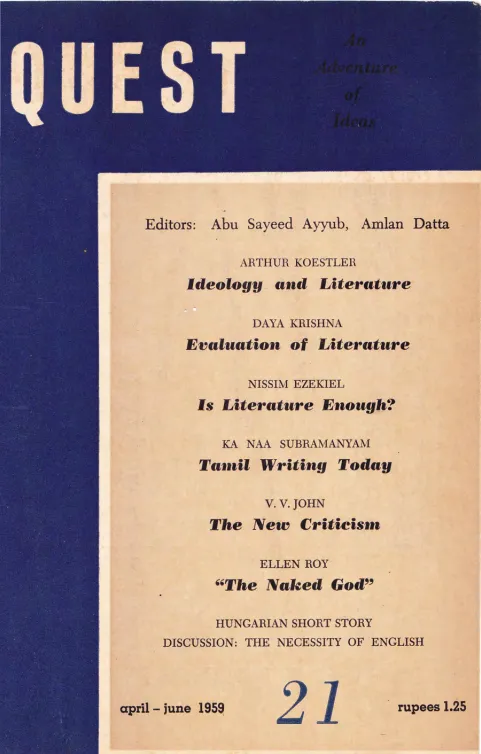
Quest
A Quarterly of Inquiry, Criticism and Ideas
By V. V. John, C. Rajagopalachari, Arthur Koestler, Daya Krishna, Nissim Ezekiel, Ka Naa Subramanyam, Paul David Devanandan, Sunanda K. Datta-Ray, David McCutchion, P. C. Chatterji, Bishnu Dey, Jagadish N. Hattangadi, R. de Loyola Furtado, Aron Tamasi, S. Kant, P. Mahadevan, A. M. Ghose, S. K. Chaubey
Printed and published by Miss Sheela Singh for the Indian Committee for Cultural Freedom, Army and Navy Building, 148, Mahatma Gandhi Road, Bombay 1, at the Kanada Press, Podar Chambers, 109, Parsi Bazar Street, Fort, Bombay 1. · Bombay · 1959
120 pages
Quest
Summary
Quest No. 21 (April-June 1959) is dominated by the aftermath of the magazine’s own Calcutta seminar on ‘Belief and Literature’ (Feb 13-15, 1959): Arthur Koestler’s inaugural address and five of the seminar papers (Daya Krishna, Nissim Ezekiel, V. V. John, Ka Naa Subramanyam, and a report of the discussion itself by D. McCutchion) argue over whether literary value can be independent of moral, philosophical or ideological considerations. Around this core sit a tribute to the recently-deceased Theosophist philosopher Bhagavan Das; a short, sharp Rajagopalachari piece proposing Gandhian ‘trusteeship’ as India’s proper ‘-ism’; a three-way reader correspondence on whether English or Hindi should carry independent India’s national life; three poems and a translated Hungarian short story; a long review-essay by Ellen Roy (M. N. Roy’s widow and co-editor of the Radical Humanist) on Howard Fast’s break with American Communism; five further book reviews (on Popper’s Poverty of Historicism, a Marathi Sarvodaya thinker, an anthology of translated Indian poetry, a Hungarian anti-Communist novel, and R. K. Narayan’s The Guide and a new Ramayana translation); and a musicological letter defending the late khayal singer Ustad Faiyaz Khan. Two unnumbered leaves of documentary photographs from the Quest seminar are the issue’s only visual matter beyond advertisements; no fine-art plate of the kind other issues carried (paintings, sculpture photo-essays, etc.) appears here.
Essays
Literature and Ideology
By Arthur Koestler
Koestler’s inaugural address to the Quest seminar argues that all literature, however ‘timeless’ it appears, embodies an implicit ideology - a ‘system of coordinates’ of value - and that the artist’s task is a tightrope walk at the intersection of the ‘vie tragique’ (the cosmic, tragic plane of experience) and the ‘vie triviale’ (ordinary daily life). He illustrates the claim with the story of Jonah and the Whale (Jonah’s sin is his contented refusal to face the tragic plane) and with Ulysses’s speech on ‘degree’ in Shakespeare’s Troilus and Cressida, which he reads as scaffolded on the Elizabethan hierarchical cosmology. He closes by diagnosing two opposite dangers for the writer - propagandistic ‘litterature engagee’ curdling into ‘litterature enragee’, and escapist retreat into an ‘ivory tower’ - and gives young writers blunt workshop advice (write for a reader a hundred years hence; practise Hemingway-style self-discipline).
- Opens with the story of RAF pilot Richard Hillary to introduce the ‘vie tragique’/‘vie triviale’ distinction.
- Defines art as perceiving trivial experience ‘sub specie eternitatis’ and reflecting the absolute in concrete images.
- Reads the Book of Jonah as an early example of implicit ideological literature.
- Analyses the ‘degree’ speech from Troilus and Cressida as resting on the Elizabethan world-picture.
- Warns that art becomes propaganda (‘litterature enragee’) on one side and empty escapism on the other.
- Closes with concrete craft advice to young writers (write for posterity; cut your ‘brilliant’ phrases; just sit down and write).
Evaluation of Creative Literature
By Daya Krishna
Daya Krishna’s seminar paper treats literature as one of the arts working through ‘the symbol’, which does not merely communicate but explores, articulates and creates significance out of lived experience via memory and imagination. He distinguishes ‘life as lived’ (the province of art and religion) from ‘life as conceptually understood’ (science and philosophy), and argues that because literature’s proper subject is inter-personal experience, moral conflict pervades it - but literature illuminates conflict rather than moralising, and is fascinated by the fall and redemption of flawed characters rather than by untempted virtue. He rejects both the ‘art for art’s sake’ claim that art has nothing to do with life, and the opposite claim that art is reducible to moral or political instruction, closing with criteria for evaluation resting on ‘intensive depth, extensive comprehensiveness, creative novelty’.
- Argues the symbol is what allows art to detach, distil and re-form significant experience, going beyond mere articulation.
- Distinguishes ‘life as lived’ (art, religion) from ‘life as understood’ (science, philosophy).
- Holds that literature centres on inter-personal moral conflict but does not moralise: ‘it only illuminates the moral conflict’.
- Argues literature is fascinated by flawed, falling characters rather than untempted saints or triumphant heroes.
- Proposes evaluative criteria of depth, comprehensiveness and creative novelty rather than technical or moral tests.
Is Literature Enough?
By Nissim Ezekiel
Ezekiel’s seminar paper opens with an anecdote: a literary friend once asked to borrow a book of ethics because, at twenty-five, he felt he needed something more ‘substantial’ than poetry, fiction and drama to believe in. Ezekiel argues in hindsight that literature does supply a ‘basic pattern of belief’ worked into sensibility and moral judgment - distinct from shifting ‘convictions and opinions’ - and that novelists are among ‘the most obstinate of moralists’. He warns against two opposite errors: treating literature as sublime moral instruction, and stripping it down to pure ‘aesthetic’ form divorced from content. Citing F. R. Leavis’s definition of ‘literary interest’ as interest in ‘man, society and civilization’, and T. S. Eliot’s remark that reading the Bible only as literature marks the end of its living influence, he concludes literature should be taken ‘as an integrated whole’, not mined selectively for beliefs.
- Frames the paper around a friend’s request to borrow C. D. Broad’s Five Types of Ethical Theory in search of something ‘substantial’ to believe in.
- Distinguishes deep, sensibility-shaping ‘belief’ from surface, fluctuating ‘convictions and opinions’.
- Argues novelists are ‘the most obstinate of moralists’ precisely because their moral knowledge is not sociological.
- Quotes F. R. Leavis’s claim that ‘a real literary interest’ has boundaries that ‘cannot be drawn’.
- Uses T. S. Eliot on the Bible to argue against reading literature merely for extractable ‘beliefs’ or pure aesthetic pleasure.
New Orthodoxy in Criticism
By V. V. John
V. V. John surveys the mid-century ‘new criticism’ associated with T. S. Eliot and F. R. Leavis, focusing first on Eliot’s own inconsistent use of his celebrated term ‘objective correlative’ - which, applied literally, would make Hamlet (which Eliot himself called ‘most certainly an artistic failure’) evidence of Shakespeare’s failure rather than success. He then surveys the ‘lemon-squeezer school’ of line-by-line exegesis (via G. S. Fraser’s volume Interpretations), giving in full Pierre Legouis’s satirical account of William Empson’s sexually-charged reading of Marvell’s ‘The Garden’, and Empson’s contested psychoanalytic (‘incest-fixation’) readings of Wordsworth and Byron, rebutted by Leavis. He also mocks quantitative ‘stylometric’ criticism (word-counting) and catalogues the New Critics’ internal heresy-hunts (‘the intentional fallacy’, ‘the affective fallacy’, ‘the ontological fallacy’), concluding that ‘the great poem still remains a miracle’ beyond full technical or historical explanation.
- Shows Eliot’s ‘objective correlative’ concept, applied consistently, would make Hamlet a proof of Shakespeare’s own artistic failure.
- Surveys the ‘lemon-squeezer school’ of exhaustive stanza-by-stanza exegesis via G. S. Fraser’s Interpretations.
- Reproduces Pierre Legouis’s satirical takedown of Empson’s sexual/psychoanalytic reading of Marvell’s ‘The Garden’.
- Notes Empson’s ‘incest-fixation’ readings of Wordsworth and Byron, and F. R. Leavis’s published rebuttal.
- Ridicules word-counting ‘stylometric’ criticism (Prof. L. A. Sherman’s 23.43-words-per-sentence ‘discovery’ about Macaulay).
- Catalogues the New Critics’ mutual heresy-hunts: the ‘intentional’, ‘affective’ and ‘ontological’ fallacies.
Tamil Writing To-day
By Ka Naa Subramanyam
Subramanyam surveys contemporary Tamil writing as caught between two forces: a purist, academic ‘Dravidianist’ strand hostile to Sanskrit influence and fixated on an idealised pre-Aryan past, and a commercially powerful periodical press (led by the weeklies of the late Kalki, and Ananda Vikatan, which has offered prizes as large as Rs 20,000 for a play) that drives popular fiction but flattens literary ambition toward escapism. Against this backdrop he identifies a handful of serious short-story writers - Ka Alagirisamy, Thi Janakiraman, La Saa Ramamritham, Naa Pichamurthy - who preserve the value of individual dignity against social and commercial pressure, and notes both the landmark (if imperfect) ten-volume Tamil Encyclopaedia and the near-total absence of little magazines or organised literary criticism in Tamil.
- Identifies purist/Dravidianist academic writing and the mass-circulation periodical press as the two dominant forces shaping modern Tamil letters.
- Cites Ananda Vikatan’s prize money (up to Rs 20,000 for a play) as symptomatic of commercial pressure on writers.
- Names four serious short-story writers (Alagirisamy, Janakiraman, Ramamritham, Pichamurthy) as preserving individual value against that pressure.
- Notes the ten-volume Tamil Encyclopaedia (Kalai-Kkalanchiyam, five volumes published) as a flawed but genuine modernising project.
- Laments the near-total absence of little magazines, organised literary criticism, or group activity in Tamil.
Religion and National Unity
By P. D. Devanandan
Devanandan, a Christian theologian, analyses religious pluralism as a structural obstacle to Indian national unity and weighs three proposed solutions: enforced Hindu religious/cultural uniformity, wholesale suppression of religion, and a genuinely Secular State, which he endorses as neither anti-religious nor syncretist but neutral toward religion while pursuing ‘this-worldly values’. He discusses communalism within Hinduism itself (the Dravida Kazhagam’s separatist claims, the mass Buddhist conversion of Adivasis under Ambedkar), floats ‘secularising’ Hindu festivals on the Christmas model into shared occasions of national feeling, and closes with concrete policy problems - religious freedom, conversion, the constitutional right to ‘propagate’ religion, and objections to compulsory common worship in Basic Schools.
- Surveys and rejects both Hindu religious uniformity and outright suppression of religion as answers to India’s disunity.
- Endorses the Secular State as neutral toward, not hostile to, religion, focused on ‘this-worldly values’.
- Cites intra-Hindu communalism (Dravida Kazhagam’s Tamil Nad demand; the Buddhist conversion movement under Ambedkar) as evidence disunity is not solely a Hindu-Muslim problem.
- Proposes ‘secularising’ Hindu festivals, on the model of a religiously-neutral Christmas, into shared occasions of national feeling.
- Closes on conversion, the constitutional right to ‘propagate’ religion, and Christian/Muslim minority objections to compulsory common worship in Basic Schools.
The Quest for an -Ism
By C. Rajagopalachari
In a brief, aphoristic piece, Rajagopalachari argues that capitalism, communism and socialism alike ‘worship the same gods’ of industrialisation and, in socialism’s and communism’s case, of state power over the individual. He proposes Gandhi’s doctrine of trusteeship - every position or piece of property held in trust for the community (traders for customers, landowners for tenants) - as India’s proper ‘-ism’, grounding it in old shastric and biblical precedent, and insists such an ethic must spread person-to-person through ‘dharma’ rather than be imposed by institutions, quoting William James on the power of ‘molecular moral forces’.
- Argues socialism shares communism’s and capitalism’s underlying idolatry of industrialisation and state power.
- Defines Gandhian trusteeship: every position and every piece of property held in trust for the wider community.
- Grounds trusteeship in old Indian shastric tradition and the biblical injunction to be merciful to one’s beasts.
- Insists the ethic must spread person-to-person (‘dharma’), quoting William James against reliance on ‘great institutions’.
The Muse of Love
By S. K. Datta-Ray
Datta-Ray’s biographical-critical essay recovers the poet ‘Laurence Hope’ - pen name of Adela Florence Nicolson, née Cory, wife of a British Indian Army general - whose sensual Orientalist verse (The Garden of Kama, Indian Love) was widely popular and, he argues, published under a masculine pseudonym partly because its frank eroticism would have scandalised Victorian readers had her authorship been known. He compares her to Kipling, Flecker and Mata Hari, praises her convincing cross-gender and cross-caste ventriloquism as a technical strength rather than a flaw, and closes by noting she died by poison two months after her husband’s death, quoting her own stoic epitaph.
- Recovers the biography of Adela Florence Nicolson (‘Laurence Hope’), army wife and Orientalist poet who died by poison in 1904.
- Argues her sensual verse was published under a male pseudonym partly to escape Victorian scandal.
- Situates her among European Orientalist writers (Edwin Arnold, Gertrude Bell) and compares her to Kipling and to Mata Hari.
- Defends her poems’ cross-gender, cross-caste ventriloquism as deliberate artistry, not a lapse.
- Closes with her fatalistic self-written epitaph.
Report on the Quest Seminar
By D. McCutchion
McCutchion’s deliberately ‘subjective’ report covers the Quest-sponsored Calcutta seminar on ‘Belief and Literature’ (Feb 13-15, 1959): Buddhadeva Bose’s welcome, Ayyub’s framing question (can literary value be independent of extra-literary values?), Koestler’s inaugural tragic/trivial-plane address, and Humayun Kabir’s extempore presidential speech. Two days of debate pit ‘configurationist’ formalists (Prabhakar Padhye on Hemingway, Sibnarayan Ray) against those insisting on philosophical or moral relevance (Ayyub, Daya Krishna), sharpened by Koestler’s blunt demand that participants vote authors (Baudelaire, de Sade, Sagan, Waugh, Pound) moral, immoral or amoral, and by Father Fallon’s confession that he loves Baudelaire but scorns ‘poor little Francoise Sagan’. The seminar closes inconclusively but, McCutchion judges, with real clarification of where the disagreements actually lie.
- Ayyub frames the seminar’s guiding question: can a novel or drama’s literary greatness be independent of all extra-literary (moral/philosophical) value?
- Koestler’s list-and-vote provocation (Baudelaire, de Sade, Celine, Sagan, Waugh, Pound) is met with ‘startled silence’.
- Daya Krishna vs Ayyub’s dispute over ‘life as lived’ versus ‘life as understood’ is identified as the seminar’s central philosophical fault-line.
- Prabhakar Padhye and Sibnarayan Ray argue for judging literature on purely formal (‘sonal’ and ‘pictorial’) grounds, citing Hemingway’s The Sun Also Rises.
- Koestler closes with concrete craft advice to young writers and a debate with the Polish writer Szimansky on literature’s social duty versus its posterity.
Bhagavan Das
By P. C. Chatterji
Chatterji’s obituary-tribute to Dr. Bhagavan Das (d. 18 September 1958, aged ninety) traces his philosophy ‘Atma-Vidya’ (Science of the Self), grounded in Theosophy under Annie Besant’s encouragement, and his major works (The Science of Peace, 1904; The Science of Social Organisation or the Laws of Manu, 1910). Its central claim is that Bhagavan Das - with characteristic modesty - was the actual, unacknowledged drafter of the 1923 ‘Outline Scheme of Swaraj’, circulated instead under C. R. Das’s signature, making him an unheralded architect of the freedom movement’s philosophical framework, a service recognised only in 1955 with the Bharat Ratna.
- Places Bhagavan Das among the first generation of Indians (with Tagore, Brojendra Nath Seal) interpreting Indian philosophy to the West.
- Traces his conversion to Theosophy under Annie Besant and his prolific output from the 1900s onward.
- Summarises his four cardinal metaphysical principles centred on the doctrine of one universal Self (‘Atma-Vidya’).
- States he was the actual, unacknowledged drafter of the 1923 Outline Scheme of Swaraj, circulated under C. R. Das’s name.
- Notes his 1955 Bharat Ratna as recognition of this philosophical service to the freedom movement.
Summer in Calcutta
By Bishnu Dey
A long free-verse poem, translated by Bishnu Dey from his own 1938 Bengali original, evoking Calcutta’s summer heat as ‘unforgiving’ - parched artificial lakes, restless traffic on Chowringhee, thinning crowds at Hogg Market - and extending the same heat and drought to rural Bengal’s burning villages, before turning on the coming of the monsoon rains as a source of renewed hope, sowing and eventual harvest.
- Opens with images of parched artificial lakes and restless motor traffic as the city suffers under summer heat.
- Extends the ‘unforgiving’ heat to rural Bengal: burning villages, dried canals, diseased streetdogs.
- Turns on the monsoon’s arrival as bringing hope, sowing and the promise of harvest.
- Closes with the speaker’s return to the ‘squalid suburbs’ singing defiance of death.
Submission
By J. N. Hattangadi
A short observational lyric: the speaker watches a young woman at a tea-stall perform stiff, self-conscious reserve - forcing a smile, walking away ‘too casually’ - and responds not with desire but with tenderness at her ‘childish maturity’, before returning to his tea.
- A sixteen-line lyric set at ‘a still stale canteen table’.
- Observes the woman’s forced smile and stiff bearing as social ‘submission’.
- The speaker’s response is described as tender amusement rather than desire.
Mrs. Graziano
By R. de Loyola Furtado
A narrative poem about Mrs. Graziano, an Italian-American mother compared to ‘a battered piano’, who waits nightly on her porch for her wayward daughter Bettina, out with ‘smart, beautiful boys’ at the rink and poolrooms. A policeman eventually arrives to report Bettina’s arrest after a fight at the skating rink; the poem closes on the mother’s unresolved, repeated vigil.
- A domestic, immigrant-genre portrait built around Mrs. Graziano’s devotion to her daughter Bettina.
- Bettina repeatedly escapes at night to rinks and poolrooms with boys.
- A policeman brings news that Bettina has been arrested after ‘an encounter’ at the skating rink.
- The poem ends on the mother’s unresolved nightly vigil, ‘waits and waits’.
Flashes in the Night
By Aron Tamasi
A Hungarian short story, translated by Alexander Harsanyi and set during the Second World War: carpenter Benke Kulu and his dog Mop must rush his labouring wife Aniska by cart through a violent spring thunderstorm to fetch a midwife after they misjudge the birth’s timing. A formation of nine warplanes crossing overhead darkens Benke’s mood mid-journey. They take refuge at old Marton Zadog’s sheepfold, where a daughter is born; the story closes on Benke’s mixed grief-and-joy and the old shepherd’s guarded hope that ‘joy may yet come to the world after all’.
- Opens with a pastoral scene of carpenter Benke Kulu, his dog Mop, and the spring thaw of the Kukullo river.
- War intrudes as nine warplanes cross the sky, deepening Benke’s old war-wound limp and his mood.
- Aniska goes into labour earlier than expected; the couple set out by cart through a violent storm to find a midwife.
- They shelter at old Marton Zadog’s sheepfold, where a daughter is born.
- The old shepherd’s closing reflection (‘Girls are what the world needs!’) ends the story on cautious hope.
The Necessity of English
By S. Kant
Responding to A. M. Ghose’s earlier Quest article, S. Kant argues English cannot serve as India’s ‘people’s language’ since barely 1% of Indians know it against roughly 42-50% who know Hindi, and that a common national language must be one ‘akin to what they speak’. He marshals Nehru’s and Gandhi’s own stated preference for an Indian language over English, Grierson’s philological claim of underlying unity among Indian languages, and Laplace’s tribute to India’s invention of positional decimal numerals (against Ghose’s claim India contributed nothing to science), concluding English should be retained only as an auxiliary foreign language, on the Japanese model, ‘dethroned’ from administrative primacy.
- Cites the Official Language Commission’s finding that roughly 42% of Indians speak Hindi as mother tongue against roughly 1% who know English.
- Quotes Nehru at length recounting Gandhi’s view that ‘no nation can become great on the basis of a foreign language’.
- Invokes Grierson’s claim that one could walk 2,800 miles across India without crossing a sharp language boundary.
- Cites Laplace on India’s invention of positional decimal numerals, against the claim India contributed nothing to science.
- Proposes retaining English only as a compulsory auxiliary/foreign language, as in Japan, stripped of administrative primacy.
The Necessity of English
By P. Mahadevan
Mahadevan’s rejoinder disputes A. M. Ghose’s original article point by point: he argues Italy, Japan and Germany modernised by enriching their own national languages rather than depending on a foreign one; accuses Ghose’s definition of culture of a ‘musty aroma of Marxism’; argues genuine cultural synthesis (citing Rammohun Roy) can only be recognised after the fact, never consciously willed; and closes with the sweeping, deliberately provocative claim that India has effectively been ‘dead as a nation’ since ‘sometime after Asoka’, a claim Ghose rebuts in the next piece.
- Argues Italy, Japan and Germany solved the modernisation problem by enriching their own languages, not by dependence on a foreign one.
- Charges Ghose’s definition of ‘culture’ with a ‘musty aroma of Marxism’.
- Argues cultural synthesis (via the example of Rammohun Roy) can only be recognised in retrospect, never ‘conceived, initiated and concluded consciously’.
- Calls the imposition of English for a century and a half ‘an intolerable incubus’.
- Closes with the claim that India has been ‘dead as a nation’ since sometime after Ashoka.
The Necessity of English
By A. M. Ghose
Ghose’s reply to both correspondents restates that language is not ‘a mere matter of convenience’ but shapes thought itself (quoting Aldous Huxley), and that India ‘has yet to emerge as a nation in the true sense’, so absorbing modern scientific, political and philosophical ideas still requires English. He defends his own reading of T. S. Eliot against the charge of being a ‘revivalist’, disputes Mahadevan’s characterisation of early Christianity as ‘barbarous’, locates the origins of physical science in Greek philosophy (quoting Heisenberg), and rejects the claim that India has been ‘dead as a nation’ since Ashoka.
- Insists language ‘perceptibly or imperceptibly’ determines thought, quoting Aldous Huxley on the power of words.
- Argues India ‘has yet to emerge as a nation in the true sense’, so language cannot yet be its chief cementing factor.
- Rebuts Mahadevan’s characterisation of early Christianity as ‘barbarous, anarchic’, citing its condemnation of slavery and infanticide.
- Locates the origin of physical science in Greek philosophy, quoting Heisenberg on atomism.
- Rejects Mahadevan’s claim that India has been ‘dead as a nation’ since Ashoka.
The Naked God
By Ellen Roy
Ellen Roy’s long review of Howard Fast’s The Naked God - his memoir of leaving the American Communist Party - likens Fast’s belated disillusionment to Hans Christian Andersen’s Emperor’s New Clothes. Drawing on Fast’s own testimony (a Martin Agronsky radio interview and passages from the book), she documents the Party’s petty tyranny over his writing: seven publishers rejected Spartacus before Fast self-published it to acclaim, only for the Daily Worker to denounce it as ‘brutalism’ and ‘sadism’; a Party functionary once forced him to rewrite a play’s third act on pain of expulsion. She notes Fast’s admission that he ‘refused to see’ the truth for years and still ‘feels rotten’ after the break, but faults the book for confronting only the Party’s leadership and never Marxist-Leninist doctrine itself as the source of the wrong.
- Frames the book through Andersen’s tale of the emperor’s invisible clothes: the Party’s ‘infallibility’ as a superstition everyone pretends to see.
- Documents, via a Martin Agronsky interview, that Fast joined the Party in 1943 after a decade of ‘believing and disbelieving’.
- Recounts the Party’s persecution of Fast’s novel Spartacus - rejected by seven publishers, self-published to a 35,000-copy success, then denounced by the Daily Worker as ‘brutalism’ and ‘sadism’.
- Notes Fast’s account of his own impoverished, violent childhood as the root of his early radicalism.
- Concludes the book’s central defect is that Fast never confronts Marxism-Leninism as doctrine, only the Party’s ‘priesthood’.
Poverty of Historicism
By Pratima Bowes
Pratima Bowes reviews Karl Popper’s The Poverty of Historicism, summarising his critique of ‘historicism’ - the belief that social science’s task is large-scale historical prophecy - in both its anti-naturalist and pro-naturalist forms, his advocacy of a falsification-driven ‘hypothetico-deductive’ method common to physical and social science, and his preference for ‘piecemeal’ social engineering over utopian total planning. The reviewer partly dissents: she argues social phenomena resist isolation from complicating factors more than physical phenomena do, and that pure piecemeal method may be inadequate for ‘backward societies’ that may need more coordinated planning.
- Distinguishes anti-naturalist and pro-naturalist historicism, both aiming at large-scale historical prophecy.
- Summarises Popper’s case that scientific method is hypothetico-deductive and falsification-seeking, not inductive, and applies equally to social and physical science.
- Notes Popper’s argument that social experiments (the New Deal, unemployment insurance) are as real and possible as physical ones.
- Contrasts ‘piecemeal’ engineering (which learns from mistakes) with ‘utopian’ engineering (which blames people for not fitting the plan).
- The reviewer dissents that ‘backward societies’ may need more coordinated planning than pure piecemeal method allows.
Socialism and Sarvodaya
By Vasant Palshikar
Vasant Palshikar’s admiring review of the posthumous Marathi essay collection by Acharya S. D. Jawadekar credits him with synthesising spiritual nationalism, liberal democracy, Gandhian thought and Marxist socialism into an ideal of ‘non-violent democracy’ - Gandhian satyagraha combined with socialist economic equality - and with a Vedantist account of Indian nationalism and of Vinoba Bhave’s Bhoodan philosophy. The review faults Jawadekar’s ‘ambivalent attitude to Marxism’ (attributed to Marx having been his intellectual guru at a formative moment) and his unexamined support for state ownership of production as inconsistent with his own analysis of totalitarian danger.
- Frames Jawadekar as scholar, Gandhian social thinker, and mentor to Maharashtra’s socialist youth.
- Summarises his ideal of ‘non-violent democracy’: Gandhian satyagraha plus socialist economic equality added to liberal democracy’s individual freedom and rule of law.
- Describes his three-fold method of social change: ideological/attitudinal change, change of heart, and institutional change via satyagraha.
- Notes his Vedantist account of Indian nationalism and exposition of Vinoba Bhave’s union of Vedanta and Buddhist ahimsa.
- Criticises his ‘undeservedly liberal’ attitude to Marx and unqualified support for state ownership of the means of production.
Modern Indian Poetry
By M. D. Hatkananglekar
M. D. Hatkananglekar reviews an anthology of translated Indian-language poetry (edited by A. V. Rajeswara Rau, forewarded by Humayun Kabir), criticising its editorial claim to trace a coherent historical ‘development’ of modern Indian poetry across six stages as unconvincing generalisation, and its translations as often ‘a laboured love match’ that loses rhythmic nuance - though he allows that a handful of pieces (by Mahendra Bora, Kunja Bihari Das, and Amrita Pritam’s Punjab lament) succeed.
- Situates the anthology within a government-sponsored post-Independence ‘culture industry’ (folk-dance troupes, official translation schemes).
- Quotes and rebuts the editor’s six-stage historical scheme for modern Indian poetry as unsubstantiated.
- Argues translating fourteen distinct Indian literatures into a single English volume falsely implies a unified ‘Indian literature’.
- Singles out a few successful translations (Mahendra Bora, Kunja Bihari Das’s ‘is not this thy prayer’, Amrita Pritam’s Punjab lament) amid many ‘laboured’ ones.
- Closes wryly on the editor’s own admission the anthology’s compilation was ‘hurried’.
The Enemy
By G.P. Pradhan
G. P. Pradhan reviews Tibor Meray’s novel The Enemy, an autobiographical narration by Nemeth, a Hungarian Communist Party cell head assigned to unmask ‘the enemy’ among four trusted colleagues; he destroys two of them on manufactured suspicion, and his fiancee Wanda - who calls him ‘a brute, beast, a monster’ - commits suicide after denouncing him, yet the novel ends with Nemeth resolving to keep serving the Party. Pradhan finds the character portraits vivid but faults the novel for never establishing that Nemeth’s atrocities were an inevitable consequence of Communist philosophy itself, rather than merely of the Party’s ‘conspiratorial methods’.
- Nemeth is tasked with unmasking a supposed ‘enemy’ among four trusted colleagues in his Party cell.
- He destroys Amelia (falsely suspected of religious subversion) and veteran member Weber on manufactured suspicion.
- His fiancee Wanda calls him ‘a brute, beast, a monster’ before committing suicide.
- The novel ends with Nemeth resolving to continue serving the Party despite recognising his own ‘petit-bourgeois heritage’ as the true ‘sin’.
- Pradhan’s chief criticism: the novel never shows Nemeth’s atrocities as an inevitable consequence of Communist doctrine itself.
The Guide
By C. L. Nahal
C. L. Nahal’s largely admiring review of R. K. Narayan’s The Guide summarises the plot - tourist guide Raju’s affair with the dancer Rosie, his fraud conviction, and his unwilling transformation into a village swami - and praises Narayan’s comic touch, illustrated via Raju’s courtship of Rosie and a Gandhian-satire episode from Waiting for the Mahatma. Nahal contrasts Narayan favourably with other Indian novelists writing in English (naming Mulk Raj Anand’s reliance on translated catchwords as ‘a nauseous experience’), while regretting that Narayan never quite achieves an ‘awe-inspiring canvas’ and suggesting he might have been ‘one of our truly great geniuses’ had he written in his own vernacular.
- Summarises The Guide’s plot: Raju’s affair with dancer Rosie, his fraud conviction, and his enforced swami-hood.
- Opens with the claim that no first-rate depiction of Indian life has yet been achieved in English by an Indian author.
- Illustrates Narayan’s comic touch via Raju’s courtship of Rosie and a satirical episode from Waiting for the Mahatma.
- Contrasts Narayan favourably with Mulk Raj Anand’s reliance on translated Indian catchwords, calling the latter ‘a nauseous experience’.
- Concludes Narayan could have been ‘one of our truly great geniuses’ had he written in his own vernacular.
Ramayana
By K. B. Rao
K. B. Rao reviews Shudha Mazumdar’s new English prose translation of the (Bengali) Kritibasa Ramayana, noting its unusually sentimental, tearful Rama and even sympathetic, devotional rakshasas - including a moment where Ravana himself sings Rama’s praises - and drawing an extended comparison to the Iliad (Rama as both Achilles and Menelaus, Ravana as both Paris and Priam). Rao judges the epic’s ‘oversentimentalisation’ a real flaw that softens its moral clarity, but calls the translation, in its ‘pleasant, free and easy’ prose, ‘definitely worth reading’.
- Notes the Kritibasa Ramayana’s unusually tearful, sentimental Rama and Lakshmana.
- Highlights the surprising devotional piety of several rakshasas, including Ravana’s own hymn of praise to Rama.
- Draws an extended comparison to the Iliad (Rama/Achilles/Menelaus, Ravana/Paris/Priam, Lanka/Troy).
- Praises Mazumdar’s ‘pleasant, free and easy’ prose style.
- Concludes the oversentimentalisation is a real flaw but the translation is ‘definitely worth reading’.
The Greatness of Faiyaz Khan
By S. K. Chaubey
A letter responding to an earlier Quest article (‘Fyaz the Romantic’ by Jagannath Banerji), correcting and expanding the record on the late Ustad Faiyaz Khan (Agra gharana khayal singer). Chaubey argues Khan’s greatness lay in the imaginative, creative interpretation of Raga through Alap (not mere technical accuracy), his mastery of Dhrupad, Hori and Dhamar-tal compositions, and his exceptionally clear diction in Braj Bhasha, summing up Khan’s own dictum that a musician must ‘play with Raga with a lover’s passion’ rather than treat it as a technical duel.
- Responds to an earlier Quest article on Faiyaz Khan, correcting points the writer feels were misunderstood.
- Traces the Gwalior and Agra gharana traditions, positioning Khan as the ‘ultimate flowering’ of the Agra style.
- Argues Khan’s Alap was distinguished by imaginative, creative interpretation of Raga, not mere technical accuracy.
- Praises his diction in Braj Bhasha and his mastery of Hori and Dhamar Tal compositions.
- Quotes Khan’s own teaching that a musician must approach Raga ‘with a lover’s passion’.
Essay 26
Two unnumbered leaves of documentary photographs (not fine-art plates) are tipped in between ‘The Muse of Love’ (ending printed p.46) and the ‘Report on the Quest Seminar’ (beginning printed p.47), and are the physical cause of the issue’s printed-folio offset shifting from -2 to -4. Four captioned images record the Quest Seminar on Belief and Literature: Buddhadev Bose welcoming delegates (with Prabhakar Padhye, Gangadhar Gadgil, Nissim Ezekiel, Ka Naa Subramanyam, Daya Krishna, Abu Sayeed Ayyub and President Humayun Kabir identified); Koestler delivering the inaugural address (with Kainikkara Pillai and Amaresh Datta visible); Gulabdas Broker reading his paper with Jayaprakash Narayan at the head of the table; and a fourth captioned ‘Jovial and Pensive’, showing Gadgil, Pierre Fallon, Ezekiel, Kazi Abdul Wadood and Koestler. No fine-art plate (painting, drawing, sculpture photo-essay, etc.) of the kind other Quest issues are known to carry appears anywhere in this issue - a genuine absence.
- Two unnumbered leaves of seminar photographs are inserted between printed pages 46 and 47, with no contents-page entry.
- Four captioned images document named attendees of the Quest Seminar on Belief and Literature (Calcutta, Feb 1959).
- These two unnumbered leaves are the physical cause of the issue’s pagination offset shifting from -2 to -4.
- No fine-art plate (painting, drawing, sculpture, etc.) appears anywhere in this 120-page issue - a genuine absence relative to sibling issues.
Generated by the v1.5 extraction pipeline. Awaiting editorial review.
Metadata and summary are AI-extracted from the source PDF and reviewed for editorial accuracy. The original work is available via the Read PDF tab above (where present); paragraph-level citation inside the PDF is deferred to a future engagement.
People in this work
- V. V. Johnauthor
- C. Rajagopalachariauthor
- Arthur Koestlerauthor
- Daya Krishnaauthor
- Nissim Ezekielauthor
- Ka Naa Subramanyamauthor
- Paul David Devanandanauthor
- Sunanda K. Datta-Rayauthor
- David McCutchionauthor
- P. C. Chatterjiauthor
- Bishnu Deyauthor
- Jagadish N. Hattangadiauthor
- R. de Loyola Furtadoauthor
- Aron Tamasiauthor
- S. Kantauthor
- P. Mahadevanauthor
- A. M. Ghoseauthor
- S. K. Chaubeyauthor
- Alexander Harsanyi
- Ellen Roy
- Pratima Bowes
- Vasant Palshikar
- M. D. Hatkananglekar
- G. P. Pradhan
- C. L. Nahal
- K. B. Rao
- Nirad C. Chaudhuri
- Sudhin Datta
- Laxmanshastri Joshi
- A. B. Shah
- Sheela Singh
- B. R. Ambedkar
- Mahatma Gandhi
- Jayaprakash Narayan
- Jawaharlal Nehru
- Karl Marx