
periodical issue
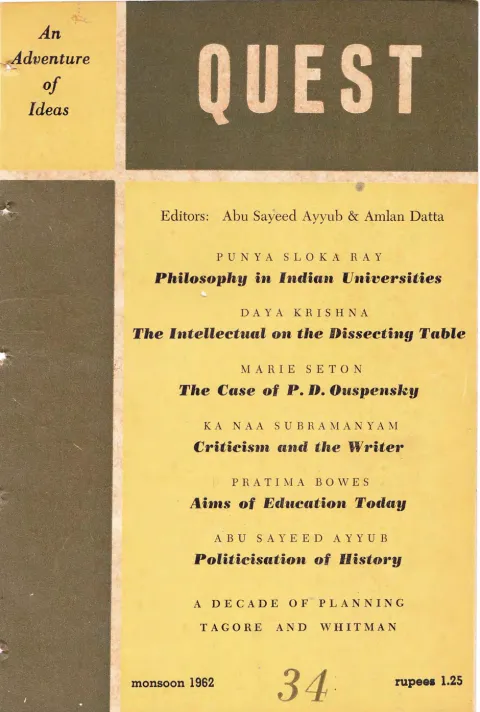
Quest
A Quarterly of Inquiry, Criticism and Ideas
By Punya Sloka Ray, Robert Gilkey, Ka Naa Subramanyam, Ramgopal Agarwala, Marie Seton, Pratima Bowes, Shivanath, N. K. Devaraja, Prof. Amlan Datta, David McCutchion, Abu Sayeed Ayyub, P. Lal, Amaresh Datta, George Keyt, David G. Briggs, Abraham Ivan Eraly, Edwina Curtis, Sadhan Kumar Ghosh, Satish C. Saberwal
Printed and published by MISS SHEELA SINGH for the Indian Committee for Cultural Freedom, Army and Navy Building, 148 Mahatma Gandhi Rd., Bombay 1, at Inland Printers, Victoria Mills Buildings, 55 Gamdevi Road, Bombay 7. · Bombay · 1962
126 pages
QUEST
Summary
Quest No. 34 (cover: ‘monsoon 1962’; contents page: ‘JULY/SEPT. 1962’), the Bombay quarterly sponsored by the Indian Committee for Cultural Freedom and edited by Abu Sayeed Ayyub and Amlan Datta with Nirad C. Chaudhuri and Laxmanshastri Joshi as advisory editors, is dominated by two arguments that run through almost every department: what is wrong with Indian higher education, and what is wrong with the Indian intellectual. Punya Sloka Ray opens with a long diagnosis of academic philosophy in India as a discipline sick from two failures of communication, and proposes a literacy test, a redesigned syllabus and a ranked account of five teaching methods; Pratima Bowes (a paper read to the Calcutta Cultural Forum) argues that an imported educational structure never took root in a feudal-agricultural society and should be restricted to students who can profit from it; N. K. Devaraja proposes that orthodox pundits be barred from teaching and Sanskrit studies transferred wholly to modern universities. Against that, Ramgopal Agarwala measures the first decade of Indian planning against other nations and finds the gap widening, and Abu Sayeed Ayyub, writing as one of the issue’s own editors, replies to Ashin Das Gupta’s Quest 32 article by refusing the proposal that historians should write for ‘the good cause’.
The issue’s argumentative centre, however, is Edward Shils’ monograph ‘The Intellectual between Tradition and Modernity: The Indian Situation’, which it engages twice: Daya Krishna reviews it at length as a Review Article, and the Reportage section prints the record of a discussion meeting on the same book held by the ICCF’s Calcutta Centre on March 31, 1962, at which Daya Krishna himself, both editors, David McCutchion, P. Lal, Kazi Abdul Wadud, Hirankumar Sanyal and Jyotirmoy Datta spoke, with an Addendum signed by Datta. Around this sit Robert Gilkey on Tagore and Whitman, Ka Naa Subramanyam on the uses of literary criticism to the Indian writer, Marie Seton’s first-hand memoir of P. D. Ouspensky’s collapse as a guru, Shivanath’s survey of Dogri writing, Edwina Curtis on imperfection and tachism in contemporary painting, five poems, Abraham Ivan Eraly’s short story ‘The Kite’, Sadhan Kumar Ghosh’s books column, seven signed book-reviews, two unlisted groups of shorter reviews signed by the Reviews Editor Nissim Ezekiel and the Assistant Reviews Editor Laeeq Futehally, and one letter. The issue carries no editorial plate or artwork of any kind; every non-textual page is a commercial advertisement.
Essays
The Teaching of Philosophy in India
By Punya Sloka Ray
Ray argues that academic philosophy in India is in a bad state for two reasons, both failures of communication: between philosophers in different parts of India and between India and abroad, and between philosophy and the other fields of systematic inquiry. The average Indian philosopher, he writes, studies Russell but not mathematics, Marx but not economics, Sankara but not comparative religion, so no Indian philosopher can influence pedagogy or psychology or criticism as Dewey, Husserl or Croce did. He treats K. C. Bhattacharya as the limiting case: the greatest modern Indian philosopher, but one who developed a style of philosophising for which communication is unnecessary. Against the profession’s self-depreciation he insists that philosophers are indispensable to any but a static primitive society, and that the demand for value-neutrality is misconceived.
The constructive half is a curriculum and a method. For the MA he proposes a single blunt test of literacy - the ability to read and explain an article in a journal like Mind - then an eight-paper syllabus: one paper of comprehension on an unseen article, three in a chosen specialist option (Philosophy of Culture, Logic, Political Theory, the theory of education, Indology), and four on the history of philosophy including a line-by-line study of one great text. He rejects the ‘well-rounded’ ideal for the young scholar, prescribes translation work rather than ‘original’ work at BA Honours level, and an openly dogmatic anthology approach for the BA Pass. He then ranks five teaching methods - catechism, tutorial, seminar, lecture, publication - against cheapness, training for novelty, testing of ideas and individual fitting, and concludes that publication is the best value for money while the catechism method is what Indian teaching actually reverts to under every other name. Finally he attacks the institutional problem: learned institutions that are one-man shows, and examining power divorced from responsibility, which he would remedy informally through professional reviews, summer institutes and exchanges rather than by taking examining powers away from universities. An editors’ headnote warns that non-philosophers might skip the middle part printed in small type.
- Two diagnosed causes: lack of communication among Indian philosophers, and lack of communication between philosophy and other systematic inquiries.
- K. C. Bhattacharya is praised as the greatest modern Indian philosopher and simultaneously used as the case of a philosophy built for non-communication.
- Proposes an operational literacy test for the MA: the ability to read and explain any article from recent issues of a journal such as Mind.
- Offers a concrete eight-paper MA syllabus with specialist options, and rejects the ‘well-rounded’ ideal for scholars between 17 and 25.
- Ranks five teaching methods and concludes that publication is the best value for money, catechism the cheapest but worst.
- Argues power and responsibility have been separated in Indian examining, so ‘bad currency inevitably begins to drive out the good’.
- Combats ‘the cynical speculation that a little more material well-being will somehow automatically improve the intellect’.
Tagore and Whitman
By Robert Gilkey
Gilkey sets out to put the Tagore-Whitman comparison on documentary footing. Existing comparisons, he argues, merely quote parallel passages and trace both poets to the Bhagavad Gita and Vedantic sources; what has been ignored is what Tagore actually said about Whitman, chiefly in the 1916-17 American lectures published as Personality. He examines Tagore’s famous praise of Whitman as ‘your greatest poet’, notes that the poem Tagore picks - ‘O Captain! My Captain!’ - is untypical and hackneyed, and that Tagore shared the American public’s misjudgement of Whitman and Poe, but shows that Tagore’s lecture quotations are better chosen and reveal a real affinity of thought.
The centre of the article is the doctrine of ‘Personalism’, which Whitman may have coined or taken from Schleiermacher and which Bronson Alcott adopted; Gilkey aligns it with Tagore’s ‘Supreme Person’ and with the Isha Upanishad, and pairs Whitman’s ‘eidolon’ with Tagore’s jibandebata. He traces the shared impatience with science and conventional morality, the pantheism both took further than Emerson, and the parallel between Whitman’s Civil War poems and Tagore’s partition-era patriotic songs, noting that Tagore broke with Gandhi and the Congress Party and came to think his patriotic verse unworthy of comparison with his other poetry. He judges the best existing comparisons - by Ajit Chakravarty, Bijoylal Chatterjee and Naresh Guha - unsatisfying beside Edward Thompson’s detailed work, blames the vagueness on the shared romantic-rhetorical moment and above all on translation, and closes by noting that Tagore at least did not damn Whitman with the faint praise of having imbibed Eastern wisdom. An author’s note promises a second article on ‘Emerson, Thoreau and Tagore’.
- Argues that Tagore’s own extensive comments on Whitman, in the Personality lectures and in Bengali, have been ignored by both American and Indian critics.
- Concedes that Tagore’s most-quoted praise of Whitman picks an untypical, hackneyed poem, and that he misjudged Poe similarly.
- Uses Whitman’s ‘Personalism’ (1868 essay, Democratic Vistas) and Tagore’s ‘Supreme Person’ as the real point of contact, with ‘eidolon’ paired against jibandebata.
- Notes Tagore’s break with Gandhi and the Congress Party and his withdrawal from active politics as the background to his hostility to aggressive nationalism.
- Finds existing comparisons by Ajit Chakravarty, Bijoylal Chatterjee and Naresh Guha vague beside Edward Thompson’s documented method, and names translation as the chief obstacle.
- Announces a sequel article on Emerson, Thoreau and Tagore that will also treat Unitarian influence on Rammohan Roy and the Brahmo Samaj.
Criticism and the Writer
By Ka Naa Subramanyam
Subramanyam argues that India has not developed a valid tradition of literary criticism, and that the reasons are historical. In Sanskrit and Tamil alike criticism stopped short as commentary, exposition, dilution and katha kalakshepam rather than emerging as a department of letters in its own right; the great Tamil commentators were learned men who often made an obscure text more obscure, and the religious diluters, though they preserved Kamban and Valmiki, bequeathed a method still mistaken for criticism today. From that twin inheritance comes the present assumption that criticism is of no use to the writer.
He then names three uses. First, the establishment and ranking of the tradition: even in the ancient literatures the classics have not been sifted, so that Sekkizhar is spoken of in the same breath as Kamban, and only by fixing the landmarks can a writer revolt against and add to them. Second, and to him the most important, the critic makes the writer a citizen of world literature, since no writer can read everything: the critic ‘has to serve as liaison officer’ between the modern writer and the world tradition. Third, criticism is a defence against subjectivism, against the Indian literary habit of equating friendship with approval of one’s work. Beyond these uses, he insists criticism must be cultivated as an art form for its own sake, without which the modern renaissance in the Indian languages cannot be called complete.
- Traces the absence of Indian literary criticism to commentary, grammatical exposition and katha kalakshepam displacing criticism proper in Sanskrit and Tamil.
- Quotes Laurence Sterne on ‘the cant of criticism’ to place present-day Indian criticism at its most tormenting stage.
- First use of criticism: sifting and ranking the classics, which has not been done even for the ancient literatures.
- Second use: giving the writer a sense of community with world literature he cannot read in the original.
- Third use: an objective standard that protects criticism from personal friendship and enmity.
- Insists criticism is itself an art form, and that without it the modern Indian literary renaissance is incomplete.
A Decade of Planning in India
By Ramgopal Agarwala
Agarwala assesses India’s first planning decade against three possible yardsticks - aggregate economic strength, welfare, and progress towards a socialistic pattern - and confines himself mainly to the first. He grants the impressive statistics (national income up about 42 per cent, industrial production up about 94 per cent, steel ingots up 150 per cent, aluminium 400 per cent, machine tools 1500 per cent, cloth consumption up 68 per cent, calories up 17 per cent) but insists figures alone settle nothing without a norm. Against the pre-plan century, when per capita income was practically constant, the decade looks remarkable; against Germany, Japan, Italy, France, the socialist economies and China, the gap has widened rather than narrowed. Measured by the test that matters - Rostow’s ‘take-off’ - savings rose only from 6.7 to 7.7 per cent of income between 1950-51 and 1958-59, against the 12 per cent-plus India needs given its foreign debt, and household savings sit in currency and gold rather than shares or bank deposits.
He attributes the shortfall to bad allocation (the Ambar Charka, the neglect of agriculture in the Second Plan, too little for roads, exports and small irrigation) and above all to organisation in the rural sector, where Community Development and National Extension Services have not transformed outlook. His remedies are concrete and statist in places: educating one or two promising young men per village and resettling them with a pilot plot, state trading in fertilisers and seeds, light tractors hired out by state agencies, minimum jute prices supported by buffer stocks, an export drive aimed at Asia and Africa with subsidised engineering goods and tied loans, compulsory life insurance for married men above an income level (which would tax marriage and protect widows), and above all the creation of a ‘development-oriented atmosphere’ of missionary zeal, since the ideal of banishing poverty has not proved inspiring enough.
- Insists growth statistics are meaningless without a norm, and supplies three: India’s own past, other countries’ present, and the take-off test.
- Finds the economic gap with Western Europe, Eastern Europe, the Soviet Union, China and Japan has widened over the decade.
- Savings rose only from 6.7 per cent of national income in 1950-51 to 7.7 per cent in 1958-59, far short of the rate needed for self-sustaining growth.
- Notes the disquieting fact that the public sector missed its investment targets while the private sector exceeded them, feeding the impression that the government is not sincere about socialism.
- Names the Ambar Charka emphasis and the Second Plan’s neglect of agriculture as identifiable planning mistakes.
- Argues Indian engineering goods are already price-competitive, citing the Perambur Integral Coach Factory against Swiss costs, and proposes subsidised exports and tied loans to Asia and Africa.
- Proposes compulsory life insurance for married persons above a specified income as a savings device with population-control and widow-protection side effects.
The Case of P. D. Ouspensky
By Marie Seton
Seton publishes, twenty years after the events and some fifteen years after Ouspensky’s death, a first-hand account of a guru losing his way. She frames it as a case with a special meaning for India, ‘a paradise for those who seek to be gurus’, and argues that the need for a guru is not confined to the ill-informed: she lists T. S. Eliot, Graham Greene and Evelyn Waugh on the orthodox side and Isherwood, Auden, Gerald Heard and Aldous Huxley on the mystical, remarking that Huxley’s articles about drug visions are of doubtful moral responsibility. Ouspensky, a Russian emigre who looked like a doctor rather than a mystic, appealed to educated people with no place in orthodox religion; his London school of the 1930s was esoteric, entry requiring an introduction and the detection of a ‘magnetic centre’, with theory Ouspensky’s province and practical work Madam Ouspensky’s at a country house.
Seton records her own six years on the periphery in England (1936-38 and after), then her sudden appointment in 1940 in New York as Ouspensky’s secretary - she thinks because she was the only person available who had been in Russia. There she watched extravagance paid for by a young couple, drab and fearful old members, ever harsher ‘ticking off’ of disciples, and nights of drinking and nostalgic talk. Asked over dinner why he had cancelled a lecture for a restaurant meal and whether he lost his temper deliberately, he answered plainly that he had taken over the leadership to save the System before he had gained enough control over himself, that the others were fools deluding themselves, and that ‘The System has become a profession with me’. She left, was told after his death that he had found his direction again, and concludes that hero-worship in the guru-devotee relation is as often spiritually deadening as enlightening - for both sides, since uncritical adulation itself corrupts the guru.
- Presented as a previously unwritten first-hand case study, published because Ouspensky’s case is not isolated but typical of the successful guru.
- Argues the need for a guru often lurks in people far above average intellect, naming Eliot, Greene, Waugh, Isherwood, Auden, Heard and Huxley.
- Describes the mechanics of the Ouspensky school: introduction by an existing member, the ‘magnetic centre’, theory under Ouspensky and practical work under Madam Ouspensky.
- Identifies excessive secrecy as a pitfall that protects the guru and exposes the disciple, since criticism can be deflected as the student’s failure to understand.
- Records Ouspensky’s own admission that he assumed leadership before he had control of himself and had lost control of his state of mind.
- Concludes that devotees contribute to the distortion of the guru’s power, and that both roles are psychologically risky.
Aims of Education Today
By Pratima Bowes
Bowes begins with the general question - what is education for, if not for a profession - and answers in two stages. Because human nature bears potentialities rather than a finished form, what a person should become is a matter of deliberate decision shaped by society; education therefore has both a social aim (learning to live with others, best inculcated in childhood) and an individual one (growth towards a perfection set by one’s own propensities, informed by the ends of knowledge, aesthetic awareness and moral goodness). She uses the social side to make a sharp local point: Indians lack civic sense because loyalty is still owed to the family, a feudal-agricultural value, and until education can create a larger loyalty the educated will keep relegating social problems to government while expending excessive energy on their own relatives - the vice called nepotism. She calls for concrete empirical research on how such loyalty can actually be taught.
The second half is a historical and institutional critique. The Indian system was imported root and branch to produce clerks with English, and has remained an ornament that never became part of us; in England the same structure grew out of the free enquiry, industry and social consciousness of the renaissance and industrial revolution, whereas in a tradition-bound society it produced reverential acquiescence, note-book memorising and examinations that count tabulated facts. The results are passive, timid young people whose energy finds an outlet in group boisterousness, and an education that fails to produce discipline, objectivity, organisational capacity, efficiency or integrity. Her remedies are blunt: ban note-books and disqualify students who use them, stop teachers giving notes, examine the capacity to think rather than memory, restrict college education to those who can profit from it, and stop founding more degree colleges - she names the West Bengal Government’s proposal for nine more in and around Calcutta. Character traits, she adds, come from atmosphere rather than instruction, so what is needed is piecemeal empirical field research with students, not more rehashing of educational principles. A printed line notes the paper was read at a symposium organised by Calcutta Cultural Forum.
- Distinguishes vocational training from liberal education and locates the question of aims in the latter.
- Argues human beings have no finished nature, so the goal of education is always a deliberate social decision.
- Diagnoses the Indian lack of civic sense as the persistence of feudal-agricultural family loyalty, with nepotism as its vice.
- Holds that the imported English educational structure could not take root in a tradition-bound society and remains ‘a kind of ornament’.
- Proposes banning note-books, disqualifying students who use them, and examining the capacity to think rather than memory.
- Argues for restricting college education to those who can profit by it, and against the West Bengal Government’s proposal for nine more degree colleges.
- Calls for empirical, piecemeal field research on student behaviour rather than further restatement of educational principles.
Contemporary Dogri Writing
By Shivanath
Shivanath surveys the whole of written Dogri, a language he describes as spoken by about four million people in the sub-mountainous Himalayan and Siwalak belt from Kangra and Himachal Pradesh to the former Jammu Province, with three sub-dialects in Jammu and a Takkri script that was never used for literature. Before the 1940s the written record amounted to Maharaja Ranbir Singh’s insistence on Dogri for court petitions, a Sanskrit professor’s translation of the Gita, a missionary New Testament and some printed didactic verse. Written Dogri literature begins when a group of young Dogra writers in Hindi, meeting in a Jammu temple in the early 1940s, turned their mother tongue into Devnagri script, founded the Dogri Sanstha (later joined by Dogra Mandal) and published two volumes of verse and one of short stories in 1945; between 1945 and 1960 the two bodies published about fifty volumes.
He classifies the output by theme and quotes it in his own English renderings: lavish praise of the beauty of the Dogra land (Dinoo Pant, Ram Nath Shastri, Madhukar, Kishan Samahlpuri, Perma Nand, Yash Sharma); vignettes of hard Dogra life, separation and the burdens of tradition (Ganga Ram on the Kandi); an effort to recover past Dogra dignity (the Gulab Nama translation, Dinoo’s ‘Vir Gulab’, the plays Bawa Jitto and Jitmal Balidan); a large body of Hindu mythological and scriptural translation, since almost all contemporary Dogri writers are Hindus with Sanskrit and Hindi backgrounds; and a nagging preoccupation with community and world problems. His verdict is candid: the poems are the best part, then the short stories; there are four full plays, three small novels, no essay collection, no magazine, no grammar and no dictionary. The climate is not yet conducive - too few readers, texts and teachers, the State education department has not produced the textbooks, and there is general apathy in the Dogra community - so he proposes a definite plan for standardisation and a programme of commissioned writing and translation by the State Academy, the Dogri Sanstha and Dogra Mandal.
- Written Dogri literature dates only from the early 1940s, when Hindi-writing Dogra amateurs adopted Devnagri script for their mother tongue.
- The Dogri Sanstha and Dogra Mandal published about fifty volumes between 1945 and 1960.
- Themes classified in five strains: praise of the land, vignettes of hard hill life, recovery of past Dogra dignity, Hindu scriptural translation, and contemporary social exhortation.
- Almost all contemporary Dogri writers are Hindus with Sanskrit and Hindi literary backgrounds, which explains the weight of mythological and scriptural translation.
- Frank inventory of gaps: no magazine or paper, no grammar, no dictionary, only three small novels and no volume of essays.
- Calls for a standardisation plan and commissioned original and translated writing, with State Academy patronage.
The Intellectual on the Dissecting Table
By Daya Krishna
Labelled a Review Article, Daya Krishna’s piece examines Edward Shils’ monograph ‘The Intellectual between Tradition and Modernity: The Indian Situation’ (Mouton, 1961) at three levels: the adequacy of its account of the Indian intellectual, the theoretical framework implicit behind it, and the relation between the two. He grants the book’s descriptive power - the class it studies, some sixty thousand ‘productive’ intellectuals with a hard core of 35,000 teachers and an average income around Rs. 350 a month, is delineated ‘with a sensitive perceptiveness that cannot but amaze the Indian reader’ - while noting that Shils warns the monograph is not a full report and that the framework must be reconstructed from stray remarks.
His objections are conceptual. Shils never distinguishes ‘modernization’ from the ‘modern intellectual tradition’ and assumes the second follows the first, though closed totalitarian societies modernise while discouraging open enquiry, and traditional India had a strong if classificatory empiricism and an experimental element in its spirituality. Creativity is not tied to the metropolitan-provincial polarity: in classical music and dancing nobody feels provincial, in poetry Indians are far more steeped in their own languages than in English, and adverse Western reviews have not dented K. C. Bhattacharyya’s standing, just as Tagore’s Nobel has not made Indians rate him above Sarat Chandra Chatterjee as a novelist. The tradition/modernity dichotomy, he adds, is not peculiar to underdeveloped countries but sits at the heart of the West itself, as The Two Cultures controversy and Colin Wilson show; and Shils has not escaped his own cultural preferences, since the individuality he misses looks to an Indian superficial and immature. He catalogues minor inconsistencies (pp. 20 vs 41 on Indian opinion of the intellectual; p. 97 on intellectuals in public life against the alienation thesis) but ends by accepting the book’s challenge: the formation of a creative intellectual tradition.
- Distinguishes three levels of assessment and notes the framework has to be inferred because Shils never articulates it.
- Core objection: ‘modernization’ and the ‘modern intellectual tradition’ are conflated, though totalitarian societies modernise while closing off open enquiry.
- Argues traditional India had a descriptive-classificatory empiricism and an experimental element in spirituality, lacking only the hypothetico-deductive method.
- Denies that creativity maps onto the metropolitan-provincial polarity, citing classical music, dance, Urdu mushairas and K. C. Bhattacharyya’s reputation.
- Holds the tradition-versus-modernity conflict is widespread in advanced countries too, citing The Two Cultures and Colin Wilson.
- Charges Shils with importing his own value-preferences, particularly about individuality and family feeling.
- Accepts the book’s central challenge - the formation of a creative intellectual tradition - despite the criticisms.
Reorienting our Educational Policy
By N. K. Devaraja
Prompted by the Government’s announced committees on educational policy, Devaraja lays down three principles. The first is negative and, he concedes, revolutionary: what is selected from the heritage for transmission must not clash with the values universally cherished in modern democratic societies. Applied to caste, this means the propagation of the beliefs that sustain caste-consciousness must stop at every level of education. Since the masses remain under the influence of traditionally minded Brahmins and Pundits, who he says are born propagators of caste ideology and have a vested interest in the caste system, he proposes that the purely orthodox pundit should not be permitted or encouraged to teach, that institutions teaching religio-philosophic texts in Sanskrit and Arabic on purely orthodox lines should be closed or deprived of State aid and recognition - naming the Varanaseya Sanskrit Vishvavidyalaya - and that all Sanskrit study and research be transferred to modern schools, colleges and universities, with eminent oriental pundits retained as consultants.
The second principle is attention to vernacular school textbooks, illustrated by the contrast between Tulsi Das and Suradas, who teach dependence on God, human sinfulness, humility and self-abnegation, and Kalidasa, who extols self-dependence, proper pride, perseverance and learning; textbook selection should be entrusted only to people with a sense of history and of present needs. The third is that Indian culture must harmonise its ideas with its institutions: a democratic government coexists with a people lacking the ideological equipment for democracy, and intellectual leaders have no better philosophy on offer than an illusionist Vedanta while excessive respect for the Purushasukta and the Laws of Manu sits inconsistently with denouncing caste. University education, which currently rewards ‘reproductive scholarship’, has produced no thinker comparable to Darwin, Einstein, Freud, Marx, Russell, Sartre or Wittgenstein, and no historian of Toynbee’s stature; it should instead develop independent, critical and creative thinking in patriotic, forward-looking scholars.
- First principle: nothing may be transmitted from the heritage that clashes with the values of modern democratic societies - applied first to caste.
- Proposes barring the purely orthodox pundit from teaching and withdrawing State aid and recognition from purely orthodox institutions, naming the Varanaseya Sanskrit Vishvavidyalaya.
- Insists he values Sanskrit highly: the proposal is to move all Sanskrit teaching and research into modern schools, colleges and universities.
- Second principle: vernacular textbooks matter most at the secondary stage, illustrated by Tulsi Das and Suradas against Kalidasa.
- Third principle: a culture must keep its ideas and institutions in harmony; democratic forms coexist with a pre-democratic ideological equipment.
- Charges the university system with producing ‘reproductive scholarship’ and no thinker of world stature.
- Notes that Gandhi and Aurobindo were educated partly abroad and Tagore largely self-educated, so Indian universities cannot claim credit for them.
Discussion on Indian Intellectuals
By Amlan Datta, David McCutchion, A. S. Ayyub, Jyotirmoy Datta and others
This is the report of a discussion meeting on Edward Shils’ book held under the auspices of the Indian Committee for Cultural Freedom, Calcutta Centre, on March 31, 1962; a first draft by the Secretary, K. K. Sinha, was sent to participants for revision, so the speeches appear in their own revised words. P. Lal opened with a critical summary. A. S. Ayyub, editor of Quest, admired Shils’ competence but objected to sociology as such when applied to intellectuals: group study by interview cannot detect something like ‘the sense of the numinous’, and he would be surprised if more than one or two of the twenty intellectuals he knows intimately possessed it. On uprootedness he dissented from Shils’ conclusion that Indian intellectuals are no more uprooted than Western ones: the Westerner who moves from Catholicism to positivism stays inside his own culture complex, whereas the Indian must cut an umbilical cord between a culture he values but finds stagnant and a living culture that is alien - Yajnavalkya and Russell are too far apart. He offered Ram Mohan Roy, Vivekananda, Aurobindo and Gandhi as rooted but not Westernised, Nehru and M. N. Roy as belonging to the West while looking homeward, and Rabindranath as the most successful synthesiser, though as a thinker still rooted in the Upanishads.
Dayakrishna argued the book is really a case study for a generalised theory of metropolitan and provincial cultures, true also of Rome, of nineteenth-century Russia and America, and of Japan, so that the real dichotomy is not East versus West but creative centre versus periphery; institutions alone do not make creative centres. Ayyub replied that India is on the provincial fringe of two cultures, one close in space but distant in time, the other contemporary but distant in space. Kazi Abdul Wadud asked how India could become a metropolitan centre and questioned whether ‘modernity’ is an adequate aim, citing Ranade. D. J. McCutchion of Jadavpur found many observations true but truistic, objected to lumping all intellectuals together, and reversed Shils on religion: the militant rationalist is commoner in India than in England, where there has been a post-war religious revival, while degenerate popular Hinduism has lost its hold on the educated and the revivalist movements do not attract keen young intellects. He proposed rough divisions - religious and non-religious, establishment and young, kinds of Westernisation - and comparisons with France and Germany rather than only England and America. Jyotirmoy Datta held that the discussion itself proved Indian provinciality, and that the nineteenth-century inferiority of America and Russia had been a spur rather than a bar to major writing. Hirankumar Sanyal argued Rabindranath, Ram Mohan and Aurobindo had all drunk deep of the West, and that alongside Rabindranath’s synthesis ran a ‘bastard culture’ that uprooted intellectuals as fine as Sudhindranath Datta and Satyajit Ray. Amlan Datta identified three sources of the sense of uprootedness, two shared with the West and one - the failure to relate ideas to the community’s accumulated experience - peculiar to India, and urged re-assessment of the Upanishads and the Gita as a form of presentation rather than a doctrine. The chairman, Jayantanuja Bandopadhyaya, concluded that in a country with problems as basic as starvation and illiteracy an intellectual cannot resolve alienation without taking part in socio-political movements. A signed Addendum by Jyotirmoy Datta argues that Shils’ value lies in noticing trivial familiar details, and that what is sad is not Western influence on Indian writers but Indian faith in certificates granted by Western reviewers.
- A record, revised by the participants themselves, of an ICCF Calcutta Centre meeting on Shils’ book on 31 March 1962.
- Ayyub’s methodological objection: interview-based group sociology cannot reach the individuality that makes an intellectual, nor detect a state like ‘the sense of the numinous’.
- Ayyub’s substantive dissent: the Indian intellectual’s uprootedness is unlike the Western case because the two cultures in question are basically opposed.
- Dayakrishna reframes the book as a case study for a general metropolitan-provincial theory, with creative centres that shift over time.
- McCutchion reverses Shils on religiosity, reporting militant rationalism commoner in India than in England, and asks for disaggregation of ‘the Indian intellectual’.
- Sanyal introduces the idea of a ‘bastard culture’ running alongside Rabindranath’s synthesis and uprooting even Sudhindranath Datta and Satyajit Ray.
- Amlan Datta names three sources of alienation and prescribes relating new ideas to the Indian past by way of criticism, modification or extension.
- The chairman concludes that in India an intellectual who does not respond to basic human problems can hardly be called an intellectual at all.
An Old Song
By P. Lal
A short lyric in four rhymed quatrains, opening the POETRY section. The speaker hears a morning bird singing an old song with a new twist and calls it a sentimentalist, unwrapping ‘layers / Of sticky song / In swaddled prayers / To a love that’s gone’. The sparrow is addressed as an unclassical singer of sorrow and told to sing on because ‘We all understand’ - the closing couplet placing its love in the sun and the fish on the sand, so that the bird’s lament and its appetite are set side by side.
- Four quatrains of light, rhymed verse; the only poem in the issue by the editor of Writers Workshop Miscellany.
- Treats a morning bird’s song as sentimentality, ‘An old song / With a new twist’.
- Turns in the last stanza from mockery to fellow-feeling (‘Sing, little one. / We all understand’).
- Closes on a deliberately unromantic pairing of the bird’s lost love with the fish on the sand.
A Strange Meeting
By Amaresh Datta
A dramatic monologue in free verse set over a cup of tea. The speaker’s ‘burrowing thoughts’ are interleaved with the woman’s polite offers of sugar, milk and another cup; he registers her ornate cheeks and ‘the resistless bust’, talks of the cosy evening and a philosophic stroll, and compares his own accent to that of the lover in Tennyson’s Maud while delivering his lines with the tepid certainty of a station master announcing a train. He then dismisses the encounter, insisting a woman could never be an abiding thought, and lists what he is really thinking about - the collective drive for a welfare state, the growing complexity of the individual mind, world peace, the fate of democracy, his personal ambition ‘in a callous globe’, and ‘the old order yielding place to chaos’. The poem ends flatly with the last sip, thanks for the tea and the eight-thirty bus, the public vocabulary of the age having crowded out the private occasion.
- Free-verse monologue that alternates interior thought with banal spoken politeness in quotation marks.
- Self-consciously literary: the speaker measures his own accent against ‘the lover in Tennyson’s Maud’ and glances at Helen and Troy.
- Sets erotic attention against the public vocabulary of welfare state, world peace and the fate of democracy.
- Ends on the deflating practicalities of the last sip of tea and the eight-thirty bus.
The Wind’s Absence
By George Keyt
A two-stanza love poem of absence built on a single sustained weather metaphor. The wind of the beloved’s presence no longer blows the rain clouds of the speaker’s heart across the place of his love for her, so they will never again ‘break with a thunder of sighs’ over the forest of her feelings; nor will the moisture of his heaven envelop her leaves and vegetation and descend into all recesses, returning to clothe the monotonous sky with clouds and mystery. The erotic content is carried entirely by the landscape.
- One of two poems by the Ceylonese painter George Keyt printed together on the same page.
- Sustains a single monsoon metaphor - wind, rain clouds, thunder, drenched forest - across both stanzas.
- The beloved’s body and feelings are figured as vegetation and the speaker’s as weather.
- Ends by making the sky monotonous once the clouds and their mystery are gone.
The Fear in the Night
By George Keyt
A single-stanza poem of nocturnal unease, printed immediately below ‘The Wind’s Absence’ on the same page. The speaker is lost in the night of his beloved’s love, voyaging in ‘the warm labyrinths of her life unclothed’ upon dark channels of warm blood, where he feels with many misgivings a colony as of fishes and then cold patches - ‘The clammy fingers of a void, the clutching of an absence, / The icy patches in the circulation of her love.’ Intimacy and dread are held in the same image.
- Keyt’s second poem in the issue, sharing the page with ‘The Wind’s Absence’.
- Figures the beloved’s body as dark warm water and channels of blood.
- The ‘fear’ of the title is located in cold patches within the circulation of her love.
- Single unbroken stanza, ending on the icy patches rather than on any resolution.
Narcissus
By David G. Briggs
Three rhymed quatrains on the Narcissus theme. With the ripples gone, the speaker’s image mirrors toward the sky, transparent and darkling, and fixes him with a watery eye; beneath his face he knows there lies ‘A murky depth of weedy lace’, though the silver surface shows only the pale blue vault behind him. No breeze disturbs his dreaming eyes, but a swirling fish, perhaps in search of deeper skies, scatters him, his dream and his wish - self-contemplation broken not by wind or another person but by something moving in the depth the surface concealed.
- Three rhymed quatrains (abab) reworking the Narcissus myth as an image on still water.
- Contrasts the silver surface reflecting the sky with the murky weedy depth known to lie beneath the face.
- The interruption comes from below, a fish ‘in search of deeper skies’, not from outside.
- Ends by scattering the speaker together with his dream and his wish.
The Kite
By Abraham Ivan Eraly
A short story in a Kerala household. A dirty, frightened boy stands on the doorstep to claim the eight annas his father Menon has promised him for a kite if he learns his second lesson; he stumbles in the recitation, and the father, whose moods are ‘sudden and violent’, drives him off. When the mother Kalyaniamma intervenes she is shrieked at and threatened, says ‘You better kill us’, and the father throws a nickel coin at his son with the words ‘Go and damn yourself’. In the drizzle the boy runs, loses the coin, and is taken in by Ramu’s mother at her tea shop, who dries his head, hears that his father will kill him, and counts out eight annas of her own from her day’s collection.
He comes home with the china-paper to find the front door shut and his mother sobbing in the kitchen, and cries with her. At noon the drunk father returns, calls her out, pulls her up by the hair and beats her rhythmically ‘like trying to beat some tune’ while the boy trembles over his kite in the veranda; then he goes out without a glance. Absorbed again, the boy finishes the frame and pastes the paper with cooked rice, needs string from the trunk in the dark attic, and is too scared to go up alone as he always went with his mother. He climbs sobbing, sees her standing there in the dark with her back to him, and runs up with a joyous shout to embrace her - ‘and she swung from the rope on which she was hanging, making him fall.’
- Third-person narration held almost entirely to the boy’s perception and level of understanding.
- The kite money is the story’s engine: promised, thrown in contempt, lost in the rain, replaced by a poor tea-shop woman’s charity.
- Domestic violence is reported flatly, the beating described as rhythmic ‘like trying to beat some tune’.
- The mother’s repeated ‘You better kill us’ and ‘If you touch me again I will die’ prepare the ending without announcing it.
- The final sentence delivers the suicide as a physical accident of the boy’s embrace.
Art and Imperfection
By Edwina Curtis
Curtis writes in two parts, ‘Perfection and Novelty’ and ‘The Tachists’. She begins with painters of enormous facility - Leonardo, Rembrandt, Picasso, Tintoretto - whose mastery of execution freed them to create ideals and to paint what had never been seen thus, and argues that their very ability leaves ‘enormous gaps of visual experience’: everything that is not perfect or perfectible, which owing to ‘the queer human streak’ is more precious and appealing than the best. Since the European measure of perfection is Greek sculpture, and repeating it is near-impossible, artists look beyond the human bounds; a spot or clumsy stroke may spoil a surface or open a world of suggestion. Signs and spots entered European art consciously only with trade in Chinese and Japanese pictures. She insists an artist has a dual consciousness, his own and that of art as a whole, whose frontiers are expanded by the ‘bad’ as much as by the accepted ‘good’, and reads nineteenth-century France on two levels: what it was (salons and an accepted style) and what it looks like now (a pattern of revolt), warning that the later recognition of ignored painters founded the false tradition that art must be obscure to be good.
The argument then turns on novelty as a market demand. She reports at length a Paris studio visit in which a dealer, herself among the least commercial-minded in the city, rejects a beautiful red canvas because that sort of thing has been done since and asks instead for more like the still-wet white one, ‘which ought to be shown this year’. Newness is indefinable and the logical steps from old to new are only visible after the fact, while the speed at which a new sight becomes obsolete is itself new, thanks to rapid transport and facile reproduction. Every stroke, she argues, spawns its own opposition: a hard edge suggests a soft one, deep space creates a need for tactile bulk. Part II treats tachism - ‘only a word (tache means spot)’ - as already a dead issue killed by the demand for newness, and contrasts cubism’s unifying of images with tachism’s glorification of the natural flow of things. She reads Tal Coat’s lyric strokes as remembrances of historical experience in art, Georges Mathieu’s four-yard canvas in the Museum of Modern Art as speed made a virtue and painting made a performance, de Kooning as visibly better than his imitators because the copied elements are material rather than spiritual, and Sam Francis as the truest tachist, whose precise later pictures cluster at the top of the canvas ‘like balloons clustering on a ceiling or kites tugging at their strings’, describing a conscious disembodiment.
- Argues that facility and perfection leave out most of visual experience, and that the imperfect is more appealing than ‘the best’.
- Names Greek sculpture as the European standard of perfection and denies there has been progress in perfection since Praxiteles.
- Traces the conscious use of spots and signs in European art to trade with China and Japan.
- Warns that the posthumous recognition of the French post-impressionists founded ‘the false tradition that art, to be good, must be obscure’.
- Reports a dealer refusing a finished painting because its kind has been done since, and asking for the still-wet canvas instead.
- Holds that the speed of obsolescence of a new sight, not novelty itself, is what is new - a product of rapid transport and reproduction.
- Reads tachism as a dead issue, and ranks Tal Coat, Mathieu, de Kooning and Sam Francis within it.
Politicisation of History
By Abu Sayeed Ayyub
Ayyub replies to Ashin Das Gupta’s ‘The Historian in India, 1962’ (Quest 32), which had asked Indian historians to do more than their traditional duty of discovering and stating the truth about the past - a duty Das Gupta calls impossible to perform - and to choose their predilections in the light of present moral and political demands, replacing communal and regional bias with ‘propaganda for the good cause’, national solidarity. Ayyub’s first move is an analogy: substitute ‘physics’ for ‘history’ and ‘nature’ for ‘past’ in Das Gupta’s own paragraph about the unattainability of the whole truth, and no physicist would object to the description, yet none would conclude that his duty is impossible. The duty of both is ‘the promulgation at each stage of inquiry of the least erroneous or distorted view’ available. The same analogy answers the complaint that the purest scholar distorts the past by lack of imagination: physics needs imagination too, and nobody infers that the scholar should cultivate impurity of purpose.
He then denies that good motives correct for bias. If predilections in one direction produce distortions, predilections in another will produce distortions of another kind, and nothing tells us which is further from the truth; the Marxists, who do claim that the right class interest confers truth, tie themselves in knots with a double standard, and Das Gupta is in the same difficulty between ‘the traditional discipline’ and ‘improving the social situation’. He concedes the difference between history and physics is real - Karl Mannheim’s ‘perspective bound’ character of the humanities - but locates the remedy chiefly with the writer’s discipline against subjectivity, and secondarily with a reader who compares books written from diverse perspectives, as one forms a notion of a hill’s shape from descriptions taken from different points. Of the three ways of handling a past that does not serve present needs - distorting history, distorting present morals in the light of history, or loosening the hold of the past - he declares openly for the third, offering examples of the first that indict Marxist historiography (India still colonial after 1947, Hungary 1956 as American agents, perfect Hindu-Muslim accord down the centuries, Assam’s role equal to Bengal’s) and citing the new European Common Market as a case where peace was made without rewriting the history of German atrocities. He ends on the historian’s first duty to truth, and on the conflict of value with value as one of the tragedies of the human situation.
- Uses a substitution test - physics for history, nature for the past - to show that Das Gupta’s impossibility claim proves nothing peculiar to history.
- Redefines the duty of every inquirer as promulgating the least erroneous view available at each stage, by continuous correction of error.
- Denies that a good purpose immunises a historian against distortion, and argues the Marxist double standard of truth collapses under examination.
- Accepts Karl Mannheim’s account of the humanities as ‘perspective bound’ while refusing the conclusion that objectivity should be abandoned.
- Prescribes reading histories written from diverse perspectives, compared like descriptions of a hill from different points of view.
- Declares for loosening the hold of the past rather than distorting history or distorting present politics to match it.
- Cites the European Common Market as evidence that political reconciliation does not require rewriting histories of atrocity.
Talking About Books
By Sadhan Kumar Ghosh
A discursive books column, written in the first person and studded with Oxbridge reminiscence, that works through seven recent English books. On M. R. Ridley’s ‘Studies in Three Literatures’ Ghosh traces the idea that each language has its own shaping power back to Vico and Herder, agrees that a Pindaric ode cannot survive translation, but is ‘frankly surprised’ by Ridley’s suggestion that Latin was less suitable as a poetic medium, defends Virgil against the charge of unoriginality, praises the essay on lyric while faulting the neglect of the Greek drinking-songs and Anacreon, and dismisses George Steiner’s disparagement of the book as ‘brash and churlish’. J. C. Masterman’s ‘Bits and Pieces’ is treated as the Oxford image itself and its vintage prose praised; Simon Raven’s ‘The English Gentleman’ is read as an analysis rather than a resurrection of the myth, with the author’s denial that he is a gentleman taken as proof that he is one.
C. S. Lewis’s ‘They asked for a Paper’ yields the column’s longest quotation, on death as the subject of Hamlet compared with Macbeth, Brutus, Othello and Lear, and Ghosh endorses Lewis’s plea to suspend anti-imperialism while reading Kipling. E. H. Carr’s ‘What is History?’ - the G. M. Trevelyan lectures - is called brilliant and stimulating, with Carr’s definition of the historian’s function quoted approvingly and his notions of progress and of the Great Man compared to H. A. L. Fisher’s, Carlyle’s and Hegel’s. Sir Richard Rees’s ‘George Orwell’ is judged honest but badly written and packed with irrelevancies, its comparisons of Orwell with Simone Weil and Koestler unjust, its author a man nursing a life-long grievance; Ghosh wishes Malcolm Muggeridge had finished his own book instead. Penderel Moon’s ‘Divide and Quit’ is credited with fairness about the Bahawalpur massacres and quoted on the Boundary Force’s inaction, though its implication that Gandhi should have accepted the Cripps proposals and that Rajaji showed statesmanship is one ‘History is unlikely to endorse’. The column closes on Wilson Knight’s ‘The Christian Renaissance’, extending his spatial-symbolic reading of Shakespeare to the New Testament.
- Seven books treated in one continuous personal essay rather than as separate reviews.
- Defends Virgil and the untranslatability thesis while disputing Ridley on Latin as a poetic medium, and calls George Steiner’s verdict on the book churlish.
- Quotes C. S. Lewis at length on death as the subject of Hamlet and endorses his defence of Kipling against anti-imperialist reading.
- Praises E. H. Carr’s What is History? and places his view of progress with H. A. L. Fisher’s and of the Great Man with Carlyle’s and Hegel’s.
- Dismisses Rees’s Orwell as a book by a man with a grievance, insisting Orwell’s metier was the essay, not fiction.
- Rejects Penderel Moon’s implied endorsement of the Cripps proposals and of Rajaji’s statesmanship over Gandhi’s refusal.
- Reports Moon’s quoted evidence that the Boundary Force looked on while Muslims murdered Hindus in West Punjab.
16 Modern Marathi Short Stories
By V. Y. Kantak
Kantak reviews a Kutub-Popular anthology of sixteen Marathi short stories in English translation, opening with the general question of what an incompetent translation costs when translation is the only channel by which one Indian literature reaches another. He finds the English rigid, the fruit of academic labour - most of the authors and translators are university and college teachers, a fact the publisher supplies in notes ‘which are neither in good taste nor good English’ - and rarely free from jars. He quotes a sample paragraph with its ‘prince’, its ‘No, no and no’ and its final ‘eh’ to show the unEnglish ring, and notes Indianisms such as ‘I folded my hands to her metaphorically in complete surrender’ which delight those who know Marathi and perplex others; Shantaram’s ‘Rain in Summer’, where everything depends on the modulation of dialogue, loses most.
On selection he accepts the publisher’s claim that the stories are representative of their sixteen authors, and characterises several: Gangadhar Gadgil’s ‘The Dog That Ran in Circles’ has a strained and spurious modernity and is more personal essay than story; Vyankatesh Madgulkar’s ‘Planning the Feast’ gives his forte, mirthful but seriously effective rural experience; Mangesh Padki shows his usual coarse interest in sex; Mahadev Shastri Joshi’s ‘The Fugitive’ is frankly reformistic good old Marathi stock. Judged in the wider context, this is ‘a fair sample of successful art which just misses that distinction which makes art great’ - where authors attempt the modern vogue the stories tend to become pointless, and the best of them are studies of the child mind and of adolescence, with Vasundhara Patwardhan’s story singled out as a great little classic with nothing particularly modern about it.
- Frames the review around the cost of bad translation when translation is the only channel between Indian literatures.
- Faults the translations for an academic rigidity that comes from too great a regard for correctness.
- Notes that a very large number of the authors and translators are university and college teachers.
- Quotes Indianisms and slang attempts to show where the English fails, particularly in dialogue.
- Judges the traditionalists of the collection more successful than the modernists.
- Singles out stories of the child mind and adolescence as the strongest, with Vasundhara Patwardhan’s the finest.
Consider India: An Essay in Values
By Lina Mayadas
Headlined ‘Thinking of India’, Mayadas reviews Horace Alexander’s ‘Consider India: An Essay in Values’ and confesses that a whole book about Values sounded fearful, since the form invites over-emphasis, dogmatism and words that yield no clear ideas. Alexander does none of these things: the book is full of pleasant surprises, free of pedantry and self-consciousness, and entices the reader into his metaphysical country to explore and ponder for himself. Addressed mainly to Westerners who consider India either as swarming hungry masses needing economic crutches or as the exotic basis of a cult of sentimental eccentrics and elderly women dabbling in the esoteric, it suggests India may have something rich to offer a competition- and tension-ridden world.
Mayadas reports his thesis - how the Gita, the Vedas and the Dhammapada affect Indian lives today and may one day affect the world - and his insistence that Hinduism and Buddhism are neither annihilistic nor negative, nirvana being tranquillity and a state of understanding rather than indifference; within the morass of metaphysical speculation and gross superstition lies the key to a maturity that conquers the need for selfish conduct, and no proper socialisation is possible while people accept slick statements like ‘cupidity is deeply ingrained in human nature’ to explain away economic empires, national self-sufficiency and nuclear deterrents. She ends by commending his criticisms precisely because after thirty years of close association he ‘knows his Indians’ and is still on our side, and because, despite the humiliating succession of catastrophes and the tremendous inertia, he is sure forces of healing are building a country that is neither a fossilised replica of the Vedas nor a pale reflection of the West.
- Praises Alexander for writing about values without pedantry, dogmatism or self-consciousness.
- Summarises the book’s address to Westerners who see India either as a hungry mass or as an esoteric cult.
- Reports his argument that Hindu and Buddhist emphases are positive, with nirvana as tranquillity rather than negation.
- Notes his link between fatalism about human cupidity and acceptance of economic empires and nuclear deterrents.
- Accepts his criticisms of Indian national life because of his thirty years’ association and evident sympathy.
- Ends on his hope for a country that is neither a fossilised Veda nor a pale reflection of the West.
A Russian Childhood
By Uma Vasudev
Headlined ‘Remembered Fiction?’, Vasudev reviews Elisaveta Fen’s ‘A Russian Childhood’ and makes its central question one of genre: the remembrance is so detailed and the line of emotional growth so coherent that one wonders whether Fen has recaptured fact or written fiction - how many of us, she asks, would recall before the age of eleven the spidery footprints of magpies on the snow on the day of a first ride on a pig? What saves the episodes from tedium is that each is tied to a discovery about herself or those nearest her: the brother who emerges as just a brother, the mother who is both the hand on the forehead that dispels nightmares and a compulsive figure whose love must be tested again and again, the humiliation over Zena that ends two hours in the currant bushes ‘raging and grieving for my shattered innocence’ and produces the first painful step to growing up. Successive discoveries mark the growth: that the reward of generosity may be a bruised body or a wounded heart, that compassion makes one vulnerable, and finally scepticism, when faith did not even help move a door.
Her one reservation is the author’s self-conscious comments on ‘us creative beings’, which she finds priggish and unnecessary, offset by clear and sympathetic observation owed to Fen’s training as a child psychotherapist. The book’s background - a well-to-do family in pre-Revolution Russia, Christian feasts and quaint superstitions, teeming descriptions of places, people and customs - gives an invaluable clue to life in a province the rumblings of revolt never reached, though they were to rock the country a few years later. She notes Fen’s naturalisation as a British subject in 1929, her translations of Chekhov and Zoshchenko, and the comment on her first novel that her English was ‘so beautiful that it could only have been written by a foreigner’, which she thinks applies here too.
- Poses the book’s problem as one of genre: recaptured fact or well-made fiction.
- Finds the structure saved from tedium because each episode is fastened to a discovery about the self.
- Reads the mother as both the source of security and a figure whose love has to be tested.
- Objects only to the author’s self-conscious remarks about ‘us creative beings’.
- Credits Fen’s training as a child psychotherapist for the clarity of observation.
- Values the book as evidence of provincial pre-Revolution Russian life untouched by the coming revolt.
Umrao Jan Ada
By Iqbal Lukmani
Headlined ‘Failure in Interpretation’, Lukmani’s review of the UNESCO-sponsored translation of Mirza Mohammad Ruswa’s ‘Umrao Jan Ada’ starts full of hope - nothing is needed more than good translators if Indian thought is to project itself, and Marathi writers know contemporary English, American, French, German and Russian trends while knowing nothing of Bengali or Tamil - and ends in disappointment on two counts. First, the choice of book is unhappy: it has only its fame to commend it, and it is hard to work up excitement about ‘another bout of confessions from an oriental prostitute’; it serves as a tame documentary of the world from which Urdu drew its nourishment, but cannot be classed as literature, and Ruswa’s other output ran to penny dreadfuls. The lush romantic quality of Urdu suits poetry better than prose, which is why prose-writers padded their work with indifferent verse, as here.
Second, the translation. Every translation disappoints someone who knows the original, but none of those difficulties requires jettisoning taste and style: the translators ‘seem to be using both hands to keep a firm hold on the size and shape, while allowing the colour and the creative view-point to slip by’, and the modern slang (‘I don’t care a fig for his life’) makes the result lifeless merchandise. She quotes the opening chapter and then the long exchange in which author and courtesan trade couplets and compliments - ‘You are in brilliant form, Umrao. Listen to one more couplet and then resume your narrative!’ - before delivering her verdict that the effort has flopped like the film version of a few years earlier. The review asks, pointedly, who would guess from this book the beauty of the language in which Ghalib and Iqbal wrote.
- Sets the review in the context of India’s need for good translations and the isolation of Indian literatures from one another.
- Judges the choice of book for the UNESCO Collection of Representative Works a mistake, famous but not literature.
- Argues Urdu’s romantic quality suits poetry better than prose, hence the padding with indifferent verse.
- Faults the translators for keeping the shape while losing the colour and creative point of view, and for anachronistic slang.
- Quotes the author-courtesan couplet exchange at length to show the tedium it produces in English.
- Concludes that the translation has flopped like the earlier film version.
Growing
By C. L. Nahal
Headlined ‘Leonard Woolf in Ceylon’, Nahal reviews the second volume of Leonard Woolf’s autobiography, covering 1904-1911 in the Ceylon Civil Service. He places it in the class of memoir that is free of rhetoric and drama, with no slick turns of phrase and no massive theme-building, which at first looks dull; read through, it accumulates into a picture of the man behind the scenes and leaves the reader captivated by his sheer honesty of purpose. He notes that Woolf’s personality was long subordinated to his wife’s, and that the extended autobiographies now give an idea of his own diverse interests.
The book, based on daily records and chaptered by district - Jaffna, Kandy, Hambantota - shows a sensitive mind caught in nasty officialdom and temperamentally unsuited to its profession, and registers a real ‘growth’. Woolf arrived at the height of imperial glory; there is no mention of political turmoil, only cooperative tribesmen and submissive natives, with Woolf the sahib and they his subjects, and on the face of it he was a good administrator and strict disciplinarian whose subordinates feared him and whose superiors rewarded him. The voice of protest against alien rule begins somewhere in the inner recesses of his soul and deepens as he sees more of the landscape and the people; Nahal admires the brief allusions to Voltaire and Kipling that touch off an emotional tone without dominating it, and the resulting ‘rare synthesis of objective reporting and psychic reactions’. Quoting Woolf on the only point of an autobiography being to reveal one’s own simplicity, absurdity, trivialities and nastiness, he names Attlee’s ‘As It Happened’ and Nirad Chaudhuri’s ‘The Autobiography of an Unknown Indian’ as the only other books he can think of that make those qualities a source of joy, and waits for the next volume on Virginia Woolf, the Hogarth Press and Bloomsbury.
- Places the book among memoirs without rhetoric or drama, initially dull and cumulatively enthralling.
- Notes Leonard Woolf’s long subordination to his wife’s reputation.
- Reads the Ceylon chapters as a record of a sensitive temperament mismatched to its profession.
- Observes that the book contains no political unrest, only submissive natives and Woolf as sahib.
- Finds the protest against alien rule emerging inwardly, through the landscape and the people rather than through politics.
- Compares the book’s use of trivialities to Attlee’s As It Happened and Nirad Chaudhuri’s Autobiography of an Unknown Indian.
Cruel Interlude
By G. C. Chatterji
Headlined ‘Punjab Holocaust’, Chatterji reviews B. S. Anand’s account of what he lived through as Principal of Khalsa College, Lyallpur, during the partition of the Punjab. He praises the restraint and objectivity, and Anand’s willingness to acknowledge at once that there was nothing to choose between the atrocities committed by frenzied gangs on either side, quoting his observation that in spite of the blinding fog of religious fanaticism and political bigotry, innate goodness asserted itself and men risked the displeasure of their coreligionists and even their lives to help the afflicted in the other camp. The book’s distinctive value, he notes, is that while many accounts of the period have been published on this side of the border he is aware of no published record of happenings on the Pakistan side; Anand describes at first hand what befell the Hindus and Sikhs in the refugee camp established in his college and those who passed through it.
Chatterji records Anand’s stated aim - not to keep the fires of hatred burning but to rouse the conscience of humanity and make recurrence impossible - and doubts the hope is justified, since man is incapable of learning from past mistakes and such things are happening in remote corners of the world that may come nearer at any time. The review’s most vivid passage reproduces Anand’s confrontation with Colonel Flinch, who had ordered the Sargodah Kafla camp surrounded with mortars and blown into oblivion because refugees were firing at the soldiery, and whom Anand shook by the arm shouting ‘Do you know what you are doing?’ until the reference to women and children penetrated and he was allowed into the camp to stop the firing. Chatterji closes on the portrait the narrative gives of its own author - modest, delicately formed, soft in speech, the embodiment of a ‘civilized’ Sikh with moral grit outshining physical courage - and on the mastery of English that lets the tale rise at times to lyrical rhythm.
- Values the book as a first-hand record of the Pakistan side of partition, for which he knows no other published account.
- Praises Anand’s refusal to rank the atrocities of either community and his notice of individual rescue across the divide.
- Reports the author’s stated purpose of rousing conscience rather than revenge, and doubts its realism.
- Reproduces the confrontation with Colonel Flinch over the order to destroy the Sargodah Kafla camp.
- Reads the narrative as a portrait of its modest author’s moral courage.
- Notes the author’s command of English and the lyrical rhythm of parts of the narrative.
The Indian Middle Classes
By Ramu Pandit
Headlined ‘A New Caste?’, Pandit reviews B. R. Misra’s study of the growth of the Indian middle classes and opens on method: the subject presupposes several disciplines, and India has not developed an interdisciplinary approach in which two or three specialists could analyse a problem together. Misra, a historian, has produced an excellent social history whose composition and comparison with the Western middle class is beautifully analysed, and its incompleteness is excusable because no single historian can also be economist, sociologist and psychologist.
The review then reports the book’s contrast. In the West capitalism made the middle class integral to society and it promoted a new order of intellectual freedom, social mobility, political democracy and respect for the individual, becoming a balancing force which, contrary to Marx’s prediction, both proletarian and capitalist classes must woo. The Indian middle class instead owes its origin to the Hindu social system: merchants were financially powerful but socially inferior, Brahmins pursued intellectual professions and regarded trade and crafts as inferior callings, and the artisan class received no education, so the immobility of caste destroyed its potential as a source of dynamic progress. British rule and Macaulay’s philosophy produced a class ‘Indian in blood and colour, but English in tastes, in opinions, in morals and intellect’; the Brahmins lost their monopoly, the educated gained money, power and status - and the new middle class proved too self-centred to care for mass education. Pandit’s own criticism is that Misra does not ask why: he wanted the economic, social and psychological cross-currents examined, and the role of today’s middle class dissected even at the cost of a little subjectivity, since the intellectual middle class keeps aloof while the opportunist middle class exploits the situation in the name of the masses and the future of democracy is in jeopardy. His verdict is that a pioneering project has collected data without interpreting it.
- Opens on the absence of an interdisciplinary approach in Indian scholarship for a subject that requires several disciplines.
- Reports the book’s contrast between a Western middle class made integral by capitalism and an Indian one shaped by caste.
- Notes that contrary to Marx’s prediction the Western middle class became a courted balancing force.
- Traces the modern Indian middle class to Macaulay’s educational philosophy and the ending of the Brahmin monopoly.
- Charges the new Indian middle class with being too self-centred to care for mass education and economic development.
- Faults Misra for collecting data without interpreting it, and argues a scholarly work need not always be uncontroversial.
Our Stuporous Society
By Satish C. Saberwal
A short letter, datelined Ithaca, U.S.A., June 7, 1962, in reply to H. R. Pasricha’s survey ‘Our Stuporous Society’ (Quest 33, pp. 23-33). Saberwal opens ironically, anticipating that Pasricha may consider the note ‘blatant evidence’ of ‘a general attitude of irresponsibility and hostility’ on the part of a ‘half-educated, uncouth, and unpolished agitator’ toward one who is obviously ‘enlightened’ and his ‘better’, and remarks that the survey reads like a lament for an old upper class which through long usage had become less predatory. He then quotes Pasricha’s claim that it ‘could be established’ that no government, however powerful, could provide jobs for more than a small minority, and that self-employed peasantry and unfettered trade and commerce would do so better than any socialist planning - italicising that last clause - and asks, with elaborate humility, by what procedure propositions of this type are ‘established’. The letter is a single methodological challenge rather than a counter-argument.
- A one-page letter replying to H. R. Pasricha’s article in Quest 33.
- Adopts the vocabulary of Pasricha’s own condescension ironically against him.
- Reads the article as a lament for a less predatory old upper class.
- Quotes and italicises Pasricha’s claim that unfettered trade and self-employed peasantry would provide work better than socialist planning.
- Puts a single question: what procedure ‘establishes’ the validity and factuality of such propositions?
Essay 28
NOT LISTED ON THE PRINTED CONTENTS PAGE. The first of two signed groups of ‘SHORTER REVIEWS’, opening with a standing italic note that lack of space prevents full-length reviews of all books received, and signed ‘By NISSIM EZEKIEL’ - the issue’s Reviews Editor. Four books are noticed. Sitansu Maitra’s ‘Shakespeare’s Comic Idea’ is dismissed as a rehash of well-known opinions by well-known critics, incoherently argued from chapters on the Renaissance and the New Individual to the last plays as ‘Advance on the Path of Symbolism’; a long quotation from that chapter is used to show a failure of tone and discretion, and Maitra’s remark that Rosalind and Orlando’s love is ‘a many-splendoured thing and light scintillates from it as the prism of their dual personality turns this way or that’ is offered as evidence that conventional scholarly apparatus cheapens even commonplaces. Alan Price’s ‘Synge and Anglo-Irish Drama’ is granted comprehensiveness and detail but denied the ‘adequacy’ its publisher claims, since adequacy is a critical and not a quantitative category, and its author is noted as admiring Synge almost to idolatry, placing him with Euripides, Shakespeare and Moliere - a minority opinion.
Wilfred Russell’s ‘Merchant in a Mirror’ is treated with more sympathy: a man who spent twenty-one years in India, married an Indian, and finally chose England, whose closing question about whether he overestimated the debits four years ago and the credits now is answered by the reviewer - two years after it was posed - with the observation that the national mood of expansionist confidence has already given way to despondent defeatism; the weaker parts are his naive politics, where exploitation is met with ‘the boon to India of our mills and cement factories’. J. M. Somasundaram Pillai’s ‘Two Thousand Years of Tamil Literature’ is judged inadequate like almost all such attempts: the collected translations, some from the 1890s onward, make Sangam classics ‘sound like the worst Georgian verse’, with G. U. Pope’s 1906 New Year greeting version of Kanyan’s poem taken as the model the compiler follows. The section’s verdict is that the anthology is ‘full of such Gems with lofty elephants’ faces’ - the fault of the translators, not of Tamil literature.
- An unlisted department: a standing note plus four book notices signed by the Reviews Editor himself.
- Sitansu Maitra’s Shakespeare book is judged a rehash whose scholarly apparatus cheapens commonplaces.
- Alan Price’s Synge study is allowed comprehensiveness but refused ‘adequacy’ as a critical category.
- Wilfred Russell’s memoir is used to register that India’s expansionist confidence has already turned to despondent defeatism.
- Somasundaram Pillai’s Tamil anthology is faulted for archaic, quaint translations that misrepresent the literature.
- Includes an explicit hope that foreign lovers of India settled here will not be induced by the national mood to return ‘Home’.
Essay 29
NOT LISTED ON THE PRINTED CONTENTS PAGE. The second group of shorter reviews, signed ‘By LAEEQ FUTEHALLY’ - the issue’s Assistant Reviews Editor - covering five books. Arnold J. Toynbee’s ‘Between Oxus and Jumna’ is read as a pilgrimage to the physical source of the beliefs a man has lived by, undertaken at seventy-one with a physical stamina Toynbee himself notices only once, when Common Sense stops him climbing to a snow line at 6 p.m.; the sites - Balkh, Herat, Ghazni, Lashkari Bazar - are described with the insight of great erudition, and Michael Gillett’s photographs are singled out for a depth of blue no camera seems to have recorded before. The translation of Sarat Chandra Chatterjee’s ‘Charitraheen’ by Benoy Lal Chatterjee is reviewed as a translation rather than a book: every page is littered with phrases that make one distrust one’s eyes, and ‘But nothing went to Sabitri’s ears’ and ‘Replied him back’ are catalogued before the suggestion that the publishers might now give us a translation of the translation.
Usha John’s ‘The Unknown Lover’ draws the harshest notice: naive, youthful and embarrassing stories, some written while the author was at school, which it would have been kinder to let be forgotten, with Nur Jehan in a ‘lacy mantilla’ and courtesans throwing bread to ‘the dearlings’; the publishers’ judgment and sense of responsibility cannot be commended, only their reckless courage, and Malcolm Macdonald’s foreword of cautious encouragement might better have been advice to defer the book. O. K. Ghosh’s paperback ‘Tales from the Indian Classics’ is judged a worthy idea wrecked in incompetent execution, quoted from the last page of Shakuntala to show how the sublime becomes ridiculous. R. V. M. G. Ramarau’s ‘Of Men, Matter, and Me’ is described as staccato reminiscence by the one-time Yuvaraja of Pithapuram, schooled ‘to fill a position of impotent wealth’, practised in name-dropping and self-praise, and yet creditable in the cheerful stoicism with which he gave up his lands and title; the notice breaks off with the observation that a reader of this brash and phoney style is left with the impression that Mr. Ramarau himself is ‘a …’
- A second unlisted group of five notices signed by the Assistant Reviews Editor.
- Reads Toynbee’s Afghanistan travel diary as a pilgrimage, noting his single acknowledgement of being seventy-one.
- Praises Michael Gillett’s photographs for a depth of blue no camera seems to have recorded before.
- Treats the Charitraheen review as a review of the translation only, cataloguing literal howlers.
- Holds publishers responsible for printing Usha John’s schoolgirl stories, granting them only ‘reckless courage’.
- Ends on an ellipsis rather than the epithet earned by the ex-Yuvaraja of Pithapuram’s memoir.
Generated by the v1.5 extraction pipeline. Awaiting editorial review.
Metadata and summary are AI-extracted from the source PDF and reviewed for editorial accuracy. The original work is available via the Read PDF tab above (where present); paragraph-level citation inside the PDF is deferred to a future engagement.
People in this work
- Punya Sloka Rayauthor
- Robert Gilkeyauthor
- Ka Naa Subramanyamauthor
- Ramgopal Agarwalaauthor
- Marie Setonauthor
- Pratima Bowesauthor
- Shivanathauthor
- N. K. Devarajaauthor
- Prof. Amlan Dattaauthor
- David McCutchionauthor
- Abu Sayeed Ayyubauthor
- P. Lalauthor
- Amaresh Dattaauthor
- George Keytauthor
- David G. Briggsauthor
- Abraham Ivan Eralyauthor
- Edwina Curtisauthor
- Sadhan Kumar Ghoshauthor
- Satish C. Saberwalauthor
- Nirad C. Chaudhuri
- Laxmanshastri Joshi
- Nissim Ezekiel
- Laeeq Futehally
- Sheela Singh
- Daya Krishna
- V. Y. Kantak
- Lina Mayadas
- Uma Vasudev
- Iqbal Lukmani
- C. L. Nahal
- G. C. Chatterji
- Dr. RAMU PANDIT
- Karl Marx
- Raja Ram Mohan Roy
- Rabindranath Tagore
- Abraham Lincoln
- Mahatma Gandhi
- Ralph Waldo Emerson
- Aldous Huxley
- Adam Smith
- Jawaharlal Nehru
- M. N. Roy
- C. Rajagopalachari
- Thomas Babington Macaulay