
periodical issue
Quest
A Quarterly of Inquiry, Criticism and Ideas
By Prof. Amlan Datta, Troy Wilson Organ, Kastur Chand Lalwani, Pranab Bardhan, N. K. Devaraja, Amit Kumar Nag, Mirza Nasir Ali, Tibor Meray, Adil Jussawala, Pradip Sen, G. C. S. Marar, Buddhadeva Bose, P. Lal, H. R. Pasricha
Printed and published by MISS SHEELA SINGH for the Indian Committee for Cultural Freedom, Army and Navy Building, 148 Mahatma Gandhi Rd., Bombay 1, at Inland Printers, Victoria Mills Buildings, 55 Gamdevi Road, Bombay 7. · Bombay · 1962
130 pages
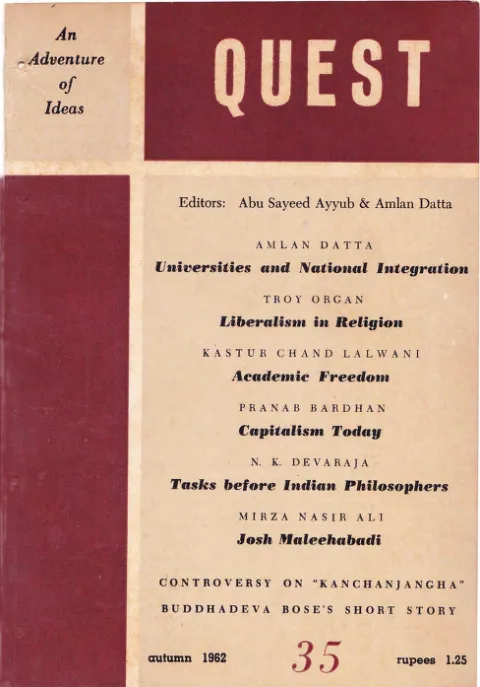
Quest
Summary
Quest No. 35 (cover ‘autumn 1962’; contents page ‘OCT./DEC. 1962’) is a 120-page Bombay quarterly sponsored by the Indian Committee for Cultural Freedom, edited by Abu Sayeed Ayyub and Amlan Datta with Nirad C. Chaudhuri and Laxmanshastri Joshi as advisory editors, Nissim Ezekiel as Reviews Editor and Mrs. Laeeq Futehally as his assistant. The issue’s argumentative centre is the university and the conditions of free intellectual work. Co-editor Amlan Datta opens with a case for retaining English as the common academic language of Indian universities against a switch to Hindi or the regional languages; Troy Wilson Organ, an Ohio philosopher recently at Santiniketan, argues that religion can only be liberal if it adopts the self-correcting method of science; Kastur Chand Lalwani turns a year of American observation into an indictment of lay government, loyalty oaths and ‘sponsored research’, which the editors append a signed rejoinder to; Pranab Bardhan asks whether post-war American capitalism has changed in kind or only in degree; and N. K. Devaraja’s Rajasthan Philosophy Conference presidential address asks Indian philosophers to stop choosing between Sanskritist self-congratulation and imported linguistic analysis. Amit Kumar Nag supplies a long sociological account of the Nagas and the ‘civilizing agencies’ that unsettled them, and Mirza Nasir Ali a critical portrait of the Urdu poet Josh Maleehabadi.
The second half of the issue is literary and critical. Tibor Meray, the exiled Hungarian journalist, remembers the Korean poet and Shakespeare translator Chung-sik Sul, whom he watched being tried and executed as an ‘American spy’; four poems by Adil Jussawala, Pradip Sen and G. C. S. Marar precede Buddhadeva Bose’s long Bengali story ‘We Three’ in Jyotirmoy Datta’s translation. An ARTS section stages a two-sided controversy over Satyajit Ray’s Kanchanjangha - flagged on the cover as ‘CONTROVERSY ON “KANCHANJANGHA”’ - with Jyotirmoy Datta defending the film as a mirror Indian audiences refuse to look into and P. Lal reading it, more sceptically, as India’s first ‘anti-film’; four unnumbered plate pages of film stills, credited to Miss Marie Seton and listed nowhere in the contents, sit between them. Ten signed book reviews and four unsigned-on-the-contents-page SHORT NOTICES by Laeeq Futehally close the issue, ranging over Tutuola, Pasternak, Romila Thapar’s Asoka, the Cold War, ex-Nazis in Bonn and Aldous Huxley, followed by a single letter from H. R. Pasricha continuing a quarrel from the Monsoon number.
Essays
A Common Language for Indian Universities
By Amlan Datta
Amlan Datta argues that Indian universities are dangerously isolated from one another and that adopting the regional language as the sole medium of higher education would complete their separation. He wants permanent residential posts for guest professors, systematic exchange of teachers between universities, and above all a single common academic language. Conceding that the mother tongue cannot be replaced for spontaneity of thought at lower levels, he insists the common binding language of higher education must be either English or Hindi, and that it should remain English: more books, more business and more international traffic pass through it, Bengali or Marathi or Tamil has more to learn from English than from Hindi, and translation introduces a time lag that instantaneous national debate cannot afford.
His case is explicitly political rather than merely pedagogic. Academic Balkanisation, he writes, would strengthen cultural and ultimately political fragmentation at a moment when India has ‘formidable antagonists across our borders’. He anticipates the objection that one need not care about national integration and answers it from the European example, from the needs of development planning and from the constitution’s silence on secession. He also answers the charge that English held back the regional languages: contact with English enriched them, and the gulf between Bharatchandra and Rabindranath is inexplicable except through the widening of horizons. His sharpest warning is reserved for Hindi: favoured by political patronage and close kin to the other Indian languages, it could displace them at home in a way English never did, reducing them to ‘dialects spoken by women at home’ and provoking resistance led by second-rank leaders.
- All-India contact between universities amounts to little more than annual Christmas conferences and occasional memorial lectures; Datta wants guest-professor residencies and planned teacher exchange instead.
- Regional language as sole medium of higher education would ‘Balkanise’ the country academically and feed political fragmentation.
- The mother tongue must be retained and enriched, but higher education needs a second, common medium; the real choice is only between English and Hindi.
- He chooses English on practical grounds - volume of books, international intercourse, and the fact that Indian languages learn more from English than from each other.
- A proposed enforcement mechanism: after a trial period, students might be required to answer at least one-third of examination questions in English or the mother tongue.
- Hindi, favoured with political patronage and closely akin to other Indian languages, is the greater threat to the regional languages than English ever was.
Liberalism in Religion
By Troy Wilson Organ
Troy Wilson Organ separates two things usually confused: liberalism as a way of holding beliefs and radicalism or conservatism as the content of belief. Crossing ‘methodological’ against ‘terminal’ liberalism he generates eight positions, then uses the distinction historically. Post-Reformation Christianity, he argues, allowed methodological liberalism - reason, revelation, mysticism, shared experience - while forbidding any conclusion but the orthodox one, which is no liberalism at all: ‘To tell a man that he is free to think so long as he arrives at a specified conclusion is to mock him.’ Modern science did the reverse, permitting any conclusion while insisting on one method, and its authority rests not on deduction or sense experience or usefulness but on intersubjective verifiability - the standing invitation to repeat the experiment.
He then sets five principles for a religion that would be liberal in the scientific way: no knowledge is certain; no method other than the scientific method of knowing is possible; the method implies no metaphysics; nothing contradicting an empirically verifiable proposition may be supported; and no belief may be held that is not pragmatically justified. The consequences are drawn deliberately: the liberal religionist will not pray for rain, but may believe in a deity, because absence of proof is not proof of the alternative, and may hold beliefs about survival after death on pragmatic grounds - while stopping short of inventing heavens of bliss. The closing section compares prospects in the two countries he knows. America, he says, is in retreat - fundamentalist sects, Billy Graham, neo-orthodoxy, the John Birch Society on campus, the middle-aged professor as the only liberal in the room - whereas India, standing ‘with one foot in the Stone Age and one foot in the Atomic Age’, may yet produce a liberalism in religion unlike the Western kind.
- Liberal/dogmatic describes how beliefs are held; radical/conservative describes what they are about - crossing these with methodological/terminal yields eight positions.
- Western religion since the sixteenth century granted method but denied conclusions; science granted conclusions but fixed the method.
- Science’s warrant is intersubjective verifiability, not deduction, sense experience or pragmatic fruitfulness.
- Five principles are laid down for a cognitively serious liberal religion, including that no belief contradicting an empirically verifiable proposition can be held.
- Absence of scientific proof of deity is not proof of non-existence, so belief in deity remains open to the liberal religionist.
- Organ reads mid-century America as growing illiberal and thinks India, with its tradition of tolerance, the more likely site of methodological liberalism in religion.
Academic Freedom
By Kastur Chand Lalwani
Kastur Chand Lalwani, a teacher formed in the British academic tradition, opens by doubting that Indian teachers and administrators enjoy the freedom of thought they had before 1947, and says that if so ‘our intellectuals have paid a heavy price to obtain the country’s liberty’. Wanting to know which model post-1947 Indian educational reconstruction was copying, he rules out the West European and the Russian and concludes India is going ‘the American way’ - so he spends his study leave in the United States reading the literature of American academic freedom. Ray Ginger’s account of the Scopes ‘monkey trial’ leads him back to Henry Dunster’s forced resignation from Harvard in 1654, through eighteenth-century religious conformity, the post-Darwin Fundamentalist campaigns, and then to the twentieth-century displacement of the threat from the church to ‘big business’ and private fortune, documented from the 1915 Report on Academic Freedom, Veblen, Hofstadter and Metzger.
The substantive charge is that American universities are governed by laymen - trustees who in law are the university and who hire and fire - with the president as a businessman in academic garb presiding over ‘a planetarium of deans’. He piles on the machinery of nervousness: the Feinberg law, the loyalty oath, the janitor Hjalmar Anderson’s refusal to sign one, the House Committee on un-American activities, a poll in which 53 per cent of Los Angeles social-science teachers felt less free than five years before and over 20 per cent thought it dangerous to discuss the Bill of Rights. His final target is ‘sponsored research’, which he thinks narrows the horizon of knowledge and subordinates universities to money-earning, quoting Whyte, Gengerelli and Norbert Wiener. Throughout he draws the Indian parallel - the UGC-chaired committee drafting a Universities Act for the older universities, victimisation of Bengal teachers on secret police reports, the flight of talent from teaching - and ends by contrasting India’s ‘vogue of a big laboratory’, built with imported money and technology, with the stick-and-string improvisation of the Bose-Ray-Raman generation.
- Lalwani’s premise: freedom of thought for Indian teachers and administrators may be narrower after 1947 than before.
- He identifies the American, not the British or Soviet, model as the template for post-Independence Indian university administration.
- The American history he assembles moves the chief menace to academic freedom from ecclesiastical control to business-dominated lay government.
- Loyalty oaths, the un-American activities committee and ‘suspect’ proscriptions are treated as a measurable chill, with survey data on teachers’ self-censorship.
- ‘Sponsored research’ is his central worry: foundation and government money channels enquiry towards organisation-favoured projects and away from individual work.
- The Indian application is explicit - a drafted Universities Act, police-report victimisation in West Bengal, and big laboratories built on imported money in a bureaucratic setting.
- The editors print a rejoinder at the foot of p.27 noting that Lalwani’s criticism of America rests almost wholly on American sources.
Capitalism Today
By Pranab Bardhan
Pranab Bardhan takes the American economy as capitalism ‘par excellence’ and asks whether the changes of the previous few decades amount to an epochal transformation. He works through the components of effective demand. Personal consumption has fallen as a share of demand but shifted decisively to durables - ‘Not tea, but TV’ - and consumer asset formation, financed by instalment credit that rose three times as fast as personal income in the fifties, is widely read as a stabiliser; Bardhan doubts it, noting consumer inventory cycles and an insurance survey finding the average American family three months from bankruptcy. Business spending is steadier but its technological dynamism need not generate investment, since innovations that cut depreciation lower capital requirements and amortisation reserves let big corporations innovate at a low rate of net investment. Wasteful expenditure - 551 brands of coffee, tail fins, twelve billion dollars of advertising - props up demand at the cost of productivity. Public expenditure, above a quarter of national output, is dominated by defence, and he cites the estimate that one heavy bomber equals a modern brick school in more than thirty cities.
The second half turns to politics and social relations. Against the Marxist claim that a capitalist state cannot regulate capital, he substitutes a ‘multiple pressure-group polity’ in which organised labour, farmers and consumers also count - no American government will enter private housing, but none can impose draconic wage cuts either. Against the ‘income revolution’ he sets Sweezy on corporate savings and unrealised capital gains, and Denison on the constancy of labour’s functional share. He accepts the atrophy of competition and the oligopolisation of society, rejects Burnham’s managerial revolution on the empirical evidence, and endorses C. Wright Mills’s power elite. His conclusion is that what is central to capitalism is not the method of surplus appropriation but the role of the individual, and that de-individualisation through giant organisation is common to capitalist and communist societies alike.
- Post-war American prosperity is steadier but not faster than the 1918-29 record: 2.2% average annual real GNP growth 1945-56 against 2.9% in 1918-29.
- Consumer durables and instalment credit are read by others as stabilisers; Bardhan treats debt-financed consumption as potentially as volatile as debt-financed investment.
- Advertising and planned obsolescence are structural, not incidental: about 12 billion dollars by the end of the fifties, over 15 billion with related activities.
- The Marxist theory of the capitalist state is replaced by a multiple pressure-group polity that constrains capital as well as labour.
- Claims of an ‘income revolution’ are discounted by corporate savings, capital gains and expense accounts, and by the constancy of labour’s functional share.
- Burnham’s managerial revolution is rejected empirically; Mills’s tightly-knit ‘power elite’ is accepted.
- The real transformation is the disappearance of the inner-directed entrepreneur - and that de-individualisation is shared by communist societies, so it cannot be charged to capitalism alone.
The Tasks before Indian Philosophers
By N. K. Devaraja
N. K. Devaraja’s presidential address to the Rajasthan Philosophy Conference of January 1962 describes philosophy as facing an unprecedented crisis in both subject matter and method: the demand for evidence has unsettled traditional philosophy and linguistic analysis threatens to cut it off from the questions that gave it its aura. In India the positivist challenge has produced a stand-off. At one end are scholars who rehearse the glories of the ancient Rishis; at the other, admirers of Wittgenstein, Carnap and perhaps Sartre who will not tolerate the metaphysics of the Mahayanists and Vedantists. Devaraja rejects both. The traditionalists fail to meet a demand for evidence that he takes as a sign of intellectual maturity and ignore values made possible by science and by the new volume of cultural traffic; the analysts have merely exchanged one inferiority complex for another, producing expository papers or pale imitations of Western discussion where the previous generation at least had the patriotic mission of interpreting ancient wisdom.
He then names the historic imbalance he wants corrected. Ancient India produced the Astadhyayi, the Arthasastra and the Kamasutra and scaled spiritual heights, but none of its great philosophers took an interest in mathematics or the sciences of his time, and none produced a major treatise on ethics, socio-political philosophy or aesthetics; measured against Plato and Aristotle or Kant and Hegel, even Nagarjuna, Dharmakirti, Sankara and Ramanuja look partial. He blames two factors: the repetitive character of Indian socio-political and economic experience, and the preoccupation of the best minds with the transcendent, which left moral and political norms to dogmatic law-givers like Manu and Yajnavalkya. Since the old dogmas underwrite the four varnas and four thousand castes as much as the values we want to keep, they cannot be appealed to now. The constructive task he sets is a philosophy of values equal to the new experience, and he offers Gandhi - punctual, exact in his accounts, scientific in his passion for experiment, morally indignant as Socrates, spiritually ardent as Tukaram - as the phenomenon Indian philosophers of value ought to be analysing.
- Delivered as a presidential address at the Rajasthan Philosophy Conference, January 1962 (footnoted on the first page).
- Indian philosophy is split between traditionalist exhortation and imitative analytic philosophy; Devaraja rejects both as failing the new nation’s intellectual needs.
- The positivist demand for evidence is welcomed as a sign of maturity; the positivist restriction of philosophy to clarifying scientific statements is not.
- Philosophy’s proper task is analysing and appraising the value-bearing consciousness of man, not promoting scientific research.
- Ancient Indian philosophy is faulted for producing no major work on ethics, socio-political philosophy or aesthetics, and for ignoring mathematics and the sciences.
- Older dogmas cannot ground today’s values because they equally support the caste order we wish to demolish.
- Gandhi is proposed as the model subject for a new Indian philosophy of moral and religious values.
The Naga Sociological Background and the Impact of Civilization
By Amit Kumar Nag
Amit Kumar Nag, a journalist specialising in Assam tribal life, surveys Naga society and then the agencies that changed it, reaching finally for an explanation of what he calls the Naga impasse. The first half is descriptive: some forty tribes on the Indian side and four principal ones in Burma, sharing broad cultural similarity but differing in dialect, custom and religious practice; contested and probably diverse origins, traced by J. H. Hutton’s collection of migration legends to almost every point of the compass; the early notices in Ptolemy, the Moghul chronicler Saiab-ud-Din Talish and Tavernier; political forms ranging from hereditary feudal chieftainship among the Semas to ‘extreme democracy’ among the Angami and Lhota; the morung or bachelors’ dormitory as the central disciplinary and educational institution; headhunting explained by the belief that soul-substance can be transferred; the two forms of marriage, formal and informal, with no stigma attaching to either; and a qualified account of women’s freedom before marriage and hard work after it.
The second half is a list of ‘factors of change’ - government, Christian missions, modern education, medicine, the two World Wars, and other contacts. Suppression of headhunting made cultivation safe but removed the discipline that filled the morung; missions abolished rather than remodelled the Feasts of Merit and the sacrificial feasts and weakened the system of social control; mission schooling is judged, on J. P. Mills’s 1931 Census testimony, ‘an evil rather than a good’ where it taught boys to expect a government ‘sitting-and-eating’ job; medicine displaced the medicine-man; the Second World War threw the Nagas into world politics, brought Japanese occupation of some nine hundred square miles and, with the INA’s victories over better-equipped white troops, destroyed the notion of Anglo-Saxon invincibility. Nag closes with Toynbee’s ‘consciousness of being disinherited from one’s ancestral place in society’, the collapse of the old balance between reality culture and value culture, the decline of wood-carving and song, and an insistence that the Nagaland problem is neither headhunters’ revenge nor one adventurer’s day-dream but a malaise that needs tackling at its own depth.
- About forty Naga tribes on the Indian side, with wide internal variation in language, custom and polity, and no single origin.
- The morung (bachelors’ dormitory) is treated as the pivotal institution of training, discipline and defence; its decay is the recurring index of social change.
- Headhunting is explained as a fertility practice grounded in beliefs about transferable soul-substance, and was still practised in unadministered areas.
- Six agencies of change are itemised: government, Christian missions, modern education, medicine, the two World Wars, and non-tribal penetration of the hills.
- Missions are charged with abolishing rather than adapting valuable customs and with destroying a working system of social control.
- Colonial-era testimony is quoted at length, including a Deputy Commissioner’s plan to suppress girls’ sleeping houses by taxing them as dwellings.
- The Second World War, Japanese occupation and the Indian National Army are given decisive weight in politicising the Nagas.
- The conclusion refuses both the ‘revenge of headhunters’ and the ‘single adventurer’ explanations of the Naga conflict.
Josh Maleehabadi
By Mirza Nasir Ali
Mirza Nasir Ali gives a four-part critical biography of the Urdu poet Shabbir Hasan Josh Maleehabadi, born 1898 near Lucknow into a landed Afghan family of poets. Part I is life: tutors including Mirza Mohummad Hadi Ruswa instead of school, an unfinished Cambridge School Certificate, six months at Santiniketan, then wide private reading in Dante, Shakespeare, Milton, the Romantics, Goethe and Tolstoy alongside Hafiz, Khayyam, Sadi, Ghalib, Kalidas, Tulsidas, Kabir and Tagore; a father who disinherited him for wanting to be a poet and then relented; ten years of literary office in Hyderabad ending in dismissal, officially for a slander on the Nizam; the journal ‘Kaleem’ in Delhi, the government monthly ‘Aajkal’ from 1948, and removal to Karachi in 1958 to supervise an Urdu encyclopaedia. Ali is candid about the man - unkeepable appointments, practical jokes, bawdy talk in religious gatherings, letters printable only after expurgation - and equally about his generosity.
Part II traces the poetry’s movement from conventional ghazal love-lyric to the nazm, which permits sequence and development, and explains the ghazal form for readers without a European analogue, offering Pope’s couplets and Mir as the nearest comparison. Josh’s turn to Hindu-Muslim unity, anti-imperialism and social inequality is placed in the nationalist twenties and thirties, with the judgment that like Shelley his fervour stayed emotional: without the constructive faculty of a political philosopher he could not trace a course of action. Ali reads him as a sceptic in polemic and a believer in poetry, a pyrrhonist who still venerates the selfless of every religion, and notes bluntly that ‘Josh is least revolutionary of all when it comes to women’. Parts III and IV praise his command of words and his quatrains while cataloguing the defects: unequal and sometimes jejune verse, didacticism, and a stock imagery of rose-gardens, nightingales and cup-bearers that makes him read like the catalogue-poetry of Kipling and Osbert Sitwell. The defence is that Urdu poetry is not to be judged by Western canons, and that Josh’s simplicity - no symbolism, no imagism, no surrealism - is closer to Milton’s sine qua non than to a defect.
- Josh (Shabbir Hasan, b. 1898, Maleehabad) is placed in a landed Afghan family with a three-generation poetic tradition; his output is claimed at over two hundred thousand lines.
- The Tagore parallel is used four times over - birth, family literary tradition, landed aristocracy, prolificacy - and later inverted when Josh pities Tagore for being born among people who did not understand him.
- His career turns on the ten Hyderabad years (1925-34), which politicised his verse and ended in dismissal.
- The technical heart of the essay is the shift from ghazal to nazm, with an extended explanation of the ghazal’s non-sequential unity for readers who have no European equivalent.
- Ali judges the revolutionary fervour genuine but unconstructive - emotional like Shelley’s, with no remedy proposed.
- Josh’s religious position is read as scepticism in argument and belief in poetic practice, with Voltairean derision reserved for priests.
- The essay states without dissent that Josh confines women to mistress, housewife or mother.
- Faults named: unequal verse, didacticism, stock phraseology, weak structural unity - outweighed, Ali says, by an indefinable appeal.
Remembering a Poet
By Tibor Meray
Tibor Meray’s memoir opens on the night of 22 August 1951 at Kaesong, where explosions had interrupted the Korean armistice negotiations and the Korean-Chinese and American liaison officers were disputing whether the town had been bombed. Standing beside Colonel Chang, Meray was struck by the interpreter’s voice rendering the Colonel’s fury into English - ‘If you are a true military man and a man of conscience, you cannot deny these adamantine, rocklike proofs’ - and only later learned that the major was also the Korean translator of Shakespeare and one of his country’s foremost poets. The two became friends over rice-wine and arguments about the Macbeth text and whether ‘Ode to the West Wind’ can be translated. When Chung-sik Sul wrote an epic poem thanking the Hungarian-donated hospital that had treated his heart, Meray had it translated with the help of Wilfred Burchett and Alan Winnington and published in Budapest, and took down Sul’s life story to introduce him: born 1912 at Tan Chun, expelled from school in Seoul in 1929 for the Kwang-ju strike, studies at Mukden and Peking, a degree at a Protestant university, Mount Union College in Ohio and Columbia, work for the US Military Government’s Public Information Department, then the underground Communist Party out of disappointment with the Americans and their support for Syngman Rhee.
The second half is the betrayal. When Meray’s Korea book was to appear, the Korean Embassy supplied a list of names to be deleted and Sul’s was among them; no explanation was given. Returning for the armistice signing in 1953, he found Sul gone from the delegation and then saw him in a Pyungyang courtroom as the fourteenth accused in a show trial of ‘American spies and conspirators’, charged with concealing his US Military Government employment - an accusation Meray thought proved his innocence, since the fact was too widely known to conceal. Meray, still a believer, searched his memory for something suspicious and found only a look in Sul’s eyes when told that Korean suffering was defending world peace: ‘when the fighting parties are great powers … why do they have to shed in their conflict the blood of my small people?’ Sul was executed. After the 1954 rehabilitations Meray proposed to Burchett that they petition Kim Il Song for Sul’s rehabilitation; Burchett disagreed and nothing came of it. The piece ends as an act of duty to the memory of a poet and a friend.
- A first-hand account by a Hungarian Communist Party correspondent of the Kaesong armistice talks and of the poet-interpreter Chung-sik Sul.
- Sul’s biography is given in his own words: South Korean birth, expulsion for anti-Japanese student action, American university education, employment by the US Military Government, then the underground Communist Party.
- He translated Hamlet, Romeo and Juliet and Macbeth into Korean; the Macbeth translation remained in manuscript.
- Censorship precedes the trial: the Korean Embassy has Sul’s name struck from Meray’s Hungarian book with no reason given.
- The 1953 Pyungyang trial is read as the local application of the Rajk-type purge - liquidation of ‘native’ communists by the Moscow-trained group.
- Meray argues the concealment charge is self-refuting because Sul’s US employment was common knowledge.
- The only ‘crime’ he can find is Sul’s unspoken question about why a small people should bleed for great powers’ conflicts.
- A written appeal to Kim Il Song for posthumous rehabilitation was abandoned when Wilfred Burchett refused to join it.
Love
By Adil Jussawala
A short lyric in four quatrains under the section head POETRY. The speaker recalls offering a woman nothing but hard, barren things - cracked rock, thistles, wildthorn, grit, ‘a desert without shade’ - and calling the gift love. Her eyes, first ‘crushed cornflowers’ seeking late for ground, harden into sapphires to match the gift; what the dry rock breeds is mantids and scorpions. The last stanza asks how to explain a death by voluntary reversion to a former state, hers being an ache to move back to parched beds and sand, and closes on the couple covering the dust and dead scorpions, hiding the thorns and the grit, ‘And called it love’. The refrain carries the whole weight: love as a name applied, by agreement, to something arid and self-destroying.
- Four quatrains, each closing on a variant of the refrain ‘And called it love’.
- The central conceit is a gift of barren and injurious things - rock, thistle, grit, desert - accepted and renamed.
- The woman’s eyes move from crushed cornflowers to sapphires, softness hardening to match what she is given.
- The ending is an act of mutual concealment rather than of feeling: the dust, dead scorpions, thorns and grit are covered over.
- First of two Jussawala poems in the issue, given separate contents lines and separate pages.
Memory
By Adil Jussawala
Three seven-line stanzas built on a single figure: memory as a starved crow beating its horned beak against a stone weathered smooth by wind, frost and primeval lava, glancing sunlight like a mirror. The second stanza empties the landscape - no weeds, no flowers, no marching children, no battle-drum, no toppled gods - repeating the flat stone to the hills and along a tedious river. The third turns the desolation into a question and an answer: even if the blood is frozen to this landscape and the heart dry, the ravenous crow will go on tapping each stone and prying it loose, its business being to attack rather than to eat, until under a flake worn smooth by fire and water live legs scamper. The poem ends on that involuntary persistence, memory as compulsion rather than consolation.
- A single extended metaphor: memory as a starved crow working at an unyielding, weather-smoothed stone.
- The middle stanza is a catalogue of absences - no flowers, no children, no battle-drum, no toppled gods.
- The closing turn insists the crow keeps working even when blood is frozen and the heart dry.
- The last image - live legs scampering under a lifted flake - makes memory’s reward small, sudden and unsought.
- Second of Adil Jussawala’s two poems in this issue.
Come with me to the water’s edge
By Pradip Sen
A short poem of address. The speaker asks a companion to come to the water’s edge and help dredge the sands for stone, explaining that he is alone and filled with fear and that ‘stones are still within / Having no sense of sin’. As the time draws near it is doubt that infests him with fear and divests him of faith, making the mind a misshapen thing. The closing movement states the position flatly: now that neither design nor accident can prevent or alter the final reckoning, what he feels is fear and not death. The last stanza sets passion against mortality - passion turned the rose red, but when a man lies dead his spent flesh spurns the rose - and ends on the claim that what grows out of death is fear, not faith.
- Cast as a request to an unnamed companion: come and dredge the sands for stone.
- Stone is envied for stillness and for having ‘no sense of sin’.
- Doubt, not death, is named as the agent that destroys faith and misshapes the mind.
- The final reckoning is treated as fixed, alterable by neither design nor accident.
- The poem closes by insisting that fear, not faith, is what grows out of death.
Dusk
By G. C. S. Marar
An eight-line poem in two quatrains, wholly descriptive and aural. The first quatrain has the darkening night calling ‘Owl by owl’ to its own still hurt while the shadow falls ‘Wing by feather’ where fear has restless feet, small and swift and lost in haunted wheat. The second turns to texture and sound: feathers soft as the light that sleeps in steel, air knotted, the domed hills pealing hollow as sepulchres, and beneath the hovering hours the closing line - ‘Sound calls up the stillness that devours’ - which inverts the ordinary relation of sound and silence. The compression is extreme; there is no speaker and no argument, only a dusk landscape whose quiet is predatory.
- Two quatrains, unnamed speaker, pure landscape-and-sound composition.
- The incremental constructions ‘Owl by owl’ and ‘Wing by feather’ carry the poem’s movement from call to shadow.
- Metallic and funerary imagery: light that sleeps in steel, hills pealing hollow as sepulchres.
- The final line makes silence, not sound, the devouring force.
- The shortest item in the issue’s poetry section.
We Three
By Buddhadeva Bose
A long story told by Bikash, looking back from after the Second World War to Dacca’s Purana Paltan in 1927, when he and his two neighbours Asit and Hitangshu - the only three households in an open field of toads and wet grass - fell in love with the same girl. She is Antara Dey, daughter of the family renting the ground floor of Hitangshu’s father’s Tara Kutir; her family calls her Taru, and the boys, after Bikash sees a print of the Gioconda, secretly rename her Mona Lisa, a private possession of a name. The comedy of the first movement is all social terror: whether to accept Mr Dey’s casual invitation, sandals leaving dirty patches on a polished floor, the disgrace of failing to return her folded-hands greeting, Bikash unable to raise his eyes or speak for fear of betraying his Dacca brogue while the Calcuttan Asit produces ‘mashima’ effortlessly.
The story’s centre is her typhoid. For a month and a half she is ‘ours’: Asit biking through rain for ice, Hitangshu waking the depot by the river at two in the morning, Bikash - who cannot ride a bicycle - shadowing her mother, measuring medicine, carrying the doctor’s bag, and keeping the night vigil in which she wakes, asks who he is, and asks him not to slip away while she sleeps. That secret he tells no one. She recovers; then the wedding to the handsome, perfumed Hiren Babu from Calcutta, whom all three promptly begin to imitate; then pregnancy, misread by the boys as a spitting sickness; then, after a night and a day of screaming that the narrator hears as ‘the primeval cry of Earth the Mother’, Mr Dey’s trembling lips forming the words ‘Come in and see’. The coda disperses everyone in a few sentences - Hiren Babu remarried within a year, the Deys transferred, Asit dead of some disease at Tinsukia, Hitangshu married and settled in Germany - leaving the narrator alone with a dream that breaks through his working hours. Translated from the Bengali by Jyotirmoy Datta, with footnotes explaining mashima, Ashwin, Aghran, Vijaya, the shanai, the turmeric bath, the dhoti and the Bengali forms of address the boys agonised over when drafting their letter.
- Framed as retrospect from after the war to Purana Paltan, Dacca, in 1927-28, with the place and date incanted throughout.
- Three friends share one unspoken love; the secret name ‘Mona Lisa’ is the mechanism by which they privately possess her.
- Class and provincial anxiety drive the comic first half - the Calcuttan’s ease against the Dacca narrator’s terror of his own accent.
- Her typhoid gives the three an ‘occupation’; the narrator’s night vigil is the story’s emotional centre and stays his secret.
- The unsendable letter, drafted to avoid choosing between ‘you’ and ‘thou’, is a set-piece on Bengali forms of address.
- Pregnancy and death in childbirth are narrated entirely from outside the room, as sound; the boys are never allowed a glimpse of her.
- The coda kills or scatters every character in a paragraph, leaving memory as the only survivor.
- Translated from the Bengali by Jyotirmoy Datta, with thirteen explanatory footnotes; the translator is credited only at the end of the story, not on the contents page.
Kanchanjangha, A Disquieting Mirror
By Jyotirmoy Datta
Jyotirmoy Datta opens the ARTS section by quoting, at length and without comment, hostile letters about Satyajit Ray’s Kanchanjangha published in an English daily - ‘new in form but hollow in content’, ‘a minute quantity of food served on a beautiful golden plate before a famished man’, ‘too bizarrely intellectual to be called art for the people’. He reads the complaints as self-revealing. The correspondents concede the film’s formal beauty and then deny it content because they wanted ‘life-force’ and a tale of the heart: ‘The Indian viewer is sentimental; he considers his money well spent only if his endocrine glands are squeezed so mercilessly that his eyes sprout tears as fast as artesian wells.’ Ray refuses those satisfactions - the anglophile Rai Bahadur is not knocked on the nose, Manisha may yet end up as Mrs Bannerji, and the reconciliation of Anima and her husband is a domestic compromise of petty sacrifices rather than a triumph of love. Worse for the ‘good Bengali’ is the dialogue, whose English words sit in the Bengali ‘like too many raisins in a cake, or rather, flies in milk’, exposing the khichry language a language-proud Bengali uses even while in love.
Against the charge that the beauty is separable from the content, Datta argues that unlike Pather Panchali or Aparajita almost nothing in this film survives abstraction from its flow - the shot of Manisha pressing her face to a tree against a blurred Gurkha band works only as a composite of colour, sound and the contrast between a lonely girl and a crowd in the most public spot in Darjeeling. He defends the accidental structure: by moving the characters to a place where social restraints loosen, Ray makes the accidental seem almost inevitable. He also concedes a cultural verdict - there has been no classical period in Bengali culture, no Kalidasa or Racine to teach the poetry of form - and notes in a footnote that the stills chosen for Quest were picked for their bearing on his theme rather than as photographic gems. The essay ends on the Rai Bahadur turning his back on the peak at the moment the cloudbank shifts, and on the Nepalese boy’s song that neither he nor we understand.
- Built out of quoted hostile newspaper letters, which Datta treats as evidence about the audience rather than about the film.
- Ray’s refusals - no defeat of the Rai Bahadur, no clear romantic victory, a marriage patched up by commonsense - are read as deliberate ambiguity.
- The English-studded Bengali dialogue is identified as the deepest source of offence, because it holds a mirror to the bilingual viewer.
- Unlike the Apu films, Kanchanjangha yields almost no shot that keeps its power outside the film’s flow.
- Darjeeling as setting is what licenses the accidental: social restraints loosen and chance encounters acquire the look of inevitability.
- Datta argues Bengali culture lacks a classical period and therefore a training in form, generalising the point cautiously to the rest of India in a footnote.
- A footnote records his own part in selecting the stills that accompany the article - the plate section the contents page never lists.
Kanchanjangha, An Experiment in Anti-Film
By P. Lal
P. Lal answers Datta from the other side of the controversy by taking Kanchanjangha seriously as a specimen of a genre. He begins with John Grierson’s 1930s prediction that the French avant-garde would give way to the propagandist film, notes how wrong it was, and places Ray’s film in a lineage running through Resnais’ Marienbad, which critics call the classic anti-film. Kanchanjangha, he says, ‘is not quite as experimental and successful as that, but it is an anti-film nonetheless’ - a serious spoof, an elaborate doodle of film and feeling, announced by the Nepalese boy winking from an oversize ‘K’ on Ray’s own poster. He then tests the film against the requirements of the form: a story allowed to meander with no real resolution, unity imposed by directorial skill rather than arising from the material; the avoidance of physical conflict, with the clatter of ponies drowning Mr Banerjee’s proposal; the refusal of chief characters, so that the cast is a clutter of vignettes with Anil Chatterjee a ‘main’ character on three minutes of screen time and Lila on about three seconds; and the refusal of moral commitment.
It is on that last requirement that Lal turns critical. Quoting Ray’s Arun - ‘Scratch us and see: we are both good’ - he objects that ‘the answer to a disintegrated civilisation is not a disintegrated poem, and the presentation of confused and amoral people is not to be achieved through a confused and amoral film’, and notes that none of Ray’s earlier films lacks responsible moral comment. He catalogues the imposed order (the shooting script’s numbered map of Observatory Hill) against the improvisation (English and American tourists recruited into shot, dahlias added because Marie Seton pointed at them), and then itemises the cliche symbols with open mockery: mist for mental confusion, tortuous roads for complicated relationships, amorous pigeons behind a courting couple, a triangular slip-chute for the triangle, saffron and white for the virginal girl and glaring striped purple for the adulterous one. He finds the blind beggar and the boy’s song fuzzy, Ashok’s transformation implausible, the uncle crudely drawn, and the loss of voice perspective in long shots - which Marie Seton called subtle - merely repetitive and irritating. The essay ends on a question that doubles as a verdict: ‘How does one assess an anti-film except by anti-criticism?’
- Locates Kanchanjangha in an international anti-film lineage (Resnais, Cocteau) and in the wider anti-art of Robbe-Grillet, Aragon, Benn and Pasolini.
- Tests the film against four generic requirements: meandering story, no physical conflict, no chief characters, no moral commitment.
- Screen-time data is used as evidence of deliberate diffusion: Anil Chatterjee three minutes as a ‘main’ character, Lila about three seconds.
- Lal’s central objection is moral, not formal - a confused subject does not license a confused film.
- The tension between the numbered shooting-script map of Observatory Hill and on-the-spot improvisation is treated as essential to the form.
- A long mocking inventory of cliche symbols: mist, tortuous roads, pigeons, the triangular slip-chute, colour-coded saris.
- Marie Seton is cited twice as the on-set source, and once contradicted on the loss of voice perspective.
- Closes by claiming Kanchanjangha as the first Indian anti-film and the first colour anti-film anywhere.
Feather Woman of the Jungle
By S. Melluish
S. Melluish reviews Amos Tutuola’s fifth book, Feather Woman of the Jungle (Faber and Faber, 132 pp. 15s.), opening the BOOKS section. He begins sceptically with the reception of The Palm-Wine Drinkard, greeted with ‘an inebriated clamour of praise’ as the first important literary work in English by a West African published in London, and suggests that English critics, made fashionable in their sympathy for African national aspirations, were quick to seize on Tutuola as the portent of an indigenous Nigerian literature. The new book, he says, glows with the same auroral light and the same stamp of aboriginal procreation, and he documents its content generously: ten Yoruba Nights’ Entertainments in which an elderly chieftain recounts six journeys in search of ‘wealths’, meeting a fish-jawed creature that scratches his face, a feather-covered Jungle Witch who turns him and his brother into mud images and whips them daily for two years, a queen who has turned half her husband into a snake, an ‘immortal night woman’ six times his height, and a twelve-foot Death who threatens to put them all in his soup pot. Melluish concedes the stories have punch, vigorous assurance and sustained tempo, and that Tutuola’s colourful imagination is undeniable. His verdict is nevertheless that for many readers this fare is not merely unattractive but unbearable: the gawky language, apt though it is, becomes exhausting, and the reader jolted over the rough bumps and misplaced words is lucky to escape a kind of car sickness.
- Reviews Tutuola’s fifth book and reads its English reception as partly political fashion rather than literary judgment.
- Describes the form precisely: ten framed tales told by an old chieftain about six journeys in search of ‘wealths’.
- Quotes the grotesques at length, including the twelve-foot Death and the Feather Woman herself.
- Grants vigour, tempo and imaginative strength.
- Rejects the prose on grounds of cumulative strain rather than of incorrectness - the idiom is ‘apt’ but exhausting.
Courage of Genius
By C. L. Nahal
Printed under the running title ‘Pasternak’s Ordeal’, C. L. Nahal reviews Robert Conquest’s Courage of Genius: The story of Boris Pasternak (Collins and Harvill, 191 pp. 18s.). He notes the book’s significance as written by a poet about a poet and dedicated to a poet, Philip Larkin, and says that what is on trial in it is not only the Russian dictatorship but every totalitarian system where the artist cannot breathe freely. His most unusual move is to concede that much of the Russian anger in 1958 was genuine and was provoked less by Doctor Zhivago than by the Nobel award, and to blame the Nobel Committee for bad timing: the Russians have a real grievance that Chekhov, Gorky, Tolstoy and, in our own times, Sholokhov were passed over, and ‘it does look queer … that the Committee should think Winston Churchill good enough for the highest honour in the field of literature but not Leo Tolstoy’. Pasternak was thus caught between a home that maligned him and a West that glorified him for the wrong reasons, reading his book as a political novel.
Nahal quotes Pasternak’s letter to Khrushchev at length - ‘I am linked with Russia by my birth, life, and work’, ‘A departure beyond the borders of my country would for me be equivalent to death’ - and describes Conquest’s method as documentary rather than interpretative, resurrected from material already in the press but held together by an artist’s visible annoyance at the bullying of a brother artist. Almost half the book is appendices reproducing the campaign texts, of which he says nothing he has ever read as adverse criticism matches their vindictive tone: ‘a decadent poet’, ‘an artistically poverty-stricken and malicious work’. His closing judgment is that they did not liquidate Pasternak but that keeping a proud man alive in those circumstances may have been more harrowing.
- Frames the Pasternak affair as a test of every totalitarian system, not of Russia alone.
- Concedes that Soviet anger was genuine and partly provoked by the Nobel award rather than by the novel.
- Blames the Nobel Committee for bad timing and for a record of passing over Tolstoy, Chekhov, Gorky and Sholokhov.
- Objects that the West read Doctor Zhivago as a political novel, which was unfair to Pasternak in a different way.
- Notes that the book is documentary rather than interpretative, with nearly half of it appendices of the campaign texts.
- Ends on the claim that not killing Pasternak may have been crueller than killing him.
Problems of Indian Democracy
By Mahesh Desai
Under the running title ‘More Political Cliches’, Mahesh Desai reviews Problems of Indian Democracy, edited by P. D. Devnandan and N. M. Thomas for the Christian Institute for the Study of Religion and Society (210 pp. Rs. 4). He quotes the preface’s description of the book as the result of a corporate study by a group of Christian friends, mostly academics, and its closing hope for ‘more fundamental conversation, conversion and commitment’, and says that between those two quotations everything worth saying about the book has been said. The contents are promising - parliamentary democracy, national integration, planning for development, social justice, dynamic secularism, foreign policy, then twenty pages on each of four national parties, with an epilogue on the sources of Christian political concern - and the failure is therefore puzzling.
Desai’s diagnosis is that the group has not made up its mind about any of the ‘crucial’ issues, and that its air of condescending detachment is not compensated by any incisive statement of fact: social justice is reduced to an enumeration of legislative measures, foreign policy to the observation that Indian policy-makers are part-time preachers and part-time peacemakers, and planning to a substitution of cliche for thought. He picks out one ‘gem’ - that the Sarvodaya movement is a non-political expression of the Socialists with an individualistic approach - while conceding that the writing sharpens whenever it analyses Hinduism as a source of Sarvodaya, as the dominant influence in Jan Sangh politics, or as the mystique of Dharma in the Swatantra defence of ‘farm and family’. He then widens the charge beyond the book: most writing on Indian politics, Indian or foreign, recalls the fable of the blind men and the elephant. Poverty is the cardinal fact, development by consent on the Indian scale will pose more questions than political scribes can answer, and the parties fumble because none of them, not even the Congress, is big enough to lead the process or humble enough to follow it.
- The reviewer lets the book’s own preface and valediction do most of the damage.
- Central charge: the Christian study group has taken no position on any of the issues it calls crucial.
- Specific failures itemised - social justice as a list of statutes, foreign policy as a quip, planning as cliche.
- Concedes the book becomes sharp when analysing Hinduism’s role in Sarvodaya, Jan Sangh and Swatantra politics.
- Generalises to a critique of the literature: writing on Indian politics resembles the blind men and the elephant.
- Sets poverty as the cardinal fact that will determine the form and content of Indian democracy.
- Quotes De Tocqueville on India as the poorest and most miserable of civilised countries.
Asoka and the Decline of the Mauryas
By Ashin Das Gupta
Under the running title ‘The Good King Asoka’, Ashin Das Gupta reviews Romila Thapar’s Asoka and the Decline of the Mauryas (Oxford University Press, 276 pp. 45s.) at unusual length and with unusual method: he describes the book chapter by chapter with page references and then argues with its thesis point by point. The opening is disarming - ancient history as ‘a closed preserve of respectability where sedate antiquarians browse’, a world lost in trivialities for which the historians are hard to blame because they have so little to build on - and that is what makes Thapar praiseworthy, her gifted pen assisting an intrepid imagination. He identifies her governing attitude in the claim that Asoka was not a visionary but representative of his time, understood his age and realised in Indian terms what it demanded, and says this is a point a reader may reject but cannot ignore. He works through the sources chapter, the narrative from Asoka’s birth to death with its frustrating chronological digressions, the treatment of Buddhist accounts that are narrated and then discarded as monkish, the economic chapter based on Megasthenes and the Arthashastra, the administrative chapter, the religious-policy chapter, the reconstruction of the fifty years after Asoka that scarcely rises above a king-list, and the final chapter’s rejection of military weakness, Brahmanic reaction, Kosambi’s economic crisis and Nihar Ranjan Ray’s popular uprising in favour of a top-heavy administration and absent national consciousness.
The review then turns adversarial. He shows that her own paragraph on economic change forcing the political pattern in fact proves the reverse - that centralised empire helped trade - and mounts five objections to the central thesis that Asoka adopted Dhamma to conciliate a rising commercial class chafing at low social status: there is little concrete evidence of a spectacular expansion of Maurya trade; there is nothing to show the merchants felt humiliated, which is an assumption others may not share; no one has connected sixth-century-BC philosophical disputation with the commercial classes; she herself concedes that Asoka’s Dhamma was not Buddhism; and it is hard to see how preaching a new faith in a land of ancient beliefs could have helped the central power at all. His own conclusion is that Asoka preached Dhamma because he thought it right.
- A chapter-by-chapter account with page citations, unusually detailed for a periodical review.
- Identifies Thapar’s governing thesis: Asoka as representative of his age rather than in opposition to it.
- Praises her linguistic equipment and bibliography while calling some chapters plodding and the post-Asoka chapter little more than a king-list.
- Shows that her own example of economic change forcing political change actually demonstrates the reverse causation.
- Mounts five specific objections to the commercial-class explanation of Asoka’s Dhamma.
- Notes her own concession that Asoka’s Dhamma was not Buddhism, which weakens the political reading.
- Concludes that Asoka preached Dhamma because he believed it right, not to woo merchants.
Culture: An Introduction
By K. D. Valicha
Under the running title ‘Culture Analysed’, K. D. Valicha reviews B. S. Sanyal’s Culture: An Introduction (Asia Publishing House, 314 pp. Rs. 16.75) and begins with a compressed classification of it: pragmatic in intention, metaphysical in sensibility, analytic in methodology, holistic in outlook, missionary in aim and, as the author would like to think, harmonious in ideal. The purpose he states bluntly - ‘to defeat the communists. To save Culture with a capital C’ - which generates the two problems of ends and means. He then reports the system faithfully. Sanyal’s individual is not a particular but a systematic unity of reflexes, instincts, percepts, scientific categories, philosophical valuation, practical activities and educational activities, analysable in those terms but not reducible to any of them; culture is ontologically the realisation of values, in which value has a regulative function and hedonic feeling is its constituent; ideal culture is non-fixational, since any fixation of feeling at a lower level of experience checks development - and Communist culture is fixational because efficient feeling is fixed at the level of social theory and practice.
Valicha lays out the three linked processes Sanyal defines - acculturation, humanization and individualization, each preventing a different fixation and the last superseding the second - and reports that religion is what lends individuality to culture while history is the next means after education. He gives space to the distinction between writing history and making history, and to the claim that historical explanation involves ‘laws’ of history as major premises. He judges the chapter on gregational ethics the most brilliant part of the book, including its broad redefinition of genocide as ‘a revolutionary method of alienation and conversion’ of which Communism is accused. His verdict is cautious rather than dismissive: a compilation of a lifetime’s study that brings scattered approaches together and catches a major characteristic of the historical situation, difficult to judge simply because its abstractions are synthesised into a system, and best allowed to grow on the reader, since a cursory reading invites a rejection that would be ‘too easy and gratifying’.
- Opens with a six-term classification of the book’s intention, sensibility, method, outlook, aim and ideal.
- States the book’s purpose as anti-communist and culture-saving, which sets up its problems of ends and means.
- Reports Sanyal’s definition of the individual as a systematic unity that is analysable but not reducible.
- Explains the key concept of non-fixational culture and the charge that Communist culture is fixational.
- Sets out the triad of acculturation, humanization and individualization with page references.
- Singles out the chapter on gregational ethics, including a broadened definition of genocide, as the book’s best.
- Declines an easy verdict: the abstractions need time to grow on a reader rather than a cursory rejection.
The Writer’s Dilemma
By Uma Vasudev
Printed under the running title ‘Introspection’, Uma Vasudev reviews The Writer’s Dilemma (Oxford University Press, 88 pp. 12s. 6d.), a collection of essays introduced by Stephen Spender. She reads the volume as a series of reactions: against the depressive fabric of proof, ‘the real cloth-of-gold fabric of a possible Way’; against conditioning and conformity, a ‘mule-like, camel-like individuality’; against God, no-God or vice-versa, and against all ills, the creative genius. Although the contributors include a historian, novelists, a philosopher, a poet and journalists, they all represent a creative order, so each winds up his reasoning with an affirmation of faith in himself and in the public; the miraculous is always round the corner and, as Spender says in his introduction, the situation is ‘pregnant with impossibilities’. Her account of the balance is exact: the pessimism flows from the discussion of averages and generalities, the optimism from faith in a creative spirit that is born tough and a rebel. She quotes Richard Wollheim’s essay, The Consequences of Communication, for the fundamental point that it is lightly assumed that the age before mass culture was a period of diffused eccentricity and happy anarchy.
The review’s own contribution is to transpose the problem to India. Where Western writers fear that their public’s creative response will be killed by cheap mass media - brainwashing, subliminal advertising, commercial television, Westerns, comics - India has superstition, prejudice and dogmatic religion, and the effect is the same; the added danger is that the modern substitutes will replace the older ones without even an interval of possible awakening, while ‘the writers themselves are sunk in pitiful platitude’. So essays that at first seem of merely academic interest to countries like ours turn out to describe a similar problem: a cocoon of cliches and ready-made ideas here, matched by women’s serials and somatic drugs there. Her conclusion takes the book’s own line - only genius is transcendental, only the unpredictable has solutions to offer - and identifies the recurrent and most hopeful theme as the need for faith and the courage to wait.
- Reviews an OUP symposium introduced by Stephen Spender, whose contributors span history, fiction, philosophy, poetry and journalism.
- Characterises the book as a set of reactions, each ending in an affirmation of faith in the writer and in the public.
- Locates the pessimism in generalisation and the optimism in the toughness of the creative spirit.
- Transposes the mass-culture argument to India, substituting superstition, prejudice and dogmatic religion for commercial television and comics.
- Warns that in India the modern substitutes may displace the old without any interval of awakening, and that Indian writers are themselves platitudinous.
- Endorses the collection’s faith in the unpredictable and in genius as the only transcendental factor.
An End to Make-believe
By Sharokh Sabavala
Under the running title ‘Appraising the Cold War’, Sharokh Sabavala reviews Edgar Ansel Mowrer’s An End to Make-Believe (Duell, Sloan and Pearce, New York, 219 pp.). He offers two possible origins for the Soviet-American struggle - the closing days of the Second World War, where political analysts have a fulminating Churchill bypassed by a dying Roosevelt who was in turn lulled by Stalin; or, for an impartial observer, the end of the First, when Imperial Russia collapsed and the democracies took fright and tried first to strangle and then to isolate Communism. That effort was bound to fail, he argues, because Marxism began as a genuine reaction to Europe’s industrial revolution and its inequalities; but the reaction lost its idealistic impetus and turned into ‘a rigid, diehard, monolothic type of Capitalism’ while Western capitalists, under their own pressures, converted themselves into unwilling votaries of the welfare state. The struggle has thus been converted into a war between self-appointed emperors of the people exercising the powers of life and death in the proletariat’s name and the elected representatives of still more people.
He treats the book as journalism of a specific kind - written by a war correspondent of 1914 who ran the Chicago Daily News Berlin bureau, watched Nazism and Fascism rise, and suffered the frustration of having his findings disbelieved out of complacency. From that he draws the review’s best generalisation about democracies: they refuse to accept anything remotely unpleasant until it is almost too late, they would prefer to see and hear nothing that might upset the tenor of their lives, and yet they are so constructed that they cannot resist finding out what is going on, employing their best men for the task and then disbelieving them until one minute before midnight. Sabavala quotes Mowrer’s author’s note (‘Now, as always, the future is with the brave and the purposeful … Yet the West still holds the aces’) and says plainly that Mowrer does not pretend to be objective and may be accepted or rejected. The Indian application is the point of the review: a country that since independence has indulged in ‘so many pipe-dreams of peaceful co-existence’ can profit from an author’s frank exposure of his own country’s policy bungles. He compares the book’s aim with George Kennan’s more erudite attempt and ends on Goethe’s complaint that the trouble with democracy is that it has to wait for an enlightened public opinion.
- Two competing origin stories for the Cold War, Yalta-era and 1917-era, are set side by side.
- Communism is granted a genuine origin as a reaction to industrial inequality before hardening into a ‘monolothic type of Capitalism’.
- The reviewer’s strongest passage is a general indictment of democracies for commissioning intelligence and then disbelieving it.
- Mowrer’s credentials as a 1914 war correspondent and Berlin bureau chief are used to explain the book’s method and its grievance.
- Mowrer is explicitly non-objective, which the reviewer flags rather than conceals.
- The Indian lesson is drawn directly: pipe-dreams of peaceful co-existence deserve the same frank exposure.
- Compared with George Kennan’s more erudite treatment of the same problem.
The New Germany and the Old Nazis
By S. Natarajan
Under the running title ‘The Problem of Germany’, S. Natarajan reviews T. H. Tetens’s The New Germany and the Old Nazis (Secker and Warburg, 257 pp. 21s.) and opens by predicting the book will fail at what it sets out to do: ‘HERE is a book which is meant to shock, to awaken the public to a potential menace to world peace but which will probably do nothing of the kind.’ He summarises Tetens’s thesis accurately - that Bonn has restored old Nazis to power, to the point where they may prefer to rule indirectly; that Britain and America know and connive at it; and that the implication is for world politics - and grants that the case is well documented, quoting the book on a general public ‘shockingly unaware that the men who once faithfully served Hitler have quietly returned to key positions in the government’.
His review then argues against its own author on grounds of political realism. To some extent the process was inevitable: it has always been a revolting spectacle to see a nation turn against a leader it lately followed blindly, as in post-war Italy or post-Stalin Russia; an administration needs men with administrative experience, and Bonn’s dependence on men who acquired theirs under the Nazi regime is understandable. If Nazism was to be overturned it could not be done by democratic methods, and that was the underlying weakness of the occupying powers, who applied the only remedies they knew - so the loudly acclaimed democratic processes themselves restored the Nazis. He reproduces Tetens’s most damaging contrast, between reparations paid to Israel on Adenauer’s insistence against his own party’s opposition and compensation to individual victims of the race laws withheld and grudgingly paid, with pensions, interest-free loans and privileges for Nazis and war criminals while more than a million survivors of persecution ‘have not received a penny’. He notes that something similar is happening in East Germany, that the final decision on unification rests with Soviet Russia and may pull Bonn’s allegiance, and that Tetens fears a day when ‘a militant leader again dominates the German scene’ - unlikely while prosperity lasts, likely on a recession or political crisis. Natarajan’s own verdict is that the Allies could have done little else, that an objective appraisal of democracy’s spread in these countries would show less progress than official opinion claims but more than Tetens allows.
- Opens by predicting the book will not achieve the shock it intends.
- Accepts Tetens’s documentation that ex-Nazis returned to key Bonn positions with Anglo-American connivance.
- Counters with a realist argument: de-nazification could not be accomplished by democratic means, and administrations need experienced administrators.
- Reproduces the sharpest contrast in the book - state reparations to Israel against withheld compensation for individual victims.
- Notes the parallel process in East Germany and Soviet leverage over unification.
- Reports Tetens’s conditional prediction that recession or political crisis, not prosperity, would revive nationalist upheaval.
- Concludes that progress towards democracy has been less than officials claim but more than Tetens believes.
Aldous Huxley, A Cynical Salvationist
By A. Bose
Under the running title ‘The Fashion of the Twenties’, A. Bose reviews Sisirkumar Ghose’s Aldous Huxley, A Cynical Salvationist (Asia Publishing House, 202 pp. Rs. 12.75). He begins with reception history: hardly any recent writer, far less a living one, has suffered as much on the whirligig of taste as Huxley, who blazed in the twenties and early thirties as the most powerful intellect and sharpest manipulator of irony of the post-war English generation, a stimulating encyclopaedia of modern knowledge whose shock-tactics encouraged Indian readers to reject the conventional and authoritarian values of their own set-ups. But shocks have a limit and fashions in smart thinking pass like fashions in trousers and frocks; as the thirties turned into the forties Huxley became a recluse whose personal development no longer matched that of contemporary society.
The question the reviewer therefore puts is whether Huxley can survive as a seminal thinker or a creative artist. He answers that a seminal thinker he certainly is not, and follows Ghose through four stages of Huxley’s thought, the affiliations with Blake, Peacock, Lawrence, the French Satanists and the English Decadents, the simultaneous correlation to Voltaire and Bunyan (‘Intellectually a Voltairean, is he not emotionally a Bunyanite’), and the eightfold marga, to the conclusion that Huxley’s grand theme is Salvation or Conversion or Freedom. He endorses Ghose’s reading that Huxley ranges eclectically over Eastern and Western thought in pursuit of freedom and is therefore certain to live, ending as an Apocalyptic visionary whose vision is supportable in the minutest details by scientific data - ‘He is his own Brahmin.’ Bose’s own contribution is an argument about continuity: Huxley’s growth is a chain-reaction, irony and satire yielding to affirmatory perception, biology merging into yoga, and the concern with the Perennial Philosophy is a logical climax rather than the aberration Materialist critics allege. He praises Ghose on Huxley’s technique - the house-party method, movements in space, the dominance of dialogue, the in-weaving of sub-plots - and calls the book substantially sound and original, with one complaint: having opened by claiming that Huxley makes the deepest appeal to the Indian mind of any living author, Ghose never explains the nature or stability of that appeal, which as an Indian reader Bose would have valued.
- Frames the book as arriving at the low point of Huxley’s reputation and explains the reversal as a change of intellectual fashion.
- Records the specifically Indian effect of Huxley’s debunking on young readers of the interwar decades.
- Concedes Huxley is not a seminal thinker and tests instead whether he survives as an artist.
- Follows Ghose’s four stages and his double correlation of Huxley to Voltaire and to Bunyan.
- Defends the Perennial Philosophy as the logical climax of a single quest rather than an aberration.
- Praises the treatment of technique - house-party method, dialogue, sub-plots - as perceptive if not original.
- Single complaint: the claim that Huxley appeals most deeply to the Indian mind is asserted in the introduction and never examined.
With Malice towards None
By Jayantanuja Bandyopadhyaya
Under the running title ‘The Admirable Administrator’, Jayantanuja Bandyopadhyaya reviews S. G. Barve’s With Malice Towards None (Asia Publishing House, 372 pp. Rs. 12.75) and is the harshest reviewer in the issue. The book, he says, contains a lot of second-rate Indian history, politics, economics, foreign affairs and even sociology, written incoherently but with irrepressible gusto, and that an ex-I.C.S. officer who must have been a brilliant student in his youth could produce such a huge mess would normally be unbelievable; Barve has a measure of enthusiasm rarely found among Indian bureaucrats and must be complimented on that score, ‘but to write a book is altogether another matter’.
The effort is not wholly wasted, though, and the review is careful to salvage what only an experienced administrator could have said: that India could have planned better utilisation of her sterling balances and that their imprudent exhaustion is the Administration’s fault; that the Community Development Programme over-emphasises welfare and underrates productivity; that the Plans have not generated the enthusiasm they could have and should be treated by all parties as national endeavours, with better Plan publicity; and that the government’s formulation of objectives is ambiguous, with much double-talk on state trading and cooperative farming. The chapter on ‘Good Government’ is credited with real meat, repeating Paul Appleby’s findings on incoherence between ministries, ministerial encroachment on the administration and the absence of proper delegation, and pleading like Appleby for a reassessment of traditional values in finance and audit, with an explanation of why democratic administration can never be as efficient as a commercial firm’s. The review’s centrepiece is a long quotation in which Barve confesses ‘widespread apathy, lack of coordination, evasion of responsibility, general stalling, monumental dilatoriness, apart even from corruption and nepotism’. On politics, sociology and foreign policy the reviewer says the less said the better: the author has malice toward none and is essentially good-natured, but need not have written about every conceivable subject. Scholars will not touch the book for its clumsiness and amateurishness and laymen will find it unreadable; confined to the administrative aspects of planning, the effort would have been much more worth while.
- The most severe review in the issue: the book is called a huge mess, though written with irrepressible gusto.
- The reviewer nevertheless extracts the observations only a senior administrator could make, chiefly on sterling balances, Community Development and Plan publicity.
- The ‘Good Government’ chapter is credited for repeating Appleby’s diagnosis of inter-ministerial incoherence and absent delegation.
- Barve’s own summary of administrative failure - apathy, evasion, monumental dilatoriness, corruption and nepotism - is quoted at length.
- Barve is credited with explaining why democratic government can never match commercial efficiency.
- Verdict: unusable for scholars, unreadable for laymen; a narrower book on planning administration would have been valuable.
Our Stuporous Society
By H. R. Pasricha
The issue’s single CORRESPONDENCE item is a letter from H. R. Pasricha replying to S. C. Saberwal of Ithaca, U.S.A., whose letter in the Monsoon number attacked an earlier Pasricha article; Pasricha calls the sarcasm devastating and says a reply is nevertheless due. His defence is that one aim of his article was to display prominently the unprepossessing character of the old upper class, each of whose elements - industrialist, businessman, intellectual, professional - he subjected to realistic appraisement; if it read to his American correspondent as a lament for that class, then instead of cursing Baal he has merely succeeded in producing a lament for him. The lament he will own to is a different one: ‘that the people of India are still incapable of independent thought and judgement, not able to recognise the risks to their freedom.’
The substantive point concerns the employability of India’s population under a state monopoly of production and distribution. Pasricha says he knows of no scientific or statistical procedure that could establish to his correspondent’s satisfaction that an Indian government holding such a monopoly could find employment for a sizable minority of 440 millions with an annual increase of 8.8 millions - allowing that such proofs might be evolved, since ‘Socialistic dialectism and the so-called science of statistics can prove anything’, and offering a Gallup poll instead. He ends with an apology for an omission that upset his correspondent: after the words the latter italicised, the words ‘by common sense and elementary arithmetic’ should have been added. The letter is printed without a title; the heading ‘Our Stuporous Society’ appears only on the contents page.
- A reply in an ongoing Quest quarrel: Pasricha answers S. C. Saberwal of Ithaca, whose letter appeared in the Monsoon number.
- He denies that his critical portrait of the old upper class was a lament for it, and re-states the lament he does own - that Indians are not yet capable of independent judgement.
- The economic issue is whether a state monopoly of production and distribution could employ a sizable minority of 440 million people.
- Population figures as printed: 440 millions with an annual increase of 8.8 millions.
- Dismisses statistical demonstration (‘can prove anything’) and suggests a Gallup poll instead.
- Concedes one omission and supplies the missing words ‘by common sense and elementary arithmetic’.
- The contents-page title ‘Our Stuporous Society’ is nowhere printed above the letter itself.
Essay 27
An unlisted editorial note printed at the foot of printed p.27, immediately below the end of Kastur Chand Lalwani’s ‘Academic Freedom’ and above the editors’ collective signature. It opens by quoting the author’s own covering request - that if they at all felt like printing the article at the cost of incurring American displeasure, he would expect them to add a strong and drastic rejoinder - and then declines to supply one. The editors’ rejoinder is that Lalwani’s criticism of America is almost wholly based on American sources and that all the authorities he quotes are American; they share his concern about the sad state of American academic life and also, they add, his delight at discovering that Americans are a very self-critical people. In eighty-odd words the note does three things at once: it discloses that the author anticipated the political awkwardness of publishing an anti-American piece in a magazine sponsored by the Indian Committee for Cultural Freedom, it defends the article by its sources rather than its conclusions, and it turns the attack into a compliment to American self-criticism. Signed ‘EDITORS’.
- Unlisted on the contents page; printed as a boxed note at the foot of p.27 under the collective signature ‘EDITORS’.
- Quotes Lalwani’s private request that a ‘strong and drastic rejoinder’ accompany his article.
- The editors decline to rebut the substance and instead point out that all his authorities are American.
- Turns the critique into evidence of American self-criticism, which they say they share his delight in.
- Documents the editorial sensitivity of publishing anti-American material in an ICCF-sponsored magazine in 1962.
Essay 28
A four-page section of unnumbered tipped-in plates carrying eight production stills from Satyajit Ray’s Kanchanjangha, inserted between printed p.88 and p.89 (PDF pages 91-94) and listed nowhere on the contents page. It is the issue’s only piece of editorial visual material - everything else illustrated in the number is advertising - and its existence is what shifts the PDF-to-folio offset from -2 to -6. Each still carries a caption naming the actor and, in most cases, the line of dialogue the frame belongs to: Ashok (Arun Mukherjee) and his uncle climbing up from the bottom of the town; Indranath (Chhabi Biswas) and Labanya (Karuna Banerji) facing a mist-shrouded Kanchanjangha as Indranath insists he has no objection to the marriage; Ashok ‘the outsider’ explaining to Manisha (Alokananda Roy) why he has refused the job her father offered, with the prospective bridegroom in the background; Mr Banerjee (N. Vishwanathan) releasing Manisha with ‘If you ever feel that security is more important than love, you let me know’; Anubha Gupta as Anima entering the Children’s park as her marriage is about to break up; and Labanya telling her brother Jagadish (Pahari Sanyal) that she will stand up to Indranath if necessary, because a life of enduring everything without a murmur is not worth living. The last plate closes with the editors’ credit to Miss Marie Seton for the photographs and captions. Two of the four leaves are bound with the image rotated ninety degrees, so their captions run vertically.
- Four unnumbered plate pages (PDF 91-94) between printed pp.88 and 89, with no contents-page entry.
- Eight stills from Kanchanjangha with captions that reproduce the film’s dialogue and name the actors.
- The only editorial (non-advertising) visual matter in the issue.
- Credited in full at the end: ‘We are indebted to Miss Marie Seton for the photographs and captions -EDITORS’.
- Jyotirmoy Datta’s essay footnote on p.85 reveals he helped select the stills and that they were chosen for their bearing on his theme rather than as photographic gems.
- Two leaves are printed with the image turned ninety degrees, so their captions read vertically; the OCR of these pages is almost entirely noise.
Essay 29
The first of four SHORT NOTICES, a section unlisted on the contents page that runs from printed p.107 to p.109 under a standing rubric explaining that lack of space prevents full-length reviews of all the books received and that those likely to interest readers are briefly noticed in these columns, signed ‘BY LAEEQ FUTEHALLY’. This notice deals with D. G. Naik’s The Art of Autobiography (Vidarbha Marathwada Book Co., 230 pp., Rs. 15). It opens by wondering why so slight a book, indifferently printed on poor paper, should be so expensive, and then concedes that the reader might get his money’s worth in its gems of thought on ‘the very resourceful, but so far neglected art of self-revelation’. The notice quotes the author’s claim that self-revelation is one of the most important aspects of literature - that a student taking up a Shakespearean drama does so not so much to study its dramatic technique as to understand the writer’s personality, and that the main attraction of Paradise Lost is not its being a grand Epic but Milton’s own personality - and answers with a single dry sentence: ‘Now we know why Shakespeare is studied with such diligence. It is in order to discover all about the poet’s own personality, or even perhaps to discover whether that personality belonged to Shakespeare or to Bacon.’ The remaining chapters, one on each English writer who recognised the importance of autobiography, are found to give way from that spirited originality to clumsily expressed platitudes, and the notice ends on a general rule: the only valid excuse for adding to the number of books about books is that the new book be sharp, well organised and well written.
- Part of the unlisted SHORT NOTICES section (pp.107-109) signed by Laeeq Futehally, the issue’s Assistant Reviews Editor.
- The rubric explains the section’s purpose: brief notices for books that cannot be given full-length reviews.
- Objects first to the physical book - slight, indifferently printed on poor paper, and expensive.
- Quotes Naik’s thesis that literature is read to discover the author’s personality, and deflates it with the Shakespeare-or-Bacon joke.
- Finds the per-author chapters platitudinous and clumsily expressed after a spirited opening.
- Lays down a criterion for books about books: sharp, well organised, well written.
Essay 30
The second SHORT NOTICE, on Padmini Sengupta’s novel Red Hibiscus (Asia Publishing House, 165 pp., Rs. 6.50), printed on p.108 and unlisted on the contents page. In four sentences the notice reduces the book to its didactic scaffolding: it is dedicated, the reviewer says, to two sociological propositions - that there is much to be said for arranged marriages, and that untouchability is a wicked practice. The first is conveyed through Sita, the well-born beauty who loves and is betrayed by a handsome young officer and then finds happiness with a husband who was ‘arranged’ for her; the second through Rashmi, a sweeper woman possessing all the virtues and beset with all the misfortunes that could be devised for her. The final sentence is the notice’s whole critical judgment, delivered as deadpan description: the destinies of the two heroines are neatly linked together because they both like to wear a red hibiscus in their hair.
- A four-sentence notice, unlisted on the contents page, within Laeeq Futehally’s SHORT NOTICES.
- Identifies the novel’s two theses as propositions rather than themes: arranged marriage defended, untouchability condemned.
- Sita’s plot carries the first proposition; the sweeper woman Rashmi’s carries the second.
- The criticism is made by describing the mechanism that joins the two plots - a shared taste in hair ornament.
- An instance of how the SHORT NOTICES column handles Indian fiction it does not rate: summary as verdict.
Essay 31
The third SHORT NOTICE, on the reprint of Henry Miller’s The Air-Conditioned Nightmare (William Heinemann, 264 pp., 30s.), printed on p.108 and unlisted on the contents page. It opens with a generalisation about the economics of national self-criticism - it is only when your own country is rich, prosperous and on top of the world that you can attack it savagely in print, whereas if your country is poor and struggling against odds you are constrained to cover up its defects and hide your own irritation with it - which quietly makes the notice about India as much as about America. The material for Miller’s attack, it records, was collected between 1939 and 1942, when he travelled the American continent ‘mainly for the purpose of discovering how much more immature, vulgar and uncultured the U.S. was compared to Europe’, and it quotes him: ‘Why is it that in America the great works of art all Nature’s doing? … Nowhere in America was there anything comparable to the cathedrals of Europe, the temples of Asia and Egypt … no exaltation, no fervour, no zeal - except to increase business.’ The closing judgment is on the reprint rather than the book: that a reissue seventeen years after first publication shows the demand persists, and that the Americans certainly seem to have a taste for self-flagellation in a crude form.
- Unlisted notice within the SHORT NOTICES column, on a reprint rather than a new book.
- Opens with a rule about who can afford to attack his own country in print - implicitly contrasting India’s position with America’s.
- Dates Miller’s material to 1939-42 and states his declared purpose of proving America inferior to Europe.
- Quotes Miller on America’s only fervour being the increase of business.
- Reads the fact of a seventeen-years-later reprint as evidence of an American appetite for self-flagellation.
- Sits alongside two other American self-criticisms in the same issue - Lalwani’s article and Sabavala’s review of Mowrer.
Essay 32
The last SHORT NOTICE, printed at the head of p.109 and unlisted on the contents page, deals with Germany. Countryside, cities villages and people (Umschau Verlag, Frankfurt am Main, 244 pp.). It quotes the book’s own opening - ‘In this volume, the separate halves have been united …’ - and explains what that reunification amounts to: this is a book of photographs celebrating Germany as it used to be in 1937. Sixteen colour plates and 228 full-page black-and-white photographs have been chosen from the work of some of the best photographers in Germany, with a short and nostalgic introduction by the poet Rudolf Hagelstange and captions in three languages by Dr Harald Busch, a former director of the Hamburg Art Gallery; altogether, the notice says, a great deal of talent has been collected to bring out this affectionate tribute to the Fatherland. Its assessment is straightforwardly descriptive and mildly favourable: the pre-war landscape is covered efficiently, natural scenery and all the more important towns are beautifully presented, and the photographs of churches and palaces have a particular significance likely to be specially valued by students of architectural styles. Placed on the same page as, and immediately above, ‘Our Reviewers’, it follows S. Natarajan’s review of ex-Nazis in Bonn by six pages, so the issue closes its book pages with two very differently-toned encounters with Germany.
- Unlisted notice of a German photographic album, the last item in the SHORT NOTICES column.
- Registers the book’s implicit politics by quoting its claim that ‘the separate halves have been united’ and identifying the date of the photographs as 1937.
- Records the apparatus precisely: sixteen colour plates, 228 full-page monochrome photographs, three-language captions.
- Credits Rudolf Hagelstange’s introduction and Dr Harald Busch’s captions.
- Judges the result an affectionate tribute to the Fatherland, valuable especially to students of architecture.
- Sits six pages after the review of Tetens on ex-Nazis in Bonn, giving the issue two contrasting treatments of Germany.
Generated by the v1.5 extraction pipeline. Awaiting editorial review.
Metadata and summary are AI-extracted from the source PDF and reviewed for editorial accuracy. The original work is available via the Read PDF tab above (where present); paragraph-level citation inside the PDF is deferred to a future engagement.
People in this work
- Prof. Amlan Dattaauthor
- Troy Wilson Organauthor
- Kastur Chand Lalwaniauthor
- Pranab Bardhanauthor
- N. K. Devarajaauthor
- Amit Kumar Nagauthor
- Mirza Nasir Aliauthor
- Tibor Merayauthor
- Adil Jussawalaauthor
- Pradip Senauthor
- G. C. S. Mararauthor
- Buddhadeva Boseauthor
- P. Lalauthor
- H. R. Pasrichaauthor
- Abu Sayeed Ayyub
- Nirad C. Chaudhuri
- Laxmanshastri Joshi
- Nissim Ezekiel
- Laeeq Futehally
- Sheela Singh
- S. Melluish
- C. L. Nahal
- Mahesh Desai
- Ashin Das Gupta
- KD Valicha
- Uma Vasudev
- Sharokh Sabavala
- S. Natarajan
- A. Bose
- Jayantanuja Bandyopadhyaya
- Marie Seton
- Immanuel Kant
- John Stuart Mill
- Abraham Lincoln
- Mahatma Gandhi
- Adam Smith
- Karl Marx
- John Kenneth Galbraith
- John Locke
- Rabindranath Tagore
- Nikita Khrushchev
- Alexis de Tocqueville
- BS Sanyal
- Aldous Huxley
- Voltaire