
periodical issue
Quest
A Quarterly of Inquiry, Criticism and Ideas
By M. P. Rege, Hans Daalder, Prabhakar Padhye, R. M. Pal, B. Mukerji, Swami Agehananda Bharati, Lokenath Bhattacharya, Gieve Patel, Jagadananda Das, Murli Das Melwani, Jai Nimbkar, A. G. Noorani, A. A. A. Fyzee, S. P. Aiyar, Suma Chitnis, Stewart Melluish, S. Natarajan, Jill Hugh-Jones, Laeeq Futehally, Richard Pipes, Sidney Hook, Kastur Chand Lalwani, Ram Kumar
Printed and published by Miss SHEELA SINGH for the Indian Committee for Cultural Freedom, Army and Navy Building, 148 Mahatma Gandhi Rd., Bombay 1. at Inland Printers, Victoria Mills Buildings, 55 Gamdevi Road, Bombay 7. · Bombay · 1965
124 pages
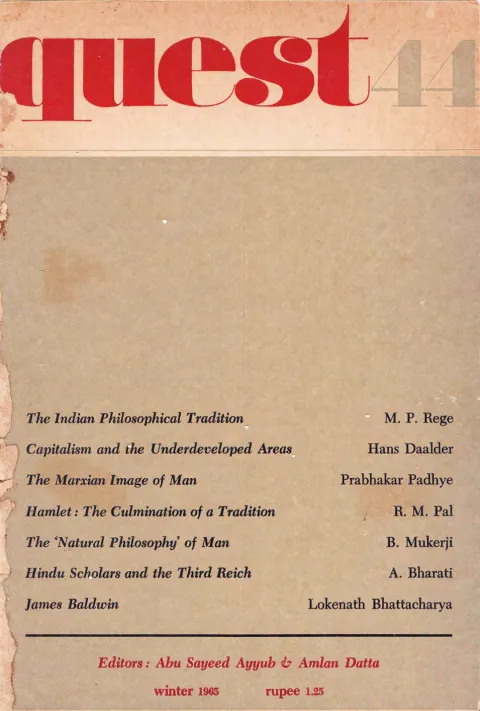
QUEST
Summary
Quest No. 44 (JAN./MAR. 1965; ‘winter 1965’ on the cover), edited from Calcutta by Abu Sayeed Ayyub and Amlan Datta for the Indian Committee for Cultural Freedom in Bombay, is built around a single argumentative centre: what happens to Marxism, and to the anti-colonial habits of mind Marxism bequeathed, once the theory is tested against either evidence or its own texts. Hans Daalder’s long article dismantles the Hobson-Hilferding-Luxemburg-Lenin account of imperialism with trade and investment tables, then argues that the discredited theory still governs how the West, the Soviet bloc and the new states behave; Prabhakar Padhye reads the 1844 Manuscripts against Engels, Lenin and Stalin to show how a doctrine of the active, creative person became an apparatus of ‘partinost’ and denunciation; and two letters in the correspondence pages — from Richard Pipes and from Sidney Hook, both addressed personally to Padhye — dispute his reading of alienation on the spot, in the same issue that prints his article. Around that spine the issue sets M. P. Rege’s diagnosis of why Indian philosophy never produced a scientific method, R. M. Pal’s defence of Hamlet against T. S. Eliot, B. Mukerji’s monist case that mind is simply a name for the functioning of the brain, Agehananda Bharati’s field report on pandits who still regard Hitler as an avatar, and Lokenath Bhattacharya’s admiring account of James Baldwin’s anger.
The issue also carries three poems (Gieve Patel’s ‘On Killing a Tree’ and two Vaisnava songs translated by Edward Dimock), two short stories, eight book reviews and four letters. Its reviewing is unusually inward-looking: A. G. Noorani reviews a study of Indian policy in South-East Asia and has his own book on Kashmir reviewed a page later by A. A. A. Fyzee; S. Natarajan reviews A National University, a book published by the Indian Committee for Cultural Freedom, which is also Quest’s own publisher, without the relationship being disclosed; and a full-page advertisement on printed p.105 lists forthcoming ICCF volumes whose contributors include the journal’s own co-editor and three people with bylines in this very number. The editorial voice appears once, unsigned but initialled ‘-EDITORS’, to concede that a story printed in the previous issue was plagiarised and to ask readers to police the magazine’s contributors for it.
Essays
The Indian Philosophical Tradition
By M. P. Rege
Rege opens from Sir Henry Maine’s boast that nothing moves in the world which is not Greek in origin, concedes most of it, and then asks what use the Indian philosophical tradition can be to Indians who want a share in a universal intellectual inheritance. He sketches what philosophy has done historically — asking after the nature of the universe, criticising the presuppositions of the sciences, making concepts explicit, giving rational form to a conception of the good life — and measures Indian thought against each task. Early Indian speculation, he argues, is monistic and hylozoistic in exactly the way early Greek speculation is, and much of it is simply obsolete science; the Samkhya theory of gunas belongs in the same line of business as modern physics and psychology and must take the same test. What survives that deduction is real and considerable: the conceptual analysis of the Buddhist, Nyaya-Vaishesika and Vedanta critiques, and the moral portraits in the Gita and Buddhist literature.
The diagnostic half of the paper identifies three linked failures. First, method: Indian philosophy proceeds by commenting on a commentary on the sutras, which reduces thought to the explication of a truth already given, and a philosopher holds views because he belongs to a school rather than belonging to a school because he holds views. Second, epistemology: revelation, not reason, is treated as the primary means of truth, so perception swells to absorb the Yogin’s direct apprehension of transcendental entities and the deductive ideal never forms — ‘There is much fine critical philosophy in the Indian tradition but no rational metaphysics.’ Third, ethics: the questions ‘what is the natural or rational way of life?’ and ‘what is the rational constitution of the State?’ were never asked, so a refined moral sensibility coexisted with barbaric customs it never had the rational leverage to criticise. Rege ends on the four resulting habits — conservatism, revivalism, eclecticism and anti-intellectualism — and notes, pointedly, that India produced no philosopher-scientist.
- Concedes Maine’s claim that modern intellectual and institutional life is Greek in descent, while insisting the Indian tradition is the only other authentic and original philosophical tradition.
- Argues that much traditional Indian philosophy is superseded science and must be rejected on the same terms as Anaxagoras or the Epicureans, not preserved as simultaneously historical and still-valid.
- Identifies the commentary-on-commentary method as fatal to free inquiry: thought becomes expounder rather than discoverer of truth.
- Traces the absence of rational metaphysics and of a deductive ideal to the primacy of revelation, which also licenses a distinction between adhikaris and the rest.
- Holds that Indian ethical thought never generated universalisable rational principles, so moral intuitions never revalued established codes; Shankara defends ritual rather than discarding it.
- Names the resulting intellectual dispositions — conservatism, revivalism, eclecticism, anti-intellectualism — and observes there is no philosopher-scientist in India.
Capitalism, Colonialism and the Underdeveloped Areas
By Hans Daalder
Daalder’s article — sub-titled on the page, though not on the contents page, ‘The Political Economy of ( Anti-)Imperialism’ — is in two sections. Section I takes the economic theories of imperialism in turn and argues each fails as theory and as history. Rosa Luxemburg’s claim that capitalism could only expand parasitically on non-capitalist economies founders on her own solution: if non-capitalist sellers are paid in goods, the effective demand she says is missing has still to come from somewhere, and her position collapses into Tugan Baranowsky’s, whom she derided. Hobson’s and Hilferding’s investment-outlet theories mistake the lure of profit for its fact — returns on British colonial investment ran barely above domestic rates, and French investors lost two-thirds of their foreign holdings across the imperialist period. The business-cycle-regulator argument is tautological, since Zimmerman and Grumbach never separate colonial trade from extra-European trade generally. The Bauer-Hilferding theory of imperialism as the policy of cartelised finance capital is, he says, a typically German theory projected onto Britain and France, whose banking and industrial structures were quite different. Three tables anchor the case: colonial trade as a share of total foreign trade for five powers 1894-1934; foreign indebtedness of the main debtor nations in 1929-30; and per capita long-term foreign investment in 1929, headed by neutral Switzerland.
Section II is the part Daalder plainly cares about most: the theories are dead as explanations and alive as causes. Their legacy confuses economic with political factors, so political independence is over-credited with economic consequences and the social preconditions of industrialisation are lost sight of; it sapped Western self-confidence until guardianship felt like an imposition and Munich became possible; it let Lenin weld proletarian and national-liberation struggles into one formula and then left communists unable to explain Western prosperity after empire; and in the new states it supplies a scapegoat for the gap between expectation and fulfilment, making private foreign capital more suspect than state-to-state aid with strings attached. He notes a paradox: the Marxist diagnosis is coming true in reverse, since the withdrawal of imperial flags is what now makes capital fly and trade flounder.
- Rejects Rosa Luxemburg’s underconsumptionist theory on three grounds and shows her extra-capitalist buyers merely relocate the problem she set out to solve.
- Uses returns data to argue capital export was ‘not an economic necessity, but a psychological deception’, with Marxists, imperial propagandists and investors equally wrong about colonial profits.
- Three tables show the main imperialist powers traded and lent more outside their empires than inside, and that the top per capita capital exporter was neutral Switzerland.
- Treats Hilferding’s Finance Capital as a German theory wrongly generalised, noting Bismarck knew German colonies would be hostages to a British enemy in war.
- Endorses Robinson and Gallagher’s documentary finding that the regions of Africa which interested British investors least concerned ministers most.
- Argues the discredited theory still shapes conduct: Western guilt, communist misjudgement of Western resilience, and a new-state suspicion of foreign capital that deprives those states of investment.
The Marxian Image of Man
By Prabhakar Padhye
Padhye reconstructs Marx’s picture of the human being from the 1844 Economic and Philosophical Manuscripts and then follows what became of it. Man for Marx is the working animal, distinguished from the bee and the spider by raising the structure in imagination before erecting it in reality; and it is precisely in the externalisation of that conscious activity that he suffers his fall. Padhye is careful about the order of causes: private property is the consequence of alienated labour, not its source, which lies in ‘the external relation of the worker to nature and to himself’. He illustrates primary alienation with the poet who loses the effervescent experience of creation the moment the poem is written and can then be tempted to make use of it — an explanation he concedes is his own rather than Marx’s. He then maps the Marxological quarrel over whether the later Marx continues or liquidates the earlier, noting that the dividing line cuts across the line between critics and defenders of Soviet communism: Daniel Bell and Adam Schaff agree that the young Marx is not the mature Marx, while Fromm, Tucker and Tomkins argue for continuity. Soviet and Polish apologists play the Manuscripts down, Padhye says, because read properly they indict present-day communism, whose ‘community of work and of equality of wages paid out by the communal capital’ Marx had already described as crude communism.
The second half is a history of a degradation. Marx used ‘condition’ and ‘determine’ interchangeably where the difference between possibility and necessity is philosophically decisive; Engels turned dialectics into a science of the general laws of motion and history into ‘the conscious reflex of the dialectical motion of the real world’; Lenin read each into the other; and Soviet debate split into determinist and activist Marxisms, arguing over Pavlov, Freud and the withering away of law and of the school. Stalin’s originality, in Padhye’s reading, was to combine the activist view of the psyche with the party ethic of ‘partinost’, making the individual responsible for his own thoughts and therefore punishable for them — writers who keep silent must explain their silence, children must denounce defecting parents, spying becomes a socialist duty. The result was a population divided into the faceless and those with protruding faces, and a personality cult grown out of the worship of the mass. The young intellectuals of the Soviet bloc, he closes, are drawn to existentialism and to the newly published Manuscripts because both name the alienation their own official philosophy cannot.
- Recovers Marx’s definition of man as the working animal and locates alienation in the externalisation of conscious productive activity, prior to private property.
- Insists private property is the consequence, not the cause, of alienated labour, quoting the Manuscripts against readings that reverse the order.
- Shows the debate over the young and mature Marx cutting across the pro- and anti-Soviet divide, with Bell and Schaff on one side, Fromm and Tucker on the other.
- Isolates Marx’s interchangeable use of bedingt and bestimmt as the philosophical crack through which Engels’s positivism entered.
- Reads Stalin’s ‘partinost’ as the point at which a doctrine of the active person became an instrument for punishing thought, silence and even unconscious motive.
- Concludes that the Marxian conception of man ‘lost itself in a morass’ and that the revisionist potential of that question mark should not be underrated.
Hamlet: The Culmination of a Tradition
By R. M. Pal
Pal’s essay is a sustained rebuttal of T. S. Eliot’s verdict that Hamlet is ‘most certainly an artistic failure’, conducted through a reading of the play’s inheritance from the Kyd prototype. He begins with the first scene, apparently useless to the action, and argues it is where Shakespeare’s method is visible: the wind-swept battlements, the unrecognisable comrades, Horatio’s voiced disbelief are the machinery by which an audience’s perception is lifted to a plane on which a trite revenge story can carry new values. He then attacks the critical habit of treating a dramatic character as a being with an existence outside the plot — Bradley’s Hamlet who ‘at any other time and in any other circumstances’ would have been equal to his task, the biographical curiosity about the girlhood of Shakespeare’s heroines. Eliot’s charge that Shakespeare failed to impose the mother’s-guilt motive on intractable material is turned round: if consonance between the hero’s will and the plot’s outcome were the test of dramatic excellence, Aeschylus, Sophocles and Euripides would all be exiled from Parnassus.
The positive argument is historical. Hamlet’s procrastination is not pathology but the friction of a refined sensibility against a convention that had outlasted its social warrant. Pal rejects Harrison’s defence of Hamlet as ‘normal’ by twentieth-century standards, because the play is not a twentieth-century plot and revenge in its most violent form was a moral obligation in the world Shakespeare built. Hamlet never questions the rectitude of what he is commanded to do; his difficulty is in bringing himself to do it, and the final killing is forced on him by accident, by the Queen’s cry and Laertes’ accusation, so that the aesthete conforms to the avenging pattern without betraying his own nature. Shakespeare, Pal concludes, was doing two things the tradition had never done: showing that the avenger destroys his own soul, and asserting the integrity of the human spirit against Fate — which is why Hamlet is the epilogue to the revenge theme rather than a failed specimen of it.
- Treats the Kyd prototype and ten years of stage popularity as limitations Shakespeare had to work inside, making the first scene the key to his method.
- Rejects the critical convention of granting a dramatic character dimensions beyond its representation, naming Bradley and Eliot as offenders.
- Argues that consonance of the hero’s will with the plot’s outcome is not a test of dramatic excellence, since no classical tragic hero willed his own retribution.
- Denies that Hamlet’s delay is a depressive mania or a modern normality, reading it instead as a subtler response to a revenge motive that had lost its social validity.
- Reads Hamlet’s final act as thrust upon him by accident, preserving his character while satisfying the tradition.
- Concludes that Hamlet is the deliberate close of the revenge tradition, in which Shakespeare examines rather than endorses revenge as a motive.
The ‘Natural Philosophy’ of Man
By B. Mukerji
Mukerji, a cancer-research director writing from an address to the International Academy of Philosophy, argues that philosophy has held itself aloof from medical investigation and can no longer afford to. He surveys what the collaboration of chemists, physicists and mathematicians with biologists has produced: the DNA helix as the ‘agent of destiny’, whose permutations of base pairs account for the variety of the living world; the cell as a complex organism whose totipotential form, the ovum, already contains the pattern for the colour of eyes and hair, the four-chambered heart and the distribution of acid-secreting cells; and the brain, where ten billion nerve cells in a three-pound mass constitute what he calls the greatest enigma in modern science. On the brain he reports the then-new hypothesis that the highest level of integration happens not in the cortex but in the evolutionarily ancient reticular system, which filters the bombardment of stimuli and decides on one thing at a time.
The philosophical payload is monist and deflationary. He runs through the history of the soul’s ‘animal spirits’ — Aristotle’s heart, Galen’s ventricles, Willis’s grey matter, Malpighi’s juice-like fluid, Galvani’s twitching frog — and through the dualisms of Descartes and Plato, the Chinese denial of a surviving soul, and the Hindu and Buddhist doctrine of transmigration, in order to say that the mind-body problem and free will are now treated as semantic rather than real questions. He endorses Bailey’s formula that mind is simply a name for the functioning of the brain, and Sherrington on the scientific unthinkability of an unconditioned event in the brain’s series. He concedes that philosophers doubt whether compassion, love and ‘soul’ can be localised, and that the human capacity to say ‘NO’ may involve some ‘extra-corporeal’ attribute — but ends by grounding compassion in a million human experiences drawn from the environment rather than in soul or stars, and by declaring that there is hardly any need to place ourselves at the mercy of unknown spiritual forces.
- Presents molecular biology, cell biology and neurophysiology as findings philosophy must absorb, and dates biology’s shift from cataloguing to measurement.
- Uses DNA’s base-pair permutations and the totipotential ovum to argue that pattern and destiny are materially specified from the one-cell stage.
- Reports the reticular-system hypothesis of highest-level integration, displacing the cortex as the seat of decision.
- Narrates the retreat of the soul’s ‘animal spirits’ from Aristotle and Galen through Willis, Malpighi and Galvani to their disappearance after 1800.
- Adopts a monist position — mind as a name for the functioning of the brain — and treats free will and the mind-body problem as semantic questions.
- Concedes an unexplained residue in the human capacity to refuse, and in extra-sensory perception, while denying any need for supernatural forces.
Hindu Scholars and the Third Reich
By A. Bharati
Bharati, a monk-turned-sociologist writing from Syracuse, reports and explains a pattern he encountered repeatedly at Kumbha Melas and Vedanta conferences: orthodox Sanskrit pandits and monastic scholars hold Germany, and specifically Nazi Germany, in naive and outspoken admiration. He traces it not to the reformist channel — Vivekananda, Dayananda, Ranade and Devendranath addressed westernised audiences with whom learned orthodoxy had no communication — but to the diffusion of the news, as early as 1895-96, that Max Mueller had published the Rgveda after removing it from India. From that, he says, grew a durable belief-cluster: that the Germans ‘somehow gotten hold of’ texts unpublished in India, that they built their weapons on Vedic recipes, that ‘Germany’ means crest-jewel in Sanskrit, that Sanskrit is compulsory in German high schools, and that Germany leads the world in Indian studies. He notes that almost no Indian scholar, Narasimha Bharati included, knew Max Mueller never set foot in India.
Onto that, Bharati argues, Hitler’s Aryan doctrine and the swastika fell as grist to the mill. He records Swami Svatantrananda at Allahabad in 1954 calling Hitler a mahatma and an avatar because he ate no meat and never married; Swami Hari Giri Mahar aj, a dasanami monk and active Congress Party member, telling a Vedanta assembly at Amritsar that the speaker had no right to abuse ‘Sri Hitler and the pandits of Germany’; a 1942 Banaras Hindu University play, Duskrtavijaya, in which Berlin, Hitler and Goering are rendered into Sanskrit puns and London burns like Lanka; and a Tibetan lama at the University of Washington admiring a photograph of Rockwell’s American Nazis as proof that ‘the greatness of the symbol’ had spread. Accounts of the camps and the exterminations, he reports, are met either with the svadharma-adhikarabheda argument that a perfected soul does not really kill, or with a flat refusal to believe Anglo-American propaganda. Bharati is explicit that modern Brahmin scholars of the calibre of V. Raghavan or P. V. Kane share none of this, but also that he has never heard one of them contradict it in a learned orthodox assembly. NOTE FOR EDITORS: the article transcribes admiring statements about Hitler and dismissals of the Holocaust; these are the reported views of the pandits Bharati is criticising, not the author’s own, and his framing is consistently critical.
- Distinguishes learned Hindu orthodoxy from westernised reformist Hinduism and argues the German enthusiasm reached the former by a separate route.
- Dates the founding rumour to Narasimha Bharati’s 1896 Allahabad announcement that a German scholar had published the Rgveda after removing it from India.
- Lists the resulting articles of belief, including the Sanskrit etymology of ‘Germany’ as siromani and the claim that Sanskrit is a compulsory German school subject.
- Reports that neither Hitler’s dismissive remarks on India in Mein Kampf nor his refusal to shake hands with the Indian hockey team was known to Indian nationalists.
- Documents specific responses from named monks, an RSS flag bearing the SS Siegrune, and a Hindi play staging the destruction of the British Raj by Hitler.
- Notes two standard orthodox replies to the camps: a scriptural argument that the perfected soul does not really kill, and dismissal as Anglo-American propaganda.
- Observes that westernised Sanskritists are free of the pattern but do not contradict it in orthodox assemblies.
James Baldwin
By Lokenath Bhattacharya
Bhattacharya’s essay is a portrait of Baldwin as a writer whose subject is the political reality of colour and whose method is to begin from the awareness of suffering. He assembles it largely out of Baldwin’s own sentences — the demon under the skin of his castle, the ‘species of postnatal depression’ about being from New York, the name Baldwin as a ‘fragile handkerchief’ hiding an irrefutable anonymity, the boast about hoeing cotton and damming rivers, the white policemen who left a ten-year-old flat on his back in a Harlem lot. He sets Baldwin against Richard Wright, who expatriated himself in Paris and lost first his country and then his sympathy for American Negroes; Baldwin also found Paris a city of refuge and spent nine years there but came back, on the view that the atmosphere at home had to be faced on the spot.
Bhattacharya then gives the biographical outline — born 2 August 1924 in New York, eldest of nine children of David and Emma Baldwin, a despised clergyman father, DeWitt Clinton High School, a profound religious crisis at fourteen — and a brisk account of the six books, treating Go Tell It on the Mountain as a novel of a Negro boy’s lost innocence, Giovanni’s Room as using homosexuality to approach a definition of the American character, and Another Country as crossing and re-crossing national, class, sexual and colour lines. He notes Baldwin’s own judgement that he is a novelist primarily, and that the essays, which may one day seem dated, are where the resources he draws on as a novelist are most sharply visible. The essay closes on the passage about the relatively conscious whites and blacks who must insist on, or create, the consciousness of the others, and on the prophecy of the fire next time — with the remark that the hope lingers it will not come to that.
- Builds the portrait out of Baldwin’s own formulations, treating fear and the ‘strange monster’ as equally important to his writing.
- Frames colour, in Baldwin’s phrase, as a political rather than a personal reality, and suffering as the first step to the end of suffering.
- Contrasts Baldwin’s return from Paris with Richard Wright’s expatriation and loss of sympathy for American Negroes.
- Notes that Baldwin is not a pacifist like Martin Luther King and finds in struggle an element of terrifying beauty.
- Records Baldwin’s insistence that Negroes must not do to others what has been done to them, since whoever debases others debases himself.
- Supplies dates, family and bibliography, and weighs the essays against the novels in Baldwin’s own estimation of himself.
On Killing a Tree
By Gieve Patel
A single-stanza free-verse poem in which the destruction of a tree is described as a procedure requiring patience and method. Hacking and chopping will not do it, because the bleeding bark heals and curled green twigs rise from close to the ground and expand again to former size; the root has to be roped, tied and snapped out of the anchoring earth so that the source, white and wet and hidden for years, is exposed. Only then does the scorching, choking, browning, hardening, twisting and withering finish the work. The poem’s flat procedural tone, and its interest in what is most sensitive and longest concealed, carry an unstated analogy that the poem never explains; printed on p.59 at the foot of Padhye’s page of footnotes on Marx, Engels and Stalin, it acquires a context Quest does not comment on.
- Presents the killing of a tree as a technical problem requiring more than violence to the visible parts.
- Turns on the distinction between the wound that heals and the root that cannot regenerate once pulled from the earth-cave.
- Ends in a sequence of participles — browning, hardening, twisting, withering — that enact the drying-out.
- Printed out of sequence with the issue’s other two poems, on the same page as the closing footnotes to Padhye’s essay on Stalinism.
Aptaduti
By Vidyapati
The first of ‘TWO VAISNAVA SONGS’, attributed to Vidyapati and translated by Edward Dimock. Eight lines in the voice of an ageing woman who decorates her once-full cheeks with beauty-spots, paints her dying eyes with kohl and puts flowers in her burned-white hair, calling her own vanity absurd; the years have slipped away, her breasts hang empty and the fullness of her hips is gone, and on her withered body a drunken Kama wallows. The unlisted translator’s note printed beneath it (catalogued separately as an unlisted item) explains that the classification of the poem as an aptaduti — a speech by Radha’s go-between urging her not to waste her new youth — is the translator’s speculation, since the collection carries no section identification.
- A short lyric of ageing and persistent desire, in the first person.
- Attributed by signature convention rather than by heading: the collection’s standard signature line is ‘Thus Vidyapati says’.
- Placed under a group head, ‘TWO VAISNAVA SONGS’, that the contents page does not print.
- Carries a translator credit to Edward Dimock that the contents page also omits.
Aksepanuraga
By Jagadananda Das
The second Vaisnava song, attributed to Jagadananda Das and translated by Edward Dimock. A woman recounts her undoing at the Yamuna: the moon-apple of Nanda’s eye lay waiting under the kadamba tree, and the honey of his look and the radiance of his body were bait and snare, so that her eyes lit there like birds and were trapped and her heart leapt like a doe into his nets, leaving the cage of her breast empty. Goaded by his glance, the wild elephant of her pride broke its chain; at the first note of his flute the lion-gate of reverence for elders and the door of dharma came down, her guarded treasure of modesty was lost, and the dark body poised in the tribhanga pose shot the arrow that pierced her. Honour, family and her home at Vraja are gone; only her life is left, and that only a departing breath. The poem signs itself internally, ‘So says Jagandananda-dasa’, with the printed byline beneath giving a different spelling of the name.
- A catalogue of losses — eyes, heart, pride, reverence, dharma, modesty, honour, family, home — each figured by a different hunting or fortification image.
- Structured as a single retrospective question, ‘why did I go to the Yamuna river?’, answered by the sequence of captures.
- Internal signature line spells the poet’s name ‘Jagandananda-dasa’ against the byline’s ‘JAGADANANDA DAS’.
- Second half of Dimock’s pair of translations; no source text or language is named on the page.
The Electric Saw
By Murli Das Melwani
A short story set in a timber district in the north-east. U Sibmon Roy, the biggest timber merchant in the district, walks up through the pines on the morning his new electric saw is to start operating, and the walk becomes a review of how he got there. He had come from a distant village as a day labourer to the contractor U Rabin Singh, made himself indispensable, then deliberately went slack — telling his employer ‘I know a lot about the world, but when it comes to business I’m just not fit for it’ — so that no one would suspect the ambition underneath. The reputation for goodness, wisdom and thrift that the district credits him with is the surface of a long deception; behind his back they joke about his pumpkin face and his habit of wearing out one set of clothes before buying another.
The memory he keeps circling back to is the evening he drove back with U Rabin Singh and a few thousand rupees through a mist that closed over five miles of hill road. Within a few minutes the jeep and the body were at the bottom of the valley, the money was under a tree on the opposite slope, and U Sibmon Roy was lying on the road with self-inflicted bruises. The police believed the highway-robbery story, the case was closed after perfunctory investigation, the business collapsed under the dead man’s brother-in-law because no accounts had ever been kept, and superstition kept other buyers away until U Sibmon Roy could buy it cheap. Melwani ends not on exposure but on rapture: the blade turns, whirrs and becomes a stationary blur, and the murderer’s delicate tingling feelings burst and engulf him until he loses sense of everything and wants only to sink deeper into the ecstasy. The story’s irony is entirely structural — it is the successful man’s happiness, not his guilt, that the narration dwells on.
- A study of a self-made timber merchant whose reputation for goodness and thrift is the instrument of a long deception.
- The rise is narrated as deliberate under-performance: he stops taking initiative so that his employer will underestimate him.
- The murder is told in three flat sentences and treated by the district, and the police, as a highway robbery.
- The absence of written accounts, which he had once urged and then stopped urging, is what destroys the business he later buys cheap.
- Closes on the protagonist’s ecstasy before the running saw rather than on any reckoning.
A Friend of the Family
By Jai Nimbkar
A first-person story narrated over the course of one day by Liloo, a Bombay suburban wife who abandoned a Ph.D. in Psychology and fills her slack hours with extra coffee and unwanted phone calls. Shekhar, her husband Narendra’s oldest friend, is returning from Calcutta after four months, and the day is spent deciding what to cook and what to wear. The narration reconstructs the triangle: Shekhar as the third presence who brought out the best in both of them and made Narendra gay and voluble; the transition, whose exact moment she cannot date, at which Shekhar came to mean slightly more than a friend; the flattering suspicion that he stayed single because of her; the feasts passed off as potluck; the unobtrusive jewellery and the touch of perfume he never noticed.
Nimbkar keeps the wife’s self-knowledge exactly one step behind the reader’s. Liloo notes, without drawing the inference, that Shekhar never called while Narendra was away, that he made his visits coincide with Narendra’s return, that his affection for Narendra ‘is nothing if not genuine’, that he expressed a generally low opinion of women at every opportunity, that he told her a man loses his soul by marrying and then said it might be pleasant to lose one’s soul under certain conditions. The story turns in its last paragraph. Shekhar arrives, takes Narendra’s hand and then his shoulder, says ‘It’s good to see you, my boy’, and under a bright overhead light does not see her at all; the tableau holds, something somersaults, and the story ends on two sentences — there is no mistaking the look in Shekhar’s eyes, and ‘I’ve been a blind fool.’ The four months in Calcutta, the irritable tirade against Bombay, the sad smile at parting are all retroactively re-explained.
- Narrated in the present tense across a single day of waiting, with the history of the friendship supplied in flashback.
- Constructs a marriage in which the wife’s demonstrativeness towards her husband is performed for the friend’s benefit.
- Plants every clue to the real configuration in the narrator’s own observations while withholding the inference from her.
- Turns on a wordless tableau at the front door rather than on any disclosure or confrontation.
- Ends on a five-word admission that reverses the meaning of everything preceding it.
India and South-East Asia, 1947-1960
By A. G. Noorani
Noorani reviews Ton That Thien’s India and South-East Asia, 1947-1960 (Librairie Droz, Geneva), and uses it to argue that India, like Britain vis-a-vis the United States, sought a special relationship with China while ignoring its immediate neighbours, who ignored it in return, so that India now counts for precious little in the affairs of the region and China for a great deal. He praises the documentation as very thorough and the analysis as original and incisive, calls it beyond question a major work and perhaps the best in the field, and adds that it is inevitably by a foreigner. He follows the book through the good early years to the 1949 Asian Conference on Indonesia, the appearance of a Communist and militant China, and Panch Sheel, which he treats as an elaboration of the Kellogg-Briand Pact and notes that Dulles and Nehru shared a tremendous faith in pacts and in the power of words.
Where he breaks with the author is on interpretation. He finds Thien contradicting himself — arguing both that India tried hard to fulfil a bargain with China and that Indian and Western policies were complementary rather than at cross purposes — and rejects outright Thien’s claim that India called in the United States to redress the balance in 1957, pointing out that India sought American help only in October 1962. He also rejects the summary verdict that India’s policy was a policy of balance of power, since India never tried to balance Red China by building an alliance of South-East Asian states but instead kept China pleased and ignored the others: ‘It was neither good morality nor sound politics.’ He regrets the omission of Pakistan from the survey and asks how far Kashmir influenced Indian policy in the region, remarking that to raise the question is to enquire about the basis of the whole foreign policy of Nehru’s later days, when he succumbed to the charms of Krishna Menon.
- Takes India’s courting of China at the expense of its South-East Asian neighbours as the explanation of its present irrelevance in the region.
- Rates the book as the best in its field and notes pointedly that it had to be written by a foreigner.
- Reads Panch Sheel as a restatement of Kellogg-Briand and pairs Nehru with Dulles as believers in pacts.
- Rejects Thien’s 1957 dating of India’s turn to the United States against the fact of October 1962.
- Denies that India practised balance-of-power politics at all, since it built no counterweight alliance.
- Faults the book for omitting Pakistan and raises Kashmir as the unexamined foundation of the whole policy.
The Kashmir Question
By A. A. A. Fyzee
Fyzee reviews A. G. Noorani’s The Kashmir Question (Manaktalas, Bombay) under the headline ‘Permanent Sore’, and opens on the position of an Indian Muslim who says the unsayable: when Rajaji or Jayaprakash or Minoo Masani call for reconsideration they can be dismissed as politically biased, but Noorani is liable to be called a pseudo-Pakistani masquerading as an Indian publicist, an objection Fyzee calls fatal and says gags many a decent Muslim in India into silence. He describes the book as neither a history nor an exhaustive discussion but an admirable analysis, within sixty-six pages, of the nature of accession from 1947 to 1963, demonstrating the thesis that Kashmir’s accession is legal and valid but provisional.
He then restates what he takes to be the basic question in his own terms, as a property dispute: A and B quarrel over X’s property, A commits aggression and B defends X at X’s request — can the rights of A and B inter se keep X out of his property forever? He accepts, with Sir Owen Dixon’s formulation quoted at length, that the October 1947 crossing of the frontier and the May 1948 entry of regular Pakistani forces were contrary to international law, and notes that Noorani gives no specific reference for the Dixon passage, supplying it himself. The review closes on the changed strategic setting — the mockery made of Chini Hindi Bhai Bhai, Khrushchev’s dismissal, the coming together of China and Russia, and India’s condition of having no enemies and no friends by virtue of non-alliance — as grounds for reconsidering the rift with Pakistan, and reports a suggestion by foreign columnists that Menon was the chief architect of a Kashmir policy designed to keep India and Pakistan permanently at a distance. He commends the book’s lucidity, cogency and sobriety and asks for more precise references to the U.N. documents. NOTE FOR EDITORS: the reviewed book’s author, A. G. Noorani, is also the reviewer of the item immediately preceding this one in the same issue.
- Frames the review around who is permitted to speak on Kashmir, and the charge of pseudo-Pakistani sympathies used to silence Indian Muslims.
- Endorses the book’s thesis that the accession is legal and valid but provisional, and rates the analysis admirable within its short compass.
- Restates the dispute as a property analogy in which the rights of the two belligerents cannot indefinitely bar the owner.
- Accepts Sir Owen Dixon’s finding that both the 1947 incursion and the 1948 entry of regular Pakistani forces were contrary to international law, and supplies the U.N. citation the book omits.
- Uses the Sino-Soviet rapprochement and Khrushchev’s dismissal as reasons to reopen the Indo-Pakistani question.
- Reports the claim that Menon designed the Kashmir policy to keep the two countries permanently apart.
The Concept of the Secular State and India
By S. P. Aiyer
Aiyar reviews Ved Prakash Luthera’s The Concept of the Secular State and India (OUP) under the headline ‘The Meaning of Secularity’, and reads it alongside Donald Eugene Smith’s India as a Secular State (1963), insisting the two must be read together because they differ on the definition of the term, on their conclusions and in their documentation. Luthera’s book was a 1959 Delhi doctoral dissertation published five years later; Aiyar remarks that time has not done too much damage to it, which is an index of the contribution it makes. Luthera’s conclusion is that India cannot and should not be described as a Secular State, and that the Secular State ideal is neither desirable nor possible in Indian society. This rests on tracing the concept through European history to the separation of Church and State, first clearly demarcated in the First Amendment, and on the claim that such separation is only possible where there is an organised church — so that Hinduism, lacking a central organisation, cannot have it, and England, where the State regulates the Church, is not a Secular State either, but a third type, the jurisdictionalist State.
Aiyar grants the strength of the definitional position and the originality of the clarification, but presses the obvious objection: many terms in political science have come to mean something quite different from their origins, so why define this one so narrowly? He reports Smith’s two grounds of disagreement from having read the thesis in manuscript — that separation of Church and State is too narrow a basis, and that Luthera takes a somewhat static view of Hinduism — and Smith’s more comprehensive definition of a State which guarantees individual and corporate freedom of religion, is not constitutionally connected to a particular religion and neither promotes nor interferes with religion. The deeper difference, he argues, is of approach: Luthera’s book is a contribution to constitutional law, Smith’s an effort to explain Indian politics and society, taking in caste, communalism, minorities, education, reform and the missionaries, and tying the future of the secular state to the future of Indian democracy and constitutionalism — a larger aspect Luthera nowhere touches. Both have bibliographical limitations; Smith’s is cast in the larger mould.
- Insists Luthera and Smith be read as a pair, since they differ on definition, conclusion and documentation.
- Sets out Luthera’s thesis that India is not and should not be called a Secular State, and that the ideal is neither desirable nor possible here.
- Explains the argument’s dependence on an organised church, which puts England in a third, jurisdictionalist category.
- Objects that political-science terms routinely drift from their historical meanings, so the narrow definition is a choice rather than a necessity.
- Reports Smith’s manuscript objections — too narrow a criterion, too static a view of Hinduism — and his broader definition.
- Characterises the books as constitutional law versus political sociology, and notes Luthera never addresses the link to Indian democracy.
Indian Nationalism and Hindu Social Reform
By Suma Chitnis
Chitnis reviews Charles H. Heimsath’s Indian Nationalism and Hindu Social Reform (Princeton) under the headline ‘Politics versus Reform’. She opens with her own argument rather than the book’s: nineteenth-century social reform could draw on the Bhakti movement but is distinct from it, because the Bhaktas encouraged silent suffering rather than revolt, whereas the reform movement followed the pattern of agitation set by the Christian missionaries and grew out of Western education — which, as Chandavarkar noted, accomplished silently what no law could have accomplished by unsettling people’s minds. The response took the form of agitation over sati and widow remarriage, of restatements of Hinduism by Vivekananda, Ramakrishna Paramhansa and Dayanand Saraswati, and of organised welfare work by the Brahmo and Arya Samajes. But because it was mainly an intellectual movement it held meaning only for a tiny minority and never touched the masses.
On the book itself she is warm. Heimsath begins with Rammohun Roy and those who demanded a rationally ordered society and insisted that reason rather than tradition define ethical norms; his documentation of the earlier phases is thorough, clear, scholarly and authoritative, and the later and harder part of the chronicle is handled with sympathy, balance and depth — she cites his dispassionate presentation of Tilak’s grievance that the Age of Consent Bill would write the character of the Indian nation in blackest letters. Where earlier authorities were themselves part of the current, Heimsath’s detachment about the movement’s brief successes and periods of apathy, and about how credit should be divided between individual reformers and the movement, is refreshingly objective. Her regret is that he could not discuss reform, and the lack of it, among Muslims and Christians. She ends by turning his epilogue’s point about the Indian government’s capacity to create economic change into a question of her own: whether it is not time to spell out the new values and behaviour patterns implied by the concept of the Dignity of Man we have accepted.
- Separates the reform movement from the Bhakti tradition on the ground that Bhakti counselled silent suffering rather than agitation.
- Credits Western education and missionary organisation, service and sacrifice with supplying both the stimulus and the model.
- Notes the movement’s confinement to a tiny educated minority and its failure to reach the masses.
- Traces the schism between Ranade and Tilak, between social and political reform, as unresolved until Gandhi.
- Praises Heimsath’s detachment against earlier authorities who were part of the current they described.
- Regrets the omission of Muslim and Christian reform and closes on the unfinished work of restating Indian social values.
Random Thoughts of a Fascist Hyena
By Stewart Melluish
Melluish reviews Constantine Fitz Gibbon’s Random Thoughts of a Fascist Hyena (Cassell) under the headline ‘Eternal Vigilance’. He begins with the author’s earlier When the Kissing Had to Stop, which set out to show how easily disaster could overtake a morally enfeebled Britain that gave way to pressure for unilateral disarmament, and which for many identified Fitz Gibbon as a ghoulish figure shrieking from the political Far Right. The new book, essays selected from recent contributions to English periodicals, will confirm that reputation for some readers despite the vigour with which he stresses the essentially liberal nature of his views — but Melluish finds him articulate and efficient, his reasoning smoothly-jointed and sane, and a sufficiently experienced guerrilla to keep his sniping under careful control.
The argument Melluish extracts is that Britain and the West face a tyranny not appreciably less disgusting or dangerous than the Nazis’, so that if Hitler’s war was worth fighting the West must be permanently prepared to fight the Soviet Union — not in order to brandish weapons but because catastrophe is likelier if the West is weak. Fitz Gibbon’s bogies are waning vigilance, false security, relaxation, indiscipline and queasiness about bombs; there is no Goldwater sabre-rattling and no urge for a show-down, only the paradox that the way to avoid one is to be permanently ready for it, and a corresponding hostility to anything weakening NATO. His most formidable prey are the unilateral nuclear disarmers, dangerous because their appeal is to the emotions and attracts sympathy from the non-committed world; he also revels in reviling anti-American opinion in Britain and those still outraged by alliance with a buoyant Western Germany. Melluish is candid that this thesis will attract little sympathy among readers in steadfastly non-aligned countries, and suggests Indian readers will find more to appreciate in the non-polemical essays — on resistance to tyranny, and on the commandant of a Nazi concentration camp — which he calls perceptive and humane commentaries on the abuse of power.
- Places the book in the wake of When the Kissing Had to Stop and the author’s reputation as a Far Right polemicist.
- Separates Fitz Gibbon’s manner — controlled, rational, articulate — from his premises, which the reviewer thinks readers may find suspect or vicious.
- Summarises the Cold War thesis: an armed peace is safer than the alternative, so preparedness must be permanent.
- Notes the absence of any appetite for a show-down and the specific targets: unilateralists, anti-American opinion, and residual hostility to West Germany.
- Judges frankly that the thesis will not persuade readers in non-aligned countries.
- Directs Indian readers to the non-polemical essays on tyranny and on a camp commandant as the book’s real value.
A National University
By S. Natarajan
Natarajan reviews A. B. Shah’s A National University under the headline ‘A Good University’. The book prints the papers and proceedings of a September 1962 seminar of the Indian Committee for Cultural Freedom, and Natarajan takes it as evidence of how useful such discussions are in clarifying thinking, while making two pointed criticisms of the form. The theme of a national university, discussed over nearly two days, mainly brought out the part played by regionalism in education and promoted a bias for an ‘International University’; linguistic arrangements claimed most of the attention, and it was left to some outsiders to raise other matters equally bearing on higher education. The conclusions printed at the end suggest to him that such seminars would be more useful if they did not require a final statement to be made at all.
His second criticism is of the temper of the discussion. Some speakers apologised for criticising politicians while others felt enough could not be said in condemnation of Education Ministers, one participant roundly denouncing them in terms Natarajan quotes. He is surprised to read how sharply G. C. Bannerjee was attacked for suggesting that if circumstances compel teaching in English, great care must be taken that young people are properly oriented — a valid point, he says, not limited to Western India or Bombay though perhaps less prevalent in the South. What is remarkable is that no speaker made any effort to face that problem, the general interest being confined to counteracting the evils of regionalism by pressing for English education. He calls the book thought-provoking and well-timed given the renewed enthusiasm both for keeping English in higher education and for shedding it, and closes on the observation that the debate is always English and the regional languages, or English or the regional languages, but never English and Hindi. NOTE FOR EDITORS: the book is published by the Indian Committee for Cultural Freedom, which also publishes Quest; no disclosure of that relationship is printed.
- Treats the volume as proceedings of an ICCF seminar of September 1962 and as a demonstration of the value of such discussion.
- Argues the requirement of a final statement damages the seminar form, on the evidence of the conclusions printed here.
- Records the seminar’s preoccupation with linguistic arrangements and the marginalisation of other issues in higher education.
- Quotes a participant’s blanket denunciation of Education Ministers and notes the range of attitudes towards criticising politicians.
- Defends G. C. Bannerjee’s point about orienting students taught in English, and observes that no speaker engaged it.
- Ends on the absent third option: the debate never poses English and Hindi together.
The Princes
By Jill Hugh-Jones
Hugh-Jones reviews Manohar Malgaonkar’s novel The Princes (Hamish Hamilton) under the headline ‘The Unclear Vision’, and turns the review into an argument about English reviewing of Indian writing. She summarises the book — a flamboyant despot of a Central Indian state who refuses to compromise with Independence and chooses death in the grand manner, and a son brought into contact with modern freedom at school and in the army who can neither break with his father nor fight singlemindedly beside him, presented as a Hamlet figure without Hamlet’s greatness. She grants the writing real qualities: the tiger shoots, the English Resident and his wife pinned with neatness and humour, the almost first-rate Maharajah, the poignant Maharani, the Bhils in whom she says she does believe.
Then she withdraws the indulgence. The ‘dismissive kindness of English reviewers of Indian products’ could not be more unhealthy when India has no literary critic of stature and Indian writers in English lack a coherent, discerning and outspoken body of readers; and there is ‘the too accepting shabash of the established’. The book is a very good popular novel and not literature, and the difference matters and must be said loudly. She quotes three passages of dialogue and description as dreadfully, vulgarly imitative, concedes that a country flooded with another’s second-rate culture has little right to complain of the result, and identifies the Minnie and Punch episodes as the worst features precisely because they reproduce a kind of Englishman and a kind of dialogue long debunked in England. Her other objections are structural: the Burma war chapters have no relevance to the novel and are often dull, and Abhayraj is a feeble young man whose actions never match his words — held up as detached and liberal one minute and wholeheartedly loyal the next, and finally shown having Kanakchand publicly whipped for political opposition, with nothing in the book suggesting we should do other than approve. Once the reader sees through the author’s sense of the Bedars’ value, she argues, pleasure in the book is cancelled.
- Summarises the novel as the collapse of a princely state seen through a father who dies grandly and a son who cannot choose.
- Praises the shikar scenes, the Resident and his wife, and the Maharajah and Maharani as genuinely achieved.
- Attacks the ‘dismissive kindness’ of English reviewers and the absence in India of critics and readers who would expose deficiency.
- Insists on the distinction between a very good popular novel and literature, and on the duty to state it loudly.
- Faults the Burma war chapters as irrelevant and the hero as feeble, with actions that never match his words.
- Singles out the climactic public whipping of Kanakchand as callously dishonest and unmarked by any authorial disapproval.
The Tribal World of Verrier Elwin
By L. F.
A review, signed only ‘L. F.’, of Verrier Elwin’s autobiography The Tribal World of Verrier Elwin (OUP), headlined ‘Indian Englishman’. The reviewer starts from the observation that a surprising number of famous and interesting people write dull autobiographies, and diagnoses two disadvantages in this one: a nature that could not reveal itself without some affectation, and the fact that Elwin had already described everything really interesting he had seen and done in his other books. For the first two hundred and eighty pages the reader is made aware on every page of pitfalls not avoided — no woman is mentioned without the adjective lovely, beautiful or charming, the identical words do duty for every piece of scenery, and a visit to French Africa is described largely in terms of meals eaten and dreamt about, by a man with neither the experience nor the knowledge to be a real gourmet.
At about three quarters of the way through, when Elwin reaches NEFA, the tone changes in what the reviewer calls a magical way: the book becomes vital, serious and immediate, the self written about becomes real and close, and the fading past becomes the live, important present. The second half of the review is about Elwin’s standing as a man who had become an Indian not only technically but in feeling and thought, so that criticisms which would have been offensive from an alien read instead as what most educated Indians think and few have the courage to say. Two are quoted: his astonishment that India has not made greater progress in prison reform when so many of its leading men have spent years in jail, and his complaint that the Community Development movement is defacing the countryside with the ugliest and most unsuitable constructions it has known, official village buildings looking like police lines and sometimes even like public lavatories. A third quotation records Elwin’s discomfort with Hinduism, whose adherents make you feel worldly and luxurious. None of these criticisms is specially profound, the reviewer concedes, but they are worth attending to because of who made them, and because he chose finally to become one of us.
- Locates the failure of the first 280 pages in affectation and in the author having used up his best material elsewhere.
- Identifies the repeated adjectives and the misplaced emphases, including several pages on food, as symptoms of a lack of balance.
- Marks the arrival at NEFA as the point where the book becomes vital, serious and immediate.
- Treats Elwin’s Indian citizenship and identification as what licenses his criticism of post-Independence India.
- Quotes his complaints about prison reform and about Community Development architecture as things most educated Indians think and few say publicly.
- Records his religious trajectory, ending easier with Buddhist beliefs than with Hinduism.
Essay 21
By Richard Pipes
A letter from Richard Pipes, written from Cambridge, Massachusetts on 25 September 1964 and addressed ‘Dear Mr. Padhye:’, printed with an ellipsis line that marks it as an extract. Pipes disclaims any standing as a ‘Marxologist’ and says he would not have written in Encounter if experts had been more outspoken. His position is that on this question the Communists are right: alienation was for Marx a passing phase, antedating his formulation of scientific socialism. He allows that liberal-minded Communists in the East who seize on the early Marx in hope of finding support for liberalism in the canon deserve human sympathy even if he disagrees with them academically, but says there is no such justification in the West, where those who present alienation as the true Marxist doctrine — he names Fromm — are simply falsifying facts. Marx did not devise the concept and rejected it in no uncertain terms after a brief flirtation.
His constructive suggestion is that Padhye study the whole history of ‘true socialism’, where the germ of the ideas of alienation is to be found and where many of them are more applicable to the modern world than surplus value, pauperisation or the concentration of wealth. He closes with a historian’s judgement that the so-called utopian socialists proved much more realistic than the so-called scientific ones, and that there is more of St. Simon than of Marx and Engels in the mid-twentieth-century world.
- Sides with the Communist reading against the Western humanist one: alienation was a passing phase in Marx, pre-dating scientific socialism.
- Distinguishes Eastern revisionists, who deserve human sympathy, from Western interpreters, who he says are falsifying facts.
- Names Fromm as the chief offender and denies Marx authorship of the concept.
- Redirects the inquiry to ‘true socialism’ as the actual source of the ideas of alienation.
- Concludes that the utopian socialists were the realistic ones and that St. Simon has outlasted Marx and Engels in the modern world.
Essay 22
By Sydney Hook
A letter from Sidney Hook, written from New York University on 30 September 1964 and addressed ‘Dear friend Padhye:’. Hook says he has returned from Vermont for the school year, found Padhye’s piece on The Marxian Image of Man, and is sending in return an essay of his own which discusses in part the Economic-Philosophical Manuscripts of the young Marx. He states that he is in profound disagreement with Padhye’s interpretation of the significance of these ‘juvenalia’, refers Padhye to the new introduction to the second edition of his From Hegel to Marx, says his own essay is still incomplete and being added to, and asks to be told if Padhye plans to publish his article anywhere so that he can make a reference to it — adding that it deserves publication as a contribution to the discussion.
He then names their chief difference. Where Padhye locates the cause of alienation, as the Manuscripts understand it, in the dynamics of artistic creation, Hook sees in it the influence of the mythology of Genesis and the cause or punishment of work — a more idealistic notion, he says, than which it would be hard to find. For the mature Marx, by contrast, the life of the creative artist is the paradigm case of the unalienated man, and he refers Padhye to his concluding chapter, ‘The Intellectual in America’, in Political Power and Personal Freedom. The letter is notable for reversing the usual polarity of the exchange: Hook, unlike Pipes, takes the young Marx’s text seriously enough to argue about what is in it.
- A private letter of disagreement printed as correspondence, in reply to the article carried in the same issue.
- Calls the 1844 Manuscripts ‘juvenalia’ and directs Padhye to the second edition of From Hegel to Marx.
- Encourages publication of Padhye’s article while disputing its central claim.
- Contests Padhye’s location of alienation in artistic creation, proposing Genesis and the punishment of work instead.
- Holds that for the mature Marx the creative artist is the paradigm of the unalienated man — the opposite of Padhye’s use of the artist.
Essay 23
By K. C. Lalwani
A letter from K. C. Lalwani, opening ‘Sir,’, responding to Shashi Kant’s ‘Approach to History’ in the Autumn 1964 Quest. Lalwani accepts Shashi Kant’s complaint that there is a Hindu view, a Muslim view, a European view and a Marxist view of Indian history but none that is truly and dispassionately Indian, and that Indian history written since 1947 is still Europocentric — but argues that this is in the main the outcome of historical circumstances. The present structure not only of Indian but of world history is the handiwork of European scholars, and would have been basically different had it been independently attempted by the Semitics, the Dravidians and the Aryans; but no historical construction in the modern sense has come down from any of these earlier peoples, and any man is limited by the view of the dominant contemporary society. Only a superman with elements of mysticism could overcome the bondage of time and space, and such a man is hard to conceive actually undertaking the work, so history is bound to remain the handiwork of the most dominant culture-group of the moment.
The second half defends his own earlier thesis, ‘A Model for Indian History’ (Quest, Autumn 1963), against what he considers an uncharitable reading. His claim was that the Indus Valley civilisation was lost long before the dawn of Indian history at about the time of the Buddha, and that the traditional Aryans had by then outlived their genesis and growth phases, so that Indic society was already in the grip of stagnation at the point where Indian history begins. He insists that this does not mean nothing remarkable happened afterwards; on the contrary, the remarkable thing to him is the virtual stagnation of traditional Indic society, which continues in almost suspended animation without ever undergoing total extinction, while the actual governance passed in succession to the Nandas, Mauryas and Guptas from outside the traditional zone, then to the Kushanas and Huns, then to the Turko-Afghans, the Mongols and the Europeans. He closes by saying he is looking forward to a historian who can give a historically balanced and politically unbiased view of Indian history basically different from his own.
- Concedes the Europocentrism of Indian historiography but attributes it to circumstance rather than to the failure of Indian scholars.
- Argues that no pre-modern people left a historical construction in the modern sense, so the framework was bound to be European.
- Holds that only a mystic superman could escape the dominant contemporary view, and that such a man would not write history.
- Restates his thesis that Indic society was already stagnant at the dawn of Indian history, and that stagnation itself is the remarkable fact.
- Lists the successive external dynasties and rulers as evidence that governance always came from outside the traditional zone.
- Invites a historian to produce a balanced account differing from his own.
Essay 24
By Ram Kumar
A short letter from the Hindi writer Ram Kumar, dated 15 December 1964 from New Delhi and opening ‘Dear Sir,’, printed with ellipses where matter has been cut. He says he was rather shocked to see in the Autumn number a short story, ‘Story of a mother’, by Shri G. C. S. Marar, that he is the real author of the story, that it was written originally in Hindi and included in his collection under the title ‘Hasna Bibi’, and that it is surprising such naked plagiarism should have found a place in a responsible paper. He asks the editors to contact Mr. Marar for a statement and to print an acknowledgement of the mistake in the next issue. The letter is the only item in the issue in which a reader corrects Quest about its own contents, and the editors’ reply printed immediately beneath it (catalogued separately as an unlisted item) concedes the charge.
- Alleges that a story published in the previous Quest was his own Hindi story ‘Hasna Bibi’.
- Names the contributor responsible, G. C. S. Marar, and asks that a statement be sought from him.
- Asks for a printed correction in the next issue, which the editors supply on the same page.
- Printed with ellipses at three points, indicating the editors cut the letter.
Essay 25
An unlisted editorial statement printed immediately beneath Ram Kumar’s letter on printed p.108, signed ‘-EDITORS’ with the Calcutta editorial address, and absent from the contents page. The editors say they have ascertained that Mr. G. C. S. Marar’s ‘Story of a mother’ follows Mr. Ram Kumar’s Hindi story pretty closely and offer their apologies to the real author for a deplorable mistake committed in all good faith. They then report that they sent Marar a copy of the letter and sought his explanation, and quote his belated reply: the story he sent was based on a story he read in a Malayalam magazine, was not an actual translation but only based on it, and he did not think it necessary to inform them, erring only through ignorance of the ethics of journalism. The editors note that he supplies neither the name of the Malayalam magazine, nor the date of the issue, nor the name of the Malayali writer, and conclude that on present data the story was an unacknowledged translation of a translation, presumably a case of double plagiarism.
The statement then turns into a request. They welcome practical suggestions for guarding against such acts, hold that an editor is duty bound to expose them when he learns of them but must normally accept the bona fides of his contributors, and ask readers to draw their attention at the earliest opportunity, with full particulars, to any plagiarist writing published in Quest. It is a rare instance in this run of the editors admitting an editorial failure in print and enlisting subscribers as a check on their own contributors.
- Unlisted on the contents page, which records only Ram Kumar’s letter under the heading ‘Plagiarism’.
- Concedes the charge and apologises to the real author for a mistake committed in good faith.
- Quotes Marar’s defence that the story was ‘based on’ a Malayalam original, and notes he identifies neither magazine, date, nor writer.
- Concludes the piece was an unacknowledged translation of a translation, ‘presumably a case of double plagiarism’.
- States the editorial principle: expose plagiarism when known, but normally accept a contributor’s bona fides.
- Asks readers to report any plagiarist writing in Quest with full particulars.
Essay 26
An unlisted translator’s note, some fourteen lines of small type printed beneath the poem ‘Aptaduti’ on printed p.84 and absent from the contents page. It is unsigned but is evidently by Edward Dimock, the poem’s translator, and it is unusually candid about the limits of what it presents. The note explains that the poem is signed ‘Vidyapati’ and comes from a collection of his poems carrying the standard signature line ‘Thus Vidyapati says’, that the collection has no section identification, and that placing the poem under the aptaduti category is therefore speculation — ‘which is not without precedent in this field’. Dimock’s reasoning is that the poem is spoken by Radha’s go-between, urging her not to waste new youth.
The rest of the note is textual. The first line has the form bhagala, which he reconstructs as something like ‘divided’ and therefore ‘lined’ cheeks, perhaps a better alternative than the ‘once full’ he printed. The word lela in the same line was taken by Subhadra Jha, who treated the poem earlier, to mean something like ‘hairs’, yielding a translation Dimock quotes as ‘I have decorated my tottered cheeks with hair-S’ and calls, even allowing for misprints, ‘a real gasser’; his own reading is ‘tiny spots’, a beauty device comparable to the sandal dots Indian women wear at weddings. He records that the literal sense of the second line is ‘rotting eyes’, that ‘burned-white’ in the third is almost literal since the word means ‘cooked’ with an undertone of a body burned out by passion, and that the last line is very tough, its basic notion being that the god of love possesses her body although she is too old to attract lovers.
- Unlisted apparatus attached to a listed poem, and the only place in the issue where a translator shows his working.
- States that the classification of the poem as an aptaduti is speculation, since the source collection carries no section headings.
- Offers an alternative reading, ‘lined’ rather than ‘once full’ cheeks, against the translation actually printed above it.
- Disputes Subhadra Jha’s earlier rendering of lela as ‘hairs’, quoting his line and calling it a real gasser.
- Glosses ‘rotting eyes’ and ‘burned-white’ as near-literal, with the undertone of a body burned out by passion.
- Concedes the last line is very tough, the notion being that the god of love possesses a body too old to attract lovers.
Essay 27
An unlisted apparatus block headed ‘OUR REVIEWERS’, printed on p.106 directly beneath the close of the Elwin review and absent from the contents page. It carries one-sentence biographical notes for seven of the eight reviewers in the issue: A. G. Noorani writes on politics for the Indian Express; A. A. A. Fyzee is an authority on Islam and was lately Vice-Chancellor of Kashmir University; S. P. Aiyar is the Edwin-Montagu lecturer in Political Science at the University of Bombay; Suma Chitnis teaches Sociology at Bombay University; Stewart Melluish works for the Oxford University Press, Madras; S. Natarajan is a journalist now working for the Council of Economic Education; and Jill Hugh-Jones has lived in India and reviewed books for several papers in Bombay. The eighth reviewer, who signs the Elwin notice only as ‘L. F.’, is not listed, so those initials go unidentified anywhere in the issue. The block is the source of the reviewer identifications in the contributor record for this number, and it is also where the spelling ‘S. P. AIYAR’ is confirmed against the contents page’s ‘S. P. Aiyer’.
- Unlisted biographical apparatus for the book-review section, printed on p.106.
- Covers seven of the eight reviewers; the initials ‘L. F.’ are given no note.
- Two reviewers are employed by publishers whose books the issue reviews or whose imprint appears in it (Oxford University Press, Madras).
- Confirms the spelling ‘S. P. AIYAR’ against the contents page’s ‘S. P. Aiyer’.
- Gives no nationality for any reviewer; the only geographic statement is that Jill Hugh-Jones ‘has lived in India’.
Essay 28
An unlisted apparatus block headed ‘OUR CONTRIBUTORS’, printed on p.109 after the correspondence and absent from the contents page. It gives biographical notes for eleven contributors — M. P. Rege, Hans Daalder, Prabhakar Padhye, R. M. Pal, B. Mukerji, Agehananda Bharati, Lokenath Bhattacharya, Murli Das Melwani, Jai Nimbkar, Edward Dimmock and Gieve Patel — and, unusually for this run, three of the notes disclose where the pieces came from. Rege’s paper was prepared for the Seminar on The Indian Tradition and Its Significance for Cultural Freedom convened by the Indian Committee for Cultural Freedom in August 1964, with an expanded version to be published by the Indian Renaissance Institute, Dehradun; Padhye’s article is taken from a forthcoming publication of the Indian Committee for Cultural Freedom on Communism, and Padhye himself is Secretary of the office for Asian Affairs of the Congress for Cultural Freedom; and Mukerji’s article is based on an address to the 3rd Congress of the International Academy of Philosophy in Delhi. Two of the notes cross-reference earlier numbers of the journal — a previous Melwani story appeared in Quest 32 and a previous Nimbkar story in Quest 26.
The block also fixes several spellings. It prints ‘R. M. PAL’, settling the text layer’s misreading; it prints ‘AGEHANANDA BHARATI’ in full where the contents page abbreviates to ‘A. Bharati’; and it prints ‘EDWARD DIMMOCK’ where the two poems credit ‘(Translated by Edward Dimock)’, so the issue spells the translator’s name two ways. No note is printed for the poets Vidyapati or Jagadananda Das, for the four correspondents, for the editors or masthead staff, or for the initials ‘L. F.’ — and no standing note appears for anyone without a byline in this number.
- Unlisted biographical apparatus for eleven bylined contributors, printed on p.109.
- Discloses the provenance of three items: an ICCF seminar paper, an extract from a forthcoming ICCF book on Communism, and an address to a philosophy congress.
- Records Padhye’s position as Secretary of the Congress for Cultural Freedom’s Asian Affairs office, which the article itself does not mention.
- Cross-references Quest 32 and Quest 26 for previous stories by Melwani and Nimbkar.
- Spells the translator’s name ‘EDWARD DIMMOCK’ against the poems’ ‘Edward Dimock’.
- Prints no note for the two medieval poets, the four correspondents, the masthead staff, or the reviewer signing ‘L. F.’; and no note for any person without a byline in this issue.
Generated by the v1.5 extraction pipeline. Awaiting editorial review.
Metadata and summary are AI-extracted from the source PDF and reviewed for editorial accuracy. The original work is available via the Read PDF tab above (where present); paragraph-level citation inside the PDF is deferred to a future engagement.
People in this work
- M. P. Regeauthor
- Hans Daalderauthor
- Prabhakar Padhyeauthor
- R. M. Palauthor
- B. Mukerjiauthor
- Swami Agehananda Bharatiauthor
- Lokenath Bhattacharyaauthor
- Gieve Patelauthor
- Jagadananda Dasauthor
- Murli Das Melwaniauthor
- Jai Nimbkarauthor
- A. G. Nooraniauthor
- A. A. A. Fyzeeauthor
- S. P. Aiyarauthor
- Suma Chitnisauthor
- Stewart Melluishauthor
- S. Natarajanauthor
- Jill Hugh-Jonesauthor
- Laeeq Futehallyauthor
- Richard Pipesauthor
- Sidney Hookauthor
- Kastur Chand Lalwaniauthor
- Ram Kumarauthor
- Abu Sayeed Ayyub
- Prof. Amlan Datta
- Nirad C. Chaudhuri
- Laxmanshastri Joshi
- Nissim Ezekiel
- Sheela Singh
- Edward Dimmock
- Bal Gangadhar Tilak
- Adam Smith
- Karl Marx
- Mahatma Gandhi
- Jawaharlal Nehru
- M. N. Roy
- V. K. Krishna Menon
- C. Rajagopalachari
- Jayaprakash Narayan
- Minoo Masani
- Nikita Khrushchev
- Raja Ram Mohan Roy