
periodical issue
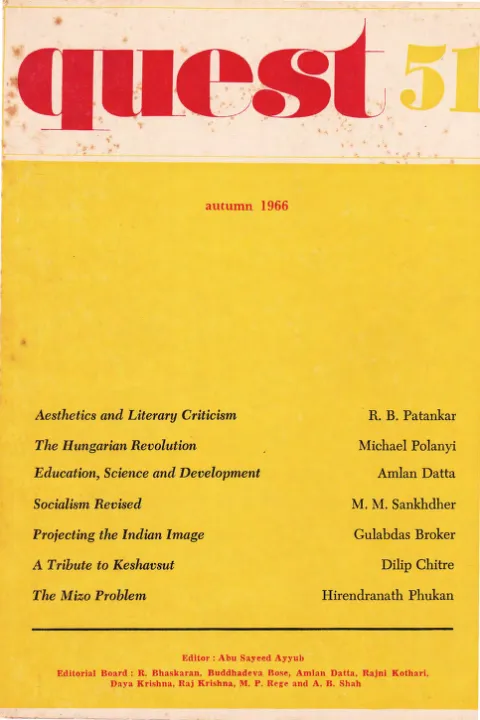
Quest
A Quarterly of Inquiry, Criticism and Ideas
By R. B. Patankar, Prof. Amlan Datta, Michael Polanyi, M. M. Sankhdher, Gulabdas Broker, Dilip Chitre, C. V. Raghavulu, D. Anjaneyulu, Hirendranath Phukan, Kejawa Assaf, Vinod Sena, Devindra Kohli, Naresh Guha, Gauri Deshpande, Gieve Patel, O. P. Bhagat, Sujatha Bala Subramanian, Punya Sloka Ray, Howard McCord, Swapan Majumdar, David McCutchion
Printed and published by MISS SHEELA SINGH for the Indian Committee for Cultural Freedom, Army and Navy Building, 148 Mahatma Gandhi Rd., Bombay 1 at Inland Printers, Victoria Mills Buildings. 55 Gamdevi Road, Bombay 7. · Bombay · 1966
126 pages
QUEST
Summary
Quest No. 51 (Oct./Dec. 1966) is the third number to appear under Abu Sayeed Ayyub as sole editor, with the eight-man Editorial Board (R. Bhaskaran, Buddhadeva Bose, Amlan Datta, Rajni Kothari, Daya Krishna, Raj Krishna, M. P. Rege, A. B. Shah) printed on the cover beneath his name and no advisory editors at all. The number has two argumentative centres. One is the university: Amlan Datta argues that a developing economy needs a dynamic, problem-oriented and deliberately selective system of education and research, and D. Anjaneyulu supplies the polemical companion piece, a mordant survey of Indian higher education in which the scholar’s real vice is ‘Academese’; a review of G. K. Saiyidain on universities and a review of a book on the teaching of English extend the same quarrel into the review pages. The other centre is the standing anti-communist commitment of the Indian Committee for Cultural Freedom, carried here by Michael Polanyi’s address on the tenth anniversary of the Hungarian Revolution, which reads 1956 as a wholesale return to the ideals of 1848 and indicts value-free behavioural political science for being unable to see it, and by M. M. Sankhdher’s argument that socialism has quietly dissolved into welfare statism and ‘regulative capitalism’.
Around those poles the issue runs unusually wide: R. B. Patankar on the proper relation of philosophical aesthetics to literary criticism, Gulabdas Broker on whether Indian writers still project an Indian image, Dilip Chitre on the Marathi poet Keshavsut in his centenary year, two policy pieces on the tribal areas and the Mizo insurgency written from opposite ends of the same argument, a Nigerian journalist’s post-coup autopsy of the first republic, a two-part Arnold-and-Keats exchange between Vinod Sena and Devindra Kohli that continues from No. 48, four poems, two short stories, nine book reviews and four letters. The undisclosed overlaps between the masthead and the reviewed matter are conspicuous: the lead review is of a book by a sitting member of the Editorial Board, and the poetry review is of a collection published by the journal’s own Reviews Editor and written by a poet printed in this same number.
Essays
Aesthetics and Literary Criticism
By R. B. Patankar
Patankar sets out to demarcate what literary criticism can legitimately ask of philosophical aesthetics. He rejects F. R. Leavis’s view that criticism has nothing to do with aesthetics, but grants that critics came by that view honestly, having asked philosophers for the wrong kind of help and been answered with omniscience and no critical sensibility. His own account is that evaluation is inescapable in criticism (there are no valuationally neutral literary facts), that evaluation implies criteria, and that criteria form competing ‘spirals’ which drive the critic from ‘Is this a good poem?’ to ‘What is good poetry?’ and finally to aesthetics.
He then tries four schools in turn. Metaphysical aesthetics flatters the artist and helps nobody: Absolute Idealism makes every sensuous presentation beautiful and so abolishes ugliness. Non-metaphysical system-builders such as Harold Osborne discipline critical discourse usefully but end by denying part of aesthetic life for the sake of self-consistency. Intuitionists and Emotivists make the decisive gain, by showing that universal aesthetic propositions state criteria rather than the meaning of beauty, so that many sets of beauty-making properties are possible. The cautionary example is the Marathi critic B. S. Mardhekar, whose three Laws of Rhythm worked (perhaps) for the plastic arts and were then forced on literature. Patankar’s conclusion is that the aesthetics of literature is nothing but poetics, that the Analysts’ method is excellent but their interest in literature negligible, and that critics must therefore analyse their own concepts.
- Rejects Leavis’s separation of criticism from aesthetics while conceding the historical grievance behind it.
- Argues no literary fact is valuationally neutral, so criteria and therefore aesthetics are unavoidable.
- Metaphysical aesthetics cancels the distinction between beauty and ugliness and so cannot serve the practical critic.
- Uses B. S. Mardhekar’s Laws of Rhythm as the case study in illegitimately extending one art’s criteria to another.
- Concludes that critics, not philosophers, must do the analysis of critical concepts; ‘the aesthetics of literature is nothing but poetics’.
Education, Science and Economic Development
By Amlan Datta
Datta argues that economic development is qualitative, not merely quantitative, and asks what kind of knowledge a developing economy needs. His first target is the diversification of higher secondary education recommended by the Sapru Committee of 1934 and the Mudaliar Commission: secondary school should be a preparation for university, not a vocational sorting house, and the selection of students for the university stream should be made at about fourteen, with the rest directed to technical institutions or on-the-job training. He argues in a long footnote from Soviet experience that multiplying institutions without regard to quality wrecks standards.
The paper then treats teaching method (a traditional society transmits settled conclusions; a dynamic one must teach through dialogue, which requires abandoning sole reliance on written examinations), the return migration of scientists (the graver loss is not defection abroad but the researcher who comes home and stops producing), the case for concentrating resources on a few centres of excellence, promotion by output rather than seniority, and the need for a class of ‘dedicated intermediaries’ and regional-language scientific literature to carry science down to people who will never attend a university. It closes on philosophy: science demands not the acceptance or renunciation of God but the belief that the measurable universe obeys measurable laws, and ‘Science is intolerant of magic’. A closing footnote records that the article was written before the Education Commission reported and was not revised in its light.
- Opposes vocational diversification of higher secondary schooling; wants a consolidated pre-university course with mathematics carried to the end.
- Proposes selection for the university stream at about the age of fourteen, with technical institutions for the rest.
- Identifies the loss of researchers who return from abroad and stop researching as more damaging than outright brain drain.
- Argues for concentrating resources on a few centres of excellence, on the Japanese imperial-university model, rather than upgrading all institutions equally.
- Calls for promotion by research output and student assessment rather than seniority, and for ‘dedicated intermediaries’ to popularise science in the regional languages.
The Message of the Hungarian Revolution
By Michael Polanyi
Polanyi marks the tenth anniversary of the Hungarian Revolution by insisting on what it was about. The rebellion began in June 1956 at the Petofi Circle, an official Party organ, among Communist Party members who had been the regime’s genuine beneficiaries, and what they demanded was that truth be recognised as an independent power in public life: a free press, public condemnation of the faked trials, the restoration of the rule of law, and an art released from subservience to the Party. He reads this, and the whole post-Stalin transformation of the Soviet countries, as a wholesale return to the ideals of 1848 and of the Enlightenment, a ‘smashing of spectacles’ rather than a change of them.
The polemical weight of the piece falls on Western social science for being unable to see this. Polanyi quotes Richard Pipes’s admission that he suppressed the claim that Russian intellectuals were fighting for truth because it sounded ‘naive and unscientific’, then turns on a 1963 textbook of political behaviour introduced by Robert A. Dahl, which restricts science to observable events, excludes statements of value, and derides the question ‘What is a good society?’ as ‘political theology’. He argues the position is self-contradictory by two complementary routes: a scientist who makes moral judgments privately must concede that moral truth exists and so that not all action can be explained without reference to moral judgment; a scientist who can explain all action value-freely must deny that his own acts have moral motives. The cost of the evasion is not academic, since it discredits both the motives and the aims of those fighting for freedom. He ends by predicting that the Russian Revolution may be recognised by its own successors, by its fiftieth anniversary, as having been virtually pointless.
- Insists the Hungarian rising began among committed Party members and demanded truth as an autonomous power in public life.
- Reads 1956 as a return to the ideals of 1848 and the Enlightenment, continuous with Western intellectuals’ defections from communism and with the release of the Kremlin doctors after Stalin’s death.
- Attacks value-free behavioural political science, and Robert A. Dahl’s introduction in particular, for excluding value statements and so being unable to describe what happened.
- Offers two complementary arguments that moral neutralism in social science is internally inconsistent.
- Cites the post-1963 acceptance of Liberman’s critique of detailed planning as evidence that ‘there is in fact no viable socialist alternative to the market’.
- Reprinted by permission from a Phi Beta Kappa copyright holder, and delivered as a talk rather than written as an article.
Socialism Revised
By M. M. Sankhdher
Sankhdher argues that socialism has changed its content while keeping its name. Conventional dictionary definitions in terms of community ownership of the means of production are formal and misleading; the word, used in Italy in 1803, by Owen in 1827, by Saint Simon in 1832 and by Marx in 1867, has meant contradictory things, and Western socialists now face ‘a dilemma: how to keep faith in socialism without loss of face’. What has been injected in place of ownership is the welfare state: social justice, full employment in a mixed economy, extended social services, graduated taxation, relief for old age and sickness, and much less noise about equality of wealth or nationalisation.
He attributes the shift to the experience of office, to the mistaken identification of labour movements with socialism, and to the failure of Marxian prognosis (the masses have not grown more miserable, the middle class has not disappeared, the state shows no sign of withering away). Socialists now adopt individualist arguments, accept capitalism’s motive of self-interest, and differ from liberals and conservatives chiefly in professing an ideology; he notes that in England liberals and conservatives ‘did more for the welfare of the working classes than the socialists’. The conclusion is that socialism has become welfare statism and ‘regulative capitalism’, and has lost its identity as an independent creed in transit.
- Treats the incoherence of ‘socialism’ as a historical fact about the word, dated from 1803 through Owen, Saint Simon and Marx.
- Identifies the substitution of welfare-state goals for ownership or control of the means of production as the decisive revision.
- Lists the failed Marxian predictions that forced the revision, and notes that socialists now regard themselves as liberal empiricists.
- Argues socialists differ from conservatives mainly in professing an ideology, and quotes Otto Bauer that ‘Nobody manages industrial undertakings worse than the state’.
- Concludes socialism has become ‘regulative capitalism’ aimed at social welfare, its separate identity lost.
Projecting the Indian Image
By Gulabdas Broker
Broker argues that a culture, not a country, projects an image, and that it does so through its arts and letters by an almost subconscious process rather than by design. He contrasts Greek tragedy with classical Sanskrit drama, Grecian sculpture with the Buddhas and Bodhisattvas of Ellora and Ajanta, and Tagore with Goethe or Rilke, to show that identical artistic excellence can carry wholly different patterns of approach. The Indian image he identifies is one that hankers for peace after war and for renunciation after kingship, that mellows the tragic into the Santa rather than ending in blood, and that works through symbols such as the lotus; he illustrates the last with an anecdote of an inverted stone lotus found beneath a pillar in an ancient church outside Rome.
The second half turns on the present. India seems to him in a sorry plight and its writers and artists correspondingly lost, sending up a cry of despair where they once sent up a shout of hope, borrowing new Western forms without the emotional impact that would justify them. His argument is not that art should be consoling but that it must be genuine: an honest record of a depressed and unsure spirit would still be an Indian image, whereas imitation is where art perishes.
- Distinguishes culture from country as the unit that projects an image, since several countries can share one culture.
- Holds that the projection is subconscious, and that tradition itself is the product of a people’s inner urges rather than their cause.
- Characterises the Indian image through classical drama, Ajanta and Ellora, and the refusal of the blood-soaked tragic ending.
- Finds contemporary Indian writers imitating Western forms without the emotional impact behind them.
- Argues that genuineness, not cheerfulness, is the test: a depressed but genuine work still projects an Indian image.
A Tribute to Keshavsut
By Dilip Chitre
Chitre writes on the Marathi poet Keshavsut in the year of his birth centenary, and opens by refusing the centenary’s terms: the exact date of Keshavsut’s birth is being debated, his horoscope has become a source of concern for literary critics, and Marxists, pure poets, Dadaists and Hindu mystics are all scrambling to claim him. Against that he argues there is no one Keshavsut, since the poems are ‘Janus-faced, multivalent and void’, and that he approaches him as a fellow poet in the same language.
His judgement is severe and admiring at once. Keshavsut was a less talented poet than many who followed him but a genius, because he was inspired by life rather than by literature; his failure is traceable to his models, drawn from The Golden Treasury and mid-Victorian ideals, which cut his generation off from Marathi tradition without giving them a living English. Chitre traces the decay of that borrowed Romanticism into ‘Parnassianism’ in his followers Balakavi and Govindagraja, reads Keshavsut’s so-called social consciousness as moral sensitiveness grounded in Advaita rather than politics, and finds the real achievement in the short metres and the metaphysical poems, where symbols are charged with power and the verse attains ‘a terse, rugged expression: an economy, a grip, a functional pertinence’. He closes by saying he translates the poems as a tribute because, being neither legislator nor building-contractor, he cannot raise a monument.
- Written for Keshavsut’s officially celebrated birth centenary in October 1966, and openly sceptical of the centenary industry.
- Argues there is no single Keshavsut, since the poems are formal metaphors that different readers legitimately use differently.
- Blames the failures on models taken from The Golden Treasury and on a generation cut off from Marathi tradition without a living English.
- Reads Keshavsut’s ‘social consciousness’ as Advaita-grounded moral sensitiveness, consonant with his Romanticism and symbolism.
- Locates the achievement in the short metres and the metaphysical poems, where he shows ‘a remarkable ability to charge symbols with power’.
Approach to the Development of Tribal Areas
By C. V. Raghavulu
Raghavulu attacks the policy of preventing the transfer of tribal land to non-tribals, which he treats as an inheritance from British ‘isolationism’ continued unchanged after Independence. He accepts that the Scheduled Tribes need special treatment but argues that protection of tribal land was wrongly made an adjunct of it, and tests the policy against three questions: whether its assumptions are justifiable, what it has done to development in the tribal areas, and whether it helps integration.
On the first, the assumption that all outsiders are exploiters and that there is no exploitation among tribals is, on N. K. Bose’s and S. C. Dube’s evidence, patently absurd. On the second, protection has not prevented large-scale alienation, and schemes such as the Tribal Development Colonies failed anyway: settlers in the Asoknagar colony sold 75 per cent of their assigned land within a decade and went home, and the Todas of the Nilgiris refused assignment outside their existing habitations. He attributes much of this to weak ‘achievement motivation’ bred by ecological isolation and stagnant living standards, and to policy conditioned by ‘too much of sentimentalism for the tribals’. On the third, isolation has strengthened separatism, as N.E.F.A. in 1962, Nagaland and the Mizo Hills showed. His proposal is to admit plainsmen and their capital, by analogy with the liberalisation of foreign private capital, with government surveillance, forest surveys and joint-stock or cooperative vehicles in which government, plainsmen and tribals are all represented. He is candid that the plainsmen will not come from benevolence.
- Treats non-alienation of tribal land as a survival of British isolationism rather than a considered development policy.
- Cites N. K. Bose and S. C. Dube against the premise that outsiders alone exploit and tribals never exploit each other.
- Uses the Asoknagar colony in Warangal district and the Todas of the Nilgiris as evidence that protected settlement schemes failed.
- Argues that isolation has bred separatism, pointing to N.E.F.A., Nagaland and the Mizo Hills.
- Proposes admitting plainsmen and non-tribal capital under government surveillance, with joint-stock companies or cooperatives representing government, plainsmen and tribals.
The Grooves of Academe
By D. Anjaneyulu
Anjaneyulu opens on the economics of education, quoting Harbison and Myers that human-resource planning can be brought inside the framework of development planning and that investments in man are not subject to diminishing returns, and Adam Curle that nobody can prove a sensitive appreciation of poetry is unrelated to economic growth. He then turns his attention to the universities, and the tone changes from policy to satire.
The charge sheet is that Indian higher education works under ‘a deteriorated copy of an obsolete model’; that external examinations split teaching from learning, so that teaching becomes oral rendition of an out-of-date textbook and learning becomes guessing topics and cramming for regurgitation; that neither teacher nor student is curious outside a fixed subject; and that the teacher’s favourite idol is Lakshmi rather than Saraswati, with note-books, tutoring a millionaire’s son and a new examinership preferred to the library. Research in the humanities is ‘another name for the collection between the covers of one book of material found scattered in several’, proceeding with due dignity ‘from inadequate facts to untenable conclusions’, and written in what he names ‘Academese’. Against this he sets English and American academics who argue publicly, Taylor against Trevor-Roper, Crossman against Crossland in Encounter, Galbraith and Schlesinger, and Leavis swooping on C. P. Snow and J. B. Priestley, and he asks whether any Indian professor now attracts students by the force of his work as Laski did. He notes the new Sussex and Essex models and observes that Indian institutions follow neither, being neither liberal enough for the humanities nor pragmatic enough for the sciences.
- Frames education as an investment not subject to diminishing returns, quoting Frederick Harbison, Charles A. Myers and Adam Curle.
- Blames the external examination system for severing teaching from learning in Indian higher education.
- Satirises the careerism of university teachers, whose ‘favourite idol is Lakshmi rather than Saraswati’.
- Coins ‘Academese’ for the prose of Indian humanities research, which turns the familiar obscure and the commonplace profound.
- Contrasts Indian academic silence with public intellectual quarrels in Britain and America, and finds Indian universities following neither the Sussex nor the Essex pattern.
The Mizo Problem
By Hirendranath Phukan
Phukan, reporting from Assam, argues that separatist and secessionist demands have crystallised among the hillmen because of plainsmen’s indifference and because the rest of India has failed to widen the mainstream enough to include them as equals. His test of indifference is personal: how many hillmen can a plainsman count among his friends, and how often has he tried to establish rapport with one. In Shillong, where both live together, there is almost no intermixing, no knowledge of hill languages, and excommunication for anyone who marries a girl from the hills.
The administrative charge is ‘pampering’: overlooking a hill student drawing both salary and scholarship, hesitating to discipline a delinquent tribal official, and above all backing away from arresting law-breakers until the situation requires military force. He narrates the growth of the Mizo National Front out of the Mizo Cultural Society and the Mizo National Famine Front through the mautam famine, the unpunished incidents at Aijal in 1960, the enrolment of ‘volunteers’ after the MNF’s 1962 defeat, Laldenga’s and Lalmunawia’s secret trip to East Pakistan in 1963, the extortion of traders from early 1965, the memorandum demanding independence handed to Lal Bahadur Shastri at Gauhati in October 1965, and the March uprising precipitated by the movement of the 18th battalion of the Assam Rifles. His remedy inverts the usual direction of integration: because minorities cannot be expected to dissolve into a majority, it is the plainsmen, as the majority, who must change first and form a composite community, with the Assamese carrying the greatest responsibility, and with a non-political, non-religious body on the model of the American Peace Corps to send the best plainsmen to work in the remotest hill areas.
- Locates the cause of Mizo separatism in plainsmen’s social indifference rather than in economic neglect alone.
- Names the administration’s policy ‘pampering’, and argues that unpunished violence taught the MNF that government could be intimidated.
- Supplies a dated narrative of the MNF from the Mizo Cultural Society through the mautam famine to the March 1966 uprising.
- Argues the majority community must change first, because minorities cannot be expected to dissolve into the majority.
- Notes that the educated plainsmen are as ‘westernized’ as the hillmen, and rejects blaming the British or foreign missionaries eighteen years after Independence.
- Proposes a non-political, non-religious service body on the model of the American Peace Corps.
Anatomy of Developing Politics in Nigeria
By Kejawa Assaf
Assaf writes a post-mortem of Nigeria’s first republic after the January 1966 army mutiny in which the Federal Prime Minister, the Premiers of the Northern and Western Regions and the Federal Finance Minister were killed. He treats the coup as the crude expression of grievances built up over years rather than as a rupture, and traces them to a constitutional settlement made in the 1950s by leaders who could not agree in London and so accepted three autonomous regions built on the Ibo, Hausa and Yoruba, which deprived the country of any national outlook.
He catalogues the resulting corruption: Coker’s Commission finding the Western Region government to have misappropriated over fifty million pounds, the allegations against four federal ministers and against the Eastern Region’s investment in Zik’s Bank, and the North’s missing financial records, with Wraith and Simpkins’s Corruption in Developing Countries cited for more. The political narrative runs through the creation of the Midwest to split the Action Group’s voting power, Awolowo’s treasonable-felony trial (which he treats, following Alun Davies Q.C., as unsatisfactory from start to finish, with a convicted forger among the chief prosecution witnesses, no jury, and his British counsel excluded), the arrest of Wole Soyinka, the disputed 1964 census, and Sir Ahmed Bello’s religious-fanatical politics and unauthorised promises abroad. His account of the old political class is contemptuous: semi-literate career politicians with no commitment to democracy who used tribalism to blindfold voters and expected to be treated as emperors. The prescription is a political institution built for turbulence, provincial devolution manned by a sound civil service, a free press, no tribe brought to the centre to dominate others, and a body of ombudsmen drawn from senior barristers of all regions.
- Reads the January 1966 mutiny as the expression of long-accumulated grievance rather than a sudden rupture.
- Blames the three-region constitution, produced by the deadlocked London conferences, for destroying any national outlook.
- Documents corruption through Coker’s Commission, Zik’s Bank and Wraith and Simpkins’s Corruption in Developing Countries.
- Treats Awolowo’s treason trial as procedurally indefensible and the 1964 census as inflated in the North’s favour.
- Prescribes provincial devolution, a strong civil service, a free press and a body of ombudsmen drawn from all regions.
Matthew Arnold and Keats
By Vinod Sena
Sena replies to Devindra Kohli’s article on the Odes in Quest No. 48, which had been provoked by Matthew Arnold’s judgement that for the faculty of moral interpretation ‘Keats was not ripe’. Sena’s first point is that Kohli picked the wrong opponent: Arnold’s essay works hard in the opposite direction, arguing that a merely sensuous man cannot be a very great poet, that Keats had ‘flint and iron in him’, and that the yearning passion for the beautiful is an intellectual and spiritual passion connected with the ambition of the intellect. Sena accounts for Kohli’s blind spot as the effect of an untempered Keatsolatory which will not brook qualified praise.
His substantive argument is developmental. Keats died at an age when Shakespeare was still in his first phase, and the Odes dramatise a critical point in his growth rather than its completion: the Psyche ode fixes on a love that ‘had not bade adieu’, the Nightingale and Grecian Urn odes try nature and art in turn as escapes from time and find both wanting, the ‘Ode on Melancholy’ (which he notes Kohli inexplicably ignores) accepts time’s inevitability as the condition of intense beauty, and ‘To Autumn’ achieves the full acceptance that frees Keats to move past the naturalist plane, as the revised Hyperion begins to do. To transpose Leavis’s ‘tragic impersonality’ from the second Hyperion back onto the Odes is to collapse the phases into each other and to have the sapling as the tree. Elegiac sadness and the pathos of mutability are not tragic vision; he invokes Yeats’s own classification of Keats among ‘the great lesser writers’ and distinguishes the ‘artifice of eternity’ from the arrest of time on Keats’s urn.
- Shows by extended quotation that Arnold’s essay defends rather than dismisses the seriousness of Keats’s genius.
- Reads the 1819 odes as a sequence dramatising a transition from the naturalist to the ethical plane of experience.
- Objects to transposing Leavis’s term ‘tragic impersonality’ from the revised Hyperion back to the odes.
- Denies that the pathos of mutability by itself amounts to tragic vision, citing Yeats’s classification of Keats among ‘the great lesser writers’.
- Reports a suggestion of David Daiches, from an informal discussion, that the closing formula of the Grecian Urn may be an ironic Lambsian comment on the protected world of art.
Matthew Arnold and Keats
By Devindra Kohli
Kohli answers on two fronts. On Arnold, he concedes he knew the qualifying remark but argues it does not help, because Arnold generalises about the poetry from the life and letters rather than from the poems, as he did in dismissing Shelley as ‘a beautiful and ineffectual angel’. Arnold’s saying that the odes are both perfect and immature amounts to conceding sensuous density while holding the moral vision thin, which Kohli calls deadly unjust; and Arnold’s excuse that in shorter things ‘the matured power of moral interpretation… [is] not required’ he rejects outright, since what matters in poetry is the cumulative quality of the experience communicated, not the size of the form.
On chronology he accuses Sena of dogmatic insistence on a rigid order among poems written within four or five months, pointing out that Keats had already finished the first 180 lines of The Fall of Hyperion before writing ‘To Autumn’, so that the neat progression to tragic impersonality will not hold; he prefers to see the odes as the culminating stage of a circular growth. He then builds the positive case for tragic intensity in the odes: the King Lear sonnet of January 1818 predicting the ‘deep eternal theme’, the fire in which Keats wishes to be consumed, the apprehension of early death, and a sustained parallel between the Nightingale ode and Hamlet’s soliloquy, in which both contemplate a permanent ‘shuffling off’ and both are brought back to the realistic plane. He turns Sena’s Yeats against him by asking in what sense Sailing to Byzantium and The Tower embody a Shakespearean vision of evil, and closes on Keats’s negative capability and Yeats’s ‘A Drinking Song’.
- Argues Arnold judged Keats’s poetry from his life and letters rather than from the poems.
- Rejects the premise that shorter poems need less matured moral interpretation, since what counts is the cumulative quality of experience.
- Uses the overlap of The Fall of Hyperion with ‘To Autumn’ to break Sena’s strict developmental sequence.
- Builds a detailed parallel between the Nightingale ode and Hamlet’s soliloquy to establish tragic intensity in the odes.
- Notes that Arnold’s own logic would deny matured moral power to Yeats’s later short poems as well.
Miracles
By Naresh Guha
A short poem in free verse, self-translated by the author from Bengali, which counts the small dependable things that make Calcutta survivable: lamps in the evening lanes, water at the tap at dawn, saffron sari-ends dripping from first-floor rails, roosters crossing midnights ripped by shouts from the neighbouring slums, a fly’s buzz teasing middays, ants taking off grains of sugar left from tea. Windows hang slices of sky all year round; a thin match makes the room glow blue. The last movement turns to the week’s small rescues, the new book smelling of English antique, the girl’s letter to be saved from grabbers, and Sundays arriving like a floating buoy after days of drifting since the wreck, until the mail-box yields ‘Envelopes of sunlight: left by whom?’
- Self-translated from Bengali by the poet, as the line under the byline states.
- Builds its argument by enumeration: the miracle is the reliability of ordinary urban detail, not anything transcendent.
- Sets domestic and municipal detail against violence in the neighbouring slums without comment.
- Ends on an unanswered question about the source of the week’s unexpected consolations.
Sakuntala
By Naresh Guha
A second self-translated poem, addressed to Sakuntala as an unpaid debt. The speaker measures the distance since her departure in natural cycles, moon phases and the oboes of many autumns, and concedes both that she is gone and that she may never return, while the heavens go on laughing and the gilded mornings blushing. The middle turns on the persistence of her presence: her dark hair in undone piles hiding his dreams each night, a voice he cannot escape invading his room. The close descends into an urban morning of mud, steam and smoke, and to sin and disgrace rubbing the soul, with Time called ‘The trickster’ for adding to the burden, before returning to the refrain, ‘When shall I repay my debt to you?’
- Self-translated from Bengali by the poet.
- Uses a refrain of unpayable debt to frame a classical figure as a personal obligation.
- Sets the endurance of Sakuntala against the indifference of the natural world.
- Moves from mythic address to a degraded modern morning of mud, steam and smoke.
Two Poems on Death
By Gauri Deshpande
Two numbered poems printed under one title and one byline. The first works through a delayed recognition of loss: leaves yellowtipped early, winter arriving while the speaker was still thinking about the brief Indian Summer, a goodbye whose dusty half-hearted fall had not told her the addressee was gone, until the yellow winter laid ‘the shearing hand of shame’ on her. Waves of mangoblossom deluge the dreams; waking, she knows she is ‘here, too much here’, and asks what the living know about ‘you the death’. The second is a poem of searching: how long must she walk the long and windsome streets before meeting you, standing under a starred black sky thinking of all the meetings and partings which are her life, wondering whether she would still recognise a step once so longed for, hurrying to be on time where they first met, and returning to search every stranger’s face and to beg for sanctuary ‘not of love, only of your arms’.
- One contents line, one printed title and one byline covering two numbered poems on a single page.
- The first turns on seasonal misrecognition as a figure for a loss registered too late.
- Addresses death in the second person, as ‘you the death’.
- The second poem converts the search for the dead into an endless walk through streets, ending in a plea for sanctuary rather than love.
The Solution of Servants
By Gieve Patel
A poem set as filler in the lower two-thirds of folio 68, beneath the close of the Nigeria article. It imagines the master suddenly opening the door, switching on the lights and breaking in on his servants smiling, and works through what the resulting scramble and ‘air of apology, not anger’ would mean. The speaker asks whether the servants’ apparent deference is really an image of the master prevailing, or protection: the keeping of him apart, his bigness acknowledged as ever-present but having little to do with their lives, providing exchanges but otherwise distant and rejected. The closing movement turns the figure back on the speaker, who sleeps in a room shut against eyes and intact to that extent but rebels at the thought of the hidden face, its beard weighty, acknowledged by agents and sometimes heavier than ‘you and I’, whose possible presence is a challenge to our find; and so asks why we do not let up and try ‘The solution of the servants’.
- Printed on folio 68 as filler under the end of Kejawa Assaf’s article, which is why the contents page’s figure breaks the poetry sequence.
- Uses the master’s intrusion on his servants to examine whether deference is submission or self-protection.
- Turns the servants’ strategy of keeping the master apart into a general model of how the self shuts out an unbearable presence.
- The poet’s first collection, Poems, is reviewed in this same issue at folio 101 (toc_index 24).
Sword and Shield
By O. P. Bhagat
A first-person story set in the town of Daryapur. The narrator, Prakash, befriends his neighbour Lala Sadhu Ram, a broker for the Pathans who bring camel-loads of chopped straw and firewood to the town: spare, robust, in his early sixties, dressed in the heavy salwar and seven yards of turban of an older generation, who walks miles daily, distrusts tea as a physician’s brew, and tells his grandchildren stories at bedtime. Lala Sadhu Ram suggests the family buy a cow, and takes charge of the search.
The comedy of the story is the succession of disqualifications. One cow has no tuft to her tail and is therefore ‘like a jar with the handle broken’; another is too old; a beautiful black animal is rejected because all four legs are white and so inauspicious, though a white patch on the head would have cancelled it; a farmer’s cow five miles away is rejected for shaking her head, which proves her ill-natured and a danger to children. While Lala Sadhu Ram is out of town the narrator buys a cow himself, and the whole lane approves. On his return Lala Sadhu Ram looks at her horns, one gracefully curved and one straight and downward, and pronounces them the sword and the shield, meaning battle and daily quarrels in the house. The family, unwilling but unable to disobey him, sells her. The narrator is left feeling guilty at having sold an ill-omened animal to an ignorant man, until he meets the buyer again and finds him delighted: his mother-in-law, Shanti Devi, ‘Goddess of Peace’ but privately his Goddess of Strife, left for her son’s town the day after the cow arrived, and he is celebrating her departure with a tumbler of the same creamy milk.
- A comedy of omens in which each candidate cow is disqualified by a bodily sign rather than by yield.
- Sets the narrator’s affection for an older man against his inability to argue with the man’s convictions.
- Turns on the horns read as sword and shield, the story’s title, which condemns an otherwise ideal animal.
- Closes with an ironic reversal: the buyer’s household becomes peaceful the day the ‘unlucky’ cow arrives.
The Zamindar of Pallipuram
By Sujatha Bala Subramanian
A dramatic monologue spoken by a dispossessed zamindar, now living in his son Santhanam’s house, who begins by anticipating his listeners’ judgement that he is in his dotage. He describes the elaborate charade the household maintains for him: the servant Raju brings coffee, shaves him, lays out his clothes and receives a handful of gleaming rupees every morning, then returns to the cupboard and puts every coin back, on Santhanam’s instructions, so that the old man may keep ‘almost the same kind of life that he is used to’.
From that humiliation the monologue slides between tenses into the Pallipuram of the past: Sankranti, when two or three hundred families filed into the courtyard newly clothed and fed at his expense, a manager whispering the accounts deferentially behind his chair; and the Green House, where the dancer Mallika became the centre of his version of paradise, and where a silver pan box with a woman’s figure on the lid was given to him as a memento. The convention that a present to the mistress must be duplicated for the wife is noted without embarrassment, as is his wife Radha’s calm knowledge of the whole arrangement. The dispossession arrives as a young collector stuttering ‘Government-compensation-’ with a piece of paper that the old man wants to throw in his face and instead folds and hands to his son, ‘as if I have handed over my whole life into another’s keeping’. The monologue closes with the arrival of Appu, a former cook who sold the gold thoda he was once given to start a hotel and has brought his old master a packet of jelabis; the zamindar, unable to let him leave empty-handed, gives away the silver pan box, the last thing he has.
- A monologue whose speaker narrates his own obsolescence, beginning from the listeners’ presumed verdict on him.
- The returned tips are the story’s central image of a dignity maintained as theatre by his son and servant.
- Slides between past and present tense to keep Pallipuram, Sankranti and the Green House continuously alive.
- Registers zamindari abolition only as a stuttered official word and a folded piece of paper.
- Ends by giving away the silver pan box, the one surviving token of the remembered life.
Towards a Theory of Social Change
By P. C. Chatterjee
Chatterjee reviews Daya Krishna’s Considerations Towards a Theory of Social Change (Manaktala) as a philosopher’s intervention in a field previously divided between sociologists describing particular societies and philosophical historians such as Toynbee and Spengler speculating. He reconstructs the argument carefully: that ‘social’ points both backwards to what an individual derives from his background and forwards to what his acts have consequences for, which if pressed reduces the individual to a cipher; that this consequence is unacceptable, since any theory denying the uniqueness of man must be false; that ‘social’ therefore reasonably means interpersonal; and that causal explanation, which explains narrower classes of events by wider ones, denies the ‘specificity’ Daya Krishna wants to preserve. In its place the author offers understanding in terms of value, treating society as more like a work of art than an object of nature, though he concedes the exaggeration, and distinguishes a realm of existence that prescribes the limits of freedom from a realm of value that is the realm of freedom.
The review then turns critical, and does so on the ground of the book’s obscurity rather than its conclusions. Having promised a middle course between speculation and fact-gathering, Daya Krishna loses himself in abstraction and metaphor; the book ‘abounds in felicitous generalities which have the appearance of profundity’. Freedom, the key concept, is never defined, and may mean no more than indetermination; the account of society is largely negative, saying what it is not; and the analogy with art objects looks artificial and, on the author’s own premises, unnecessary, since if freedom means indeterminism he has already shown there is freedom in nature. Not disclosed anywhere in print: the author under review is one of the eight members of this issue’s Editorial Board.
- Reconstructs Daya Krishna’s move from ‘social’ as derived-from and pointing-to, through the reduction of the individual to a cipher, to ‘social’ as interpersonal.
- Sets out the distinction between a realm of existence that limits freedom and a realm of value that is the realm of freedom.
- Presses the objection that ‘freedom’, the book’s key term, is never defined and may amount only to indetermination.
- Finds the analogy between society and art objects artificial and unnecessary on the author’s own premises.
- The book’s author sits on this issue’s Editorial Board, and the connection is nowhere disclosed.
Foreign Policy in the Sixties
By A. G. Noorani
Noorani reviews a festschrift for Arnold Wolfers on foreign policy in the 1960s, praising it for making theory relevant to policy in a decade he characterises, quoting the volume, as dealing with ‘an inchoate world, post-dating the old structures and predating new and as yet not clearly discernible relationships’. He notes Raymond Garthoff on the cracks in the Red monolith and Laurence W. Martin’s less tidy conclusion that the United States must resign itself to an untidier coalition than the American political genius finds congenial, which supplies the review’s headline.
The centre of gravity, for an Indian reader, is Charles H. Heimsath’s reassessment of non-alignment. Noorani accepts the thesis that non-alignment remained relevant to the dominant state system of the super-powers but not to the subordinate system of South and South East Asia, and adds a criticism of his own: Heimsath notes India’s isolation in South East Asia but fails to connect it with India’s cultivation of China, so that when China changed course India was too flat-footed to mend fences with her natural friends in the region, ‘a flat-footedness which still continues’. He endorses Heimsath’s prescription of winning support among Asian states already opposed to China, a military agreement with Pakistan for joint defence, and understandings with Japan, Formosa, the Philippines, Malaysia, Thailand and South Vietnam that would not commit India to Western strategies. He is warm about David S. McLellan’s study of Dean Acheson’s political style as a model of policy-making that begins from knowledge of the problem rather than from a priori moral abstraction, and closes by contrasting that with what passes for a theory of international politics in India.
- Reviews a Wolfers festschrift as a demonstration that theory can be made relevant to policy.
- Accepts Heimsath’s distinction between the dominant and subordinate state systems as the key to non-alignment’s limits.
- Adds his own charge that India’s isolation in South East Asia followed from cultivating China, and that the flat-footedness persists.
- Endorses a joint-defence agreement with Pakistan and understandings with anti-Chinese Asian states.
- Uses McLellan’s account of Dean Acheson’s method to indict Indian foreign-policy thinking.
India’s Policy of Recognition of States
By S. B. Mookherji
Mookerji reviews K. P. Misra on India’s policy of recognition of states and governments, opening with the history of the doctrine: Grotius and Pufendorf paid it little attention, but by the end of the nineteenth century Lorimer could call recognition ‘the basis of International Law, with a fair measure of justification’. He rehearses the competing characterisations of recognition as a legal act (Quincy Wright, Ti-Chiang Chen), a political act (Philip Marshall Brown), or both (Kelsen), noting in passing that Soviet legal theory treats it as legal pure and simple.
The substance is India’s record across China, Israel, North and South Vietnam, the German Democratic Republic, the Congo, the G.P.R.A., Syria and Mauritania, with the Algerian sequence given in detail down to the four-day interval between the end of French power on 2 July and Indian recognition on 4 July. The review’s argument is that India’s practice has been unusually consistent, which it attributes to eighteen years of single-party rule and to Nehru’s supremacy as his own Foreign Minister for sixteen of them. It identifies the operative principles: recognition generally conditional on admission to the United Nations, a refusal to recognise dismembered countries (with the Federal Republic of Germany the one exception, explained by India’s wartime position as an Allied partner), indifference to dynastic or constitutional legitimacy and to the ideological character of a successful revolution, reliance on the principle of effectiveness, a refusal to treat recognition as reward or punishment, and a refusal to recognise emigre governments. It closes on the gap between recognition and diplomatic relations, noting that of eighty-one states recognised by 1961 India had no diplomatic relations with twenty-four, and finds India ‘more honest and more idealistic than many nations’, though the book’s price is high.
- Traces recognition from Grotius and Pufendorf’s neglect to Lorimer’s claim that it is the basis of international law.
- Attributes the consistency of Indian practice to single-party rule and to Nehru’s sixteen years as his own Foreign Minister.
- Sets out India’s principles: admission to the UN, non-recognition of dismembered states, indifference to the character of a revolution, and reliance on effectiveness.
- Notes the Federal Republic of Germany as the standing exception, explained by India’s wartime alignment.
- Reports that of eighty-one states recognised by 1961, India had diplomatic relations with only about two thirds.
Confessions of a Native Alien
By R. K. Kaul
Kaul reviews Zulfikar Ghose’s autobiography, published at thirty, and treats its central subject as the problem of ‘roots’. Born in Sialkot before the formation of Pakistan, moved to Bombay before Partition, migrated to England in 1952, Ghose is critical of both India and Pakistan and an alien in England; Kaul’s argument is that he is in fact more Indian than Pakistani, and attacks India more unsparingly because he knows it more closely. He supports this with the book’s own evidence: the Punjab landlord in the train, splendid and silent behind his moustache, admired as a being on a different planet with whom the writer would never have to eat or drink, against the numerous emotional attachments of his Bombay school days and his serious consideration of a Bombay job.
The review is warm about the writing. It places the book in the Boswell-Rousseau tradition, praises the chapter ‘An Intimacy with the Sun’ as ‘twenty pages of the most authentic lyrical prose’, and identifies Ghose’s secret as the impression of merely recording experience and giving the whole truth, including the sexual and scatological; the account of his own circumcision ‘must surely be unprecedented in history’. Kaul also registers what the book lacks: not a single Urdu or Hindi writer among the literary influences, not even Ghalib, with the omission of Iqbal ‘a very serious one’. He ends on the epigraph from Hopkins, ‘send my roots rain’, observing that for Hopkins the rain was faith rather than climate, that Ghose began to hate religion after the 1946 riots and has found no substitute as Yeats found one in pre-Christian Ireland, and predicting that his poetry ‘is likely to lack the third dimension’.
- Treats ‘roots’ as the book’s organising problem and argues Ghose is more Indian than Pakistani.
- Contrasts his distanced admiration for the Punjab landlord with his close, unsparing attachments in Bombay.
- Places the autobiography in the Boswell-Rousseau tradition and praises the lyrical prose of ‘An Intimacy with the Sun’.
- Notes the absence of any Urdu or Hindi influence, singling out the omission of Iqbal as serious.
- Reads the Hopkins epigraph against Ghose to argue his poetry will lack a third dimension.
The Symbolism of Virginia Woolf
By Nita Pillai
Pillai reviews N. C. Thakur on Virginia Woolf’s symbolism, and begins by crediting the book with a solid sense of pleasure in its writer. Thakur limits himself to interpreting Woolf’s use of symbols and to explaining why she leans on them, linking her debilitating illnesses and her susceptibility to visionary states of mind with an almost necessary use of symbol, and drawing on her diaries and critical writings throughout as well as on the Chhandogya Upanishad, the Persian Sufis, De Quincey, Bergson and Radhakrishnan.
The review grants real gains and names real costs. On the early novels Thakur reads image against image to reveal the tightening web of fear and instability in Jacob’s Room, tracking details relentlessly, as with the three half-flying geese chased by Johnny associated with Mrs Flanders’ fears for her sons; the chapters on To the Light-house and The Waves are sound, and his account of Mrs Ramsay and Lily Briscoe, and of the comparison with ‘god-intoxicated people like the Sanyasins of India’, is singled out. But the pursuit of symbols costs him critical detachment: he never queries whether a symbol or character convinces, so that Jacob’s death is lent a portentousness Woolf nowhere developed, and he is less than adequate on Woolf’s controlled criticism of Clarissa Dalloway. Pillai also resists his turn to religion in reading Between the Acts, where Lucy Swithin’s ‘simple Christian faith’ becomes an axis for a theme of universal brotherhood and the relationship between Isa and Giles is side-stepped. Her verdict is that the study covers original ground and is lucid, detailed and often perceptive, with no major insight, and that Thakur’s British Council year at Oxford was well spent.
- Credits Thakur with linking Woolf’s illnesses and visionary states to a necessary use of symbol.
- Praises the image-by-image reading of Jacob’s Room and the chapters on To the Light-house and The Waves.
- Objects that the pursuit of symbols costs Thakur critical detachment about whether they convince.
- Resists his religious reading of Between the Acts and his side-stepping of the Isa-Giles relationship.
- Concludes the book offers no major insight but covers original ground lucidly.
Poems
By K. N. Kutty
Kutty reviews Gieve Patel’s first collection and uses it to argue about how Indian poetry in English should be judged. He rejects Donald Davie’s view, from the New Statesman, that Commonwealth poets should be read ‘less for what they say than for how they use English to say it’, on the ground that it carries the unacceptable assumption that poems written in English by those whose mother tongue is not English are at best exercises in mastering a foreign medium. His alternative is comparative but locally so: judge an Indo-Anglian poet against his own native contemporaries and against the poetry written in the Indian languages, not against contemporary Anglo-American work; do not set Kamala Das beside Sylvia Plath or look for affinities between Peter Porter and Gieve Patel.
On that test he finds Patel’s poems refreshingly different: not derivative or imitative, not couched in cliches, neither romantic nor sentimental, and free of the self-advertisement he attributes to a large number of Indo-Anglian poets ‘including the much over-rated Dom Moraes’. Patel is a poet of involvement whose clinical experience has sharpened his sensitivity, and whose world of peasants, servants, lepers, beggars and invalids has pain as its greatest reality without tipping into sentimentality; the review quotes ‘Servants’ and the longer poems Nargol, Naryal Purnima and Pavement at length. The criticism is that the lines are often bald and devoid of suggestive content, and that Patel has still to acquire control of verse movement, terseness and a tougher diction. Two overlaps go undeclared: the collection is published by Nissim Ezekiel, this issue’s Reviews Editor, and its author has a poem printed in this same number.
- Rejects Donald Davie’s how-not-what prescription for Commonwealth poetry as rigid, academic and one-sided.
- Proposes that Indo-Anglian poets be judged against their own native contemporaries and against Indian-language poetry.
- Praises Patel for avoiding derivation, cliche and self-advertisement, with a passing attack on Dom Moraes.
- Identifies pain as the greatest reality of Patel’s world and credits his clinical experience for the sharpness.
- Faults the baldness of the lines and calls for control of verse movement and a tougher diction.
- The book is published by the journal’s own Reviews Editor and the poet appears in this issue; neither is disclosed.
Universities and the Life of the Mind
By A. M.
A. M. reviews G. K. Saiyidain on universities, welcoming any serious attempt to pinpoint problems in Indian higher education and then finding this one tame. It opens with a mawkishly sentimental posthumous letter of dedication to Nehru and proceeds through a laborious demonstration of obvious truths about man’s dual nature and the need to balance material and spiritual development, culminating in salvation through ‘Culture’, which Saiyidain defines as the cultivation of freedom, tolerance, respect for truth, personal dignity, recognition of the humanity in other men, justice and honour. The first 173 of 231 pages are, on this account, needless emphasis on familiar themes larded with quotations from Russell, Bronowski, Huxley and Radhakrishnan, amounting to a re-hash of the reference works consulted, delivered in tones of prophetic warning.
The review comes alive where the book does, in the chapter on the general situation in Indian universities, which draws on Vice-Chancellors’ replies to letters asking how far the universities have promoted ‘the life of the mind’. With few exceptions they answer that the universities have failed, and their analysis of causes is found authentic and immediately recognisable: over-crowding, paucity of resources, lack of teacher-student contact, emphasis on examinations instead of scholarship, poor teaching methods, uninspired teachers, and exploitation of groups within the university by political leaders. A. M. presses two points of her own. Saiyidain’s plea for greater social recognition of scholarship is not matched by any comparable passion about salaries, and the reviewer insists teachers must be thought of realistically rather than as rishis in huts; and the book ignores the connection between school and university, so that, in his phrase, saving ‘The Goal of the University’ must begin at school. A closing paragraph notes the numerous printing errors and faults of language, especially inexcusable in a work that preaches high standards.
- Finds three quarters of the book a re-hash of familiar truths quoted from Russell, Bronowski, Huxley and Radhakrishnan.
- Credits the chapter drawing on Vice-Chancellors’ replies as authentic and immediately recognisable.
- Attacks Saiyidain’s reticence about teachers’ salaries and the image of the teacher as a rishi in a hut.
- Faults the book for ignoring the dependence of the university on the quality of school education.
- Notes the book’s numerous printing errors as especially inexcusable in a work preaching high standards.
Journal of the Sangeet Natak Academi
By L. F.
A single review covering three books, of which the contents page names only the first. On the Journal of the Sangeet Natak Akademi, L. F. begins with the physical object, noting that one does not usually associate good looks or readability with government and semi-government publications and that the first two numbers set a high standard in both, down to the practical point that the journal will stand on a bookshelf and the cover is strong enough to last. The contents promise an indispensable repository of scholarly exposition for anyone seriously interested in music, dance or drama, and the emphasis on other Asian countries is welcomed; the editorial board, headed by H. H. Sri Jaya Chamaraja Wadiyar Bahadur, is noted as ‘obviously more active than most editorial boards’ since several members appear among the contributors. The most useful article, because it consists of first-hand working ideas, is judged to be E. Alkazi’s short piece ‘Style in the Theatre’ - ‘Style is something we all most conspicuously lack just now.’
Frank Whitehead’s The Disappearing Dais is about teaching English to English children, which might seem useless for Indian conditions, but L. F. argues ninety per cent of it is highly relevant if one upgrades the school children and thinks of university students instead, and endorses Whitehead’s insistence that the English teacher’s business is not instruction but the provision of abundant opportunity to use English. She contrasts the average English child’s fifty to sixty books a year with the Indian student’s disinclination to read outside the prescribed textbook, cites Dr Johnson on letting a boy read any book that engages his attention, and praises Whitehead’s method of having pupils analyse advertisements as objective practice. On Kamala Markandaya’s A Handful of Rice she finds the working-class characters more plausible than the middle-class ones, gives a deliberately flat plot summary of Ravi’s decline, and locates the real loss of authenticity in the staccato English slang used to render Indian speech, concluding that Kipling’s invented style remains unrivalled for the purpose.
- One review covering three books; the contents page lists only the Sangeet Natak Akademi journal.
- Judges the journal well made and scholarly, and singles out E. Alkazi’s ‘Style in the Theatre’ as the most useful piece.
- Argues Whitehead’s book on teaching English to English schoolchildren applies to Indian university students.
- Contrasts English children’s reading volume with Indian students’ confinement to prescribed textbooks.
- Faults Markandaya’s staccato English slang for failing to convey the flavour of Indian speech.
- The Sangeet Natak Akademi also advertises this journal inside the same issue, at folio 120.
T. S. Eliot
By K. N. Kutty
Kutty reviews P. Lal’s Eliot commemoration volume and uses it to indict Indian criticism of Western literature generally. He opens by saying he has always viewed such attempts with suspicion, and that despite the enthusiasm, the seminars and the approved doctoral theses, India has yet to produce a first-rate critic of Western literature. He approached this volume without suspicion, out of respect for Lal’s literary efforts, read the whole of it ‘a marvellous feat of human patience, I feel now’, and had his suspicion confirmed. His causal claim is blunt: had Eliot’s scanty acquaintance with Sanskrit and the Upanishads not been publicised so much, and had The Waste Land not ended in what he calls a mystical abracadabra, Eliot would not enjoy half his Indian popularity.
The editorial charge is that Lal was too generous: of sixty-one commissioned contributions, half do not rise above the college-miscellany level, and publishing bilge under the title of homage merely encourages laziness and boosts idiotic self-importance. He then names names, dismissing Ahmed Ali’s cataloguing, ridiculing Bantleman’s prose by quoting it back, calling C. D. Narasimhaiah’s assurance that the predicament of Western man is not yet ours ‘spiritual bunkum’ from a man who has been a student of Leavis, and declaring Ka Na Subramanyam’s ‘Reading T. S. Eliot’ ‘pure crap’. Three of his approving judgements are entanglements the issue does not disclose: David McCutchion’s ‘T. S. Eliot - An Irritated Reaction’, singled out as among the few essays showing clear and disciplined thinking, is by a correspondent printed on folio 111 of this same issue; ‘Prof. Nissim Ezekiel on The Cocktail Party’, called particularly interesting, is by this issue’s Reviews Editor; and the mystery of what inspired Lal to ask Sujatha Bala Subramanian to write about Eliot concerns the author of the short story on folio 88.
- Uses the volume to argue that India has produced no first-rate critic of Western literature.
- Attributes Eliot’s Indian popularity to the publicity given his Sanskrit and Upanishadic borrowings.
- Calls the editor’s generosity ‘an editorial disaster’ across sixty-one commissioned contributions.
- Names and dismisses individual contributors in unusually blunt terms.
- Three of the contributors he judges - McCutchion, Ezekiel and Sujatha Bala Subramanian - also appear in this issue of Quest, undisclosed.
Secularism in Letter and Spirit
By Punya Sloka Ray
A letter answering a thesis attributed to Shri N. W. H. Pande, that Indian Muslims are a half-cut branch of the main Indian tree which must either fall off or reintegrate. Ray makes four numbered replies. First, the metaphor of a single tree is invalid: a viable society can be focussed on several partly separated, partly overlapping, partly competing and partly cooperating centres, as India is between legislature and executive, Union and States, English and Hindi, Right and Left, with no prospect of homogeneity. He argues that this polycentrism is hard for those used to monocentric societies to grasp, that ‘Hindu’ is itself not a simple concept (the monocentric Hinduism propagated by Dayanand and Vivekananda succeeded only partly, and pre-Muslim society was bicentric, with Brahmans competing with Kshatriyas), and that the Indian tradition is polycentrism, ‘or as our President puts it, of unity in diversity’.
Second, responsibility goes with power, so most of the responsibility for Partition rests with the British, who had the most power; Muslim opinion was guilty only in proportion to its very little power, and his reading is that the Muslim League wanted Pakistan to regroup for a revival of the Mughal Empire, aiming not against the country’s unity but against its secular and democratic constitution. Third, moral reciprocity is necessary: the Muslims who refused to go to Pakistan ‘are with us now’, and inward loyalty must be matched by inward consideration, which is why Gandhi supported the Khilafat movement. Fourth, parochial and even treasonable feelings in minorities are too common to excite anyone, and what matters is actions, not feelings; in a polycentric society where ‘First Class is visibly vacant’, the temptation is to explain one’s own second-class position by an invisible, intangible ‘them’, a conjugation he says the Bengalis, the Mizos, the Marwaris of Calcutta and the fishermen of Midnapore all perform. He ends by observing that it is fortunate no single collection of fanatics can dominate the nation, and that this good fortune is precarious.
- Replaces the single-tree metaphor with an argument that India is constitutively polycentric.
- Denies that ‘Hindu’ names a monocentric tradition, citing the partial success of Dayanand and Vivekananda and the bicentric structure of pre-Muslim society.
- Assigns most responsibility for Partition to the British on the principle that responsibility goes with power.
- Reads the Muslim League’s aim as directed against India’s secular and democratic constitution rather than against its unity.
- Argues that a polycentric society generates parochial resentment precisely because no visible ruling nucleus exists to blame.
New Indian Poets: An Anthology
By Howard McCord
A letter from the Department of English, Washington State University, dated July 22, 1966, and addressed ‘Gentlemen:’. McCord reports a long visit the previous summer during which he talked to a number of young poets and became convinced that India offers a moving and sophisticated display of the interchange between East and West: nowhere else in Asia is the English language so at home or the currents of the Western tradition so strong, and nowhere else is there such a body of profound wisdom and ancient tradition to be placed in fertile tension with the West. He adds that India’s social and economic problems are so vast and immediate that no poet can withdraw from confrontation with the most elemental questions. On those assumptions he has begun gathering poems for an anthology to be called New Indian Poets, and invites manuscripts ‘from the most daring and concerned of young poets writing in English’, with return postage, permission to publish and a brief biographical sketch; payment will be made on publication.
- A solicitation of manuscripts for an anthology, New Indian Poets, rather than a letter of comment.
- Grounds the project in the claim that English is more at home in India than anywhere else in Asia.
- Argues that the scale of India’s social and economic problems makes withdrawal impossible for a poet there.
- Carries no title in print; the contents-page heading is supplied by the editors.
Dance of Shiva and other Tales
By Swapan Majumdar
A letter dated 8-8-‘66 answering David McCutchion’s review, in Quest 50, of Oroon Ghosh’s The Dance of Shiva & other tales from India, which had accused Ghosh of changing his stories in the retelling and cited the episode of Kacha and Devayani. Majumdar’s defence is that the shift is not deliberate and that the responsibility lies elsewhere: it is Tagore, in the shorter verse-drama Biday Abhishap, who turned Kacha into a figure of saintly forgiveness by concluding the play with a blessing instead of a curse, and Ghosh is probably not aware of the change, since for Indian readers Tagore is more immediate and irresistible than either the myths of bygone days or the Siddha rasas of the Sanskrit schools of rhetoric. He adds, in parenthesis, that he personally finds the novelty of the transformation the more fascinating, and closes with the general principle that since all the puranas are myths they are necessarily subject to innumerable allegorisations.
- Answers a review in the previous number, Quest 50, rather than anything in this issue.
- Shifts the charge of altering the Kacha-Devayani story from Oroon Ghosh to Tagore’s Biday Abhishap.
- Argues Tagore’s version is more immediate to Indian readers than the puranic original or Sanskrit rhetoric.
- Defends retelling on the general ground that myths admit innumerable allegorisations.
A Reply
By David McCutchion
A short reply printed immediately below the letter it answers, untitled in print and headed ‘A Reply’ only on the contents page. McCutchion refuses Majumdar’s defence on the book’s own evidence rather than on the question of Tagore’s licence. He quotes Ghosh’s Preface, that ‘The tales… are in all essential respects the old stories’, with Ghosh’s own italics, and points out that in the introduction to the section ‘Tales of Love and Adventure’ Ghosh says he has taken the story of Chitrangada from Tagore, while on the same page the tale of Kacha and Devayani is said to be ‘from the Mahabharata’. The point is thus one of declared provenance, not of the legitimacy of retelling. He closes with an analogy: surely Majumdar would not prefer to be given Tennyson’s Ulysses rather than Homer’s in a book purporting to present the legendary tales of Europe.
- Answers on the ground of declared provenance rather than the legitimacy of retelling.
- Quotes Ghosh’s own Preface claim that the tales are in all essential respects the old stories.
- Notes that Ghosh credits Tagore for Chitrangada but the Mahabharata for Kacha and Devayani on the same page.
- Closes with the analogy of being given Tennyson’s Ulysses in a book purporting to present the legendary tales of Europe.
Essay 32
An unlisted poem occupying the whole of folio 49, printed with its own title and byline immediately after Chitre’s prose tribute and before the next article. It is not a translation from Keshavsut but Chitre’s own address to him, and it continues the essay’s argument in verse. The speaker sits breaking his head and heart over the poems because he suffers from a different sort of mouth, a more tortured mind and a more twisted mode, and tries to measure Keshavsut’s movement and sweep as someone might see it today in the few surviving phrases, ‘some Spiritual clockwork that’s a self-winding self’, made common and mysterious by the uses we go on inventing for his words. The middle stanza refuses to find him in his objectified actions, ‘Those atrocious rhyme-schemes… Terrible meters, those Sanskritised phrases, And those idiotic poetic lapses’ that would deserve a burial in Palgrave, and the last locates him instead in what the living poet consciously avoids, ‘The glittering norms of Anglo-Saxon verse’, and envies him only for ‘Your helpless lapse into a more native speech’. Note that the prose essay ends by promising translations of Keshavsut’s poems; no such translations are printed anywhere in this number.
- Unlisted on the contents page although it occupies a full folio with its own title and byline.
- Chitre’s own poem to Keshavsut, not one of the translations the essay promises.
- Restates the essay’s double judgement, rejecting the derivative Anglo-Saxon norms and valuing the lapse into native speech.
- The blunt line ‘It’s good you are dead’ turns the centenary’s piety inside out.
- The promised translations of Keshavsut do not appear in this issue.
Essay 33
An unlisted standing block headed OUR REVIEWERS, printed on folio 108 immediately below the last review and set off by rules. It carries one-line notes on six of the nine reviewers, giving their employment: All India Radio; political commentary for The Indian Express and The Sunday Standard; head of the History Department, Swendranath College, Calcutta; English literature at Rajasthan University; English at Wilson College, Bombay; and the Department of English, Mithibai College of Arts, Bombay. The two reviewers who signed only with initials, ‘A. M.’ and ‘L. F.’, are not listed and are nowhere expanded, so the reviewers of the Saiyidain volume and of the three-book ‘Differing Styles’ piece remain unidentified in print. The block also contains a printing error: the first name is set ‘F. C. CHATTERJEE’ where both the contents page and the signature at the foot of the review on folio 94 read ‘P. C. CHATTERJEE’.
- Unlisted on the contents page; a standing block of reviewer notes on folio 108.
- Covers only six of the nine reviewers, all with employment rather than biography.
- The two initials-only reviewers, ‘A. M.’ and ‘L. F.’, are omitted and nowhere identified.
- Prints ‘F. C. CHATTERJEE’ against ‘P. C. CHATTERJEE’ on the contents page and at the foot of the review.
Essay 34
An unlisted standing block headed OUR CONTRIBUTORS, printed on folio 112 after the correspondence and before the back advertising. It carries seventeen biographical notes, one for each bylined contributor of an article, current-affairs piece, discussion paper, poem or short story, and none for the editor, the Editorial Board, the masthead staff, the reviewers or the correspondents. The notes are the issue’s only source of biographical evidence, and two are unusually informative: Michael Polanyi is ‘born in Hungary, Professor at the Kaiser Wilhelm Institute for Physical Chemistry in Berlin from 1922 to 1933, moved to England in 1933’, with Personal Knowledge, the Study of Man and Beyond Nihilism listed; and Kejawa Assaf ‘is a Nigerian journalist who writes mainly on African and international affairs’. Amlan Datta’s entry is a single sentence acknowledging his standing with the journal’s readers. The block also contradicts the review pages of the same issue: it states that Gieve Patel’s Poems ‘has just been published by the Writers’ Workshop, Calcutta’, where the book line at the head of the review on folio 101 gives the imprint as ‘Nissim Ezekiel, Bombay 8’.
- Unlisted on the contents page; seventeen notes on folio 112.
- Covers every bylined contributor of prose, verse and fiction but no editor, board member, reviewer or correspondent.
- The only two notes carrying printed evidence of non-Indian origin are Polanyi’s (‘born in Hungary’) and Assaf’s (‘a Nigerian journalist’).
- Contradicts the review pages on the publisher of Gieve Patel’s Poems.
- Amlan Datta, a serving Editorial Board member, is given a one-line note rather than a biography.
Generated by the v1.5 extraction pipeline. Awaiting editorial review.
Metadata and summary are AI-extracted from the source PDF and reviewed for editorial accuracy. The original work is available via the Read PDF tab above (where present); paragraph-level citation inside the PDF is deferred to a future engagement.
People in this work
- R. B. Patankarauthor
- Prof. Amlan Dattaauthor
- Michael Polanyiauthor
- M. M. Sankhdherauthor
- Gulabdas Brokerauthor
- Dilip Chitreauthor
- C. V. Raghavuluauthor
- D. Anjaneyuluauthor
- Hirendranath Phukanauthor
- Kejawa Assafauthor
- Vinod Senaauthor
- Devindra Kohliauthor
- Naresh Guhaauthor
- Gauri Deshpandeauthor
- Gieve Patelauthor
- O. P. Bhagatauthor
- Sujatha Bala Subramanianauthor
- Punya Sloka Rayauthor
- Howard McCordauthor
- Swapan Majumdarauthor
- David McCutchionauthor
- Abu Sayeed Ayyub
- R. Bhaskaran
- Buddhadeva Bose
- Rajni Kothari
- Daya Krishna
- Raj Krishna
- M. P. Rege
- A. B. Shah
- Nissim Ezekiel
- Laeeq Futehally
- Sheela Singh
- P. C. Chatterjee
- A. G. Noorani
- Sudhansu Bimal Mookherji
- R. K. Kaul
- Nita Pillai
- K. N. Kutty
- Adam Smith
- Ishwar Chandra Vidyasagar
- Immanuel Kant
- Karl Marx
- John Stuart Mill
- Mahatma Gandhi
- John Kenneth Galbraith
- Lal Bahadur Shastri
- Jawaharlal Nehru
- Rabindranath Tagore