
periodical issue
Quest
A Quarterly of Inquiry, Criticism and Ideas
By Piloo Mody, Sibnarayan Ray, A. B. Shah, Abu Sayeed Ayyub, Edward Shils, R. S. Chaturvedi, David McCutchion, Nissim Ezekiel, Jibanananda Das, To Thuy Yen, K. Raghavendra Rao, Perin C. Mehta, Premendra Mitra, Sean Purcell, Bishnu Dey, M. V. Sastry, Sadhan Kumar Ghosh, S. P. Aiyar
Printed and published by Miss Sheela Singh for the Indian Committee for Cultural Freedom, Army and Navy Building, 148 Mahatma Gandhi Rd., Bombay 1, at Inland Printers, Victoria Mills Buildings, 55 Gamdevi Road, Bombay 7. · Bombay · 1960
122 pages
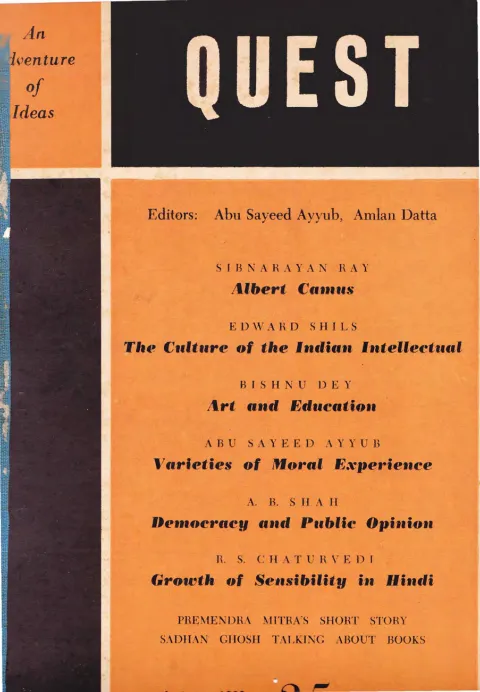
QUEST
Summary
Quest No. 25 (April/June 1960) is dominated, front and centre, by a memorial to Albert Camus, killed in a car accident on 4 January 1960: Sibnarayan Ray’s long biographical-critical essay ‘Albert Camus’ opens the issue and an unnumbered full-page photographic portrait of Camus, captioned ‘ALBERT CAMUS 1913-1960’, is tipped in a few pages later. Around this centre the issue assembles its usual mixture of moral and social philosophy (A. B. Shah on democracy and public opinion, Abu Sayeed Ayyub on three tiers of moral obligation and a sustained attack on Marxist ‘scientific ethics’, Edward Shils’ sociological study of the Anglophile Indian intellectual), literary-cultural material (R. S. Chaturvedi on language and sensibility in Hindi, David McCutchion’s satirical reportage of the Third All-India Writers’ Conference, five poems, two short stories, Bishnu Dey on art education), overtly political argument (Piloo Mody and M. V. Sastry both defending the Swatantra Party’s programme against an earlier critic, and a correspondence letter opposing ‘Democratic Decentralisation’), and a substantial book-review section plus Sadhan Kumar Ghosh’s gossipy London literary column. The issue continues to describe itself two ways at once — ‘An Adventure of Ideas’ on the cover, ‘A Quarterly of Inquiry, Criticism and Ideas’ on the contents page — and is edited by Abu Sayeed Ayyub and Amlan Datta with Nirad C. Chaudhuri, Sudhin Datta and Laxmanshastri Joshi as Advisory Editors, under the sponsorship of the Indian Committee for Cultural Freedom.
Essays
Albert Camus
By Sibnarayan Ray
A tribute essay occasioned by Camus’s sudden death, tracing his poor Algerian childhood, his Resistance-era journalism with Combat, and the arc of his fiction and essays (L’Etranger, Le Mythe de Sisyphe, La Peste, L’Homme Revolte, La Chute) as a sustained meditation on ‘the absurd’ and on revolt as a response to it. Ray argues that Camus’s mature affirmative philosophy rests on a conception of a shared ‘human essence’ that grounds universal values without recourse to either Christian transcendence or Marxist historical determinism, both of which he rejects as forms of ‘bad faith’. The essay closes by promising a second part assessing how far this humanism survives close logical scrutiny.
- Biographical sketch: born Algeria 1913, father killed at the Marne in 1914, worked as car-accessories salesman, police clerk and meteorologist before university; edited the Resistance paper Combat.
- Camus’s fiction and essays are read as two planes (concrete/fictional and abstract/discursive) of one continuous exploration of ‘the absurd’ — man’s alienation from a meaningless universe.
- Camus is presented as rejecting both Christian faith (Meursault’s refusal of the prison chaplain) and Marxist ‘scientific’ resolution of alienation, which he is said to have called a system that ‘degrades men into things’.
- His late ethics is grounded in a ‘human essence’ that is the source of both the sentiment of the absurd and of universally binding values (life, freedom, justice) with ‘no support in any suprahuman design’.
- Died 4 January 1960 in a car accident at the height of his powers; the essay is explicitly framed as mourning (‘whose sudden and premature death… we deeply mourn’) and promises a critical Part II.
Democracy and Public Opinion
By A. B. Shah
Originally a background paper for a 1960 World Brotherhood Seminar on Indian democracy, this essay argues that the health of Indian democracy depends less on formal institutions than on the existence of ‘enlightened public opinion’ — sober, rational, empirical and comprehensive. Shah surveys, and finds wanting, India’s cultural tradition (hostile to secular, participatory thought), its intellectual class (imitative and ‘destructive’), its universities (bureaucratic, lacking any real ‘General Education’), its press and All-India Radio (sectional and government-servile respectively), and its political leadership (sloganeering, and complicit in exploiting caste and linguistic loyalties) — naming Nehru directly for blurring the distinction between communism and democratic socialism. He closes with concrete proposals: General Education and democratized administration in universities, extramural-education programmes, subsidy for the district-level press through professional bodies, and an autonomous corporation for AIR.
- Defines ‘enlightened public opinion’ as sober, rational, empirical and comprehensive — explicitly not mere vox populi.
- Argues India’s caste-ridden, other-worldly cultural tradition discouraged sustained secular political thought historically.
- Accuses front-rank Indian intellectuals of ‘intellectual adaptability verging on dishonesty’ and of directing criticism only, and safely, at Government.
- Criticizes All-India Radio as an uncritical mouthpiece of government policy and the vernacular press as commercially sectional and unprofessional.
- Directly criticizes Nehru for equating communism’s ideals with democratic socialism’s, differing ‘only in methods’.
- Proposes reforms: General Education in universities, democratized college administration, extramural-education departments, subsidized district press via professional bodies, and an autonomous broadcasting corporation.
Varieties of Moral Experience
By Abu Sayeed Ayyub
A presidential address to the Indian Philosophical Conference distinguishing three levels of morality: prudential morality (Spinoza’s and Russell’s desire-based ethics, refined by ‘practical reason’ into a coordinated life-policy), Kant’s ethic of duty (treating every person, self and other, always as an end and never merely as a means, which alone Ayyub treats as carrying absolute, universal obligation), and a third ‘axiological’ personal morality of art, knowledge and moral perfection, whose claims are ‘optative’ rather than obligatory. The second half is a sustained attack on Marxist and other ‘scientific ethics’ (Fromm, Waddington, Julian Huxley, Cornforth, Selsam) for illegitimately treating cultural ‘needs’ as scientifically determinable the way biological needs are, and for licensing, in Ayyub’s view, totalitarian compulsion in the name of a scientifically fixed human good.
- Distinguishes prudential morality (maximizing one’s own integrated satisfaction) from Kant’s ethic of duty (treating every person as an end).
- Argues only the value of another person’s freedom/dignity carries absolute, universally binding obligation; values of art, knowledge and heroic self-sacrifice are ‘optative’, not duties.
- Treats value-experience as capable of being ‘veridical’ or ‘illusory’ much like perceptual experience, resisting a simple subjective/objective dichotomy.
- Sharply criticizes Marxist ‘scientific ethics’ for stretching the concept of biological ‘need’ to cultural and spiritual life, and for its consequent ‘cocksureness’ about a scientifically knowable human good.
- Concludes that value-inversions (Socialist Realism in art; instrumentalist views of knowledge) are condemnable from the standpoint of an ethic of values even where they are not, strictly, breaches of the ethic of duty.
The Culture of the Indian Intellectual II
By Edward Shils
Part II of Shils’ sociological study argues that the widely diagnosed ‘rootlessness’, ‘ambivalence’ and ‘schizophrenia’ of the Indian intellectual are largely a ‘painful phantasy’ unsupported by his own interview evidence (only about one percent of subjects reported genuine inner conflict). He instead documents a deep and, he argues, sincere — not merely snobbish — attachment of educated Indians to English literature, British university degrees and institutions, and to ‘modern thought’ generally (including Marxism, psychoanalysis and existentialism), most of which reaches India mediated through Britain and the English language. He closes by attributing the Indian intellectual’s real, more mundane handicaps to poverty, weak institutions, unproductive relations with authority, and the burden of working in a non-native tongue, and argues genuine synthesis will emerge only from pursuing real intellectual tasks, not from deliberate cultural reconciliation.
- Indian intellectuals display an ‘uncomfortable sense of national inferiority’ producing both excessive self-criticism and compensatory nationalist praise of India.
- Extensive anecdotal evidence of the outsized prestige of British publication, British degrees, and English literature among Indian intellectuals.
- Marxism, psychoanalysis and existentialism are read as substantially British-mediated imports whose appeal in India lies partly in their promise of individual liberty against traditional and family constraint.
- Reports that in his own interviews only about one percent of Indian intellectuals actually professed the ‘ambivalence’/inner-conflict routinely attributed to them by critics.
- Concludes the Indian intellectual’s genuine problems are poverty, weak institutions, unproductive relations with authority, and having to work in a non-native language — not a deep cultural schizophrenia.
Language and Sensibility in Hindi Literature
By R. S. Chaturvedi
Chaturvedi argues, against the conventional ‘language-in-attendance’ view that a writer’s language merely serves a pre-existing sensibility, that the developmental maturity of a language itself sets limits on the sensibility that can be expressed through it. He traces this through the historical emergence of Hindi from Apabhramsha and through Brajbhasha/Awadhi to modern khari-boli, argues Hindi’s crude, euphemism-free vocabulary for sex is a linguistic rather than moral defect (citing Agyeya’s Nadi ke Dweep as proof a mature enough style can overcome it), and concludes that the perceived ‘backwardness’ of Hindi and Indian fiction generally, relative to European fiction, reflects linguistic immaturity rather than any deficiency in Indian writers themselves.
- Inverts the traditional view: language’s own developmental stage determines and limits sensibility, rather than sensibility simply choosing its verbal expression.
- Differences among Hindi poets of successive generations (Maithili Sharan Gupta, Sumitranandan Pant, Agyeya, Raghuvira Sahay) are attributed to differing linguistic resources available to each.
- Hindi’s common sexual vocabulary is called ‘utterly crude’, lacking euphemisms comparable to English ‘in the family way’; obscenity is located in the term, not the underlying concept.
- Agyeya’s Nadi ke Dweep is cited as proof that sufficiently mature literary language can render even sexually frank scenes without vulgarity.
- The ‘backwardness’ of Hindi/Indian fiction compared to European fiction (Zweig, Camus) is attributed to the limited maturity of the language, not to any failure of sensibility on the part of Indian writers.
All-India Writers Look to the Past and to the Future
By David McCutchion
A satirical reportage piece covering the Third All-India Writers’ Conference (Madras, December 1959): addresses by C. P. Ramaswamy Aiyer, M. Bhaktavatsalam and Tarasankar Banerjee on cultural freedom, censorship and revivalism, followed by extended, often comically rendered seminar debates on ‘The Indian Tradition and the Contemporary Writer’, ‘Form and Content in Creative Writing’ and ‘The Art of Translation’, in which McCutchion lets sharply divergent voices — from devout traditionalists to Sibnarayan Ray’s insistence on a new ‘cosmopolitan phase’ of world culture — talk past and around each other, closing with Rajaji’s afternoon address urging young writers to try other professions first and to master the ‘art of reticence’.
- C. P. Ramaswamy Aiyer warns against ‘the tyranny of the majority’ and mass-media vulgarization, and favours self-discipline and popular translations of Indian classics over state censorship of ‘undesirable books’.
- Sibnarayan Ray argues the modern Indian writer belongs to a new ‘cosmopolitan phase’ of world culture and warns against any ‘Un-Indian Activities Committee’.
- Gangadhar Gadgil argues tradition is simply ‘the way we interpret history at any particular point’ and concludes ‘to depart from tradition is the best way to serve tradition’.
- The Form-and-Content seminar ranges from Vinda Karandikar’s three-stage account of the aesthetic process to P. Lal’s live audience demonstration of how small verbal substitutions change a poem’s meaning.
- The Translation seminar debates fidelity to ‘the living voice’ versus the translator’s own re-creation, with concrete examples (P. Lal’s rendering of a Shakuntala verse) and closes inconclusively with a plea for pragmatic tolerance of imperfect translators.
Enterprise
By Nissim Ezekiel
A short allegorical poem in which a group pilgrimage gradually disintegrates — through hardship, desertion and mounting disillusionment — until, on finally reaching its destination, the travellers ‘hardly knew why we were there’; it closes on the quietly ironic reflection that ‘home is where we have to gather grace’.
- Allegorizes a collective journey/pilgrimage as a source of disillusionment rather than exaltation.
- The group loses members to disagreement, attack, and simple exhaustion along the way.
- Arrival brings anticlimax rather than fulfilment: ‘The trip had gnawed at every face.’
- Closes with an aphoristic redefinition of ‘home’ as something to be earned through grace, not simply arrived at.
Banalata Sen
By Jibanananda Das
A translated Bengali poem in which a weary wanderer, traversing vast stretches of time and geography, finds momentary peace in the beauty of ‘Banalata Sen of Natore’; the poem ends with all things — birds, seas, giving and taking — subsiding into darkness, leaving only her remembered face.
- The speaker figures himself as a ‘lost soul’ wandering through named historical places and eras (Bimbisar, Ashoka, Vidarbha, Vidisha, Sravasti).
- Banalata Sen appears as a figure of momentary, restorative peace amid perpetual wandering.
- The poem closes by dissolving all imagery into darkness except her face.
The Return
By To Thuy Yen
A self-translated Vietnamese poem in which the speaker recalls a childhood friendship, leaves in youthful ambition ‘to change the world’, suffers disillusionment and exhaustion, and finally returns, transformed and unrecognisable, to find that intimacy still lives in the other’s remembered voice.
- Opens with an image of shared, sheltered childhood (‘at the edge of the waste of childhood in a fog of dreams’).
- The speaker departs to ‘change the world’ and ‘draw again the human face’, framing youth explicitly as weaponized ambition.
- History is figured as rolling on ‘irrevocably… from station to station’, leaving the speaker emptied ‘even of enthusiasm’.
- Ends on a note of reconciliation: an old intimacy survives change and long separation.
A Girl’s Face
By K. Raghavendra Rao
Addressed through the voice of a mirror, the poem meditates on the fragility and inevitable decay of youthful female beauty, urging its subject to stop dwelling on her reflection and instead to ‘laugh like a blade of grass’ and live wisely within the limits of time.
- The mirror itself is personified as speaking and musing on the girl’s beauty.
- Beauty is figured as fragile, easily ‘fractured’, and inevitably lost to time (‘the diamond teeth’).
- Closes with direct advice to the girl to abandon vanity and be ‘seasonable and wise’.
Two Poems
By Perin C. Mehta
Two short lyrics printed together: ‘The Paper Boats’, on children’s paper boats sailing away as an image of fragile, fading dreams, and ‘Longing’, on an unfulfilled desire to cross a broken ‘bridge of time’ to reach a happiness left on the other side.
- ‘The Paper Boats’ treats a simple childhood image (paper boats in rain) as a figure for dreams that ‘fade into eternity’.
- ‘Longing’ inverts the natural world’s inviting abundance (trees, flowers, clouds) against an inner numbness and an impassable ‘bridge of time’.
The Discovery of Telenapota
By Premendra Mitra
Told almost entirely in an unusual second-person future tense, the story follows ‘you’, an amateur angler, and two friends on a journey to the fictional, malaria-depopulated ruin of Telenapota. There you meet Jamini, a poor young woman caring for her blind, dying mother, who mistakes you for Niranjan, the fiance who long ago abandoned Jamini and secretly married elsewhere; moved by the dying woman’s plea, you impulsively promise to marry Jamini, then fall seriously ill with malaria back in the city, and the story ends uncertain whether the whole episode, and Jamini herself, was ever real.
- Narrated almost entirely in second-person future tense (‘you will…’), producing a dreamlike, semi-hypothetical mode of storytelling.
- Telenapota is depicted as a jungle-swallowed ruin depopulated by malaria a century before, a ‘forgotten borderland of the world of the living’.
- Jamini’s blind, bedridden mother mistakes the narrator for Niranjan and extracts a promise from him to marry her daughter.
- The narrator falls ill with malaria on returning to the city, and on recovery cannot be sure whether Telenapota, or Jamini, were ever real.
The Distant Signal
By Sean Purcell
Narrated by a boy in rural southern Ireland, taunted as a ‘coward’ by other children and provoked by his own brother’s boast that there were ‘no cowards in our family’, he climbs a dangerously high railway distant-signal pylon; abandoned mid-feat by his friends, who wander off to watch a rabbit hunt, he attempts one final reckless stunt and is badly injured when the signal mechanism suddenly operates beneath him. The story closes years later with the narrator, now permanently disabled, reflecting that it is children, not adults, who are the cruellest.
- A boyhood dare, precipitated by taunts of cowardice and the narrator’s brother’s boast, drives the climb of a dangerous railway signal pylon.
- Abandoned by his friends partway through the feat, the boy attempts a further reckless stunt to reclaim their attention.
- He is seriously injured (loses a leg) when the signal mechanism operates suddenly beneath him.
- The story closes on the adult narrator’s isolation and his judgment that children, not adults, are the cruellest.
The Problem of Art and Education in India
By Bishnu Dey
Dey argues Indian education has never resolved ‘the purpose of art’, oscillating between an inherited Victorian-era suspicion of art’s ‘wildness’ and today’s merely verbal acceptance that art has ‘a capital A’ and a purpose. He treats art and literature as essential, not decorative, to a properly ‘whole man’ education (citing a Calcutta girls’ school where art activity improved even pedagogically weak students’ general performance), diagnoses a pervasive, damaging ‘artyness’ — superficial engagement with folk art, ‘Oriental-cum-Indian Artism’ and imitative modern/abstract art — and calls for outdoor sketching, study with local craftsmen, and serious art-history teaching rather than mechanical importation of Western methods.
- Traces Indian education’s ambivalence toward art from Victorian-era ‘Indo-Victorian puritanism’ to a merely verbal contemporary acceptance of its importance.
- Frames art (via Whitehead) as essential to human development, on a par with sleep or food, and cites a Calcutta girls’ school where art activity improved weak students’ general studies.
- Diagnoses ‘artyness’ — decorative, insincere engagement with folk art, ‘Oriental-cum-Indian Artism’, and derivative modern/abstract art — as a pervasive, damaging pretence.
- Proposes concrete reforms: outdoor sketching, exploration of villages and cities, study with local craftsmen, and more serious teaching of art history and aesthetics.
A Much Closer Look at the Swatantra Party
By Piloo Mody
A rebuttal to Ellen Roy’s earlier Quest article criticizing the Swatantra Party, arguing that the Party’s real distinctiveness is its foundational ‘faith in the people’ — laws should punish wrongdoing rather than presuming citizens are inherently bad. Mody defends the Party’s opposition to concentrated state economic power as more dangerous than any private monopoly, its agricultural policy (opposing cooperative/collectivized farming as coercive, favouring abolition of land revenue and farmer self-interest), and Gandhian ‘trusteeship’ against the charge that it is a device for letting the rich get richer.
- Frames the Swatantra/Congress difference as a difference in anthropology: the Party trusts human beings rather than presuming them bad and requiring pre-emptive restriction.
- Argues state monopoly and planning concentrate more economic, political and (via constitutional amendment and judicial appointments) even judicial power than any historical private cartel.
- Criticizes Congress agricultural policy and proposes ending land revenue (replacing it with income tax parity for farmers) and rejecting cooperative farming as a route to collectivization.
- Defends Gandhian trusteeship as an instrument of moral regeneration, denying it licenses the rich or assigns ‘spiritual values’ only to the poor.
A Way Out - A Programme Party
By M. V. Sastry
Sastry defends the Swatantra Party’s 21 principles as a coherent ‘programme party’ response to Congress’s ‘Socialistic Pattern’, arguing (via Djilas’s The New Class) that state monopoly does not cease to be monopoly for being state-owned, and that a ruling-party ‘New Class’ emerges to own and waste national property. He argues consumer interest should be paramount, secured through free competition rather than licence-permit systems, and criticizes both deficit financing/inflation and the government’s self-contradictory land policy (opposing small holdings while also legislating land ceilings).
- Frames Swatantra explicitly as a ‘programme party’ built on 21 published principles, not merely an oppositional or laissez-faire movement.
- Draws on Milovan Djilas’s The New Class to argue Communist/state-socialist leaders ‘handle national property as their own’ while wasting it as if it were someone else’s.
- Argues consumer interest, secured through free competition, should be the guiding economic principle: ‘as much competition as possible, as much planning as necessary’.
- Criticizes the government’s land policy as self-contradictory (decrying small holdings’ inefficiency while imposing land ceilings) and its recourse to deficit financing and currency inflation.
Talking About Books
By Sadhan Kumar Ghosh
A gossipy ‘Literary Pilgrim in England’ column reporting Ghosh’s encounters and reading in London literary circles: enthusiastic notices of Sir Lawrence Jones’s memoir, Polly Hobson’s Brought Up in Bloomsbury, Fredric Warburg’s publishing memoir, Gay Wilson Allen’s book on Whitman, Laurie Lee’s Cider with Rosie/Roses in Winter, Lovat Dickson’s The Ante-Room, and J. M. S. Tompkins’s study of Kipling, interwoven with anecdotes of meeting Kathleen Nott, T. R. Fyvel, Harold Nicolson and Frank Swinnerton.
- Declares a preference for Britain’s ‘Quiet Old Men’ (Bowra, Lucas, Swinnerton, Ivor Brown, Wilson Knight) over the ‘Angry Young Men’.
- Praises Sir Lawrence Jones’s memoir for its sensory, nostalgic evocation of Edwardian English country life.
- Discusses Reginald Reynolds’s anti-imperialist The White Sahibs in India approvingly but calls a later book of his smug, and argues (apropos A Passage to India) that ‘the Memsahib in India, rather than the Sahib, spoilt racial amity’.
- Praises Laurie Lee’s rural-childhood memoir for its unembarrassed, poetic treatment of adolescent sexual awakening.
- Assesses J. M. S. Tompkins’s Kipling study as valuable but incomplete for relying only on the novels and largely ignoring his poetry.
The Saundaryalahari
By Swami Agehananda Bharathi
A review of W. Norman Brown’s critical Harvard Oriental Series edition and translation of the Saundaryalahari, endorsing Brown’s philological case against its traditional ascription to Adi-Shankaracharya (the poem’s doctrine is incompatible with Shankara’s canonical commentaries, and an internal reference to nose-ornaments post-dates 1000 A.D.), praising the edition’s unprecedented scholarly apparatus — 51 manuscripts collated, illustrated manuscripts reproduced, and the Srividya mantra printed for what the reviewer believes is the first time — while gently correcting Brown’s translation of the Devi’s cosmic ‘creation’ to the more accurate ‘emanation’.
- Endorses W. Norman Brown’s philological argument (notably an anachronistic reference to nose-ornaments) against Shankaracharya’s authorship of the Saundaryalahari.
- Notes that tantric devotees nonetheless continue to invoke Shankaracharya as ‘Adiguru’ regardless of the scholarly consensus.
- Highlights the edition’s exceptional scholarly apparatus: 51 manuscripts collated, illustrated manuscripts reproduced in colour and black-and-white, and (per the reviewer) the first-ever printed disclosure of the Srividya mantra.
- Corrects Brown’s rendering of the Devi’s cosmic activity as ‘creates’, arguing the Sanskrit root ‘srj’ means ‘to let out, exude, emanate’ and that Indian tradition has no concept of ex nihilo creation.
Sources of Indian Tradition
By T. G. Mainkar
A review of the Columbia University Press sourcebook Sources of Indian Tradition, praising its chronological essays (by Basham, Dandekar, Hardy, Raghavan, Qureshi and Harrison) for tracing Indian civilization’s characteristic capacity for religious and philosophical ‘synthesis’ from Vedic times to the creation of Pakistan, while noting that, on the book’s own account, Islamic thought alone resisted assimilation into that synthesis, and voicing mild reservations about the compressed chronology from 1200 B.C.
- Frames ‘synthesis’ as the interpretive key to Indian civilization across Vedic, Buddhistic, Jain and Islamic encounters.
- Reports the book’s argument that Islamic thought, uniquely, remained an ‘unassimilated ideology’ that never fused with Hindu thought.
- Raises a mild reservation about the compressed historical span (from 1200 B.C.) straining the available archaeological evidence.
Lokamanya Tilak
By Kshitimohan Mukerji
A review of Pradhan and Bhagwat’s biography of Bal Gangadhar Tilak, praising its readability and comparative dispassion — rare, the reviewer notes, ‘in a land addicted to deification’ — while arguing it does not fully escape letting Tilak’s personal biography stand in for the whole nationalist movement, and raising unresolved questions about whether Tilak’s revivalist methods were calculated tactics or genuine conservatism, alongside specific quibbles about the authors’ treatment of Gokhale’s Poona plague-period apology and the Sharada Sadan controversy.
- Praises the biography for avoiding hagiography while remaining broadly readable and factually careful.
- Criticizes the tendency for Tilak to ‘become too big to be fitted into anything at all’, effectively standing in for the whole Poona-centred nationalist movement.
- Notes an unresolved tension in the authors’ ‘national liberal’ framing: Tilak’s revivalist methods are called both mistaken (regarding Agarkar) and ‘a correct step… from the point of view of expediency’.
- Flags specific interpretive quibbles about the authors’ treatment of Gokhale’s plague-period apology and the Sharada Sadan/Ramabai proselytization controversy.
A Passage to England
By K. B. Rao
A review of Nirad C. Chaudhuri’s A Passage to England, praising it — against the genre convention of shallow traveller’s impressions — as ‘a very sincere account’ in ‘strong, fresh and masculine’ prose, questioning whether Chaudhuri’s occasional naivete about England is genuine or a literary device, and noting his sweeping, sometimes uncharitable generalizations about Indians alongside his striking observation that in Anglo-Indian relations ‘the Memsahib in India, rather than the Sahib’ did the more lasting racial damage.
- Contrasts the book favourably with the typical banal ‘traveller’s impressions’ genre.
- Notes Chaudhuri consistently finds English things ‘not only not wanting but also infinitely superior’ to Indian counterparts, and questions whether his naivete is genuine or performed.
- Highlights Chaudhuri’s sweeping generalizations about Indians (on money, dress, politicians).
- Praises the prose style directly as ‘strong, fresh and masculine’.
Contemporary Indian Short Stories
By M. G. Desai
A mixed review of the Sahitya Akademi’s first anthology of Indian short stories (one per recognized language), praising several selections (Assamese, English, Hindi, Kashmiri, Malayalam, Oriya) as genuinely excellent — singling out the Kashmiri ‘The Bride’s Pyjamas’ as the anthology’s best piece — while criticizing others (Tamil, Sindhi, Marathi, Punjabi) as unrepresentative, and recommending future volumes be chosen by a representative panel and eventually translated across all Indian languages, not only into English.
- Praises Dhumketu’s ‘Letter’ (Gujarati), Bhabani Bhattacharya’s ‘A Moment of Eternity’ (English), Premchand’s ‘The Child’ (Hindi), and especially the Kashmiri ‘The Bride’s Pyjamas’ as standout pieces.
- Criticizes the Marathi, Punjabi, Tamil and Sindhi selections as unrepresentative of their literatures.
- Specifically faults the Kannada translation for reading as un-English, ‘full of vernacular idioms’.
- Recommends future selection by a representative panel rather than a single editor, and eventual translation of the anthology into all Indian languages, not only English.
History & Philosophy of Science
By M. K. Haldar
A critical review of L. W. H. Hull’s History and Philosophy of Science, disputing Hull’s thesis that Platonism, ‘Ecclesiasticism’ and Roman ‘utilitarian’ barbarism were science’s three chief historical enemies, and specifically rebutting his claim that the medieval Church obstructed science, countering that Bruno and Servetus were burned for religious rather than scientific heresy and that Copernicus and Kepler received Church encouragement.
- Summarizes and rejects Hull’s ‘three chief enemies of science’ framework (Platonism, Ecclesiasticism, Roman barbarism).
- Counters that Bruno and Servetus were burned for religious, not scientific, heterodoxy, and that Copernicus and Kepler enjoyed Church encouragement.
- Notes Hull’s own alarm at increasing scientific over-specialization and his hope (via Clifford) for reunifying scientific and humanistic culture.
- Closes with Whitehead’s line that ‘Plato shared reasons with the Gods and Aristotle with the foxes’, implying Hull’s dismissal of Plato is too glib.
‘Three Traditions of Moral Thought’
By S. Ookerjee
A sharply critical review of Dorothea Krook’s Three Traditions of Moral Thought, admiring her close analytical readings of individual philosophers (Plato’s Gorgias, Bradley) but rejecting her overall three-tradition grouping (Platonic-Christian, Aristotelian-Hobbesian, Humanist) as forced, and repeatedly mocking her recurring rhetorical habit of ‘resolving’ philosophers’ difficulties (in Hobbes, Mill, Lawrence) simply by invoking Christian revelation — calling the chapter on St. Paul ‘frankly unreadable by mere philosophers’.
- Praises Krook’s close readings of Plato’s Gorgias and of Bradley as instructive even while rejecting her book’s larger thesis.
- Calls her three-tradition grouping (Plato and St. Paul together; Aristotle, Hobbes and Hume together; Mill, Bradley, Arnold and D. H. Lawrence as ‘Humanists’) ‘odd’ and unconvincing.
- Repeatedly criticizes her habit of answering philosophers’ difficulties (in Hobbes, Mill and Lawrence) by simply invoking Christian love/revelation.
- Judges her subsidiary thesis — that literary style should shape philosophical evaluation — unsubstantiated.
The Role of Joint-Stock Companies
By D. A. Dabholkar
A review of a Forum of Free Enterprise lecture-series volume on joint-stock companies, agreeing such companies (about 30,000 in India) drive the country’s economic development but disputing the volume’s rhetorical equation of joint-stock enterprise with ‘co-operative’ endeavour, arguing private enterprise must actually live up to its professed ideal of a ‘profit motive pre-conditioned by the ideal of service’ to win public trust against the growth of the public sector.
- Accepts joint-stock companies’ central role in India’s industrial development while questioning the volume’s equation of joint-stock enterprise with cooperative principle.
- Frames public-sector growth as a response to public doubts that private economic power was always used in the common man’s interest.
- Quotes the volume’s own aspirational language about a society ‘in which no workman is exploited… and every worker gives his best efforts’.
Democratic Decentralisation
By S. P. Aiyar
A correspondence letter arguing that the Balwantray Mehta Committee’s ‘Democratic Decentralisation’ scheme (already adopted in nine states) rests on a mistaken assumption — contradicted by studies of Indian village life and by Dr. Ambedkar’s Constituent Assembly warning against romanticizing the village — that local self-government intrinsically produces democratic habits; the letter further warns decentralization may become a vehicle for ‘Communist infiltration’ of local government and, given Cold War urgency, that India cannot afford such ‘experiments of dubious value’.
- Challenges the premise that local self-government instrumentally teaches democratic habits, citing village-life studies against it.
- Invokes Dr. Ambedkar’s Constituent Assembly warning against founding democracy on the Indian village.
- Cites Richard Park on Socialist and especially Communist parties’ particular interest in capturing local government positions as a specific danger of decentralisation.
- Frames the whole argument within Cold War urgency: India cannot afford ‘experiments of dubious value’ given the ‘rivalry between democratic and totalitarian systems’.
Essay 27
An unnumbered full-page photographic plate, tipped in with a blank verso between printed pages 16 and 17, showing a profile photograph of Albert Camus in a garden setting, captioned only ‘ALBERT CAMUS 1913-1960’. No photographer is credited. The plate has no caption text beyond the name and dates and carries no separate contents-page listing; it functions as a memorial insert accompanying Sibnarayan Ray’s tribute essay, and its two unnumbered leaves are also the physical cause of the issue’s mid-issue folio-offset shift (from printed-page-minus-2 to printed-page-minus-4).
- A tipped-in, unnumbered full-page photographic portrait of Camus with a blank verso — not listed in the printed contents page.
- Captioned only ‘ALBERT CAMUS 1913-1960’; no photographer credited.
- Physically explains the issue’s folio-offset shift from -2 to -4, since it inserts two unnumbered leaves between printed pages 16 and 17.
- Functions as visual matter accompanying, but separate from, the lead Camus essay.
Generated by the v1.5 extraction pipeline. Awaiting editorial review.
Metadata and summary are AI-extracted from the source PDF and reviewed for editorial accuracy. The original work is available via the Read PDF tab above (where present); paragraph-level citation inside the PDF is deferred to a future engagement.
People in this work
- Piloo Modyauthor
- Sibnarayan Rayauthor
- A. B. Shahauthor
- Abu Sayeed Ayyubauthor
- Edward Shilsauthor
- R. S. Chaturvediauthor
- David McCutchionauthor
- Nissim Ezekielauthor
- Jibanananda Dasauthor
- To Thuy Yenauthor
- K. Raghavendra Raoauthor
- Perin C. Mehtaauthor
- Premendra Mitraauthor
- Sean Purcellauthor
- Bishnu Deyauthor
- M. V. Sastryauthor
- Sadhan Kumar Ghoshauthor
- S. P. Aiyarauthor
- P. Lal
- Shyamasree Devi
- Kironmoy Raha
- Swami Agehananda Bharati
- T. G. Mainkar
- Kshitimohan Mukerji
- K. B. Rao
- M. G. Desai
- M. K. Haldar
- S. Ookerjee
- D. A. Dabholkar
- Sheela Singh
- Karl Marx
- Jawaharlal Nehru
- Abraham Lincoln
- Mahatma Gandhi
- C. D. Deshmukh
- Rabindranath Tagore
- C. Rajagopalachari
- Bal Gangadhar Tilak
- Gopal Krishna Gokhale
- B. R. Ambedkar